
Add ₹999 more to unlock FREE SHIPPING!
Your sacred cart is currently empty.
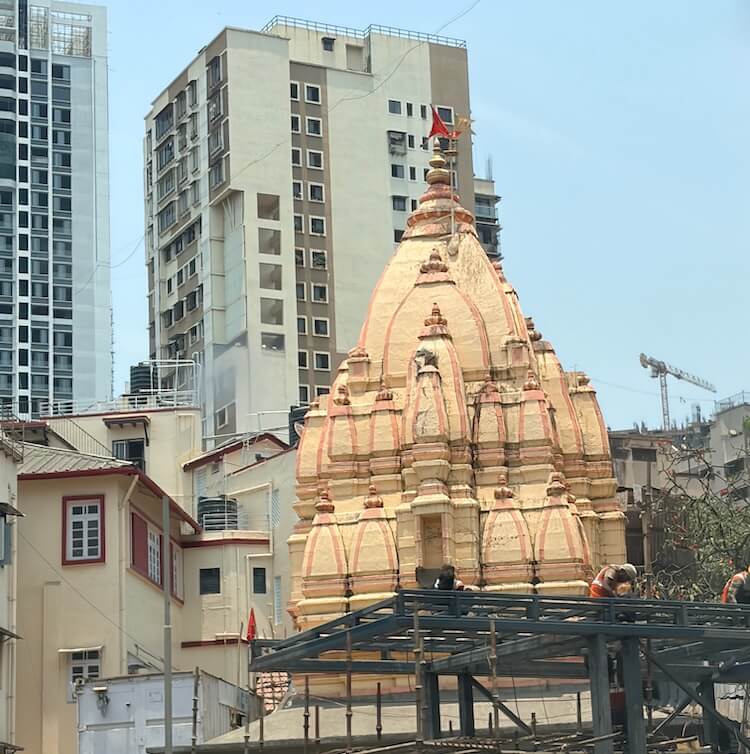
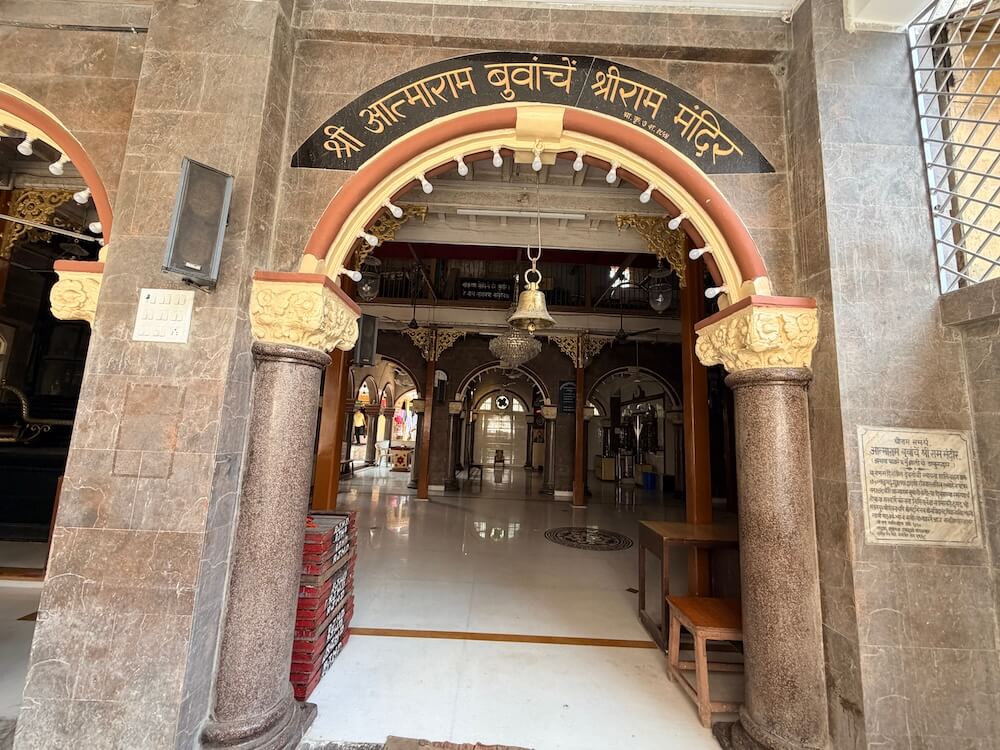
Shop Photo FramesThe Girgaon-Thakurdwar area is home to many ancient temples of various deities. The Ram Mandir established by Atmarambuva is one of the most renowned shrines among them. In fact, it is because of this temple that the area came to be known as Thakurdwar. This temple is also referred to as the ‘Thakurdwar of the Pathare Prabhu community’. In this temple, which was erected in the first half of the nineteenth century, the Ram Panchayatana made of black stone is consecrated. Due to these idols and the abundant use of black stone in the temple’s construction, this temple is also known as the ‘Kalaram Mandir’. Located near the Zhavba’s Shriram Mandir, which is known as the ‘Gora Ram Mandir’, this temple is a place of faith for countless devotees of Lord Shriram in the Girgaon-Thakurdwar area.
Girgaon means Girigram. According to the book ‘The Origin of Bombay’ published in the year १९०० by historian Gerson da Cunha, the name Girgaon originated from the combination of the two words ‘Giri’ (hill) and ‘Gram’ (village). Since this area was at the foothills of Malabar Hill (Malabargiri), it began to be called Girigram, which later corrupted into Girgaon. According to the first volume of the ‘Greater Bombay District Gazetteer’, Girgaon was a small village during the British era. Between the years १७४४ and १७६४, the population of Mumbai rose to between ८० and ८५ thousand. During this period, the British took several measures for the security of the Mumbai islands and built new docks. In १७५४, the construction of new houses within the city walls, i.e., within the Fort, was prohibited, and many houses in the Fort area were removed. It was during this time that the settlement in Girgaon gradually began to grow.
The nineteenth century gave a major boost to the development of this area. In १८१९, Mount Stuart Elphinstone, known as ‘Ishtur Phakada’, was appointed as the Governor of Mumbai. He brought about many improvements in public works, water supply, taxation, and the field of education in Mumbai. In १८१९, the Apollo Bunder was opened for traffic here. In १८२७, Elphinstone College was established. A Town Hall was built here for meetings, gatherings, and a library. Around this same time, in the year १८२८, Atmarambuva established this Ram Mandir in the Thakurdwar area near Girgaon.
Atmarambuva possessed the qualities of a saint and was very compassionate. He would narrate stories that were both spiritually enlightening and delightful. He was extremely generous and spent his life in virtuous deeds; this is how Govind Narayan Madgaonkar praised him in the book ‘Mumbai che Varnan’ published in the year १८६३. About a year after this book, in the year १८६४, Anant Vasudev Marathe published a booklet titled ‘Mahant Atmarambuva Ramdasi – Including information on temple management, festivals, etc.’. According to this booklet, Atmarambuva was born into a poor family with the surname Palsule-Desai of the Vashistha Gotra in the Vijaydurg-Rajapur area of South Konkan. His year of birth is stated to be १७४६. He was a follower of the Samarth Ramdas Swami’s Shirgaon Math. He was married at a young age, but not finding interest in worldly life, he traveled across Bharatkhand like Samarth Ramdas Swami. After this pilgrimage, he returned to Konkan and resided at his nephew’s house in Sawantwadi. During this period, once while visiting Valaval, he had a divine vision. Shri Shivshankar told him, ‘I am here at a grocer’s house, on his grinding stone (pata). I am used daily for grinding chilies, which causes a burning sensation on my body; therefore, take me from here and place me in a suitable, holy place.’ Upon waking up in the morning, he searched and found that grocer’s house and the grinding stone (varvanta) in the form of a Shivling. He took it and returned to Sawantwadi.
At that time, the third Khemsavant, also known as Rajarshi (reign १७५५ to १८०३), was the ruler of the Sawantwadi princely state. Upon learning of the revelation Atmarambuva had received and his intention to consecrate the Shivling brought from Valaval in Sawantwadi, the ruler built a temple in a large space in the Mathewada area of the city in the year १७९९, naming it ‘Atmeshwar’, and installed the Shivling there. Similarly, Atmarambuva installed a crystal linga (sphatiklinga) found in Kashi under the name ‘Praneshwar’.
After the management of the temple there was established, Atmarambuva came to Mumbai around the year १८२८. Here, he met Bhau Russell. Bhau Russell’s original name was Laxman Harishchandra Ajinkya. Born in १७८८, Bhau belonged to the Pathare Prabhu community and was originally from Karanja in the Raigad district. He came to Mumbai in the year १८०१ at the age of १२. He learned English and also acquired skills in record-keeping and clerical work (typing did not exist in १८०१). He started working at the East India Company’s ‘Gun Carriage Factory’ in Dhakuta Kulaba. There, he worked as a head clerk under Captain Russell. It was this Russell who encouraged Bhau to enter business. Under his guidance, Bhau took on construction and land reclamation contracts for the Company government. He was the one who established the villages of Akruli, Dindoshi, and Chinchavali. He also built the ‘Ferry Wharf’, the first wet dock in Mumbai, which is well-known as ‘Bhaucha Dhakka’. Since he was a trusted aide of Captain Russell, he earned the nickname ‘Bhau Russell’. Bhau was a devotee of Swami Samarth of Akkalkot. Bhau was impressed by Atmarambuva’s personality and work. With his help, Atmarambuva collected donations from many people, purchased land in Girgaon, and built a temple for his beloved deity, Lord Shriram. In this temple, the Shriram Panchayatana was consecrated with due rituals on Bhadrapad Shuddha Dwadashi, Shake १७५०, September २०, १८२८.
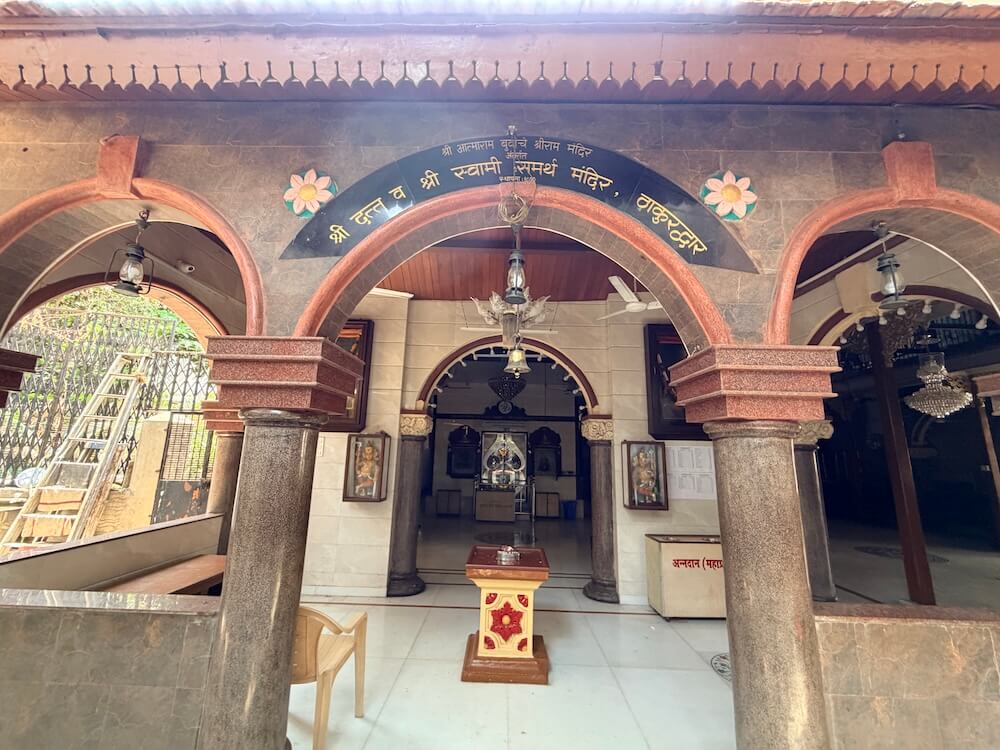
According to historian Gerson da Cunha, this area derived the name Thakurdwar from Atmarambuva’s temple. In his work, The Origin of Bombay, da Cunha notes that this temple was referred to as ‘Atmarambuva’s Thakurdwar’. The book ‘Mumbai cha Vruttant’, published in 1889 by Balkrishna Bapu Acharya and Moro Vinayak Shingne, also records that ‘the place where Atmaram Bawa’s temple is situated is called Thakurdwar’. The temple stands on Jagannath Shankarshet Road, formerly known as Palav Road. The temple resembles a two-story mansion built in the Maratha architectural style. Govind Narayan Madgaonkar stated that it cost 30 to 40 thousand rupees at that time. The temple was renovated on 25 September 1928.
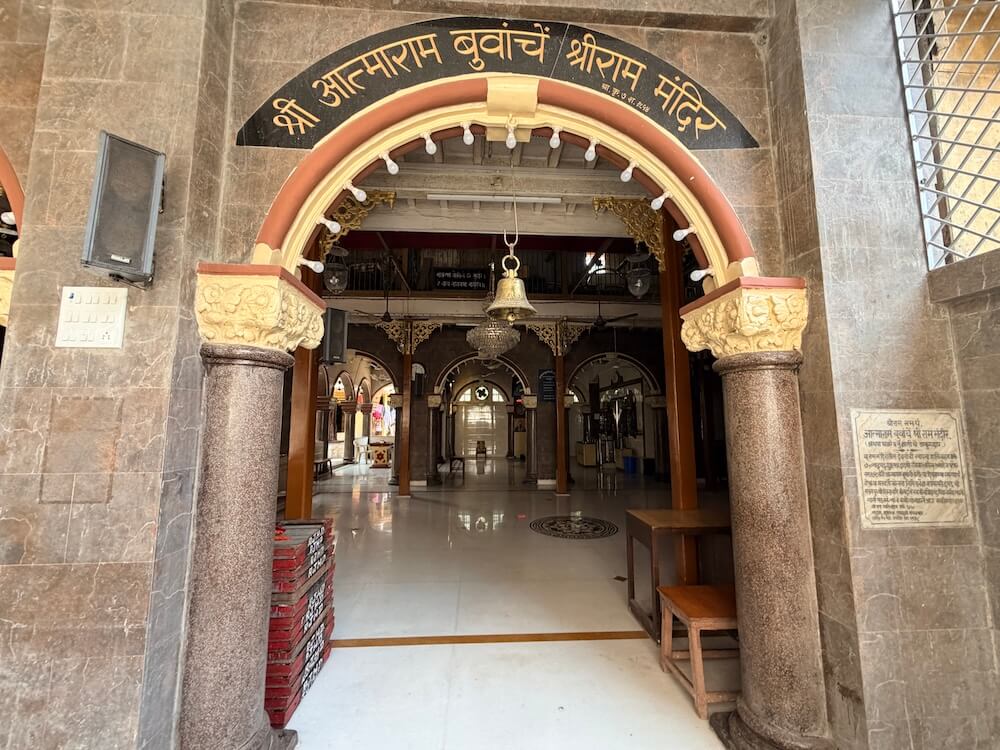
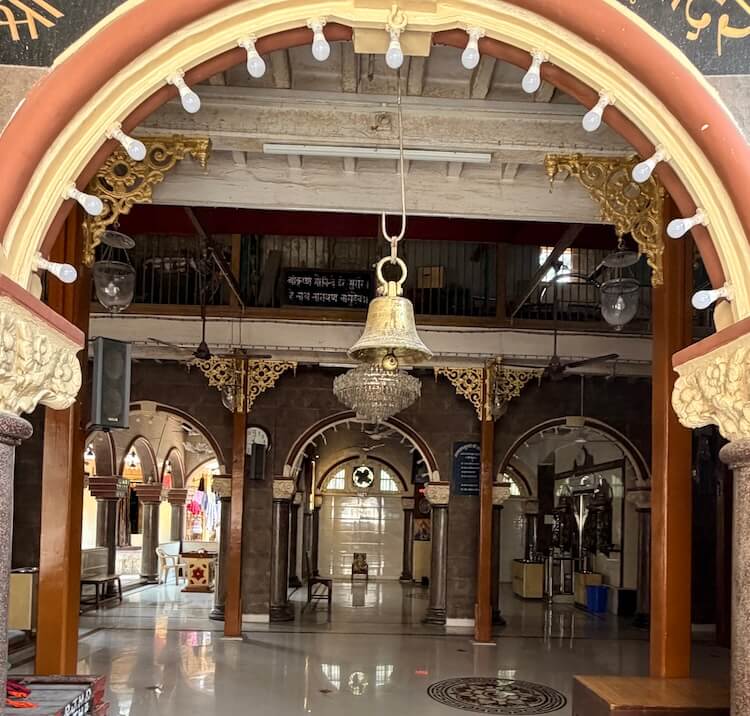
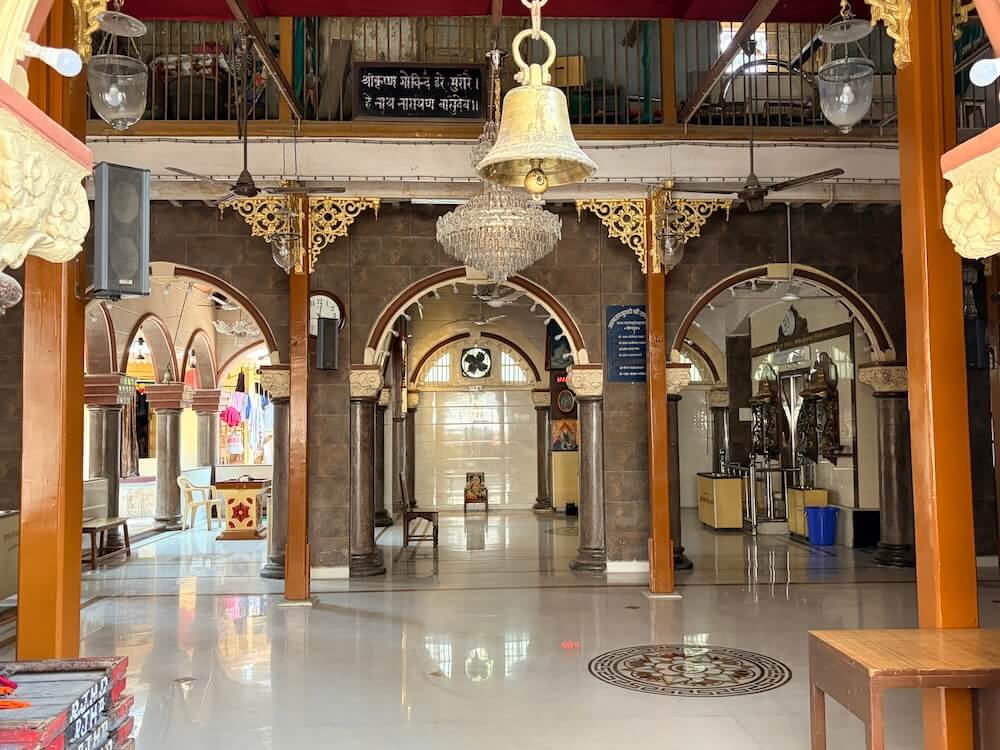
The temple is situated amidst tall buildings on this busy road. In front of the temple is a small paved courtyard. The temple’s structure consists of a spacious two-story assembly hall (Sabhamandap) with the main sanctum inside. The assembly hall features a grand arched entrance, and above it is a structure resembling a nagarkhana with a sloping roof. The spacious assembly hall has square wooden pillars, and above the central square of the hall is a balcony with wooden railings. Crystal chandeliers and old-fashioned glass lamps give this assembly hall an historical aura. Inside this assembly hall is the main temple built of black stone. Situated on a high plinth, this temple has three steps leading up to it, from where one enters the assembly hall of the temple. Here, there is a stone entrance that bears witness to the antiquity of the temple, featuring carved pillars and an arched top. The inner sanctum has an entrance with a beautiful and heavy wooden door, flanked by tall statues of gatekeepers (Dwarapalas) on both sides. The assembly hall has a dome-shaped ceiling. Inside, the Shri Ram Panchayatan is enshrined on a high altar within a stone niche. These idols are carved from black stone and are adorned with garments and ornaments. In the meditation verse (Dhyan-shloka) of the Ramraksha Stotra composed by Sage Budhkaushika, Lord Rama is described as ‘Vamankarudha Sita’ (with Sita seated on his left). A unique feature of this temple is that the idol here is in this very form, with Sita seated on the left thigh of Lord Rama. In front of the idol of Lord Rama, on the altar, the idol of Goddess Bhagwati and a silver mask of Atmarambuva are enshrined. Above this niche is a dome-shaped spire (Shikhara) topped with a finial (Kalash).
The assembly hall also houses the Samadhi of Atmarambuva. Seven to eight years after the establishment of the temple, Atmarambuva’s health declined due to old age. He then appointed a board of trustees consisting of prominent contemporary figures such as Laxman Harishchandra Ajinkya alias Bhau Russell, Vasudev Vishwanath, Kashinath Moroji, Balkrishna Vasudevji, and Raghoba Govindji, and handed over the temple to them. Subsequently, he adopted a son named Rambhau Patodekar and appointed him as the manager of the temple. After making these arrangements, on 2 September 1836 (Shravan Vadya Saptami, Shake 1758), Atmarambuva took Samadhi within the premises of the Ram Mandir. The Samadhi of Bua is located in a stone niche on a large stone platform made of black stone. The image of Bua, his mask, and an idol of Hanuman are enshrined here.
Within the temple premises, there is also a Shri Dattatreya and Swami Samarth temple. Around the year 1870, Krishnathbuva alias Bapubuva, the priest of the temple, lived in the dharmashala adjacent to the Shri Ram Mandir. Later, he installed the footwear (Padukas) of Swami Samarth, idols of Vitthal-Rukmini, Goddess Bhagwati, Ganpati, and a Shiva Linga in this Datta temple. Festivals such as Ram Navami, Hanuman Jayanti, Akkalkot Swami Samarth’s Punyatithi (Chaitra Krishna 13), Navratri, Datta Idol Installation Day (Jyeshtha Krishna 8), Atmarambuva’s Punyatithi (Shravan Krishna 7), Gokulashtami, Ram Panchayatan Installation Day (Bhadrapad Shukla 12), Datta Jayanti, and Das Navami are celebrated with religious fervor at the Shri Ram Mandir. The Ram Janmotsav program begins with Hari-kirtan between 10:30 AM and 1:00 PM. The special moment of Lord Rama’s birth is celebrated at 12:39 PM. From 5:00 PM to 10:00 PM, devotees can have darshan of the child-form of Lord Rama, and Prasad is distributed. A large number of devotees gather for this celebration. During festivals, programs like Kirtan and Pravachan are organized. On Chaitra Shukla Ekadashi, the Lord’s palanquin procession is taken out, which is carried to the residences of trustees and devotees upon their invitation. During every Chaturmas and Adhik Maas, Puran recitation and Kirtan ceremonies are organized in the temple. Devotees can visit the temple for darshan from 7:00 AM to 12:00 PM and from 5:00 PM to 9:00 PM.
This sacred temple stands as a testament to deep spiritual devotion, ancient architectural grandeur, and rich local cultural traditions.
The sanctum sanctorum houses the divine idol consecrated according to ancient Vedic traditions, surrounded by serene courtyards and traditional temple architecture.
Navratri, Maha Shivratri, Annual Temple Jatra & Deepotsav
Compare and book flights, secure top-rated local hotels near the temple, hire reliable guides, and rent cars instantly.
Extend your pilgrimage by visiting other highly sacred temples located nearby.


Add ₹999 more to unlock FREE SHIPPING!
Your sacred cart is currently empty.
Shop Photo FramesFill in your delivery details below to place your order.
Add comment