
Add ₹999 more to unlock FREE SHIPPING!
Your sacred cart is currently empty.
Shop Photo FramesBalaji, also known as Venkatesh, resides on the hilltop in Tirupati, Andhra Pradesh. Although not associated with the twenty Puranic incarnations of Vishnu, Venkatesh is considered a form of Vishnu and is a deity synonymous with Vitthal of Pandharpur. Like in Tamil Nadu and Andhra Pradesh, Venkatesh Balaji is the family deity (Kuladaivat) for many in Rajasthan as well as Maharashtra. An ancient and renowned temple of this Venkatesh, who is known by various names in the south such as Venkat, Perumal, Srinivasa, Venkateshwarudu, Sheshadri, Tirupati, and Tirumalavasa, is situated in Phanaswadi. A unique feature of this temple, which boasts a century-old tradition, is that Venkatesh devotees honor it as ‘Chota Tirupati’ (Little Tirupati).
A legend is told regarding Venkatesh Balaji. In the Satya Yuga, Sage Bhrigu went to Vishnu to test him in order to decide which deity should receive the fruits of the penance performed by the sages. At that time, to test the Lord, he kicked Vishnu on his chest. Seeing this, Lakshmi, who resides in Vishnu’s heart, became angry and left the divine realm for Earth. Vishnu, however, massaged Bhrigu’s feet, saying they must have been strained, and destroyed the ‘eye of ego’ located on his foot. Thereupon, Sage Bhrigu offered all the accumulated merit to Vishnu. He blessed Vishnu, saying, “In the Kali Yuga, you shall fulfill the wishes of every seeker on Earth.” Thereafter, Vishnu established himself on Earth in the form of Balaji and began fulfilling the wishes of his devotees.
The tradition of this Venkatesh Balaji temple in Mumbai is linked to the Mudumbai-Nambi lineage. The Mudumbai-Nambi lineage is a historical and prestigious guru-parampara (lineage of teachers) from South India. The great Vaishnava saint Ramanujacharya (1017-1137), who lived in the south during the eleventh century and spread the Vaishnava path of devotion across the country, had appointed 74 of his main disciples as ‘Acharya Purushas’ for the propagation of the path of devotion. They are referred to as Simhasanadhipati or Peethadhipati. Mudumbai Nambi was one of them. In his lineage, Hastyadrinatheshwar, also known as Mudumbai Anna, born in 1361 AD, was extremely proficient in scriptural debate and discourse. Due to this immense knowledge and his skill in silencing opponents, he was bestowed with the title ‘Prativadi Bhayankara Anna’. Just like the ‘Venkatesh Suprabhatam’ chanted at dawn to awaken Venkateshwara in the Tirupati temple, the ‘Venkatesh Stotram’, ‘Venkatesh Prapatti’, and ‘Venkatesh Mangalashasanam’ were composed by Prativadi Bhayankara Anna. Prativadi Bhayankara Anna was included among the eight principal acharyas, known as the Ashtadiggajas, appointed by Swami Manavala Mamunigal, also known as Varavaramuni (1370-1443 AD), who is considered an incarnation of Ramanujacharya, for the growth of the tradition. P. B. Anantacharya, also known as Prativadi Bhayankara Anantacharya, who held the headship of the ‘Sri Kanchi Prativadi Bhayankara Math’ in this tradition and was famous as ‘Jagadguru Gadi Swami’, founded this temple in Mumbai.
P. B. Anantacharya, a profound scholar of religious scriptures and a devotee of Sudarshana, expressed his desire in 1920 AD to build a ‘Divya Desh’, meaning a temple, in Mumbai to propagate the Vaishnava faith. To give shape to that desire, many local devout merchants and businessmen came together. Balaji devotee Khemraj Shrikrishnadas Bajaj, who established the ‘Shrivenkatesh Press’ in Mumbai in 1880 AD, donated the land for this temple. Many others gave donations in cash and kind. P. B. Anantacharya himself donated his entire self-earned wealth for the construction of the temple. The construction of this temple lasted for seven years and was completed in 1927 AD. In that year, during the ceremony held from Saturday, 4 June to 10 June, the idol of Venkatesh was consecrated in the temple according to scriptural rites.
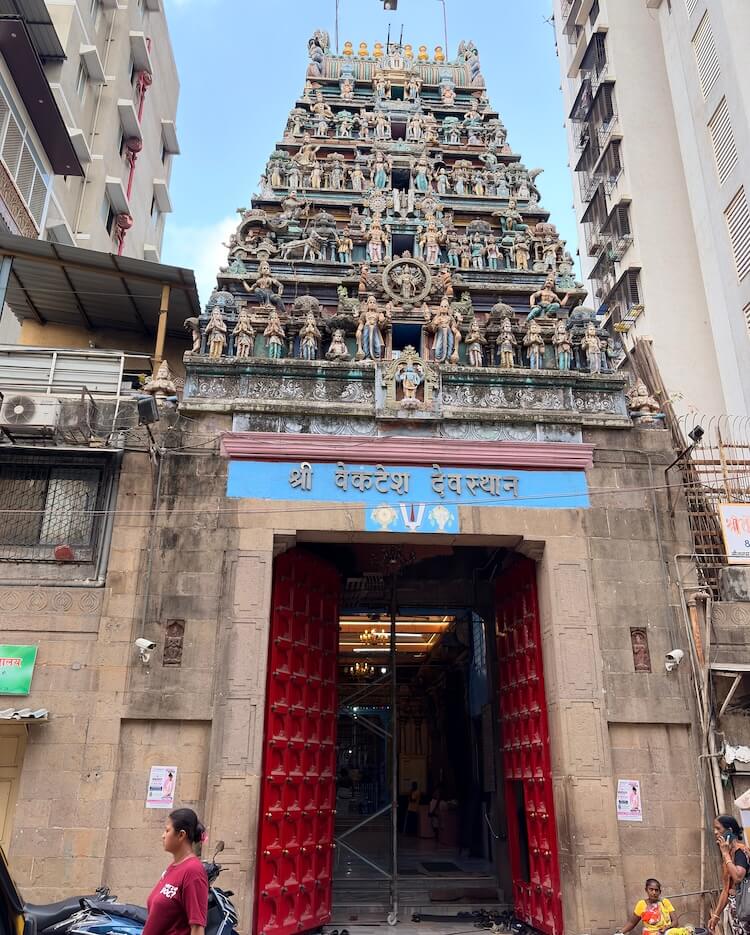
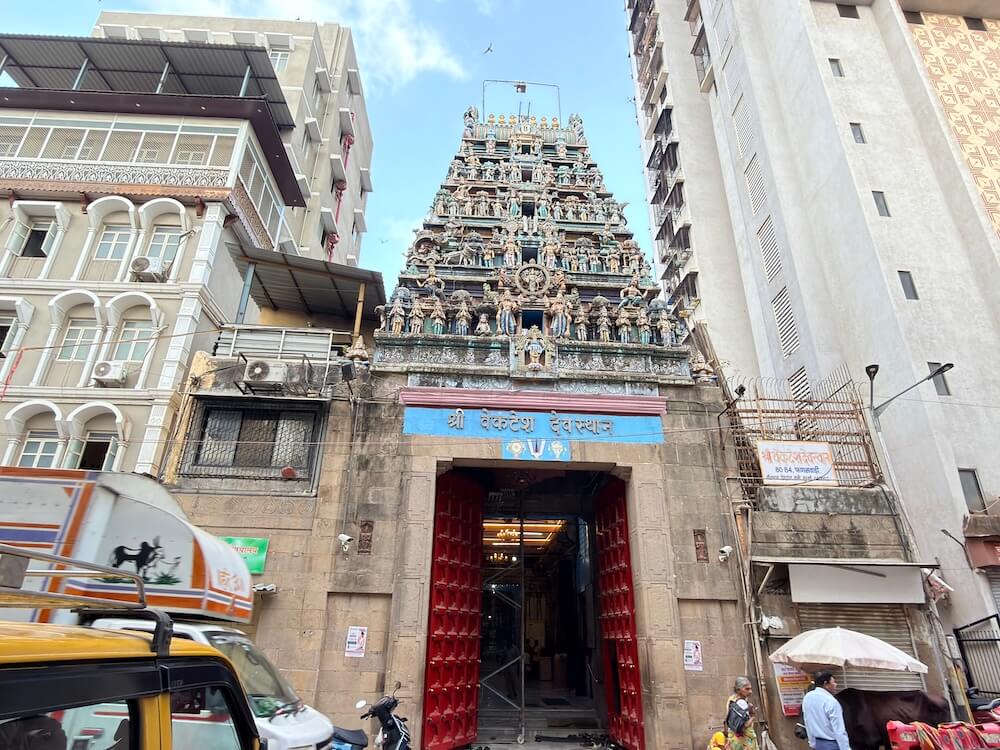
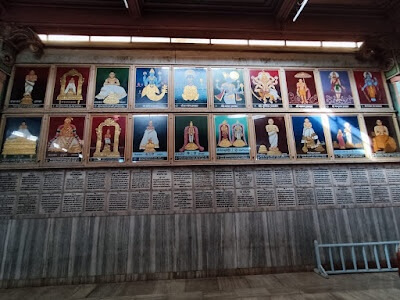
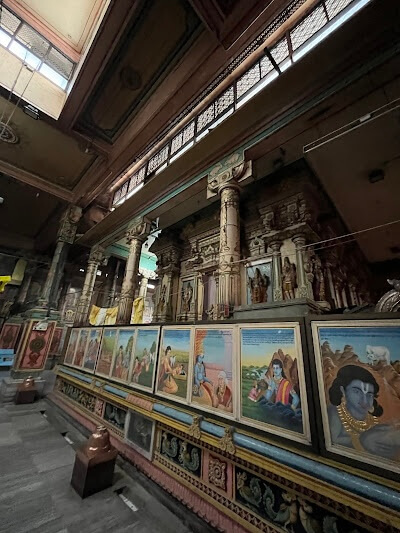
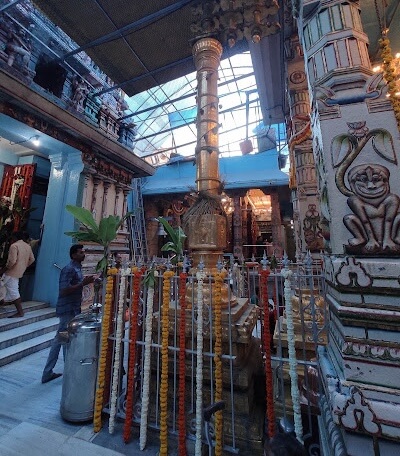
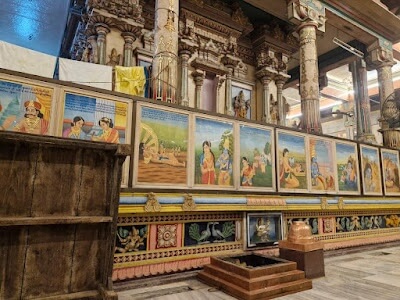
The architecture of this temple is heavily influenced by the South Indian temple style. The Gopuram-style entrance gate provides the first impression of this. Above the temple entrance stands a tall, multi-storied Dravidian-style Gopuram. It features colorful sculptures of various incarnations of Vishnu, Garuda, Lakshmi, Alwar saints, Yaksha-Gandharvas, and scenes from the Puranas. Each tier has small niches, and there is a Kalash at the summit. Through the Gopuram, one enters the first courtyard. Here, there is stone paving, colorful arches, grand carved pillars, and floral and geometric patterns carved on the ceiling. The pillars here are painted in the South Indian style. Some pillars are painted with Vyala (Yali), lotus flowers, vines, and Vaishnava symbols like the Conch (Shankha) and Discus (Chakra). Sculptures of the 24 incarnations of Vishnu, known as Chaturvimshati Murti, are carved on the courtyard walls. Being able to see all these 24 forms in one place is considered a major feature of this temple. In the courtyard, there is an ‘Utsav Bhavan’ (festival hall), a ‘Kach Mandap’ (glass pavilion), and special rooms for storing the deities’ clothes and sandalwood, known as Vastra Griha and Chandan Griha. At some distance here, like in traditional Vaishnava temples, stands a Dhwajasthambha (flagstaff). In front of this grand gold-plated flagstaff is the Balipitha. From here, one enters the main twelve-pillared assembly hall (Sabha Mandap) of the temple. A high ceiling, multi-colored pillars, carved arches, an interior decorated with Vaishnava symbols, a separate space for keeping the festival idols, and arrangements for bhajans and Vedic chanting are the features of this assembly hall. In this assembly hall, near the main entrance of the temple, an image of the temple’s founder, Prativadi Bhayankara Anantacharya Swami, has been placed. From this hall, there is a path leading to the main sanctum sanctorum. The entrance to the sanctum sanctorum features doors adorned with silver and gold. Sculptures of gatekeepers (Dwarapalas) as well as symbols such as the conch (Shankha), discus (Chakra), and lotus flower are carved upon them. In the main sanctum here resides a beautiful and magnificent idol of Lord Venkatesha, that is, Balaji. This idol is an exact replica of the original idol at Tirupati. Carved in black stone, this idol is adorned with gold ornaments, a crown (Kirit), a Vaijayanti garland, a Tulsi garland, and silk garments. Beside the main idol, the idols of Sridevi (Lakshmi) and Bhudevi are enshrined. Along with the main deity, idols of Lakshmi Narasimha Swami and Chakraraja Sudarshana are also enshrined in the temple. Above this sanctum is a Vimana, or spire, built in the South Indian style. Idols of various gods and goddesses are enshrined in the niches on the outer walls of the sanctum. Adjacent to the main temple is a sub-shrine dedicated to Goddess Padmavati. Similarly, on the left side, there is a sub-shrine for Rajagopala Swami, that is, Krishna with Rukmini and Satyabhama, as well as the Shri Rama Parivar. On the walls of the temple’s circumambulation path (Pradakshina Marg), there are images of various saints from the Vaishnava tradition. Likewise, paintings depicting episodes from the mythological life of Venkatesha have also been rendered here.
In this temple, daily worship is conducted according to the strict, rule-bound South Indian Pancharatra Agama tradition. Here, the temple rituals begin at 5:30 in the morning with auspicious music (Mangalavadyam). At 6:20 in the morning, Vishwaroop Darshanam and Mangalarati take place. Following this, from 6:25 to 7:10 is Darshan, from 6:25 to 6:45 is the Archana of Vishnu Sahasranama, and from 7:15 to 8:45, Nityaradhana, Mantrapushpa, Nakshatra Arati, Divya Prabandha recitation, and Venkatesha Sahasranama Archana are performed. Thereafter, from 8:00 to 8:45 is Darshan, between 8:45 and 9:15 is Bhoga and Balipradana, from 10:00 to 11:00 in the morning is Panchaparva and Abhishekam, followed by Darshan until 11:30, Rajabhoga from 11:30 to 12:00, Masa Nakshatra Arati at 12:00 in the afternoon, and Darshan from 12:00 to 1:00. The temple doors are closed from 1:00 to 4:30 in the afternoon. Thereafter, from 4:30 to 5:45 in the evening is Mangalavadyam, between 5:00 and 5:40 is Divya Prabandha recitation, from 5:45 to 6:15 is Bhoga, from 6:15 to 7:20 is Darshan, between 7:30 and 8:00 at night is Ratri Aradhana and Ashtottara Namarchana, at 8:00 is Bhoga, and from 8:30 to 9:00 is Darshan. At 9:30 at night, the Shayan ritual is performed, and the temple doors are closed for devotees. Ekadashi is an important day at this temple. Similarly, various Hindu festivals and celebrations are also observed here in a religious manner. Hundreds of devotees participate in the palanquin procession held here on the occasion of Brahmotsavam.
This sacred temple stands as a testament to deep spiritual devotion, ancient architectural grandeur, and rich local cultural traditions.
The sanctum sanctorum houses the divine idol consecrated according to ancient Vedic traditions, surrounded by serene courtyards and traditional temple architecture.
Navratri, Maha Shivratri, Annual Temple Jatra & Deepotsav
Compare and book flights, secure top-rated local hotels near the temple, hire reliable guides, and rent cars instantly.
Extend your pilgrimage by visiting other highly sacred temples located nearby.


Add ₹999 more to unlock FREE SHIPPING!
Your sacred cart is currently empty.
Shop Photo FramesFill in your delivery details below to place your order.
Add comment