
Add ₹999 more to unlock FREE SHIPPING!
Your sacred cart is currently empty.
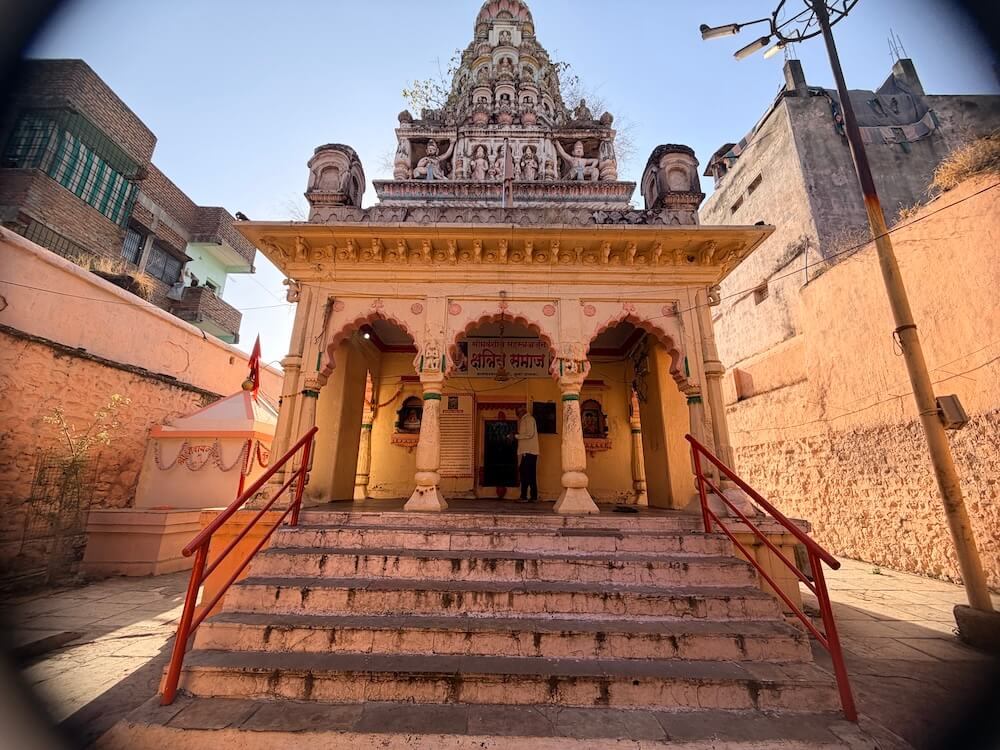
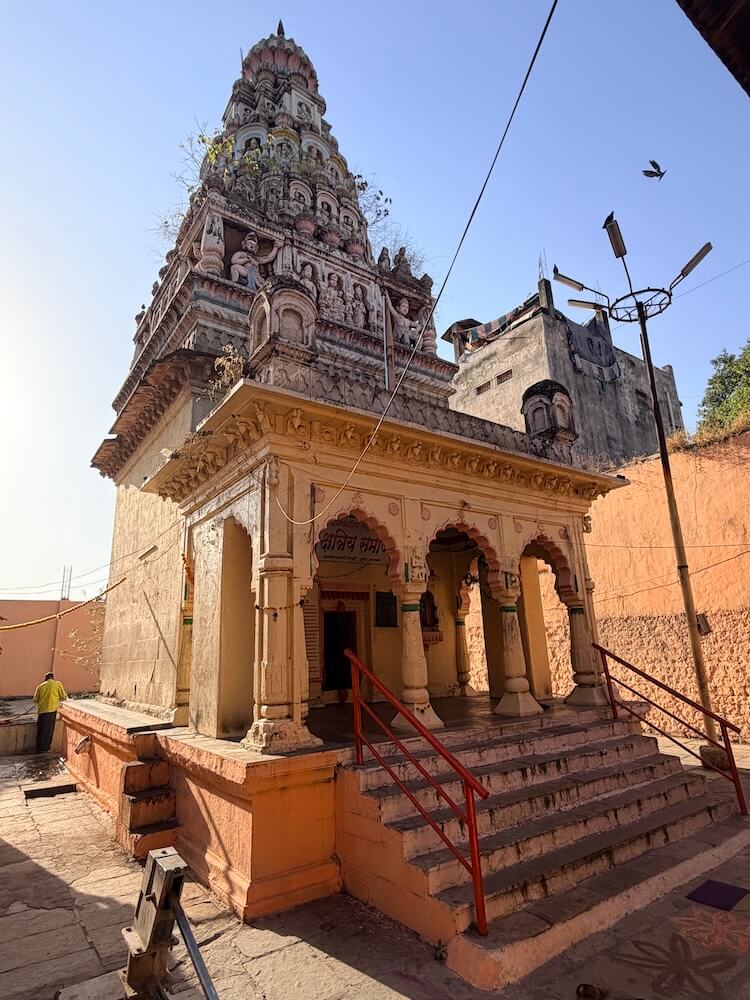
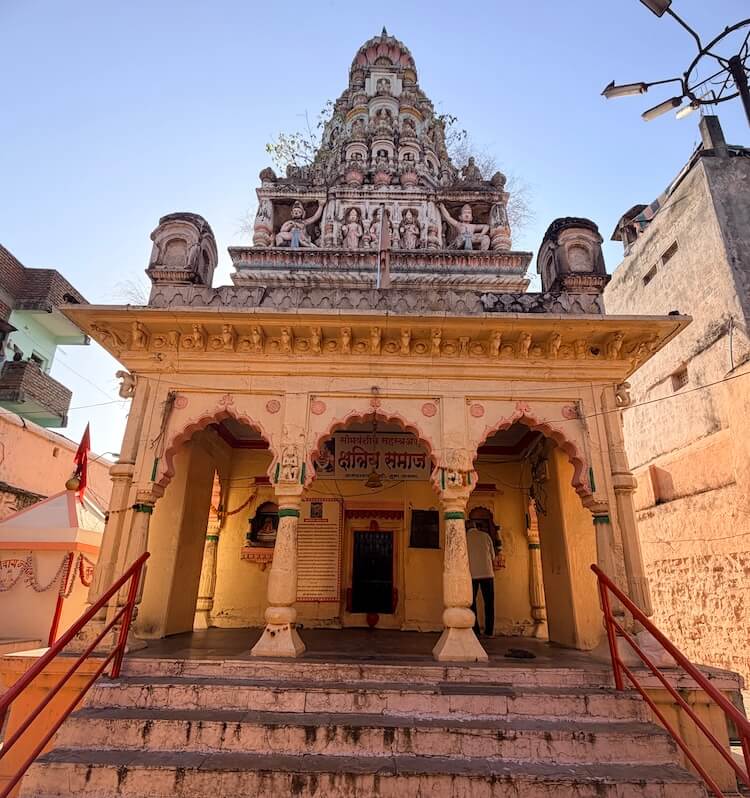
Shop Photo FramesThe ancient Kalbhairav Temple, located in the Juna Jalna area of Jalna city, is a spiritually awakened shrine blessed with a rich historical legacy. This temple is considered an excellent example of North Medieval and particularly Maratha-era architectural style in Maharashtra. The construction of the temple is divided into two phases; the foundation and the walls of the sanctum sanctorum are made of sturdy stone, while the main upper spire (shikhara) is crafted entirely from bricks and lime. The main spire consists of five tiers, adorned with intricate craftsmanship. A unique ceremony of pulling twelve carts is celebrated here with great enthusiasm every year on the occasion of the annual fair held on Vaishakh Krishna Ashtami.
It is said that this Kalbhairav temple is approximately three to four hundred years old. According to the legend associated with the temple, in ancient times, a very devoted and supreme follower of the Kalbhairav of Kashi lived in Jalna. Every year, this devotee would regularly travel on foot from Jalna to Kashi for the celebration of Bhairavnath’s Jayanti and for the holy darshan of the deity. For many years, he completed this arduous pilgrimage with immense devotion. However, as he grew older, it became physically impossible for him to undertake this long journey on foot. Distraught by the thought that he would no longer be able to visit Kashi, he placed his head at the feet of the deity during his final pilgrimage and prayed for forgiveness with a heavy heart. He told the deity, “Lord, this is my last journey. I will not be able to come for your darshan hereafter.” Seeing the devotee’s anguish, Lord Kalbhairav was greatly pleased and appeared before him, asking him to request whatever he desired. At that moment, the devotee expressed his wish, saying, “Please come to my hometown, Jalna, so that I may have your darshan until the very end.” The Lord granted his devotee’s wish; Bhairavnath followed the devotee to Jalna and established Himself here.
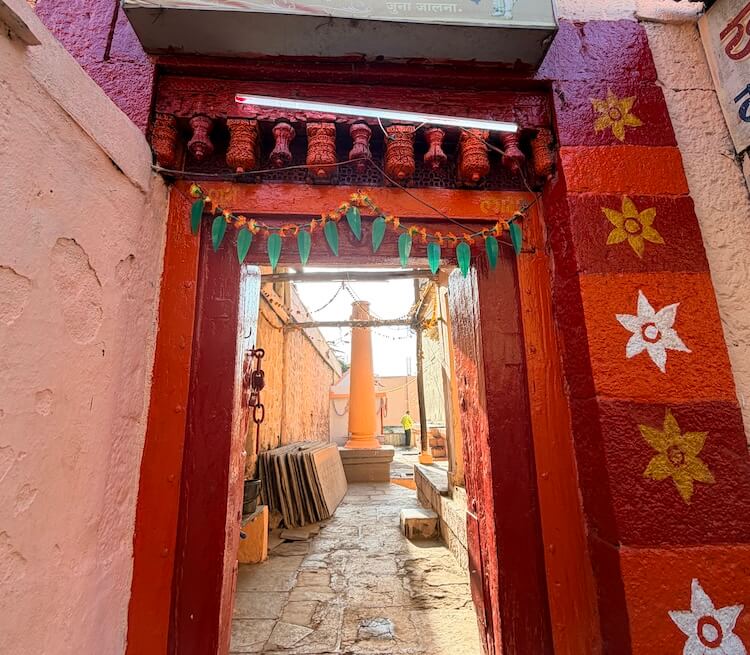
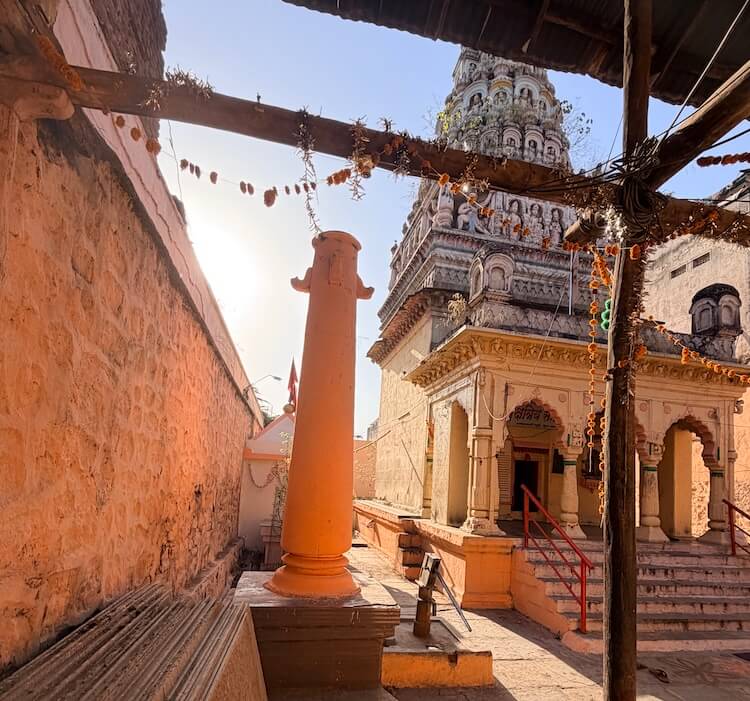
This historical temple is situated in the Anandi Swami Math Galli of Juna Jalna. The entire temple is surrounded by a strong fortification wall. There is a small entrance gate about four feet wide to enter the temple premises. This main entrance is located slightly above the road level, with two steps provided for access. The old chandelier chain (jhumarmal) on this entrance clearly highlights the antiquity of the temple. Upon entering, one steps into a paved courtyard. In this courtyard, in front of the main temple, two separate platforms have been erected on the left and right sides, featuring tall lamp pillars (deepmalas).
In this same courtyard, the Samadhi of the late Mahants is built, and in front of that Samadhi is a small Shiva temple. As is customary, a beautiful Nandi sculpture is installed in front of the Shiva temple. Inside the temple, a Shiva Linga is consecrated on the floor. In front of the Shiva temple, a vermilion-smeared stone idol of Mhasoba is also enshrined. This entire temple complex is considered a prime example of North Medieval and particularly Maratha-era architectural style in Maharashtra. A close observation of the various parts of the temple reveals that its architecture is primarily divided into two distinct phases. The foundation and walls of the temple are made of stone masonry, while the main spire above is constructed entirely of bricks and lime. This use of bricks and lime is considered a prominent and distinct architectural feature of temple construction during the Maratha period.
The entire temple stands on a sturdy plinth about five feet high from the ground. There are seven steps to ascend to the main assembly hall (sabhamandap) of the temple. Iron safety railings have been installed on both sides of these twenty-foot-long steps. After climbing the steps, one enters the semi-open assembly hall. The assembly hall has six pillars—four in the front and one each on the left and right sides. All these pillars stand on square bases at the bottom, and their central shafts are circular. All pillars are connected by arched gateways (mahirap). These arches have been given an attractive form, and most of them appear wavy or petal-shaped. These arches showcase a mixed style that evolved from the influence of Maratha-era architecture and the contemporary Sultanate or Mughal architectural styles.
In the assembly hall, on both sides of the sanctum entrance, there are niches in the front walls containing images of Swami Samarth and Renuka Mata. Sculptures of gatekeepers (dwarapalas) are carved on both sides of the sanctum entrance, and a sculpture of Lord Ganesha is placed on the lintel (lalatbimba) of the doorway. The archway of the entrance features a chandelier chain, and its apex bears a Kirtimukha sculpture. Inside the sanctum, there is an iron mesh safety railing in front of the main Vajrapitha. On the Vajrapitha in the sanctum, there is an ornate canopy (makhar). Supported by four pillars and topped with a dome-shaped spire, this canopy is the main attraction of the sanctum. Inside this canopy, three stone idols are enshrined in the form of ‘Tandala’ (aniconic stones). All three stone idols are smeared with vermilion, and the eyes, eyebrows, and mustaches of the deity are drawn on them in black. Of these three stone idols, the largest one in the center is that of the main Kalbhairav. The two smaller idols on his left and right are those of Batuk Bhairav and Chatuk Bhairav. These are considered forms of Bhairavnath himself.
The main spire on the roof of the temple consists of five tiers and is adorned with intricate craftsmanship. The first tier of this spire is square-shaped, while all other tiers are built in a circular fashion. All these tiers of the spire contain niches with idols of deities, as well as carvings of human and divine figures. Small amalakas and finials (kalash) are placed on top of all these niches. The apex of the spire features the main amalaka and finial.
Throughout the year, many religious festivals and celebrations are observed with great enthusiasm at the Kalbhairav Temple. Among these, Vaishakh Krishna Ashtami is considered the annual Jatrotsav (fair) of Kalbhairav. A very unique ceremony takes place on the occasion of this fair, in which twelve chariots (gaade) of Bhairavnath are paraded through the city. These twelve chariots are joined together in a very sturdy manner, one after another. Thousands of devotees from the surrounding areas gather in large numbers to pull these connected chariots and seek the blessings of the deity, participating in this tradition with great fervor.
Kartik Krishna Ashtami is celebrated here with great devotion as the Kalbhairav Jayanti festival. Apart from these main festivals, other significant occasions throughout the year, such as Dussehra, Diwali, the holy month of Shravan, and Kartik Purnima, are celebrated in the temple according to tradition. On the occasion of all these festivals and celebrations, programs such as Bhajans, Kirtans, music, and discourses (Pravachans) are organized at the temple. In addition to these annual festivals, there is a special influx of devotees at the temple every month on Kalashtami. People come here on this day to perform special worship.
This sacred temple stands as a testament to deep spiritual devotion, ancient architectural grandeur, and rich local cultural traditions.
The sanctum sanctorum houses the divine idol consecrated according to ancient Vedic traditions, surrounded by serene courtyards and traditional temple architecture.

Navratri, Maha Shivratri, Annual Temple Jatra & Deepotsav
Compare and book flights, secure top-rated local hotels near the temple, hire reliable guides, and rent cars instantly.
Extend your pilgrimage by visiting other highly sacred temples located nearby.


Add ₹999 more to unlock FREE SHIPPING!
Your sacred cart is currently empty.
Shop Photo FramesFill in your delivery details below to place your order.
Add comment