
Add ₹999 more to unlock FREE SHIPPING!
Your sacred cart is currently empty.
Shop Photo FramesAccording to mythological legend, Lord Shiv acquired the name Nilkanth after he consumed the Halahala (a lethal, primordial poison) that emerged during the Samudra Manthan (the churning of the ocean) performed by the Devas (gods) and Danavas (demons) to attain Amrit (the nectar of immortality). The ancient temple of this Lord Nilkanthameshwar is situated on the northern bank of the Narmada in the village of Zadeshwar in Bharuch. Regarded as one of the prominent temples in Bharuch, it is said to be approximately two hundred years old. A grand fair is organised here on the day of Mahashivratri. Located on the Narmada Parikrama (circumambulation) route, the temple also draws a vast number of Parikramavasis (pilgrims undertaking the circumambulation) who come to seek blessings.
The story behind Shankar’s name ‘Nilkanth’ is inextricably linked to the Samudra Manthan. This legend is recounted in various forms within the sixteenth chapter of the ‘Shatarudra Samhita’ of the ‘Shiva Purana’, as well as in the ‘Ramayana’, the ‘Mahabharata’ and the ‘Vishnu Purana’. The tale narrates that Sage Durvasa, being pleased with Indra, the king of the Devas, bestowed upon him a divine garland of celestial flowers. Indra, who was then riding on an elephant, placed the beautiful garland on the elephant’s forehead, but it fell to the ground and was trampled under the elephant’s feet. Enraged by this, Sage Durvasa cursed Indra, proclaiming that his strength would vanish and his glorious kingdom would be lost. Rendered powerless by the effects of this curse, the Devas began to suffer consistent defeats in their battles against the demons.
Shukracharya, the guru of the Danavas, possessed the Sanjivani Vidya (the knowledge of reviving the dead). Through the power of this knowledge, he would bring fallen demons back to life during battle, leading to the repeated defeat of the Devas. Ultimately, the Devas sought refuge with Lord Vishnu. Vishnu then proposed a plan to obtain Amrit by churning the ocean and advised the Devas to seek the assistance of the Danavas by befriending them. Accordingly, the Devas and Danavas used Mount Mandara as a churning rod and the serpent Vasuki as a rope to churn the sea. Vishnu took the form of a tortoise (Kurma) to support Mount Mandara at the bottom of the ocean. The churning of the ocean agitated all sea creatures and from this process, the lethal poison known as Halahala emerged. As the Devas and Daityas began to be scorched by its intensity, they entreated Lord Shankar to intervene, who then consumed the poison. However, at that moment, Lord Vishnu ensured that the poison would not descend beyond Shankar’s throat. The poison caused Shankar’s neck to turn blue and since then, he has been known as Nilkanth (the blue-throated one).
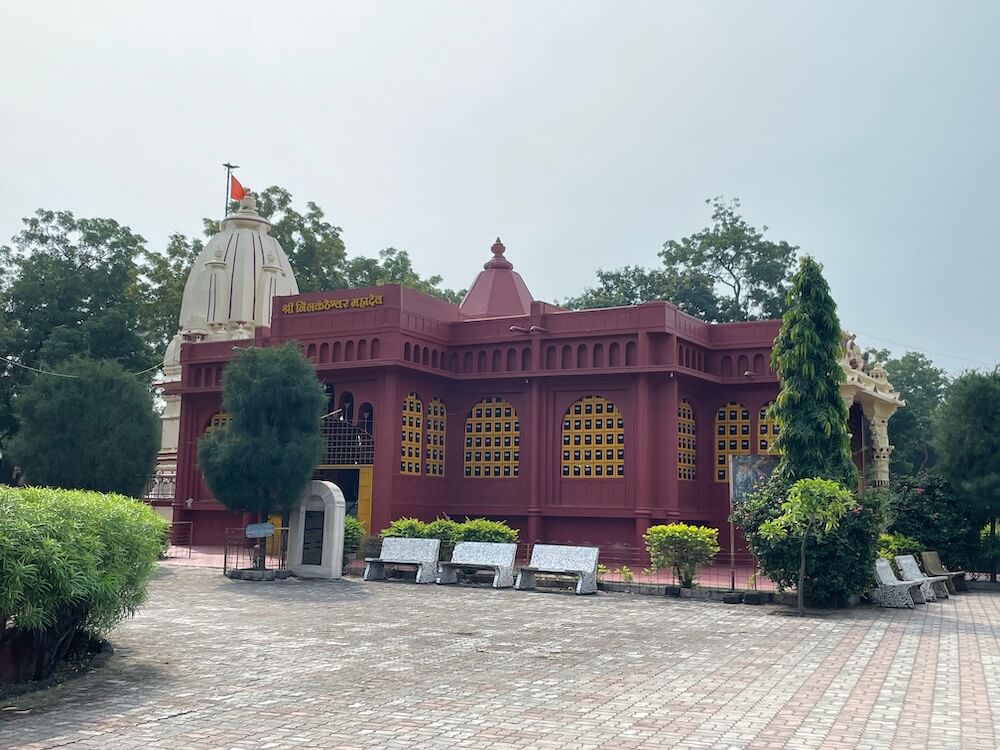
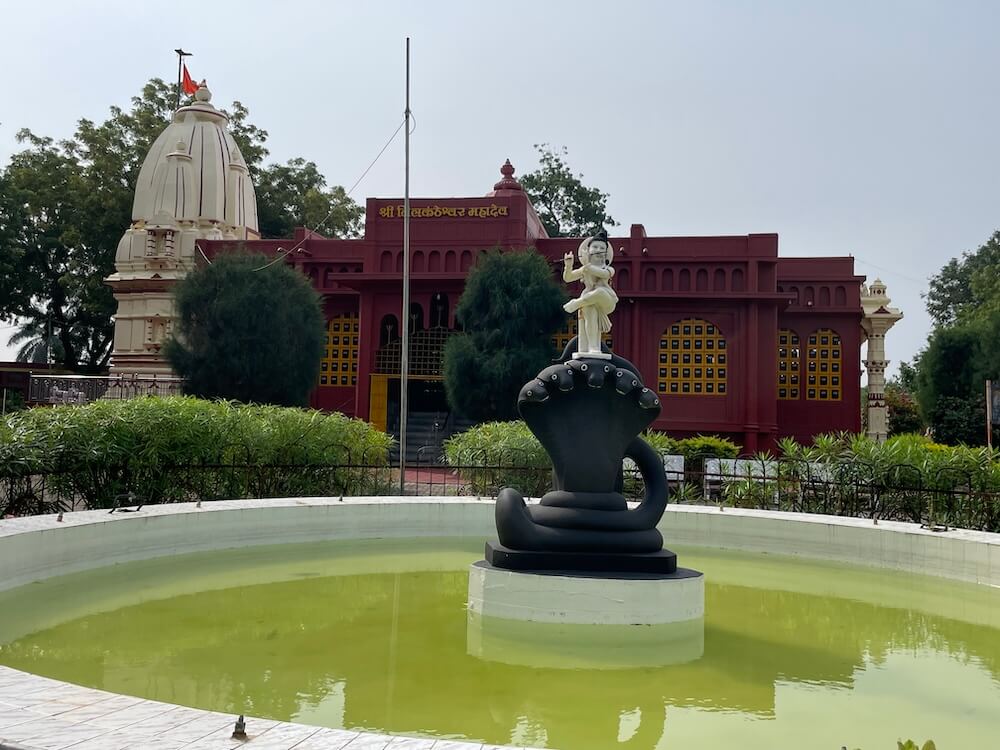
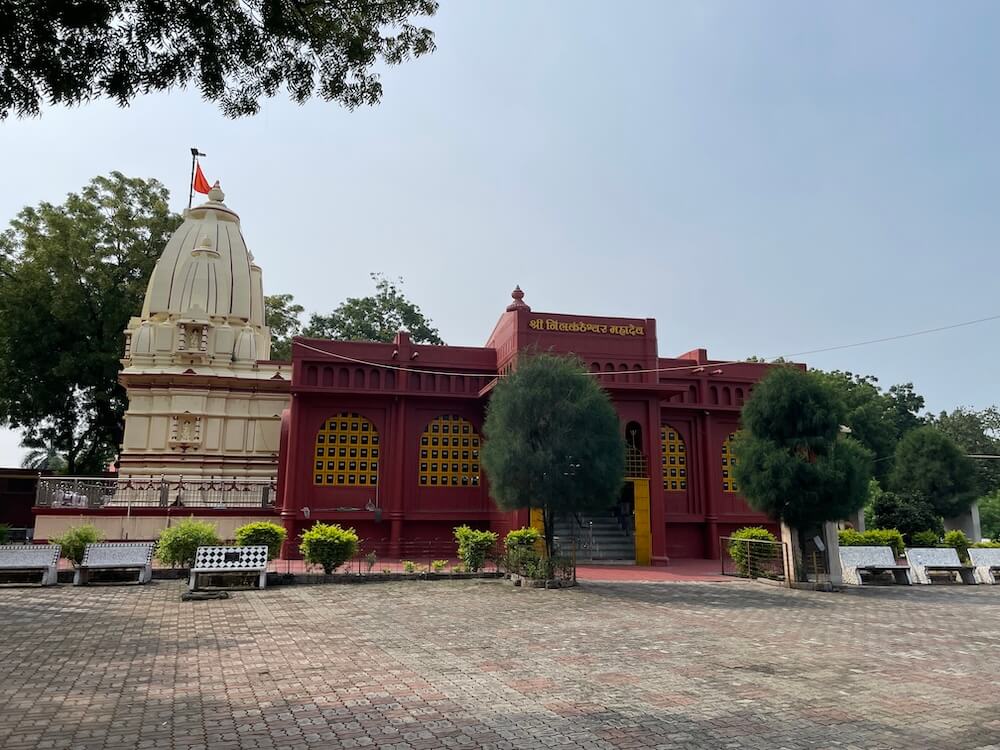
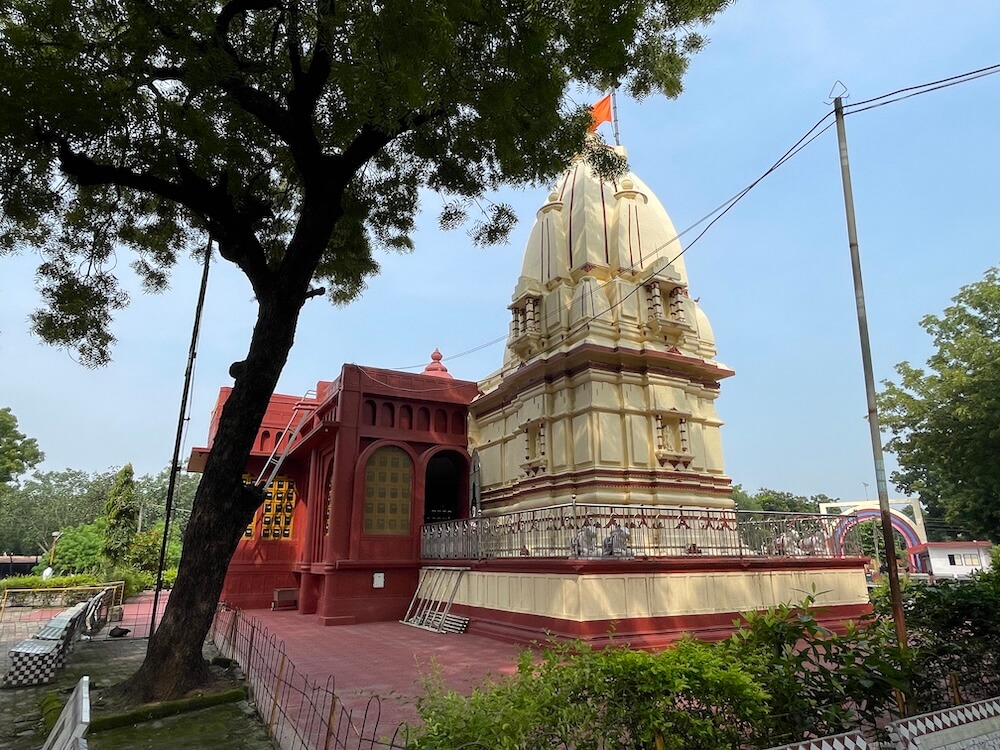
There are numerous Nilkantheshwar Mahadev temples across the country. Swami Baba of Savli restored this Nilkantheshwar Mahadev temple in Zadeshwar village approximately 50 years ago. A few years ago, the temple was further renovated to bestow upon it its current magnificent form. The temple is nestled within a spacious courtyard amidst scenic surroundings. The courtyard features two entrance gates and is adorned with numerous trees and flowering plants. Benches have been provided for the comfort of devotees. The premises also house a Yagyashala (sacrificial hall), a Dhyana Kaksha (meditation hall) and an Annakshatra (charitable kitchen) for Narmada Parikramavasis. Beside the main temple, the courtyard contains another small Shiva temple and a Hanuman temple. The Hanuman temple features a colossal idol of Lord Hanuman. On one side of the courtyard, a statue of Shri Krishna performing the Kaliyamardana (the subduing of the serpent Kaliya) is situated within a large circular pool.
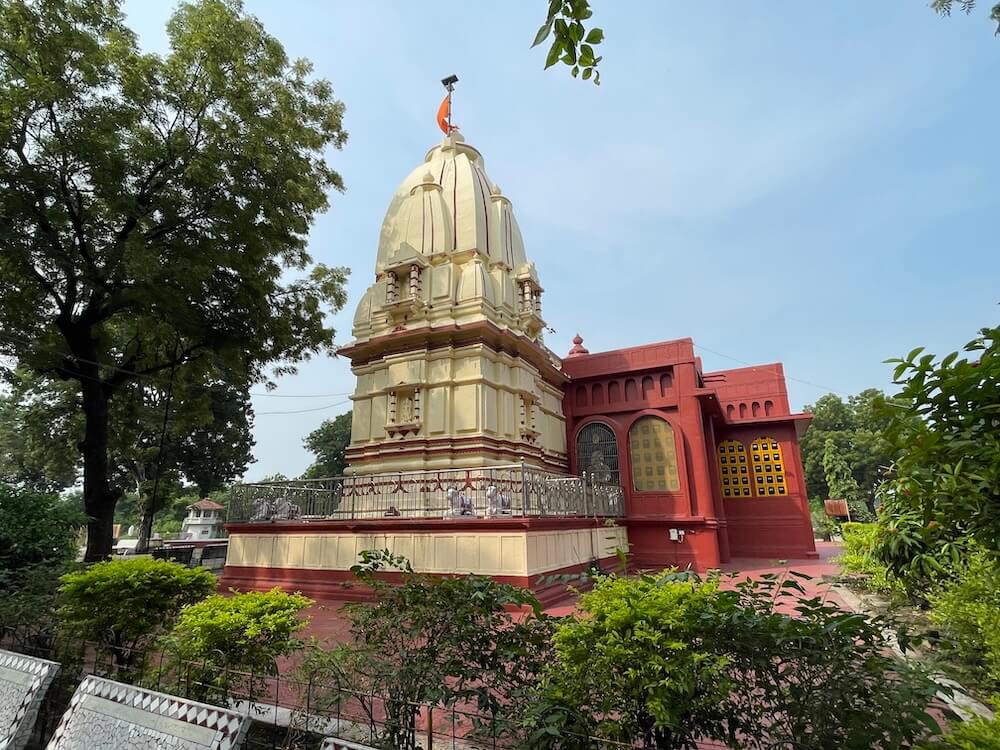
The Nilkantheshwar Mahadev temple is constructed in the Nagara architectural style, exhibiting a blend of traditional Gujarati and Rajasthani architectural elements. The structure comprises a Sabhamandapa (assembly hall), Antarala (vestibule) and Garbhagriha (sanctum sanctorum). The Garbhagriha is crowned with an Urushringa style spire, topped with an Amalaka (stone disc) and a Kalash (finial). The niches on the spire house idols of various deities. The red-hued Sabhamandapa also features a spire with an Amalaka and Kalash. Dwarapalas (gatekeepers) stand on either side of the entrance and an image of Lord Shiva is positioned centrally above the doorway. Entry to the temple is gained by ascending seven steps. The walls of the Sabhamandapa are adorned with the 1,008 names of Lord Shiva and 1,008 miniature Shivalingas. The assembly hall is exceptionally spacious and contains an idol of Nandi on a pedestal, followed by a sculpture of a tortoise. Stainless steel railings have been installed in the Sabhamandapa to manage the flow of devotees. A portrait of Swami Baba of Savli is displayed on one side of the hall. The niches in the temple’s Antarala house idols of Lord Ganesh and Kartikeya. The entrance to the Garbhagriha is made of stone, with figures of gatekeepers carved onto the door pillars. An Ardhachandrashila (half-moon stone) is situated at the base of the doorframe, flanked by Kirtimukhas (faces of glory). In an arched niche above the doorframe sits a marble idol of Lord Shankar. Inside the sanctum, a cylindrical Shivaling is placed within a large Shalunka (pedestal), which is encased in a silver sheet. A silver serpent provides a canopy over the Shivaling and a large silver Abhishek Patra (vessel for ritual libations) hangs above. In a large niche behind the Shivaling stands an exquisite idol of Mother Parvati carved in marble.
The Aarti of Lord Nilkantheshwar is performed daily at 6:00 am and 7:00 pm. Every day, hundreds of devotees visit to perform Abhishek (ritual bathing) of the Shivaling. A Ghat (flight of steps) has been constructed at the rear of the temple leading down to the Narmada riverbed. Many devotees bathe in the river and use Narmada water to perform Abhishek on the Shivaling. Large numbers of followers visit the temple on Mahashivratri and every Monday of the month of Shravan. The temple is managed by the Nilkantheshwar Charitable Trust. As the temple lies directly on the Narmada Parikrama route, many pilgrims visit for Darshan (sacred viewing). Some Parikramavasis rest at the temple for a day or two before continuing their journey. Complimentary lodging and boarding are provided for them.
This sacred temple stands as a testament to deep spiritual devotion, ancient architectural grandeur, and rich local cultural traditions.
The sanctum sanctorum houses the divine idol consecrated according to ancient Vedic traditions, surrounded by serene courtyards and traditional temple architecture.

Navratri, Maha Shivratri, Annual Temple Jatra & Deepotsav
Compare and book flights, secure top-rated local hotels near the temple, hire reliable guides, and rent cars instantly.
Extend your pilgrimage by visiting other highly sacred temples located nearby.


Add ₹999 more to unlock FREE SHIPPING!
Your sacred cart is currently empty.
Shop Photo FramesFill in your delivery details below to place your order.
Add comment