
Add ₹999 more to unlock FREE SHIPPING!
Your sacred cart is currently empty.
Shop Photo FramesIn the city of Renapur, which carries the very existence of Renuka Devi in its name, stands an ancient temple with a history and tradition spanning over 800 years. It is believed that Lord Parashurama worshipped his mother, Renuka Devi, at this very site. Renuka Devi is the presiding deity (Gramadevata) of Renapur and the revered goddess for many devotees in the district. This temple is also known as a replica of the Mahur Devi; therefore, it is customary to seek blessings here before visiting Mahur Fort. The swaying lamp pillar (Halnari Deepmal) is a unique feature of this temple.
Renuka Devi is Bhudevi (Goddess of the Earth), and the word Renuka signifies the earth composed of dust. According to mythological legends, Renuka was the wife of Sage Jamadagni. The ‘Renuka Mahatmya’ scripture narrates her life story: in ancient times, King Renu, also known as Prasenajit of the Ikshvaku dynasty, ruled the Kanyakubja country. When he performed the Kanyakameshti Yajna, a daughter was born from the sacrificial fire. She was named Kamali in her cradle. As the daughter of King Renu, she came to be known as Renuka. After she grew up, King Renu arranged her Swayamvara at the Bhagirathi region, where she chose Sage Jamadagni as her husband. The couple had five sons: Rumanvat, Sushena, Vasu, Vishwavasu, and Ramabhadra, also known as Parashurama.
Her devotion to her husband (Pativratya) was so intense that she could fashion a pitcher from the sand on the riverbank to carry water, using a coiled snake as a support for the vessel. One day, while watching the Gandharva Chitraratha playing in the waters of the Tungabhadra, her mind wandered for a few moments. Because her pure, sattvic state of mind was momentarily lost, her ability to form a pitcher from sand vanished. She returned to the ashram empty-handed. Through his meditative powers, Sage Jamadagni understood everything. He became extremely enraged and ordered his sons to behead Renuka. The first four sons—Rumanvat, Sushena, Vasu, and Vishwavasu—refused this paternal command. Consequently, Jamadagni cursed them, causing them to lose their power of reasoning. However, the fifth son, Parashurama, who is considered an avatar of Lord Vishnu, obeyed his father’s command and severed his mother’s head with his axe (Parashu).
Pleased with Parashurama’s filial piety, Jamadagni asked him to seek a boon. With great wisdom, Parashurama requested that his mother be brought back to life and that his brothers be freed from the curse. Jamadagni granted this. Renuka was brought back to life. Another part of this legend states that when Parashurama beheaded Renuka, the place where her head fell is believed to be the present-day Mahur Fort. The Renuka Mata Temple in Renapur is famous as a replica of the Renuka Devi of Mahur Fort.
According to mentions in the Markandeya Purana, in ancient times, Renapur was part of the Dandakaranya region. Sage Jamadagni and Mother Renuka resided here. Because Sage Jamadagni performed penance at this location, the area was known as the ‘Tapobhumi of Sage Jamadagni.’ The ancient name of this village was ‘Bhingari.’ Due to the presence of Mother Renuka, it came to be known as Renapur. A local proverb regarding the antiquity of the village is famous: ‘When there was no creation, there was Pandharpur. Even before that, there was Renapur.’ This proves the ancient nature of the village.
The legend of this temple states that Parashurama worshipped his mother here and built a temple for Renuka Devi at this spot. Over time, it was destroyed. Later, eight hundred years ago, the Goddess appeared in a vision to the local citizens, indicating her presence here. When the devotees searched, they found an idol of Renuka Mata in the form of a Tandala (a naturally formed stone) in the nearby Rena River. The idol was consecrated at the site where the temple now stands, and the structure was subsequently built. After periodic renovations, the temple attained its current form.
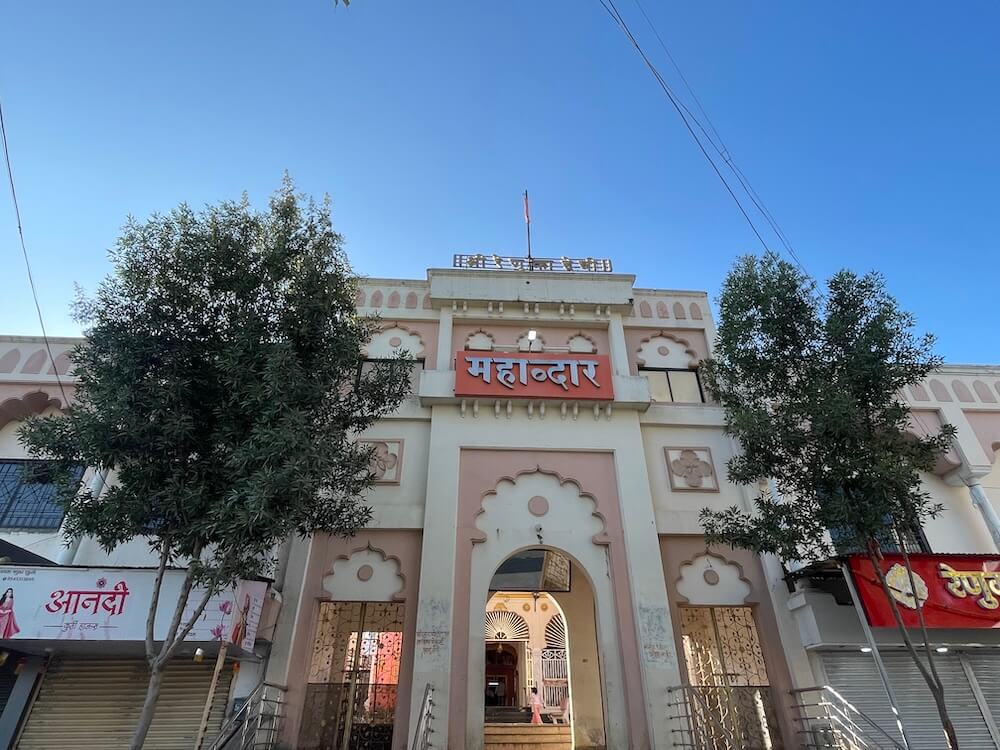
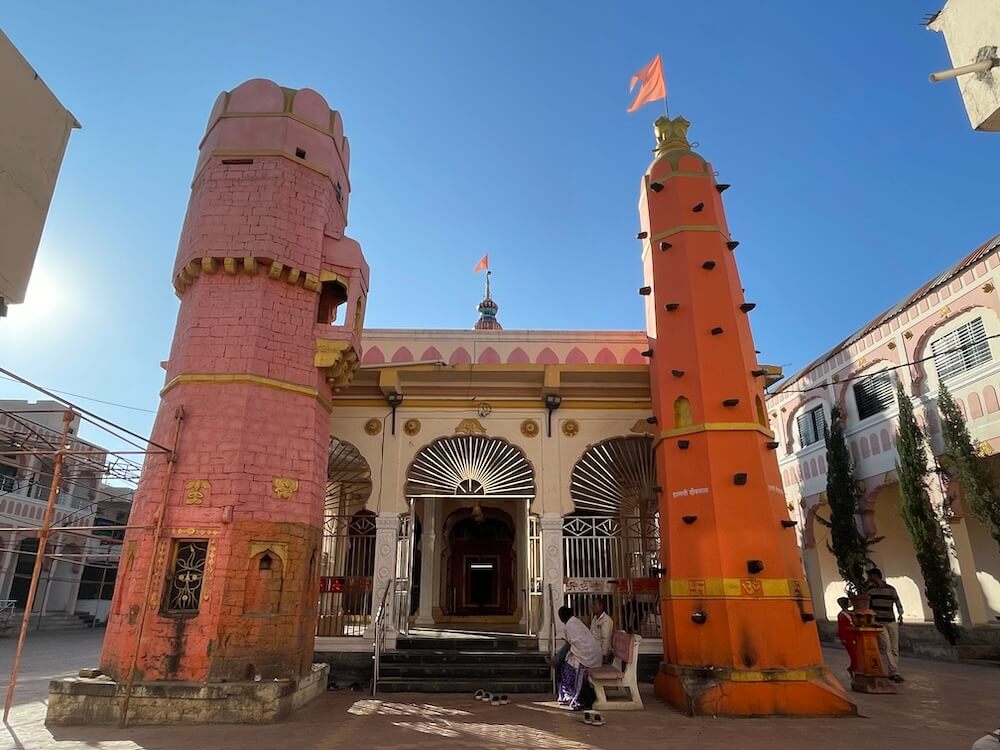
Situated in the heart of Renapur city, the temple is surrounded by a fortification wall. One enters the temple courtyard through a large gateway in this wall. Near the entrance, there are two ancient lamp pillars (Deepmalas) about 20 feet high. The one on the left has internal steps leading to the top. The pillar on the right is famous as the ‘Swaying Lamp Pillar.’ This stone structure features niches and stone brackets for lighting lamps. The unique feature of this pillar is that if pushed with a specific rhythm, it begins to sway. It is said that this movement is a result of the advanced engineering skills of that era. In such constructions, no mortar is used between the stones, leaving microscopic gaps. When force is applied, the stones slide slightly against each other, making the entire structure flexible. This design is intended to absorb vibrations from earthquakes. The 12th-century Indian architects used the same principle that allows the ‘Pagodas’ in Japan to sway during earthquakes without collapsing. Over time, the upper part of one of the pillars fell and was replaced with cement construction, but the original stone structure remains intact today. A legend is also told about this swaying pillar: some evil-minded individuals once entered the temple to cause destruction. One day, while these individuals were inside, the stone pillar suddenly began to sway. Its movement caused the bells to ring. Alerted by this, the devotees rushed to the temple and stopped the vandals. Devotees believe that this miracle was performed by the Goddess herself. Since then, this pillar has been known as the ‘Halati Deepmal’ (Swaying Lamp Pillar).
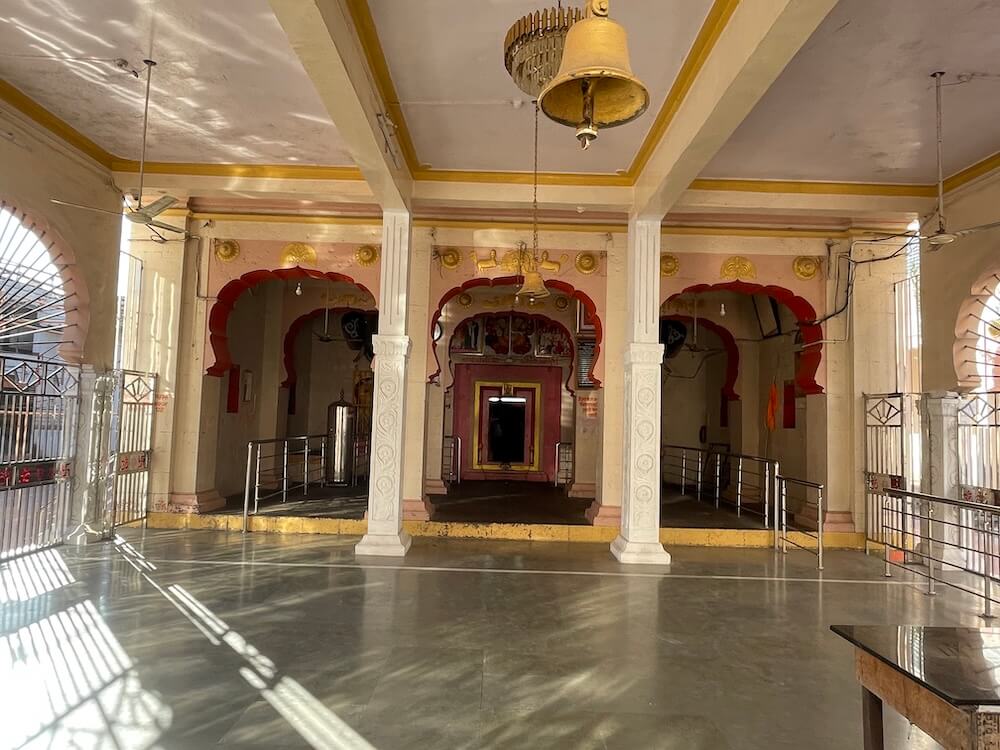
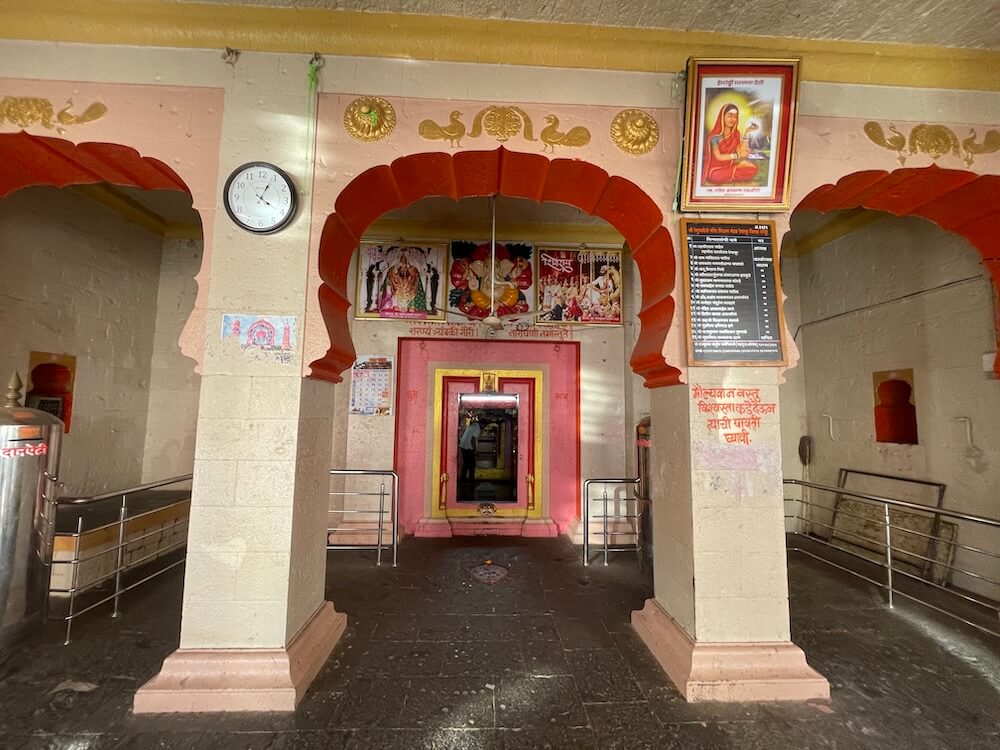
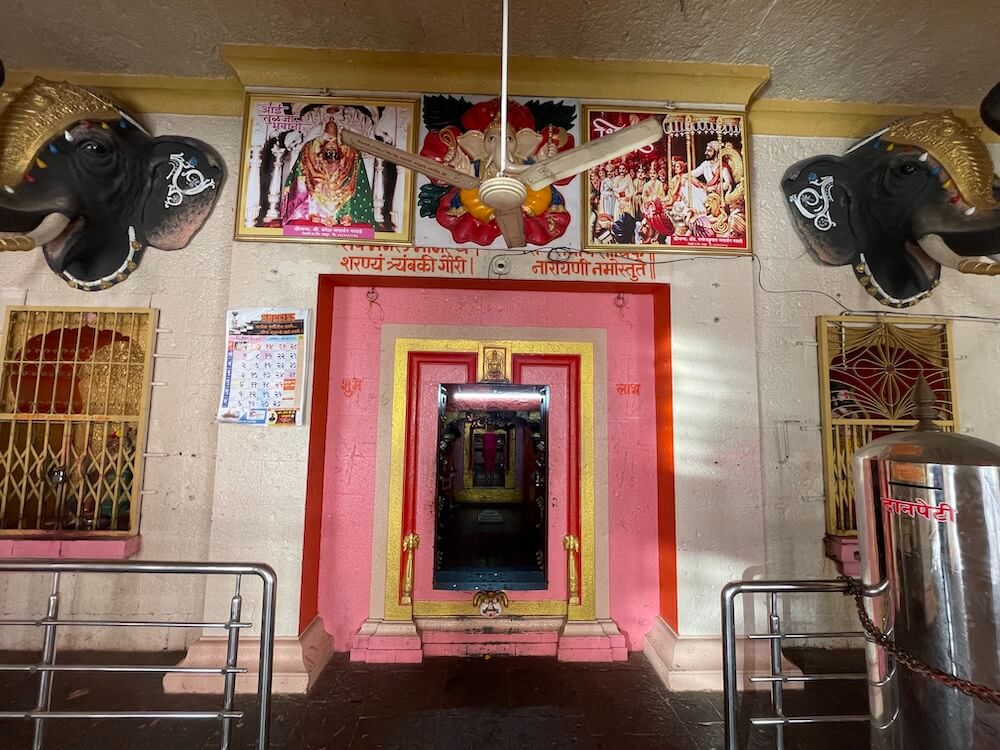
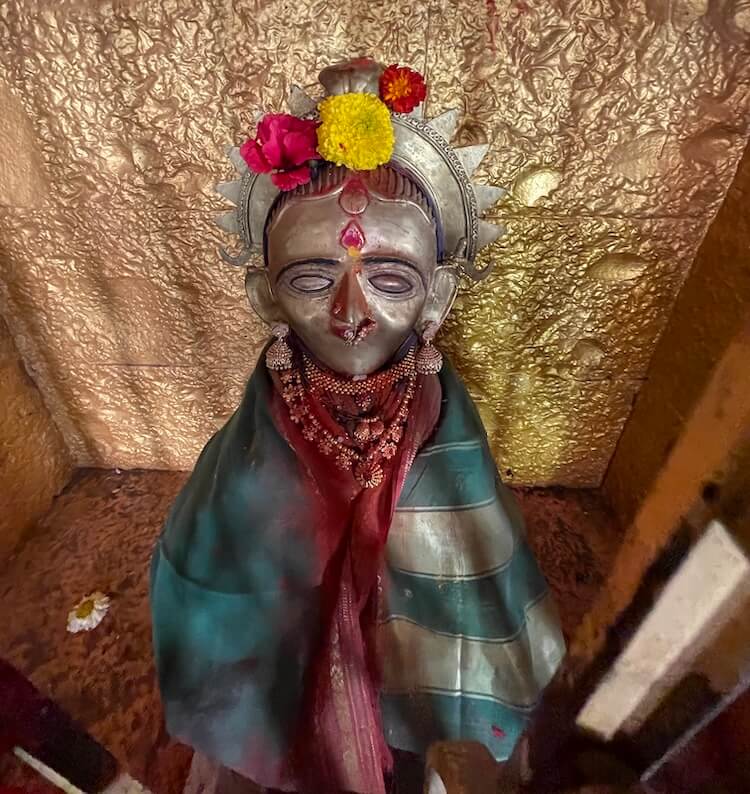
From the space between these two lamp pillars, one enters the temple hall (Mandap), which is situated on a high platform. The temple structure consists of a Mandap, a semi-open Sabha Mandap, an Antarala, and the Garbhagriha (sanctum sanctorum). It appears that the Mandap here was built at a later period in front of the original temple. From this pavilion, one enters the semi-open assembly hall of the original temple. On the front side of the assembly hall, four pillars are connected to each other by arched gateways. In this assembly hall, a queue system has been arranged for the convenience of devotees. Near the entrance of the inner sanctum in the assembly hall, there is a tortoise statue on the floor. On the threshold of the entrance, there is a Kirtimukha, and on the lintel, there is an idol of Lord Ganesha. In the niche next to the entrance, there is an idol of Lord Parashurama. From here, one proceeds into the inner sanctum. The inner sanctum features Hemadpanti-style construction and stone pillars. In front is the entrance to the sanctum sanctorum. On the front wall of the sanctum sanctorum, there are niches containing idols of Lord Ganesha and the Goddess. Inside the sanctum sanctorum, the Goddess is present in the form of a stone slab (Tandala) on a Vajrapitha. The halo, eyes, ears, nose, and hands of this idol are made of silver. During festivals, a silver or gold mask is placed on the idol of the Goddess. There is a circumambulation path around the exterior of the sanctum sanctorum. On the roof of the sanctum sanctorum, there is a decorative parapet and a four-tiered spire. On all four sides of this spire, there are lion sculptures. In the niches of each tier of the spire, there are idols of various deities. At the top of the spire, there are two Amalakas and a pinnacle above them.
The Sharadiya Navaratri festival is celebrated here with great enthusiasm. During this time, Ghatasthapana is performed, followed by the worship of the Goddess, Aarti, and Abhishekam. Special Homa-Havan rituals are also conducted. At the end of the festival, on Vijayadashami, a palanquin procession takes place. During this time, a procession of the Goddess is carried out, in which thousands of devotees participate. During this period, the temple is beautifully decorated with leaves and flowers. Apart from this, Chaitra Navaratri is also celebrated in this temple; however, its scale is not as grand as Sharadiya Navaratri. Other festivals include Mahashivratri, Diwali, and Ekadashi. On Mahashivratri, Rudrabhishekam and Shiva-Shakti worship are performed. Additionally, on Parashurama Jayanti, special worship and food distribution are organized. It is said that on Champashasthi, the palanquin of Khandoba-Mhalshabai arrives here.
On Vaishakh Purnima, a three-day fair is held here. During this time, thousands of devotees from Latur, Dharashiv, Beed, and Karnataka come here for the Goddess’s Darshan and to fulfill their vows. According to gazetteer records, “This Goddess is famous for curing illnesses and diseases.” Especially in cases of skin diseases or viral infections, vows like ‘offering neem leaves’ or ‘Dandavat’ (prostrating while circumambulating the temple) are made. At this time, devotees seek the Goddess’s guidance through the Kaul ritual. A large turnover of agricultural tools, utensils, and sweets takes place during this fair.
This sacred temple stands as a testament to deep spiritual devotion, ancient architectural grandeur, and rich local cultural traditions.
The sanctum sanctorum houses the divine idol consecrated according to ancient Vedic traditions, surrounded by serene courtyards and traditional temple architecture.
Navratri, Maha Shivratri, Annual Temple Jatra & Deepotsav
Compare and book flights, secure top-rated local hotels near the temple, hire reliable guides, and rent cars instantly.
Extend your pilgrimage by visiting other highly sacred temples located nearby.


Add ₹999 more to unlock FREE SHIPPING!
Your sacred cart is currently empty.
Shop Photo FramesFill in your delivery details below to place your order.
Add comment