
Add ₹999 more to unlock FREE SHIPPING!
Your sacred cart is currently empty.
Shop Photo FramesThe village of Pimpalgaon Raja in the Khamgaon taluka of Buldana district is renowned for its rich historical and spiritual heritage. Situated on the banks of the Dnyanganga River, the Renuka Mata Temple here is considered an invaluable treasure of ancient Indian architecture and history. The unique feature of this temple is that the entire structure is carved into an underground cavern. Here, one witnesses a distinct marvel of nature and architecture. When the Dnyanganga River floods, the river water directly touches the feet of the Goddess; this characteristic design still amazes scholars today. An inscription in the Modi script on the very first step of this temple bears witness to the ancient existence of the village.
In the Shakti tradition of Maharashtra, the position of Renuka Mata is unique, and the Goddess at Pimpalgaon Raja is considered a vibrant manifestation of the original seat at Mahur. According to mythological references, Renuka, the daughter of King Renu of the Ikshvaku dynasty, was married to the highly ascetic Sage Jamadagni of the Bhrigu clan. The couple had five sons: Rumanvan, Sushena, Vasu, Vishwavasu, and Parashurama. Renuka Mata was a woman of immense virtue and devotion. The radiance of her chastity was so intense that she would go to the river daily, craft a pot out of sand with her bare hands, and bring water for the yajna in that fragile vessel to the ashram.
One day, seeing the water sports of Gandharvas and Apsaras at the river, her mind wavered for a moment. Consequently, she could not form the sand pot that day. Sage Jamadagni, through his divine vision, recognized the thoughts in the mind of Renuka, who had returned empty-handed. Enraged, he ordered his sons to behead their mother. The first four sons refused this harsh command of their father and were cursed to turn into stone; however, the youngest, Parashurama, considering filial duty supreme, beheaded his mother. Pleased with this obedience, Jamadagni asked Parashurama to seek a boon. Parashurama requested three boons: the resurrection of his mother, the liberation of his brothers from the curse, and the erasure of the memory of the incident. With the Sage saying “Tathastu” (so be it), Renuka Mata was brought back to life. Although the main Shakti Peetha of this Goddess is at Mahurgad, the temple at Pimpalgaon Raja is considered a vibrant sub-seat of that primal mother.
It is believed that the village of Pimpalgaon Raja was established about ๙๐๐ years ago by a shepherd king named Piratsing. The history of this village is very ancient. According to a legend, the family of this shepherd king sacrificed themselves to ensure the construction of the village fort was completed without obstacles; this folklore is still prevalent in this region. Historically, Pimpalgaon Raja was an important administrative center (Pargana) in the ๑๘th century. A clear mention of this place is found in the ‘Central Provinces and Berar District Gazetteers – Akola District (๑๙๑๐)’. When the Maratha Sardar Malharji Shinde was returning from the Delhi campaign, he had camped at this location. In this village, which has a great tradition of scholarship, a great scholar named Ganesh Daivajna resided around the year ๑๗๑๙. He wrote significant treatises and dissertations on astrology and Hindu theology.
Historically, Pimpalgaon Raja was part of the Varhad province. This region was under the dominion of the Nizams of Hyderabad for a long time. However, during the Maratha Empire, especially under the Bhonsle rule, the Marathas also had a significant influence on this area. After the British took control of the Varhad province from the Nizam in ๑๘๕๓, districts were reorganized for administrative convenience. According to old records, Pimpalgaon Raja village was previously included in the Malkapur taluka and was later transferred to the Khamgaon taluka.
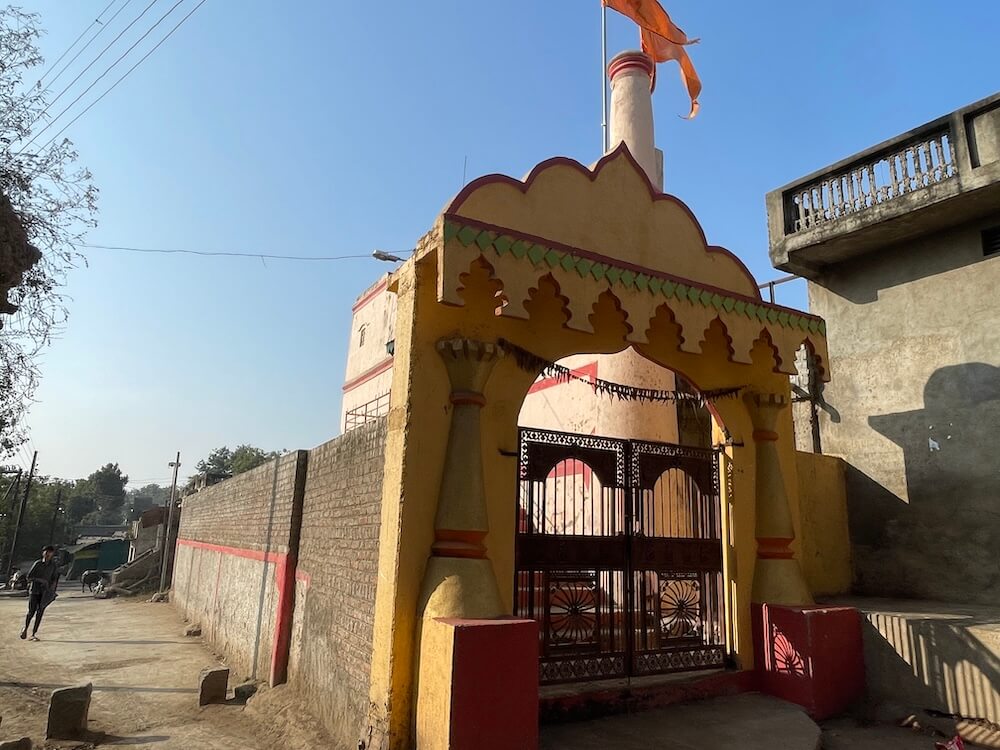
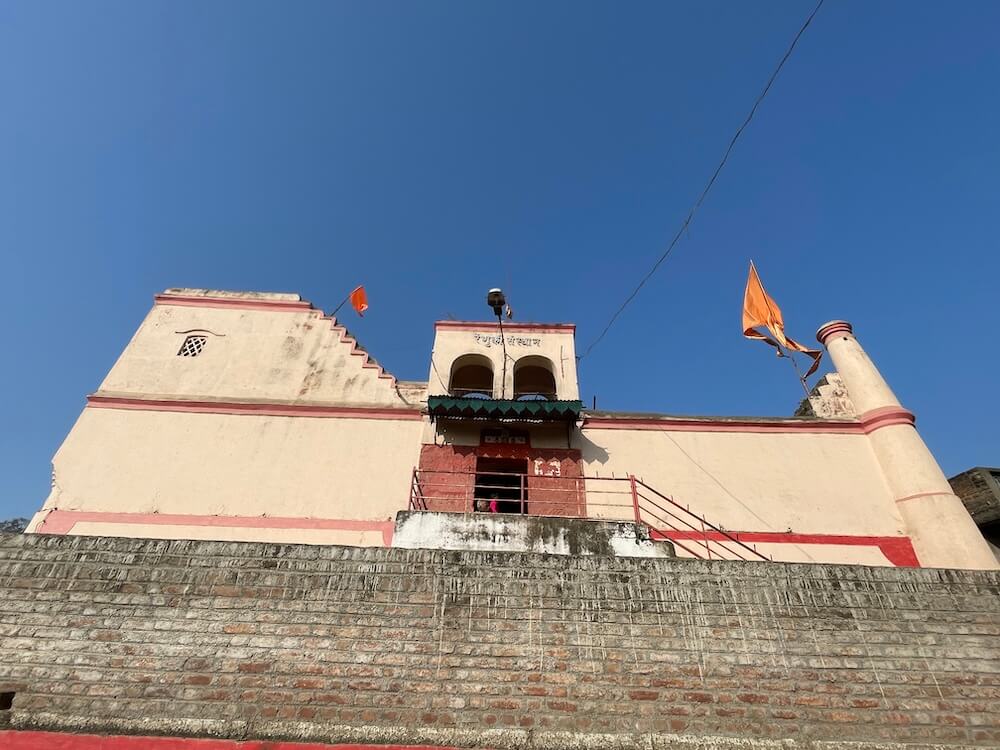
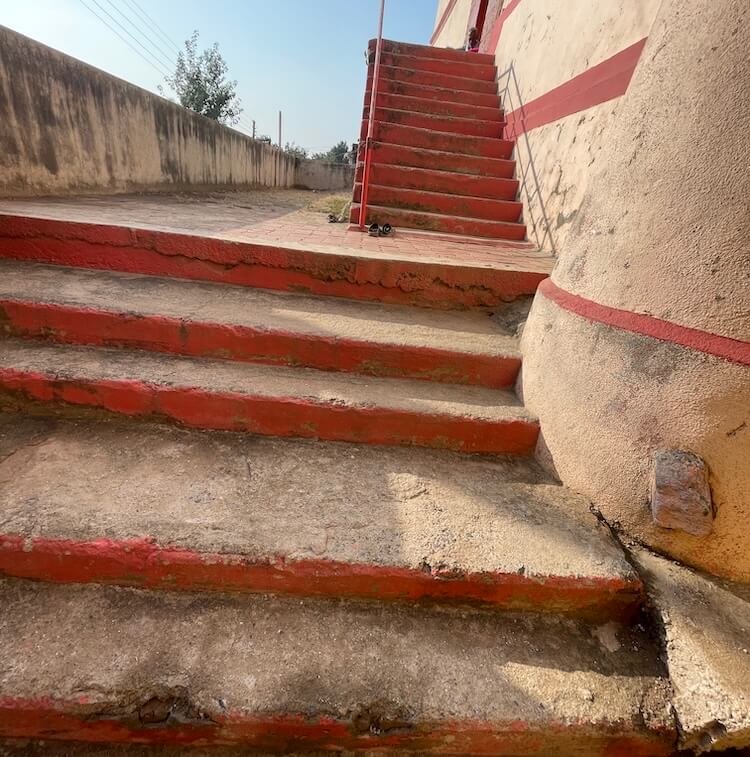
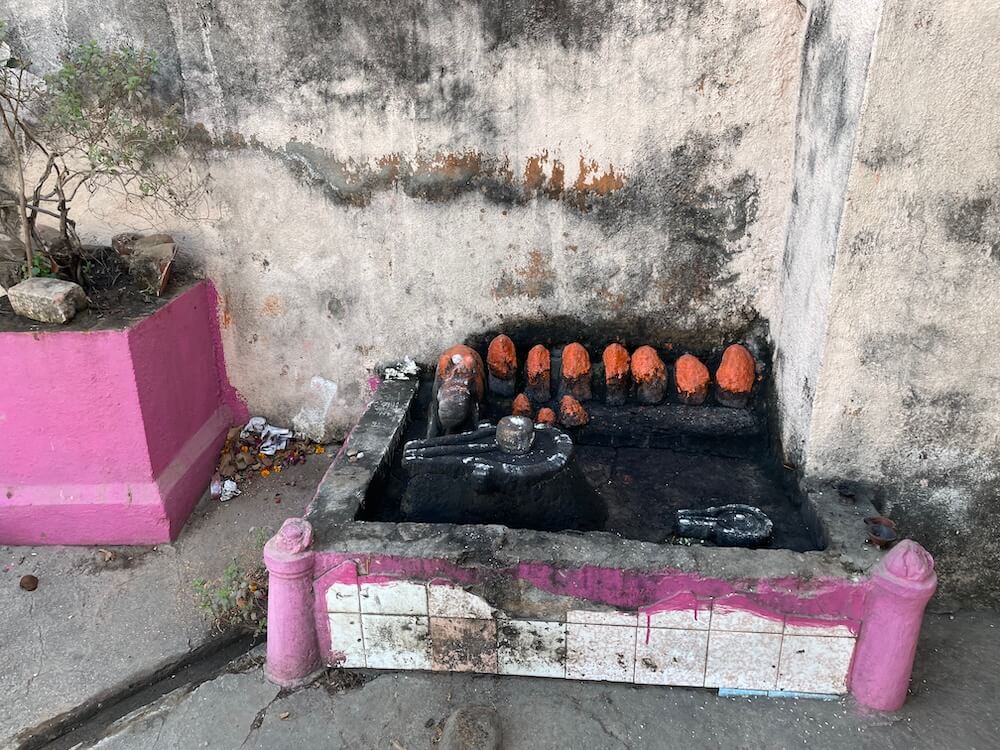
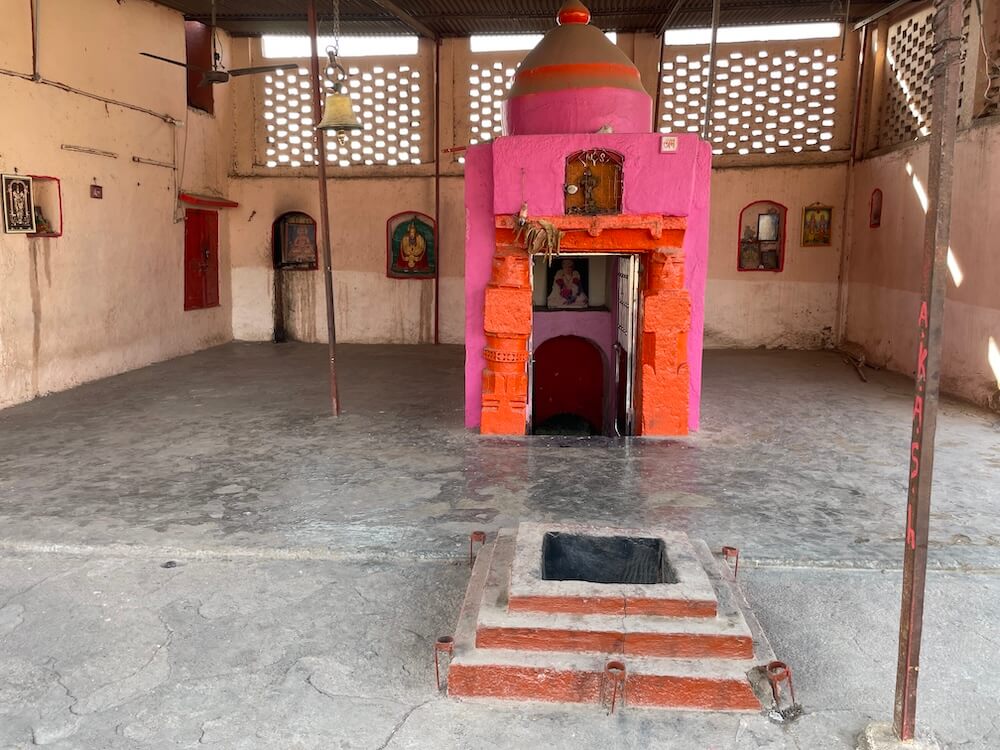
There is no written history available regarding when the Renuka Devi temple, carved into the cavern on the banks of the Dnyanganga River at Pimpalgaon Raja, was constructed. However, it is said to have been here since ancient times. After a renovation carried out a few years ago, while keeping the original structure of the temple intact, the temple attained its current form. There is a fortification around this temple adjacent to the riverbed. The first entrance of the temple is in this fortification. From here, one climbs a few steps to enter the open pavilion of the temple through a second entrance. To the right inside this entrance, there are some vermilion-smeared stones and sculptures. These include an ancient Shiva Linga and Nandi idols. There is a Homa-kunda (sacrificial fire pit) near the entrance of the temple in the pavilion.
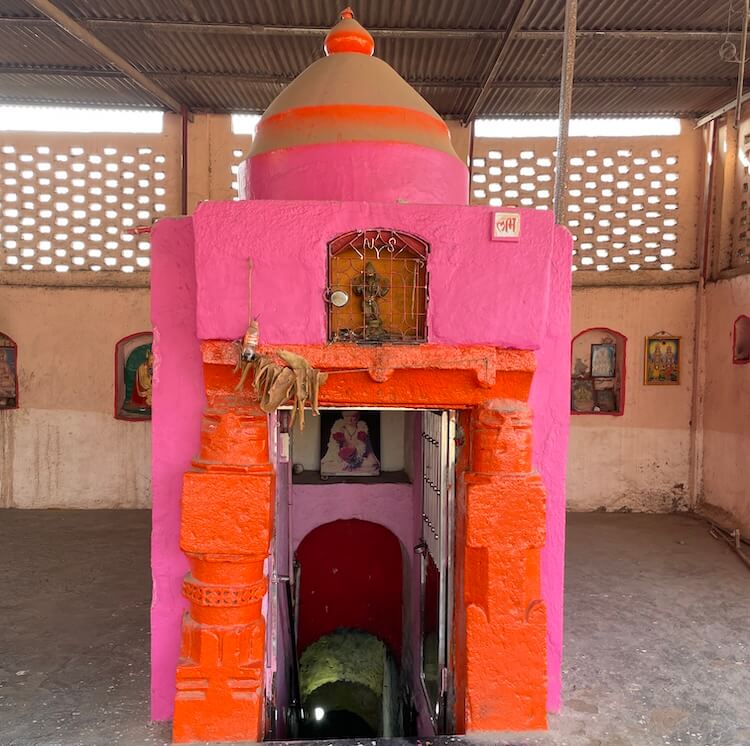
Beyond the Homa-kunda, a small temple is visible. However, this is not a temple but the stairway leading to the underground shrine. On both sides of the entrance to this stairway, which is somewhat small in size, there are pillar branches, and there is a brass idol of Ganapati in the niche above the lintel. There is an inscription on the very first step while descending the stairway. This inscription is in the Modi script. This inscription primarily mentions the antiquity and historical period of this temple. The text in this inscription is considered solid evidence of the ancient existence of Pimpalgaon Raja village; this is why this temple has acquired special historical importance.
There are lamp niches and deity niches on both sides of this stairway. After descending ๒๐ steps from the entrance into the cavern, there is a vermilion-smeared Tandala (aniconic stone) and some ancient idols on a pedestal in a niche. Descending another ๕ steps from here, one enters the sanctum sanctorum of Renuka Mata. Recently, this sanctum has been beautified. In the carved stone arch within the sanctum, there is the vermilion-smeared Tandala idol of Renuka Mata. There is a silver mask on this idol. Adorned with various garments and ornaments, this idol looks beautiful.
It is said that there is an underground passage behind this idol, which leads directly to the ancient fort at Gondanapur. To the right of the sanctum, there is a spring of pure water. The main feature here is that when the Dnyanganga River floods, the river water enters this cavern, touches the feet of the Goddess, and merges back into the riverbed. There is also a legend that if an Aarti plate is released into this water, it goes directly into the adjacent riverbed. This design is considered an excellent example of advanced construction skills by ancient architects who accurately estimated the water flow and the depth of the ground. There is an ancient Shiva Linga in a niche near the sanctum. In this underground temple, one feels a constant coolness even in summer.
This Goddess is the guardian of the village. She is revered as the ‘Goddess of the Boundary’ or the ‘Goddess who protects while crossing the village threshold.’ The villagers believe that she acts as a shield, protecting the village from natural disasters, epidemics, or any calamities. About one hundred years ago, when an epidemic of cholera or plague struck the Vidarbha region, the village of Pimpalgaon Raja faced a grave crisis. Medical treatments were proving insufficient. At that time, the village headman and the villagers prayed fervently to Mother Renuka. It is believed that the Goddess stood guard at the village entrance in the form of a woman and prevented the disease from entering the village. Following this, the epidemic subsided. In memory of this event, many still regard the Goddess as the ‘Bestower of Health.’
Many devotees from the Vidarbha region come here to seek the blessings of the Goddess. During the Sharadiya Navratri festival, a grand celebration takes place here for all nine days. On the occasion of this festival, many stalls are set up in the temple premises. The temple is also decorated with attractive lighting. Various religious programs are organized here for this festival. On the day of Saptami, a Havan is performed, and a community feast for the village is also organized.
This sacred temple stands as a testament to deep spiritual devotion, ancient architectural grandeur, and rich local cultural traditions.
The sanctum sanctorum houses the divine idol consecrated according to ancient Vedic traditions, surrounded by serene courtyards and traditional temple architecture.
Navratri, Maha Shivratri, Annual Temple Jatra & Deepotsav
Compare and book flights, secure top-rated local hotels near the temple, hire reliable guides, and rent cars instantly.
Extend your pilgrimage by visiting other highly sacred temples located nearby.


Add ₹999 more to unlock FREE SHIPPING!
Your sacred cart is currently empty.
Shop Photo FramesFill in your delivery details below to place your order.
Add comment