
Add ₹999 more to unlock FREE SHIPPING!
Your sacred cart is currently empty.
Shop Photo FramesKnown by various names such as Khandoba, Khandeshwar, Martand, Malhari, and Mallana, this deity is the family deity (Kuldev) of the eighteen communities (Athara Pagad Jati) across Maharashtra, Karnataka, and Andhra Pradesh. The ‘Malhari Mahatmya’ is considered the primary scripture of Khandoba. The main temple of Khandoba at Jejuri was built by Virpal in the year 1381. Later, in 1635, Rago Mambaji of Khatav expanded this temple. Records indicate that Chaitanya Mahaprabhu visited the Khandoba of Jejuri, and Nana Fadnavis had once made a vow (navas) of one lakh rupees. There are many small and large temples of Khandoba in villages across Maharashtra. The Khandeshwar temple in the village of Kusalamb in Beed district is famous as ‘Prati Jejuri’ (a replica of Jejuri). Devotees have deep faith that the awakened deity here grants their prayers.
The priests here state that this temple, built in the Hemadpanti architectural style, is about three to four hundred years old. The legend regarding this temple is that there was a devout follower of Khandoba named Mumbarya in this village. Every full moon (Pournima), he used to travel on foot to Pali in Satara district to seek the blessings of Khandoba. Later, as it became impossible for him to undertake this journey due to old age, he prayed to the Lord to come to his village. The Lord began to follow Mumbarya, saying, “I will follow you to your village, but I will be established at the very spot where you turn back to look at me.” As they neared the village, Mumbarya turned back, and at that very moment, the Lord manifested here in the form of an idol. Subsequently, the villagers built a wooden temple. Later, a Patil named Genuba Pawar renovated the temple and constructed this structure in the Hemadpanti style. The priests mention that the temple has been renovated a second time in recent years.
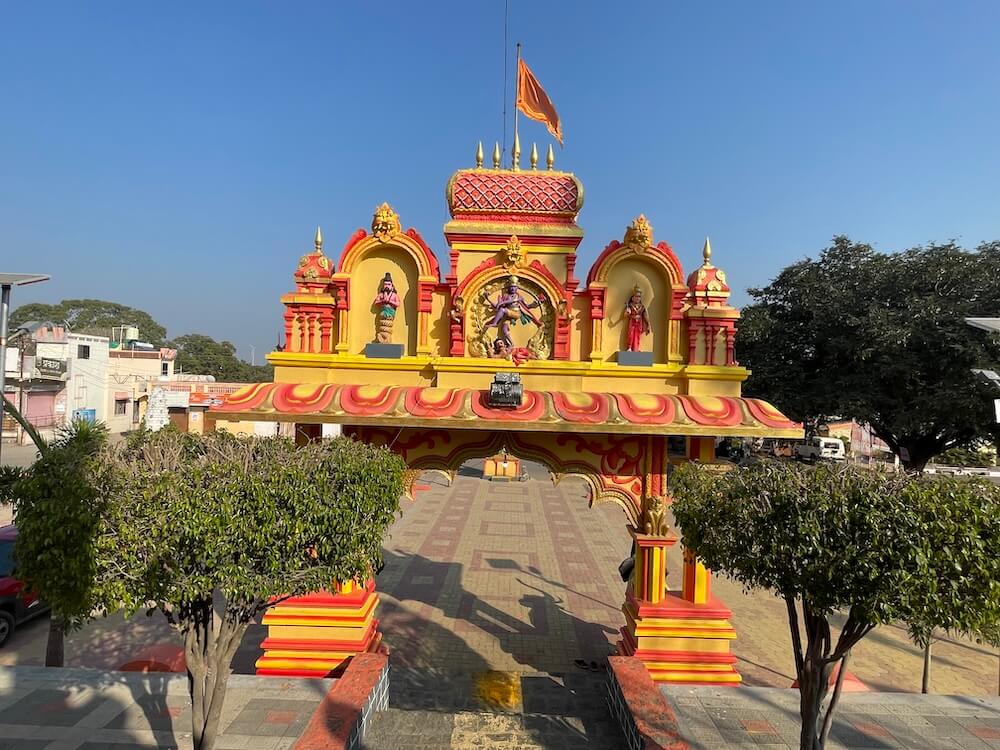
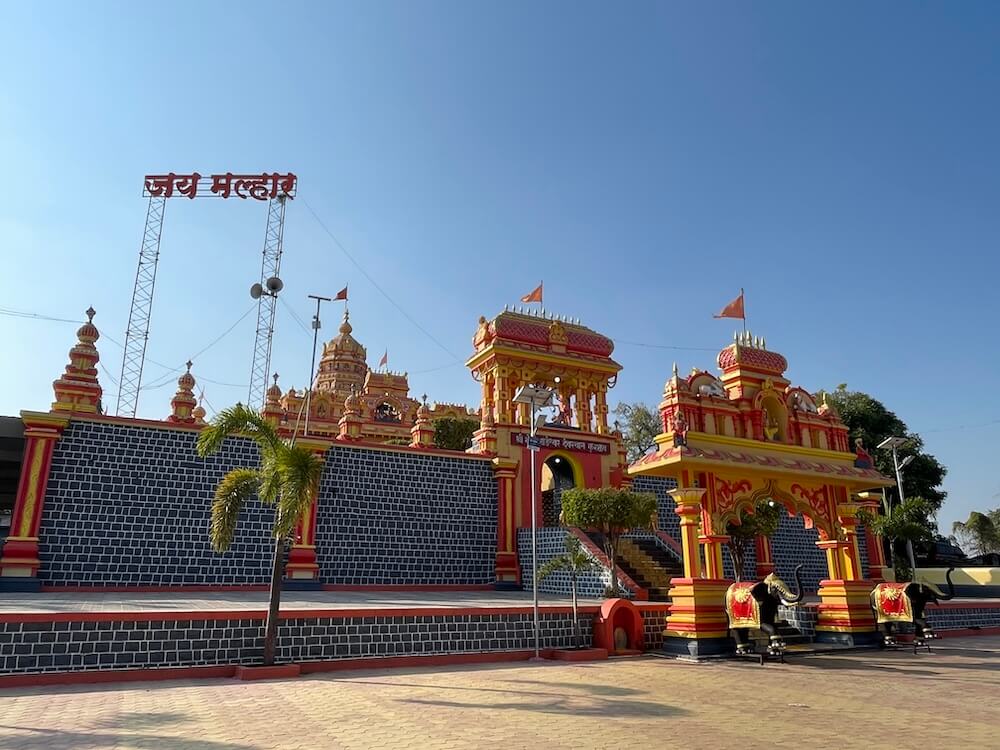
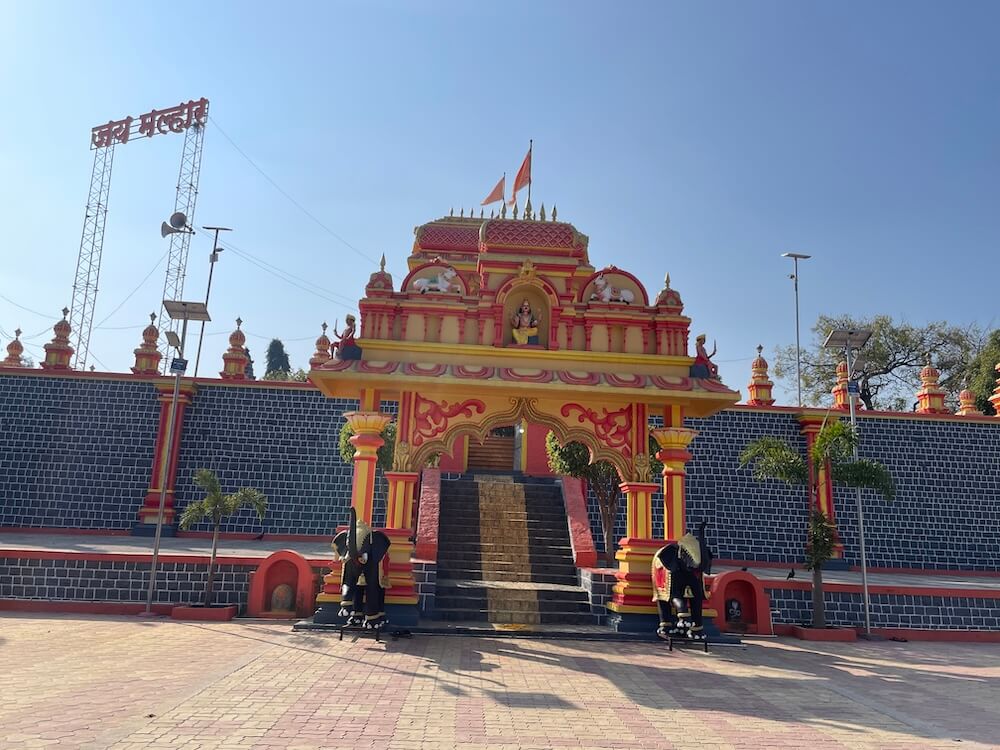
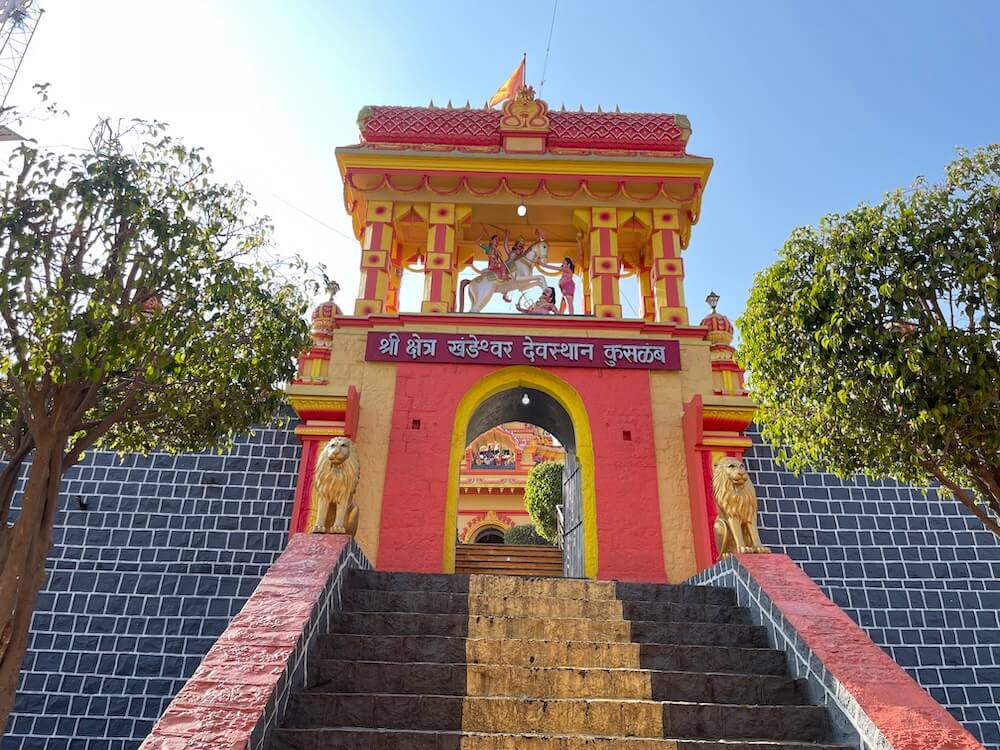
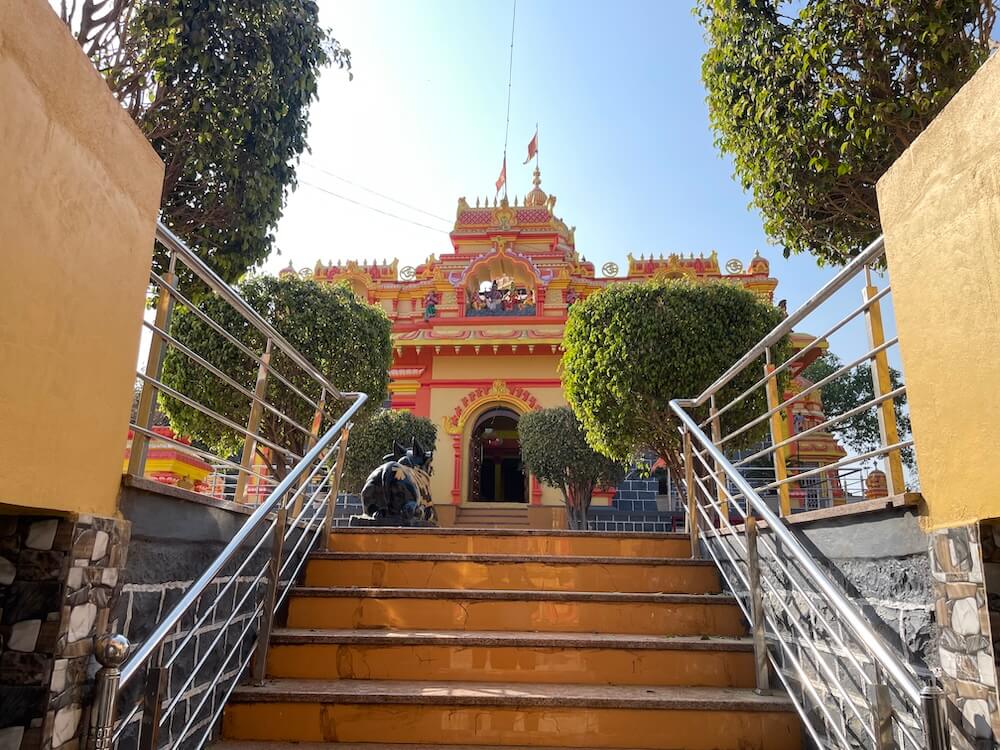
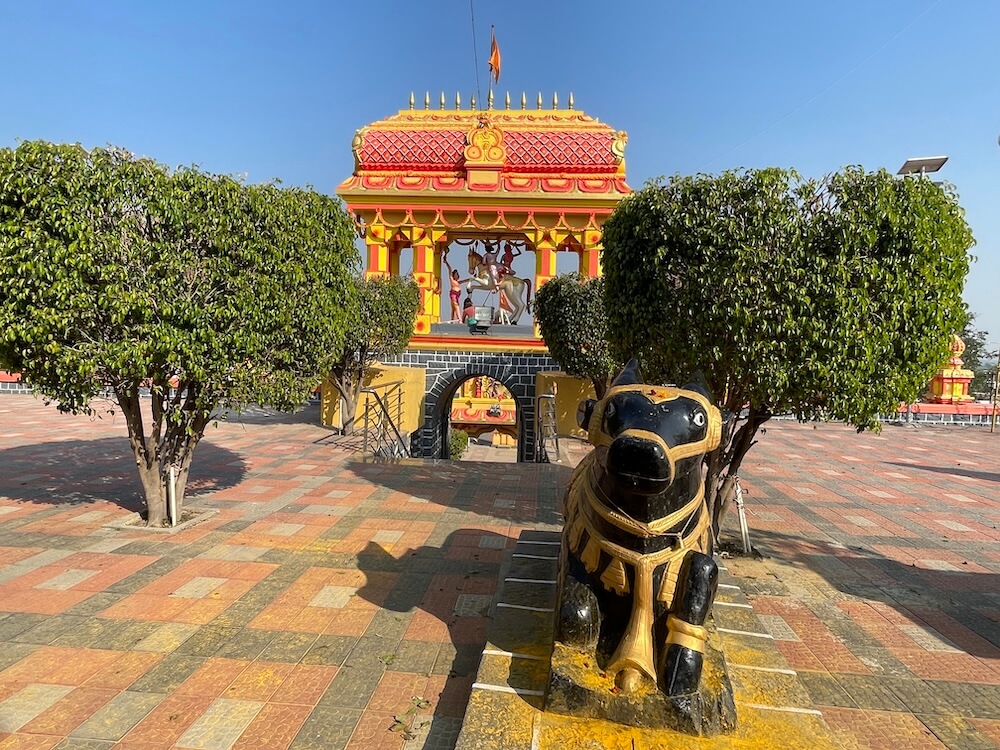
Situated near the village and along the main road, this temple stands on a small hill. At the foot of the hill, along the road, there is a spacious parking area. Beyond it is the welcome arch. The horizontal-style shikhara (spire) on the canopy of this arch features five kalashas (finials). There are sculptures of saints on both sides of the shikhara. In front of the arch, there are elephant sculptures on both sides. From the arch, one can climb about twenty steps to reach the entrance on the second floor of the temple. There are safety railings on both sides of the steps, adorned with lion sculptures. On both sides of the second entrance, there are paintings of gatekeepers (dwarapals) and lamp niches (deep-koshtakas). On the floor above the entrance, there is an idol of Mhalsa-Khandoba riding a horse, engaged in battle with the demons Mani and Malla. The upper floor has eight ornate pillars. All the pillar shafts feature various geometric shapes such as squares, hexagons, octagons, and circles. There are beams over the pillars and a roof over the beams. The roof features a horizontal-style shikhara topped with a kalasha. On both sides of the entrance, there is a sturdy fortification wall about twenty feet high. The outer right side of the fortification has niches containing deity idols. At regular intervals on the fortification, there are ornate pillars topped with amalakas. From the entrance, there are about ten steps leading into the paved courtyard of the temple. There are stainless steel safety railings on both sides of the steps. The courtyard is beautified with various plants. On the left side of the courtyard, there is a circular lamp tower (deepmal). In front of the temple, on a vajra-peetha (diamond pedestal), stands a large black stone idol of Nandi. The Nandi is carved with a saddle cloth on its back and bells around its neck.
The temple stands about five feet higher than the courtyard. The temple, which consists of a sabhamandap (assembly hall) and a garbhagriha (sanctum sanctorum), has five steps leading to the entrance of the sabhamandap. To the left of the steps is a platform (chautara). During festivals, the deity’s palanquin is placed on this platform. On both sides of the entrance, paintings of guards are depicted on the walls, and the door frames feature vertical carvings. Since there are high platforms on all four sides of the sabhamandap except for the entrance, corridors (ovaris) have been built upon them. To the right of the entrance, the palanquin used during festivals is kept in the corridor. There are twenty square pillars each in the front and back rows of the corridors. The ceiling of the sabhamandap is dome-shaped and features beautiful carvings. In the center of the sabhamandap floor, there is a tortoise sculpture.
Further ahead is the entrance to the garbhagriha. In the sabhamandap, paintings are depicted on the front wall of the garbhagriha on both sides of the entrance. There are two doors leading to the circumambulation path (pradakshina marg) from the left and right sides outside the garbhagriha. The door frames have vertical carvings, and the lintel features a Ganesha sculpture. The entrance has ornate wooden shutters. Inside the garbhagriha, on a vajra-peetha against the back wall, is an ornate stone shrine (makhar). Within it, the idol of Khandoba riding a horse appears highly distinctive.
The roof of the temple has a parapet on all four sides. The niches there contain idols of various deities. The roof of the sabhamandap, towards the entrance, has a Dravidian-style horizontal shikhara with five kalashas. The roof of the garbhagriha has a four-tiered hexagonal shikhara. Each tier contains six niches with various deity idols. At the apex of the shikhara is an amalaka topped with a kalasha. In the courtyard beside the temple, there are small shrines dedicated to Ganesha and Tulja Bhavani.
The Chaitra Pournima is the main three-day annual fair celebrated here with great enthusiasm. On the first day of the fair, the deity is anointed with water from holy rivers brought by devotees in kawads (shoulder poles). Thereafter, the deity’s ‘tali’ is lifted, and Bel-Bhandara (turmeric powder) is showered. In the afternoon, the deity’s palanquin procession circumambulates the samadhi of Mumbarya at the foot of the hill before returning to the temple. During the fair, programs such as bhajans, kirtans, music, and Mahaprasad are organized in the temple. Thousands of devotees come for darshan during this time. Due to the fair, the area takes on the appearance of a temporary market as shops selling various items are set up. The market during the fair sees a turnover of lakhs of rupees through the buying and selling of various goods. The palanquin procession also takes place during Champa Shashthi and Dussehra. Festivals such as Chaitra Padwa, Sharadiya Navratri, Diwali, and Kojagiri Pournima are also celebrated in the temple. During all these festivals, thousands of devotees visit for darshan and to fulfill their vows. There is a large crowd of devotees at the temple on days like Pournima, Amavasya, Sundays, and Pradosh.
This sacred temple stands as a testament to deep spiritual devotion, ancient architectural grandeur, and rich local cultural traditions.
The sanctum sanctorum houses the divine idol consecrated according to ancient Vedic traditions, surrounded by serene courtyards and traditional temple architecture.
Navratri, Maha Shivratri, Annual Temple Jatra & Deepotsav
Compare and book flights, secure top-rated local hotels near the temple, hire reliable guides, and rent cars instantly.
Extend your pilgrimage by visiting other highly sacred temples located nearby.


Add ₹999 more to unlock FREE SHIPPING!
Your sacred cart is currently empty.
Shop Photo FramesFill in your delivery details below to place your order.
Add comment