
Add ₹999 more to unlock FREE SHIPPING!
Your sacred cart is currently empty.
Shop Photo FramesBeed district is famous for its temples dedicated to the Shaiva and Shakta sects. Just like the Parli Vaijnath Temple, one of the twelve Jyotirlingas, the Yogeshwari Devi temple in Ambajogai is a major center of faith in the district. The district houses many ancient and famous temples of Mahadeva; similarly, various Peethas and Upapeethas of the Goddess can also be seen. Among the revered Shakti Peethas in the district, such as Yellamma, Yogeshwari, and Renuka Devi, the ancient Renuka Devi Temple at Belgaon in Ashti Taluka is extremely famous. The wrestling tournament held here during the annual fair is considered famous throughout the state.
Local villagers state that this temple is about five to six hundred years old. Experts express the opinion that, given the Hemadpanti architectural style and the monolithic stone pillars, it must date back to the fifteenth or sixteenth century. The legend regarding this temple is that a villager from Belgaon was a staunch devotee of Renuka Devi of Mahurgad. He would visit Mahurgad every year without fail for the darshan of Renuka Devi. Later, due to old age, it became impossible for him to attend the festival at Mahurgad. As he aged, even riding a horse became difficult for him. The devotee then requested the Goddess to come to his village. The Goddess replied, “I will walk to your village in the form of light, but you must not look back while I am walking. At the very place where you look back, I will be established in the form of stone,” and she began to follow the devotee. As they reached the outskirts of the village, the devotee lost his patience and looked back. At that very moment, the Goddess was established here in the form of a Tandala (aniconic stone). Later, the villagers built a temple here.
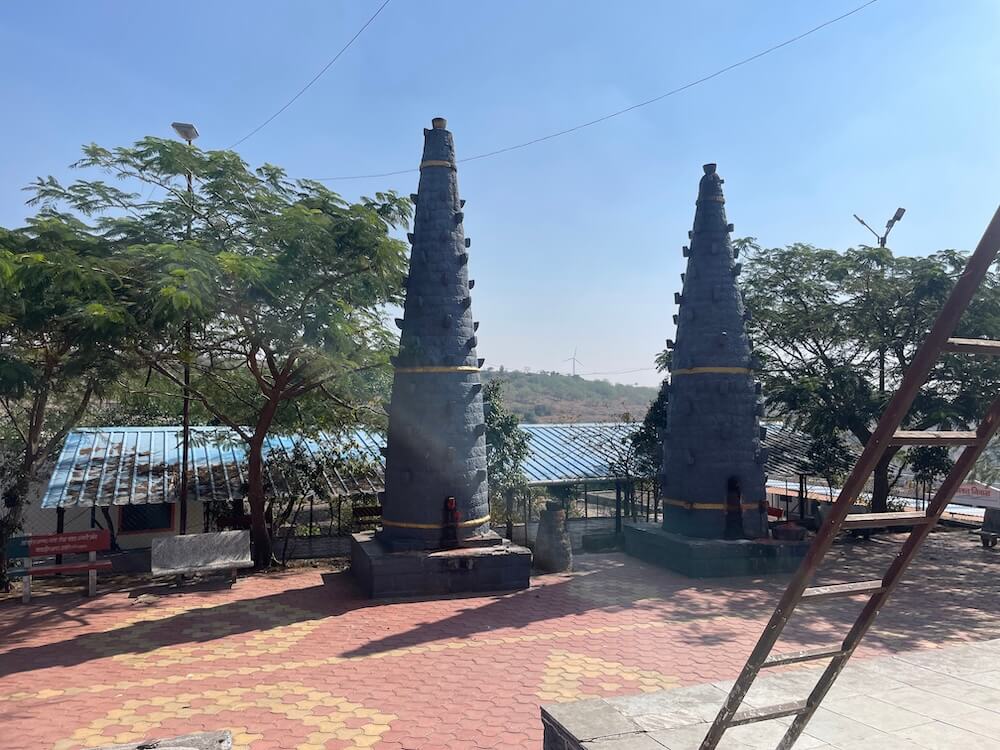
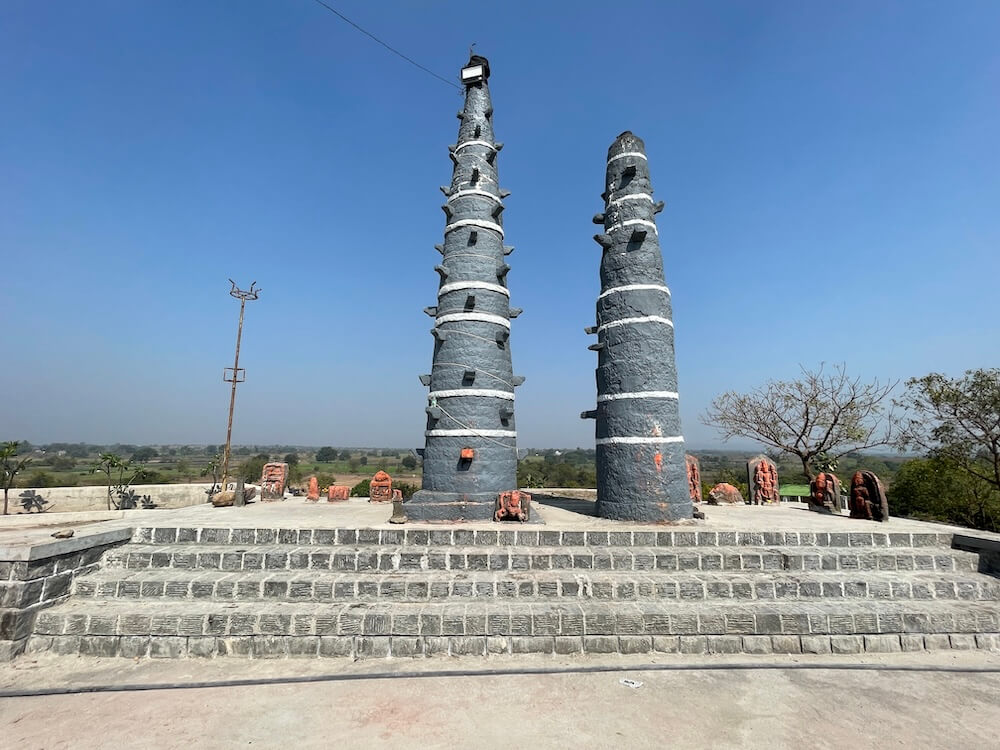
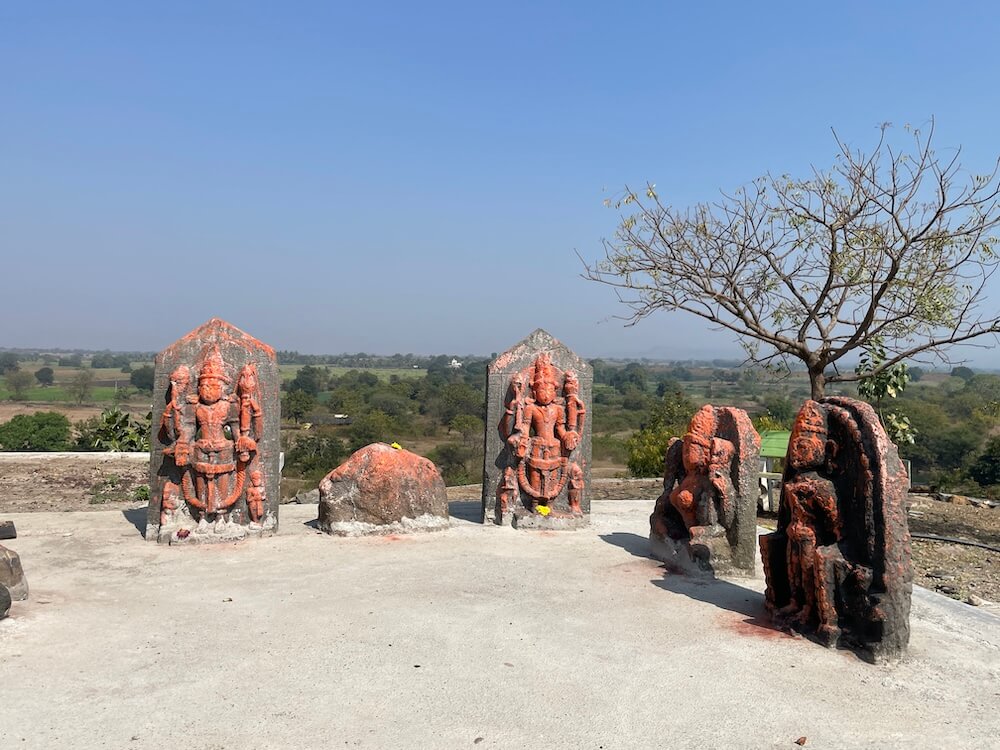
Belgaon is a small village situated about ten kilometers from Ashti. The first welcome arch of the temple is visible at the entrance of this village. This welcome arch consists of two square pillars on each side with a horizontal beam resting on them. The temple is situated on a hill near the village, and there is a paved asphalt road leading up to it. In the spacious courtyard covered with paving blocks in front of the temple, there are two platforms on the edge of the hill, upon which circular lamp towers (Deepmalas) are erected. The lamp towers are wider at the base and taper towards the top. On the platform where the lamp towers are located, there are ancient sculptures of Bhairava and Bhairavi. These images of Bhairava and Bhairavi are given special importance in Tantric practices. There is also a Tulsi Vrindavan on the platform. Beside the platform in the courtyard, there is a sacrificial pit (Yajnakunda) on the ground. Yajnas are organized here during Navratri and festival periods.
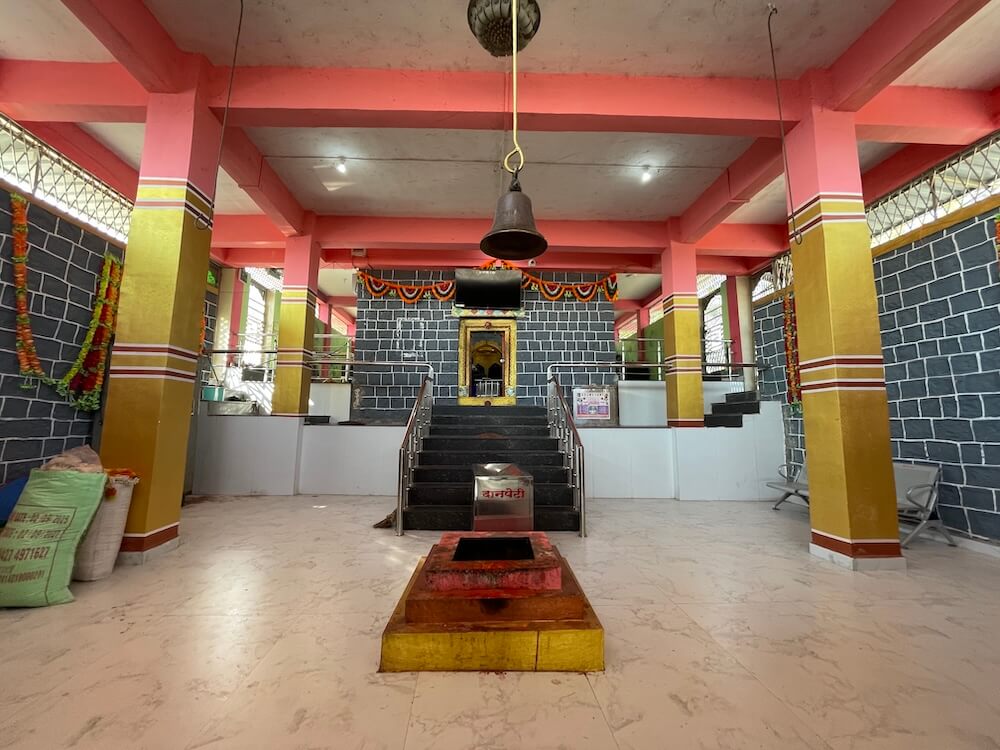
Further ahead, the temple stands on a platform higher than the courtyard. The temple structure consists of a Sabha Mandapa (assembly hall) and a Garbhagriha (sanctum sanctorum). The front side of this enclosed Sabha Mandapa is open. There is bastion-like construction on both sides of the Sabha Mandapa. In the Sabha Mandapa, there are three horizontal rows of ten pillars each. These square stone pillars are monolithic, and their tops have hand-like structures. In the Sabha Mandapa, on the front wall of the Garbhagriha, there are two niches on each side of the entrance. On the door frames of the Garbhagriha, there is vertical edge carving, and on the lintel (Lalatbimba), there is a sculpture of the presiding deity. A Padma-Paduka sculpture is placed on the threshold. In the center of the Garbhagriha, there are four ornate pillars. The pillar shafts feature various geometric shapes such as squares, hexagons, octagons, and circles. In the Garbhagriha, the self-manifested (Swayambhu) Tandala of Renuka Devi is placed on a Vajrapitha. There is also a silver crown on the Goddess’s head and a canopy above. Behind the Goddess, there is floral carving on the Prabhavali (halo).
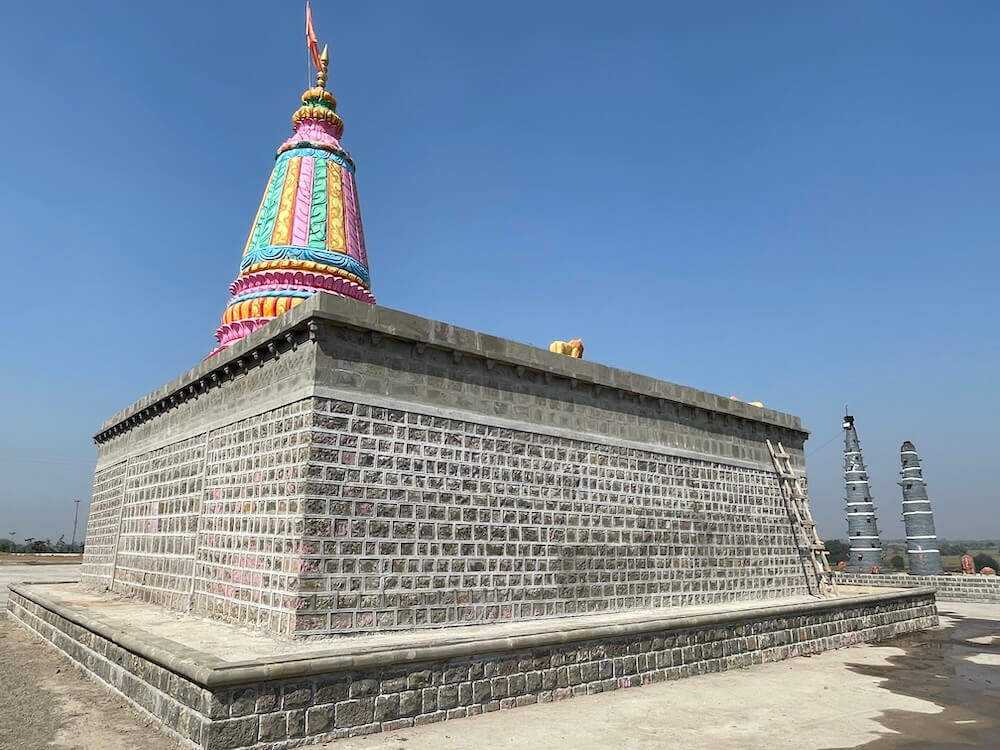
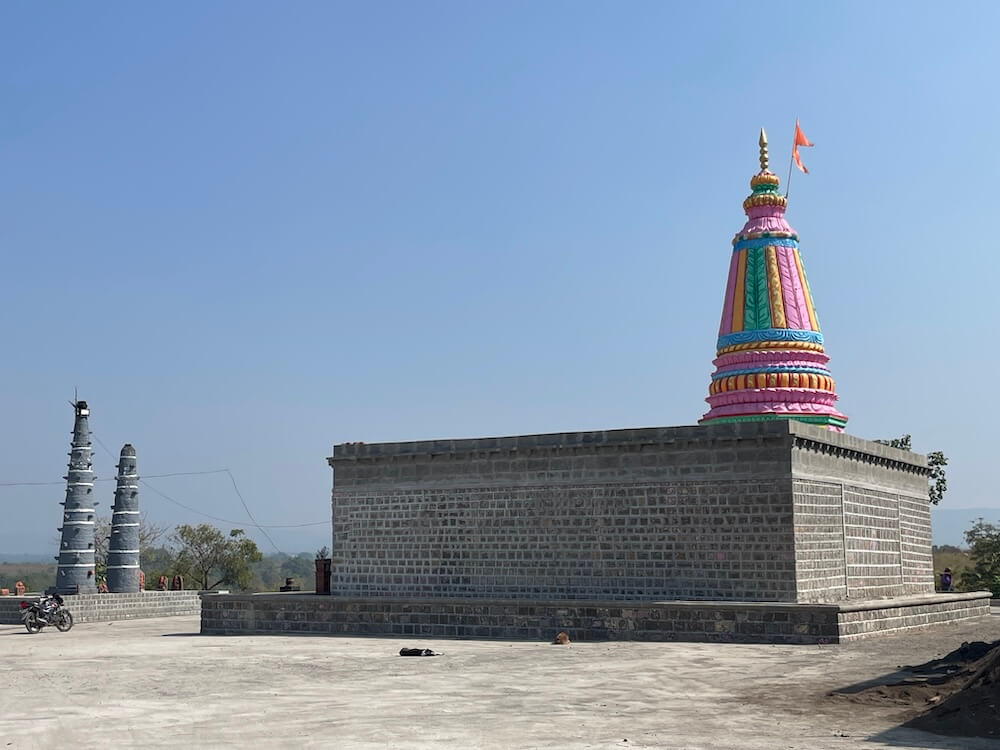
On the roof of the temple, there is a parapet wall on all four sides, and above the entrance of the Sabha Mandapa, there is a sculpture of the eight-armed Durga Devi in the roof parapet. There are lion sculptures on the bastions on both sides of the Sabha Mandapa. On the roof of the Garbhagriha, there is a circular spire (Shikhara) that tapers towards the top, and in the lower part of the spire, there are two lotus mandalas. The spire features vertical pillar carvings and floral designs. At the top of the spire, there are two Amalakas placed one above the other, topped by a Kalasha. Adjacent to the temple on the right side is the priest’s residence, and at the back is a hall for auspicious ceremonies. A short distance from the temple is the wrestling arena (Akhada). Grand wrestling matches are held here during the annual festivals.
A grand fair is celebrated in the temple during the days of Margashirsha Purnima and Vadya Pratipada. On Margashirsha Purnima, the Goddess is seated in a palanquin and taken for a procession around the village. At this time, thousands of devotees participate in the palanquin procession amidst the sound of drums and the showering of Gulal. On this occasion, various religious, cultural, and social programs are organized in the temple premises. Everyone in the village, young and old, participates in this. On the second day of the fair, a wrestling competition is held in the temple premises. Many wrestlers and grapplers from across the district attend to participate. A large crowd gathers at this time.
The Navratri festival at the temple is especially famous. On Bhadrapada Vadya Dashami, the youth of the village bring a divine flame (Divyajyot) from the Renuka Devi temple at Mahur in Nanded district and reach the temple at Belgaon on Bhadrapada Amavasya. After that, the festival begins with Ghatasthapana. Thousands of devotees come for the darshan of the Goddess at this time. Apart from this, a special crowd of devotees is seen at the temple on days like Tuesday, Friday, Purnima, and Amavasya.
This sacred temple stands as a testament to deep spiritual devotion, ancient architectural grandeur, and rich local cultural traditions.
The sanctum sanctorum houses the divine idol consecrated according to ancient Vedic traditions, surrounded by serene courtyards and traditional temple architecture.
Navratri, Maha Shivratri, Annual Temple Jatra & Deepotsav
Compare and book flights, secure top-rated local hotels near the temple, hire reliable guides, and rent cars instantly.
Extend your pilgrimage by visiting other highly sacred temples located nearby.


Add ₹999 more to unlock FREE SHIPPING!
Your sacred cart is currently empty.
Shop Photo FramesFill in your delivery details below to place your order.
Add comment