
Add ₹999 more to unlock FREE SHIPPING!
Your sacred cart is currently empty.
Shop Photo FramesThe supreme saint Vamanbhau Maharaj uplifted the downtrodden and the marginalized. He propagated and spread the Warkari tradition by taking it to the edges of farm fields and river banks, striving to elevate the standard of living of common people. Through his kirtans, he delivered scathing critiques of undesirable and obsolete customs. He performed the noble task of guiding addicted individuals toward the righteous path and bringing spiritual salvation to society. The Samadhi temple of this great saint is located at Chincholi in Beed district. Devotees believe that by having darshan of the Samadhi, one receives the companionship and energy of Saint Vamanbhau.
Saint Vamanbhau was born at his maternal grandparents’ home in Borgaon on January 1, 1891. His mother’s name was Rahibai and his father’s name was Tolaji Gyanba Sonawane. Just forty days after his birth, Rahibai passed away. Bhau was raised by his grandmother. From a young age, he felt drawn to the path of devotion and dedicated himself to the propagation and spread of the Bhagavata Dharma. Later, he went to Gahininath Gad under the shelter of Yadav Baba and became his successor. Throughout his life, he observed the vows of renunciation. His thousands of followers still recount with faith that Bhau possessed the power of speech (Vacha Siddhi) and that the blessings he bestowed would unfailingly come to fruition.
It is said that the Samadhi of Gahininath and the Shiva temple at Chincholi are ancient. The significance of this place is such that, in the past, there were only cactus plants here. There is a legend that Gahininath himself placed his Padukas here. Gahininath gave a vision to the ascetic sage Damodar Nath Maharaj and instructed him to build a temple here. After performing penance in the Himalayas, Damodar Nath Maharaj came to Kanakagiri (Chincholi), gathered the local people, inspired them toward religious work, and began the construction of this temple. Thereafter, Saint Yadav Baba arrived here. He gathered the people, taught them to serve Nath Maharaj, imparted the knowledge of spirituality, and laid the foundation for the Gahininath temple. Subsequently, he attained Samadhi. Prior to that, Saint Vamanbhau Maharaj had completed his penance here. Saint Vamanbhau carried forward the ancient lineage of Saint Sadguru Yadav Baba. Accordingly, Vamanbhau Maharaj imparted knowledge to the devotees here through Kirtans, discourses, and Harinam Saptahs, taught the religion of humanity, built the Gahininath temple, and erected the adjacent stone fort. He established monasteries in many places across Maharashtra, including Pandharpur and Alandi. By traveling on foot He performed great work in social awareness, cow protection, and tree plantation. On the day of Paush Vadya Saptami (24 January 1976), Saint Vamanbhau concluded his earthly journey and attained Samadhi at this very place.
The first welcome arch of the temple is located on the road leading to Gahininath Gad from the main road. On both sides of the road, there are two pyramid-like platforms. Upon these stand carved square pillars, which support a balcony. On this balcony, arranged in a horizontal row, are three ornate canopies, each featuring carved deity idols and two lion sculptures. The entire temple premises have been beautified by installing paver blocks. In the parking area, there are shops selling prasad, worship materials, food items, and other goods. Within the parking premises are the samadhi temples of Khandoji Baba and Guru Yadav Baba, disciples of Saint Vamanbhau. The roofs of these temples feature square spires in the Dravidian style. At the apex of these spires are stupikas topped with kalashas.
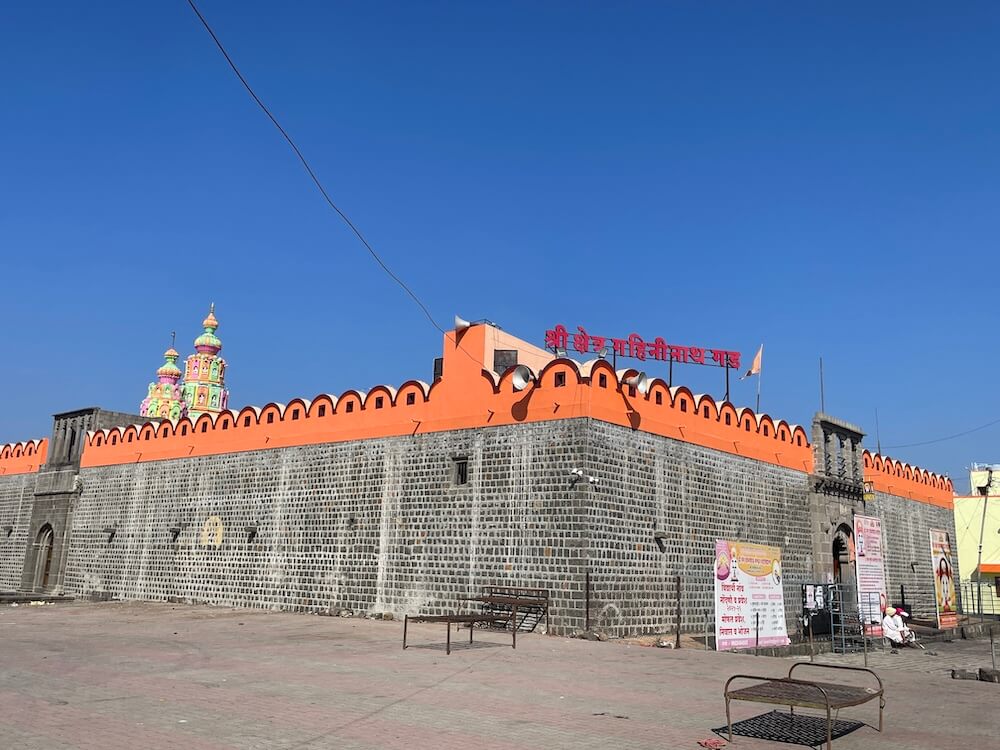
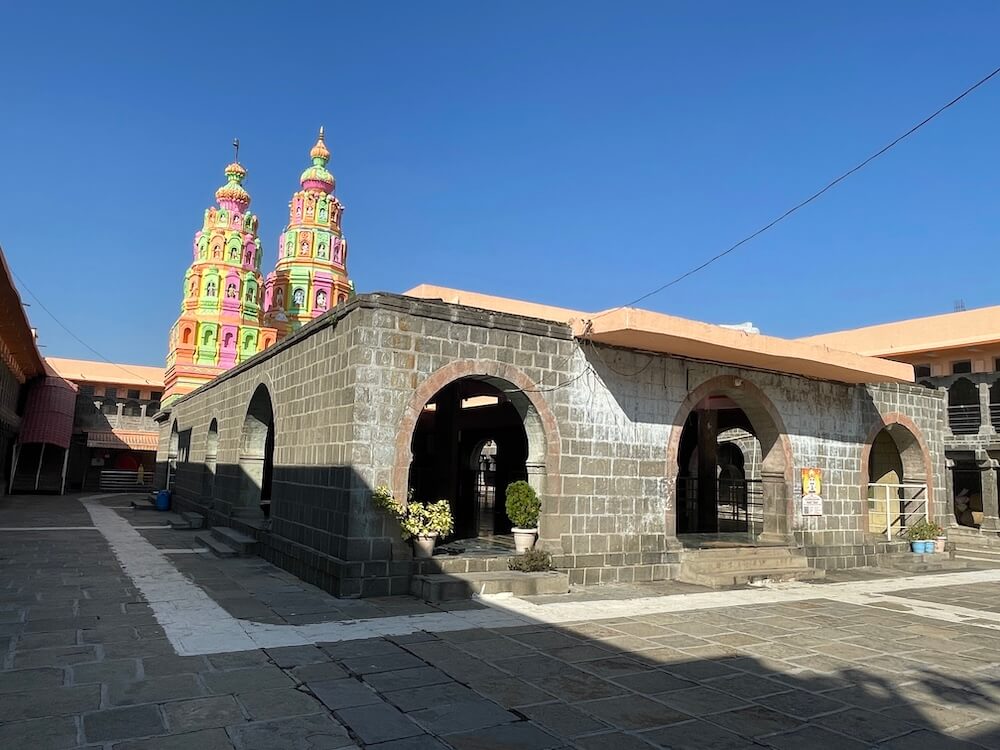
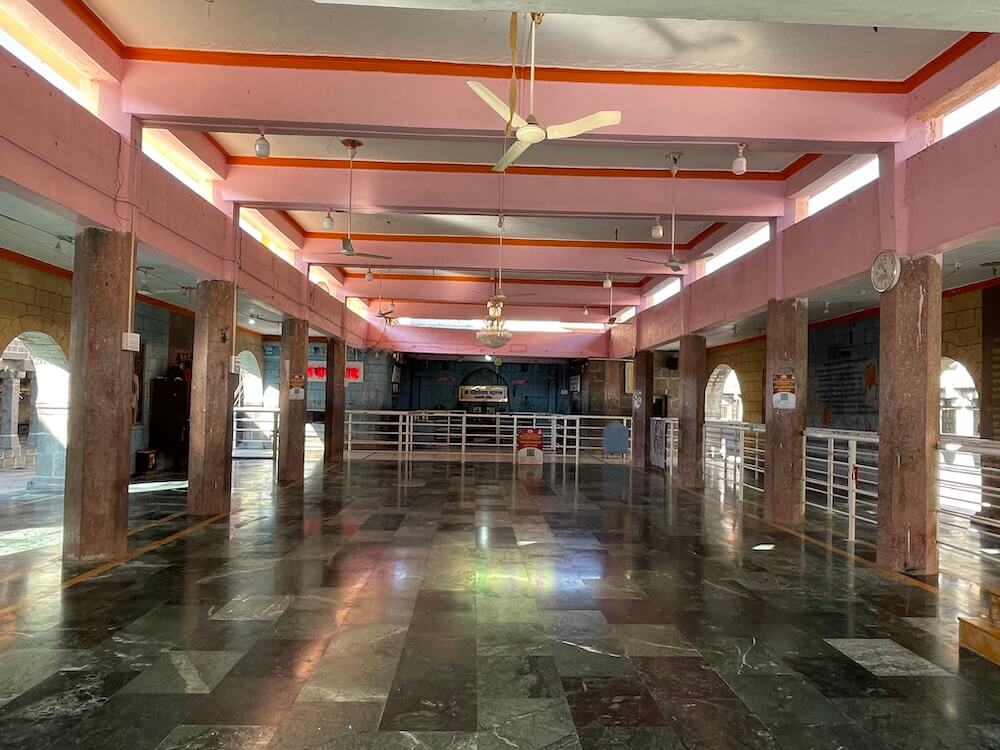
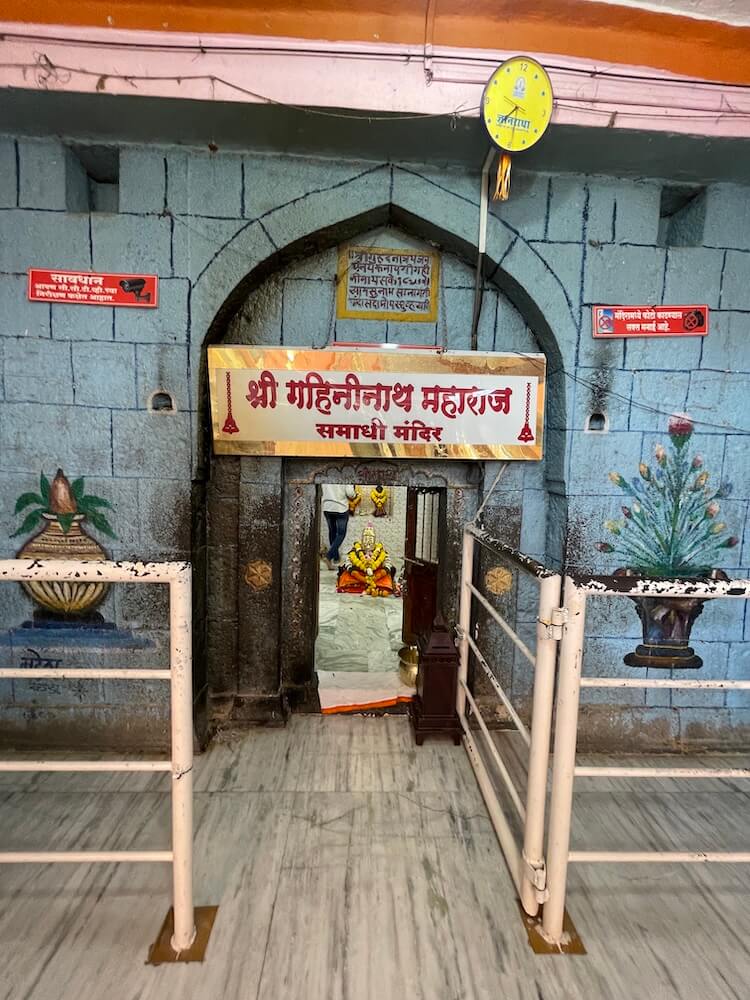
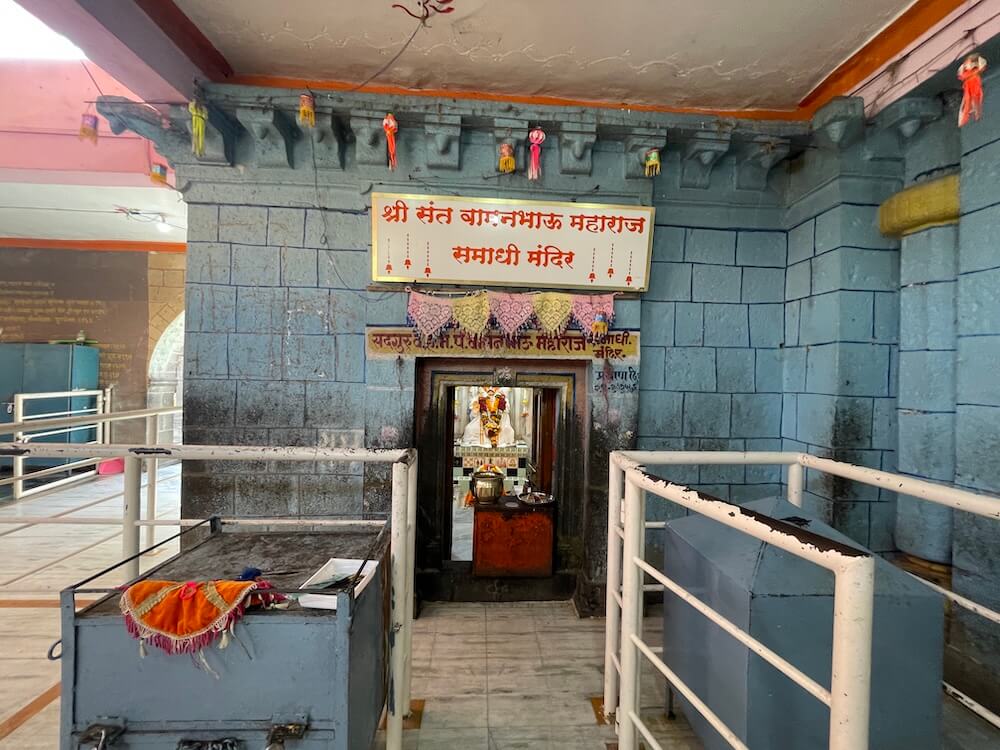
The Samadhi Mandir of Saint Vamanbhau is enclosed by a sturdy stone fortification approximately twenty feet high. Within this fortification stands a two-storied entrance gate. The entrance is adorned with sculptures of Vyala, Gajraj, and other figures. It features intricately carved wooden doors, with niches on both sides of the interior. In the right-hand niche of the entrance stands the idol of Maruti, and in the left-hand niche is the idol of Ganapati. On the upper floor of the entrance is the Nagarkhana. Passing through the entrance, one enters the courtyard. The temple structure consists of a Sabha Mandap followed by three sanctum sanctorums. The semi-open Sabha Mandap has three open-style entrances. Inside the Sabha Mandap, there are four rows of five pillars each. The outer pillars are connected by semi-circular arches. The pillars support beams, which in turn support the roof. On the right side of the Sabha Mandap is the Dhuni of Gahininath. Beyond this lies the main sanctum sanctorum. The door frames of the sanctum are decorated with vertical carvings, and the lintel features a sculpture of Ganapati. The entrance has intricately carved wooden doors. Inside the sanctum is the Samadhi of Gahininath. The Shiva stone of the Samadhi is adorned with Rudraksha garlands. There are lamp niches in the walls of the sanctum. In a niche on the back wall of the sanctum are the idols of Vitthal-Rukhumai.
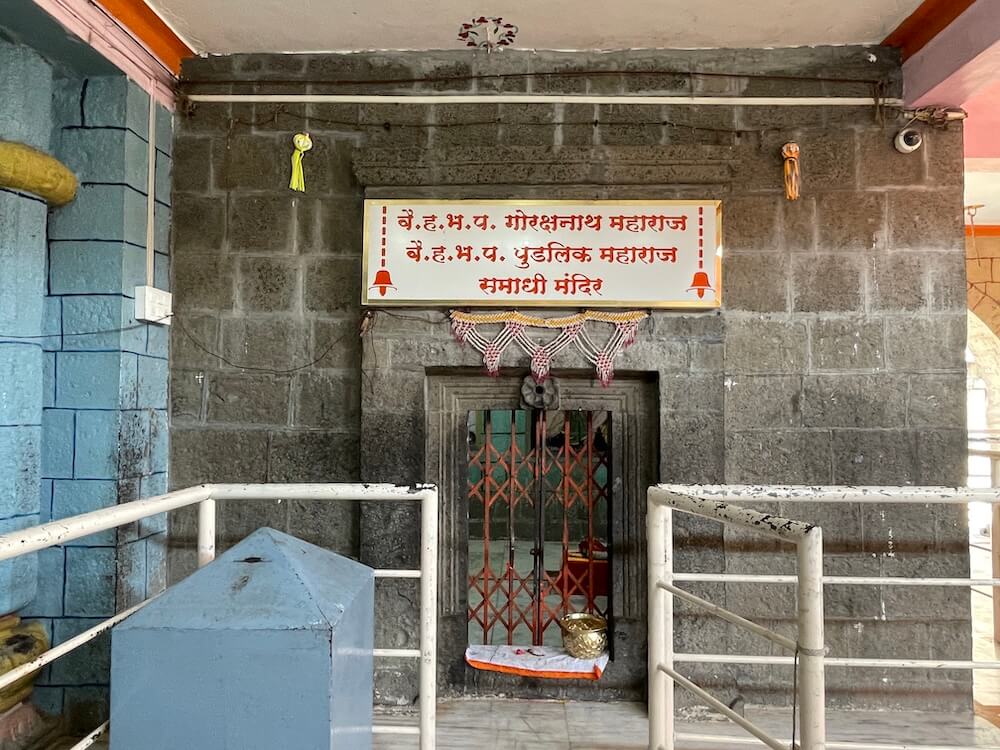
To the right of this sanctum sanctorum is another sanctum sanctorum. Its door frames also feature vertical carvings, and the lintel bears a sculpture of Lord Ganesha. The entrance has ornate wooden doors. In the center of the sanctum sanctorum lies the Samadhi of Sadguru Sant Vamanbhau Maharaj. A square Shiva stone is placed upon the Samadhi. Near the back wall of the sanctum sanctorum, on a Vajra-peetha, stands a meditative idol of Vamanbhau. In the sanctum sanctorum to the right are the Samadhi sites of Gorakshanath Maharaj and Pundalik Maharaj. The roof of the sanctum sanctorum housing the Samadhi of Gahininath features a tall, five-tiered Shikhara. The first square tier of this Shikhara contains twenty niches, each housing idols of various deities. The four octagonal tiers above have eight niches each, which also contain divine idols. At the pinnacle of the Shikhara are two Amalakas placed one above the other, topped by a Kalasha and a flag. An identical Shikhara is also present on the roof of the sanctum sanctorum of the Sadguru Vamanbhau Samadhi temple.
Along the fortification walls in the temple courtyard, there are two-storied cloisters. These are used as resting places and pilgrim accommodations for devotees. In one of these areas, the palanquin used during festival periods is kept. In a cloister at the rear, the throne and sacred footwear of Sadguru Vitthal Maharaj are enshrined. To the right of the throne is the temple of Mahadeva. Inside the temple, facing the entrance on a pedestal, is the idol of Nandi, and in front of Nandi is the Shiva Linga. In a niche in the rear wall of the temple, there are idols of Mahadeva and Parvati. There is a sacrificial fire pit in the courtyard.
The Punyatithi festival of Saint Vamanbhau is celebrated in the temple on Magh Vadya Ashtami in a deeply devotional atmosphere. On this occasion, thousands of devotees come to seek the blessings of Bhau. To mark this event, a Harinam Saptah is organized at the temple. For eight consecutive days, programs such as Bhajans, Kirtans, and Pravachans are held. Festivals and auspicious days such as Ashadhi Ekadashi, Kartiki Ekadashi, Chaitra Padwa, Datta Jayanti, Gahininath Samadhi Day, Dussehra, and Diwali are celebrated in the temple. Every day, hundreds of devotees visit the temple to seek the blessings of Bhau and Gahininath.
This sacred temple stands as a testament to deep spiritual devotion, ancient architectural grandeur, and rich local cultural traditions.
The sanctum sanctorum houses the divine idol consecrated according to ancient Vedic traditions, surrounded by serene courtyards and traditional temple architecture.
Navratri, Maha Shivratri, Annual Temple Jatra & Deepotsav
Compare and book flights, secure top-rated local hotels near the temple, hire reliable guides, and rent cars instantly.
Extend your pilgrimage by visiting other highly sacred temples located nearby.


Add ₹999 more to unlock FREE SHIPPING!
Your sacred cart is currently empty.
Shop Photo FramesFill in your delivery details below to place your order.
Add comment