
Add ₹999 more to unlock FREE SHIPPING!
Your sacred cart is currently empty.
Shop Photo FramesThe Ganesh temples of Ashapura Ganesh in Namalgaon and Navgan in Rajuri, both in Beed district, are extremely renowned. In the eleventh and twelfth-century Hemadpanthi architectural style temples of this very district, one finds Ganesh idols in various mudras (postures) in the sculptures. The Matruganesh on the shikhara (spire) of the temple in Ambajogai is particularly famous. Just as in Konkan, Beed district also has an ancient tradition of Ganesh worship, and thus, there are many ancient Ganesh temples in the district. One such ancient and famous temple is located in Limbaganesh village in Beed taluka. It is believed that Chandra Deva (the Moon God) himself established this Ganapati. Devotees hold a deep faith that this awakened Ganesh rushes to the call of his devotees and grants their wishes.
Experts estimate that this Hemadpanthi style temple is approximately four hundred to five hundred years old. An inscription on the temple’s entrance mentions that Bhavandas Bhusari renovated this temple in the year one thousand nine hundred and eight. Many legends are prevalent about this temple. According to one legend, when Lord Ganesha and Kartikeya, the two brothers, had a dispute on Kailasa, Chandra (the Moon) laughed sarcastically upon seeing Ganesha’s form. Due to this, Ganesha cursed Chandra to lose his radiance. Distressed by the curse, Chandra wandered through forests and fields and finally sat meditating on Ganesha on the banks of the Ganeshi River. Pleased by Chandra’s penance, Ganesha blessed Chandra with the darshan (sight) of his face during the Sankashti Vrata. However, Ganesha also warned that no one should see Chandra’s face on Ganesh Chaturthi. After receiving Ganesha’s blessing, Chandra established Ganesha at this very spot.
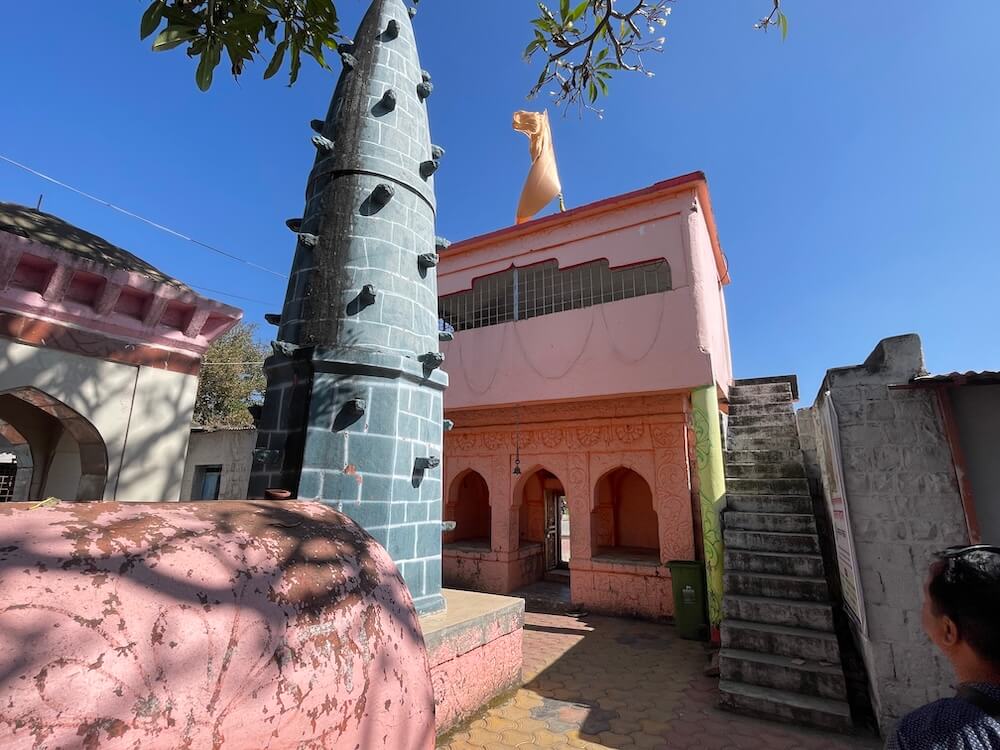
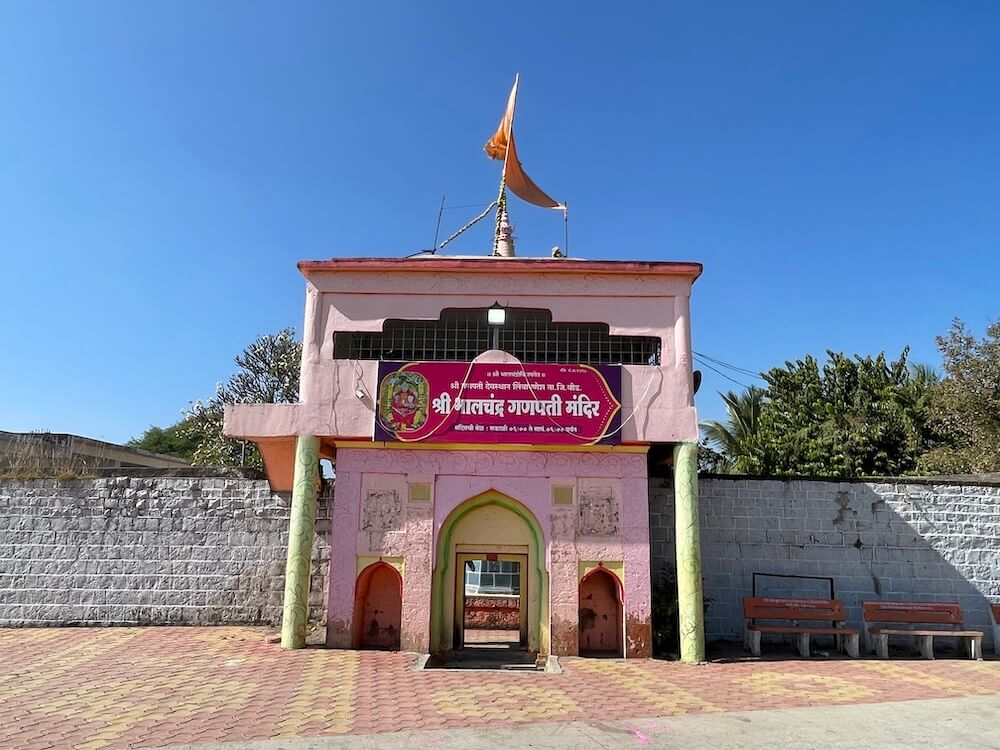
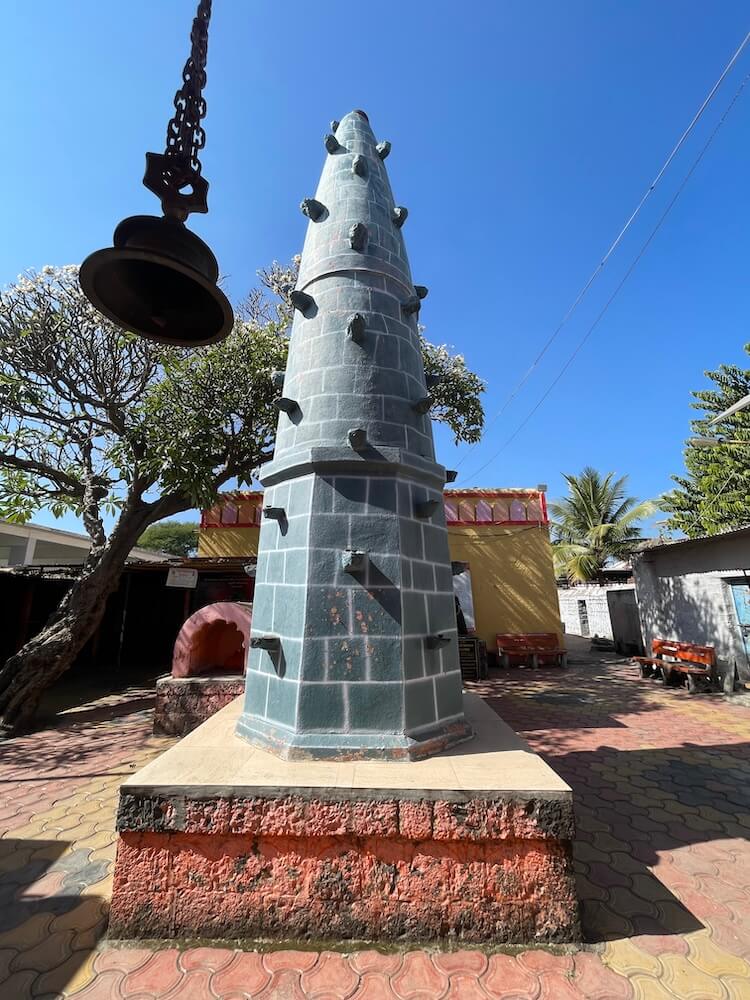
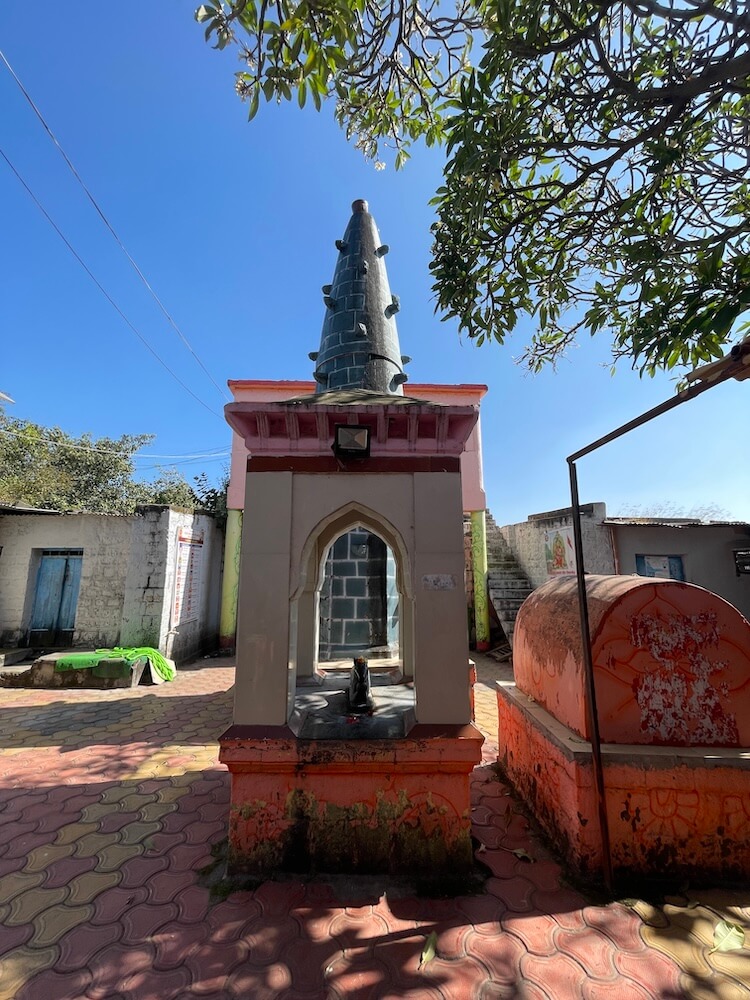
According to another legend, devotees distressed by the torment of the demon Limbasura on the banks of the Ganeshi River prayed to Ganesha. Thereupon, Ganesha slew the demon. As Limbasura was dying, he asked for a boon that ‘the Lord should grant him a place in His name and proximity.’ As Ganesha granted this boon, the village received the name ‘Limbaganesh’. Limbasura’s samadhi (tomb) is located in the Bhalchandra Ganesh temple complex. Mentions of this temple are found in ancient texts. This temple is close to the village, and there is a paved road leading up to it. The spacious parking area in front of the temple is covered with paver blocks, and there are seats for devotees to rest. Around the temple, there is a strong wall about ten feet high, with a two-storied entrance gate. On both sides of the entrance, there are devakoshthakas (niches for deities) and a sculpture of Ganapati on the lalāṭabimba (lintel). On the upper floor of the entrance, there is a nagarkhana (drum house). Inside the entrance, on both sides, there are guard rooms. Upon entering through the gateway, one sees a platform in the paved courtyard, and on it, a three-tiered deepamala (lamp tower). The bottom tier of the deepamala is octagonal, and the upper two tiers are circular. The deepamala tapers upwards.
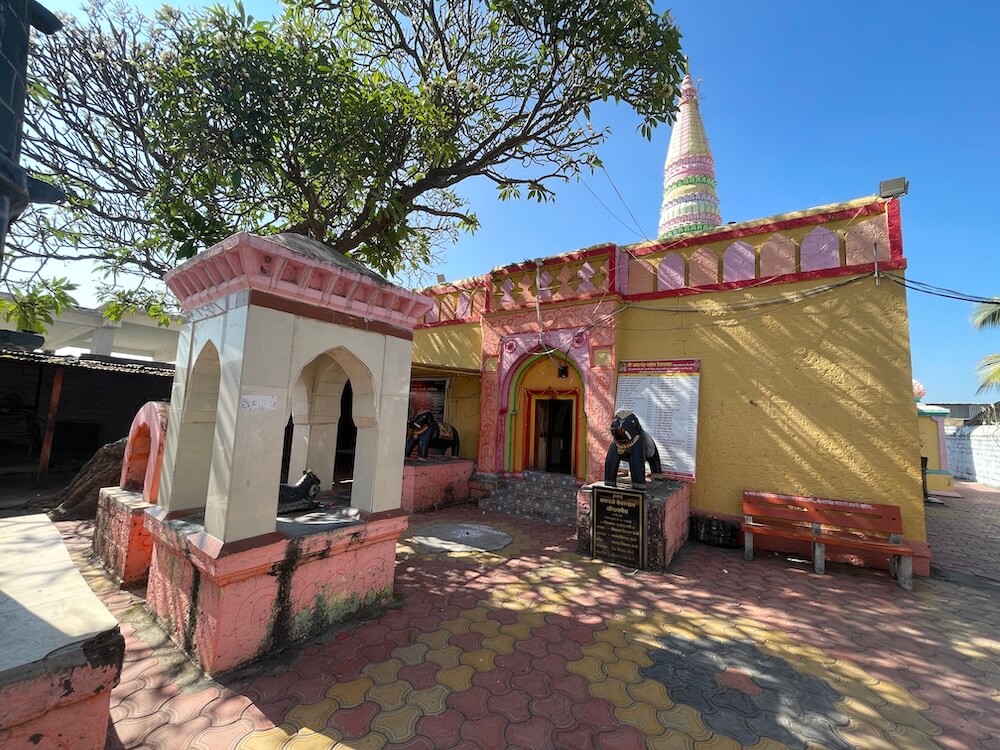
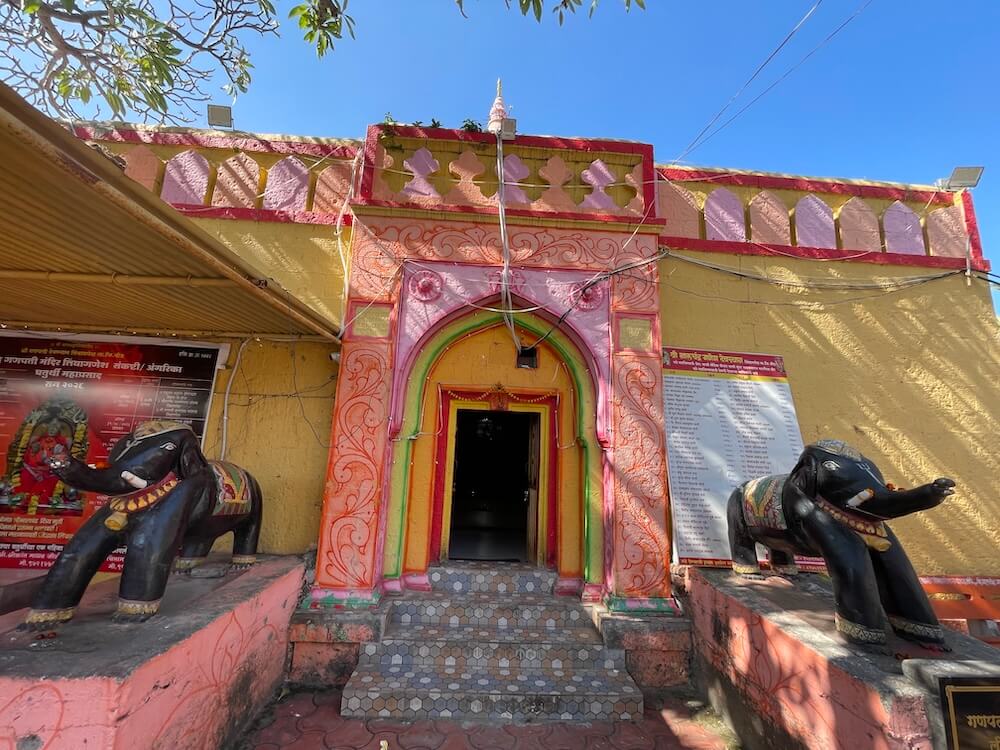
In front of the deepamala is the Mushak Mandap (mouse pavilion). There are pillars at all four corners of the Mushak Mandap, which is on a platform, and they support a roof. In the center of the Mushak Mandap, on a vajrapiṭha (diamond pedestal), there is a sculpture of a mushak (mouse). Beside the Mushak Mandap, on the platform, in a meghadambari (canopy), there is an ancient idol of Ganesha smeared with sindoor (vermilion). The temple’s structure consists of a sabhamandap (assembly hall), antarala (vestibule), and garbhagriha (sanctum sanctorum). On both sides of the entrance to this sabhamandap, there are platforms with Gajraj (elephant king) sculptures. On both sides of the entrance, there are square pillars with a triangular torana-kaman (archway). Above this torana, in the center, there is a Ganesh sculpture, and on both sides, there is chakra (wheel) ornamentation. The door jambs of the entrance have a vertical ridge design.
In the sabhamandap, there are four rows, each with four square pillars. The outer pillars are embedded in the walls. All pillars are connected to each other by semicircular arches, and there is ornamentation on the domed ceiling between every four pillars. In the center of the sabhamandap, on the ground, there is a tortoise sculpture. In the sabhamandap, there are two doors on the pradakshina marga (circumambulatory path) on both sides of the antarala. In the antarala, there are four square pillars in all four corners, a domed ceiling, and ornamentation on the ceiling. The door jambs of the five-branched entrance to the garbhagriha have creeper, leaf, flower, and pillar ornamentation, and at the bottom, there are dwarapala (doorkeeper) sculptures. Below the door jambs are Gajraj and animal sculptures. On the lalāṭabimba, there is Ganesha, on the lalāṭapaṭṭi (forehead band), there is leaf and flower ornamentation, and in the torana, there are shikhara sculptures. The entrance has ornate wooden shutters. On both sides of the entrance, on the dwarapala-piṭha (doorkeeper pedestal), there are four-armed Gan-dwarapala sculptures. Inside the garbhagriha, on a vajrapiṭha, the sindoor-smeared idol of Ganesha is enshrined. This idol has a turban on its head, and in the prabhavali (halo) behind the idol, there is a Kirtimukha at the top. On both sides, there is leaf, flower, and animal-bird ornamentation. Below the vajrapiṭha, on a paṭa (wooden plank), the utsavamurti (processional idol) of Shri Ganesha is placed. On the outer side of the garbhagriha, there is a Gomukhapranala (cow-mouth spout). The temple roof has a parapet on all four sides. On the roof of the garbhagriha, there are Mushak sculptures at all four corners, and in the center, there is a shikhara about twenty-five feet high, tapering upwards. The lower part of the shikhara is hexagonal, while the upper circular part has seven lotus petal rings. The upper part of the shikhara has pillar ornamentation. At the very top, there are two amalakas (finials) placed one above the other, and on them, a kalasha (pot finial) and a dhvajapataka (flag). In the courtyard, there is a homakunda (fire pit), and near the temple, there is a Chandra Pushkarani (moon pond) built with carved stone. Beside the pushkarani is Limbasura’s samadhi.
The Ganesh Utsav in Bhadrapada is the main annual festival here. The Ganesh Utsav begins on Bhadrapada Shuddha Pratipada and concludes on Rishi Panchami. During these four days, the deities at the village gates in the four directions are worshipped. This begins with Mayureshwar Ganesha in the wada (mansion) of the Kanitkar jagirdars (landlords) in the village. Invitations are extended after worshipping deities such as Padmavati in the east, Navra-Navri Mal in the west, and Borjai in the south. During the four-day festival, the usal (sprouted bean curry) made from pulses brought from various homes for the Lord’s prasad is combined and offered to the Lord as ‘Satal’ naivedya (offering). On the fifth day, the utsavamurti of the Lord is placed in a palanquin and embarks on a gramapradakshina (village circumambulation). Amidst the sounds of drums and tashe (percussion instruments) and the showering of gulal (colored powder), the palanquin is danced through the night. The next morning, at dawn, the Lord returns to the temple. The Ganesh Jayanti festival on Magh Shuddha Chaturthi is also celebrated here with great enthusiasm. Additionally, on Sankashti Chaturthi, Vinayaki Chaturthi, Tuesdays, and other days, the temple sees a special rush of devotees.
This sacred temple stands as a testament to deep spiritual devotion, ancient architectural grandeur, and rich local cultural traditions.
The sanctum sanctorum houses the divine idol consecrated according to ancient Vedic traditions, surrounded by serene courtyards and traditional temple architecture.
Navratri, Maha Shivratri, Annual Temple Jatra & Deepotsav
Compare and book flights, secure top-rated local hotels near the temple, hire reliable guides, and rent cars instantly.
Extend your pilgrimage by visiting other highly sacred temples located nearby.


Add ₹999 more to unlock FREE SHIPPING!
Your sacred cart is currently empty.
Shop Photo FramesFill in your delivery details below to place your order.
Add comment