
Add ₹999 more to unlock FREE SHIPPING!
Your sacred cart is currently empty.
Shop Photo FramesBeed district is home to many pilgrimage sites and tourist destinations with deep mythological and historical significance. Ambajogai in the district is a renowned Shaktipeeth. Beed district features various sacred places, including the Vaijnath Temple at Parli, one of the twelve Jyotirlingas, as well as the Kankareshwar Temple, Khandoba Temple, Shani Temple (Rakshasbhuvan), Rameshwar Temple at Sauthada, and the Ganesh Temple at Namalgaon, which is one of the twenty-one famous Ganesha shrines in the state. The Samadhi Temple of Shri Manmath Swami, located at the Kapildhar pilgrimage site near Manjarsubha village in this same district, is highly revered. Devotees hold a deep faith that the presence of Manmath Swami, who attained Samadhi about five hundred years ago, is still felt here today.
This Samadhi temple dates back approximately five hundred years. Manmath Swami was born into a Veerashaiva family to mother Parvati and father Shivling Swami at Kenkur in Beed district. Dinodar Baba was his spiritual guru. Kapildhar is a pilgrimage site established by Sage Kapila. Sage Kapila was the guru of Dinodar Baba. Dinodar Baba entrusted the responsibility of this sacred site to Manmath Swami and attained Mahasamadhi at the place of the Panchkundas here. Manmath Swami was a disciple of Shivacharya Maharaj and a Balayogi. Through rigorous penance, he attained spiritual mastery and numerous siddhis. At the tender age of twenty-six, he took Sanjeevan Samadhi at this very spot. Anubhavanand, Swayamprakash, Dnyanbodh, and Gurugita are the famous poetic works composed by him. Veerashaiva followers regularly recite the text ‘Shri Paramarahasya’, which was authored by him. While propagating and spreading his sect, he was always careful to ensure that other religions and sects were not disrespected. It is for this reason that the saints of Pandharpur honored him with the title of ‘Sant Shiromani’.
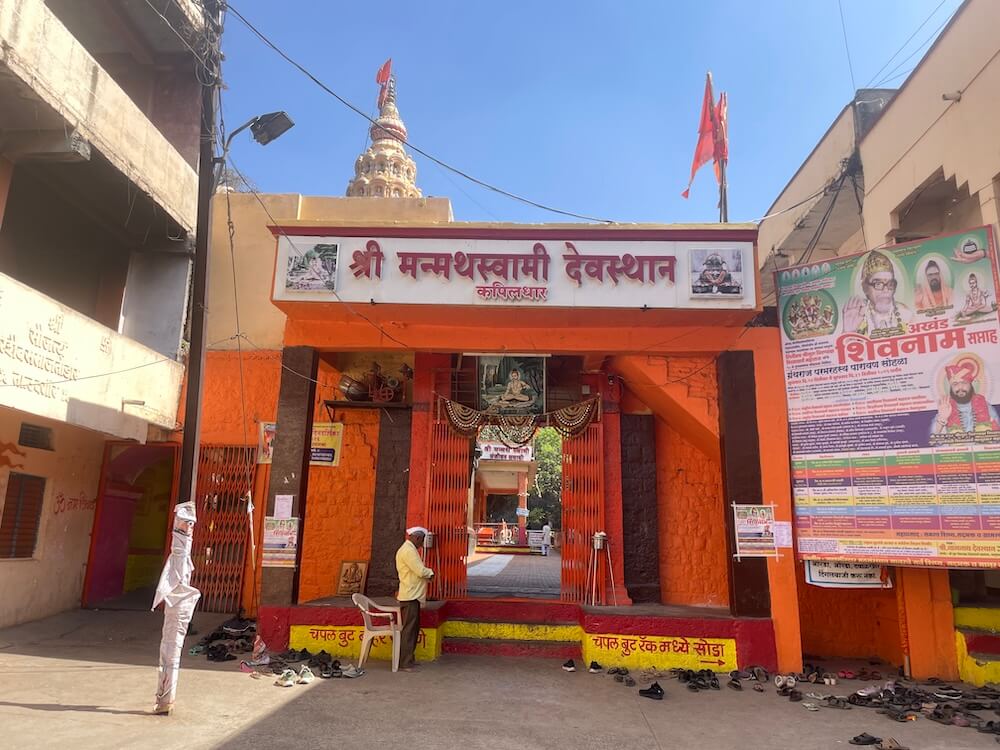
This holy shrine is located about eighteen kilometers from Beed city. The temple is situated in the hills, three kilometers from the Beed-Solapur highway and about one kilometer from Manjarsubha village. The first welcome arch of the temple stands on the road leading from the highway to the temple. There are Nandi sculptures on all four corners of the main spire of this arch. Additionally, there is a meditative idol of Manmath Swami in the niche on the front side.
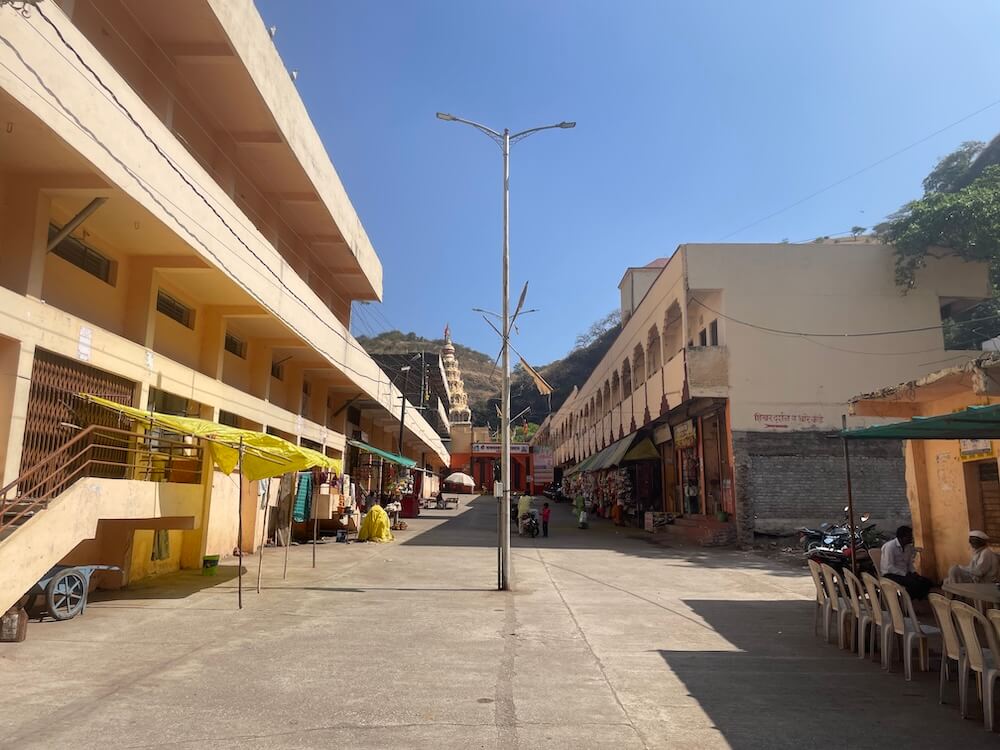
There is a spacious parking area in front of the temple, and there is a paved road to reach it. On both sides of the road leading from the parking lot to the temple, there are two-story buildings. On the ground floor of these buildings, there are shops selling worship materials, food items, and various other goods. The upper floor of the building serves as a Bhakta Niwas (pilgrim lodging), where accommodation is provided for devotees arriving from far away. Further ahead, connecting both buildings, is the entrance gate of the temple. There is a tortoise sculpture on the floor of the entrance. On the right side of the entrance, there is a staircase leading to the balcony, which is connected to the Bhakta Niwas.
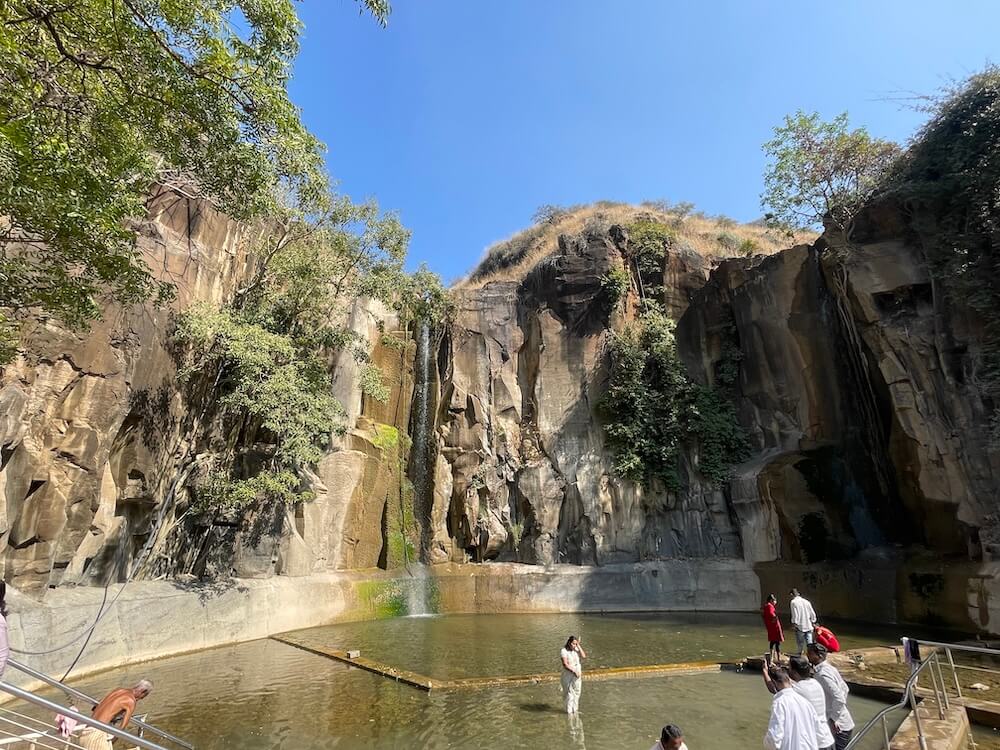
Inside the entrance, there are guard rooms on both sides, followed by a courtyard paved with paver blocks. In the courtyard, there is a second two-story Bhakta Niwas building on the right. The left side and the front of the courtyard are naturally enclosed by a mountain cliff. The Panchdhar waterfall cascades down from the cliff in front of the temple, which is referred to as ‘Kapildhar Tirtha’. There is a water tank beneath the waterfall. Stainless steel safety railings have been installed along the side of the tank in this courtyard. Many devotees bathe in this tank before going for the Swami’s Darshan. There are many old trees in the courtyard. Beneath these trees, on the platforms, are ancient stone sculptures and Shiva Lingas.
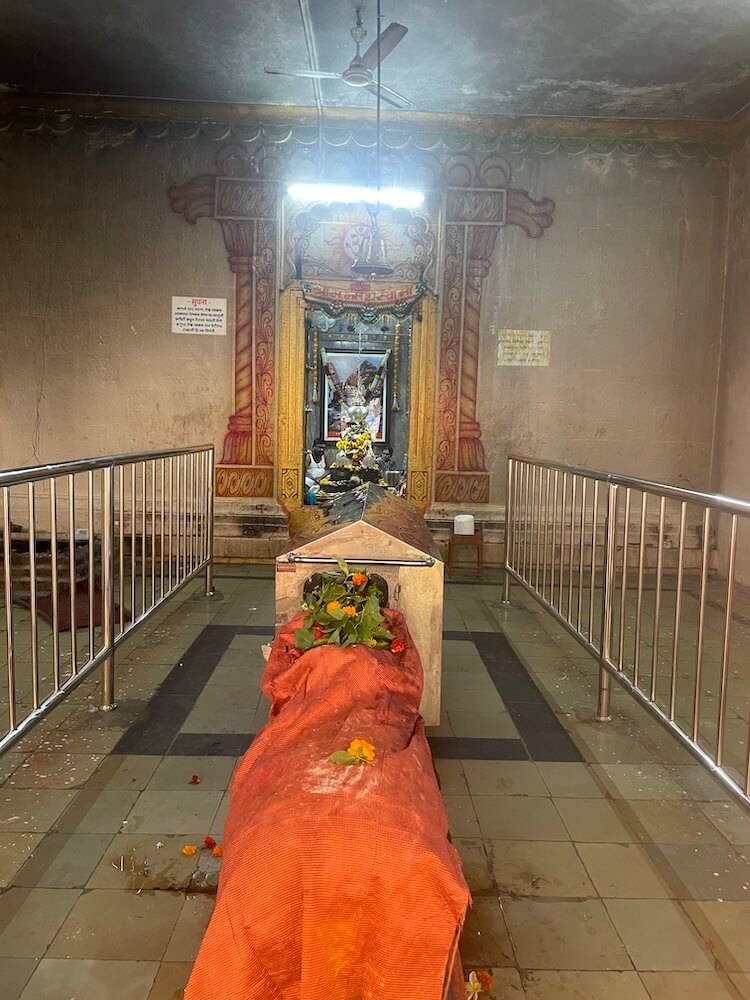
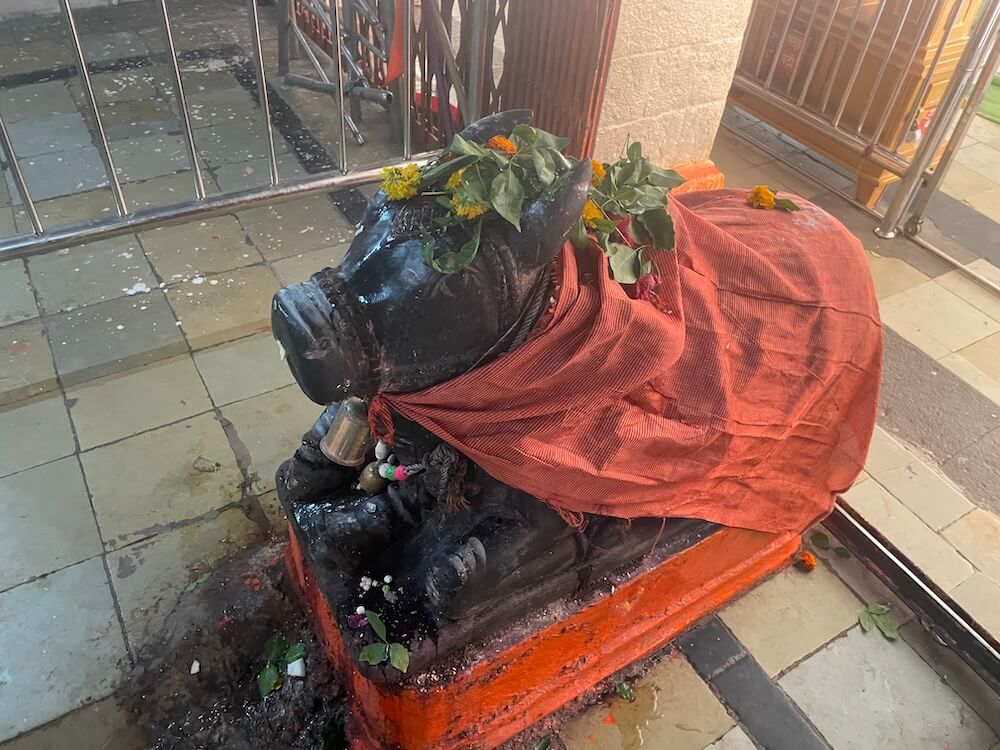
The temple structure consists of a Sabhamandap (assembly hall), Antaral (vestibule), and Garbhagriha (sanctum sanctorum). The Sabhamandap was built in recent times. The Sabhamandap has four rows of square, ornate pillars. The two outer rows each have four pillars, while the two middle rows each have three pillars. All pillars are adorned with intricate carvings. In the Sabhamandap, there is a brass mask of Manmath Swami, as well as a brass serpent holding a canopy over the mask. Further ahead is the Antaral and Garbhagriha, constructed in the ancient Hemadpanti architectural style. In the Antaral, four ornate pillars are connected to each other by arched lintels. The ceiling of the Antaral is supported by the front pillars, the left and right walls, and the walls of the Garbhagriha. Brass bells are hung from the ceiling. In the center of the Antaral, there is a black stone idol of Nandi on a Vajrapitha. In front of Nandi is the entrance to the Garbhagriha. Since the Garbhagriha is at a higher level than the Antaral, there are two steps at the entrance. The door frames of the Garbhagriha feature vertical edge carvings. In the center of the Garbhagriha floor lies the Samadhi of Manmath Swami. A copper Abhishek pot, which drips water, is hung from the ceiling over the Samadhi. The dome-shaped roof of the Garbhagriha is made of stones stacked one upon another. There are doors on the right and left sides to exit the Garbhagriha.
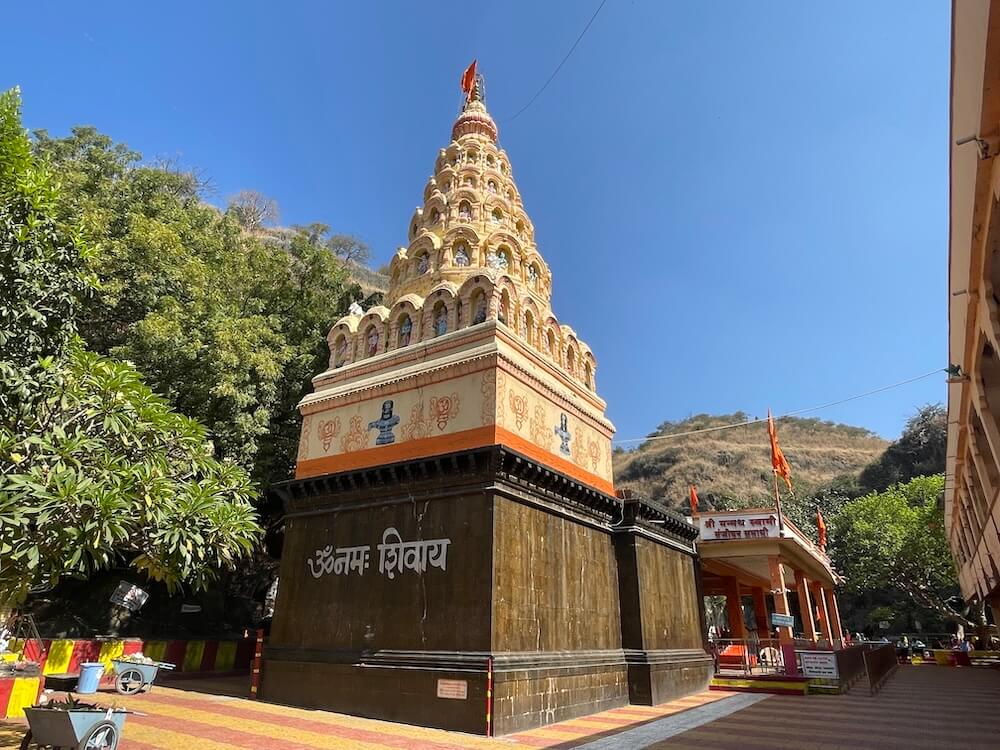
The roof of the Garbhagriha is topped by a five-tiered Shikhara (spire). The lowest first tier of the Shikhara is square, with five niches on each of the four sides. The other four tiers of the Shikhara are dodecagonal, and all tiers have twelve niches each. All the niches contain idols of various deities. At the apex of the Shikhara, there are two Amalakas stacked one above the other, and atop the Amalaka are the Kalash and the flag.
Kartik Purnima is the main annual festival celebrated here with great enthusiasm. The Swami’s birth anniversary is celebrated in the traditional manner on Magh Shuddha Panchami. On this occasion, the silver idol of the Swami is placed in a silver cradle, and hymns and lullabies are sung. The Swami’s Punyatithi (death anniversary) is observed in a devotional atmosphere on Falgun Shuddha Chaturthi. A large fair is held here on the third Monday of Shravan. At this time, thousands of devotees from states like Maharashtra, Karnataka, Andhra Pradesh, and Telangana come for the Swami’s Darshan. Tourists who come to enjoy the waterfall in the temple courtyard make it a point to visit the temple for Darshan. The temple sees a steady stream of devotees every day.
This sacred temple stands as a testament to deep spiritual devotion, ancient architectural grandeur, and rich local cultural traditions.
The sanctum sanctorum houses the divine idol consecrated according to ancient Vedic traditions, surrounded by serene courtyards and traditional temple architecture.
Navratri, Maha Shivratri, Annual Temple Jatra & Deepotsav
Compare and book flights, secure top-rated local hotels near the temple, hire reliable guides, and rent cars instantly.
Extend your pilgrimage by visiting other highly sacred temples located nearby.


Add ₹999 more to unlock FREE SHIPPING!
Your sacred cart is currently empty.
Shop Photo FramesFill in your delivery details below to place your order.
Add comment