
Add ₹999 more to unlock FREE SHIPPING!
Your sacred cart is currently empty.
Shop Photo FramesA *jatra* or pilgrimage fair is a religious, cultural, social, and commercial tradition of Maharashtra. Each year, approximately twelve thousand famous and large *jatras* are held across Maharashtra. The main features of these *jatras* include honouring the deity, performing *puja*, palanquin and chariot processions, honouring the village headman, bullock cart and wrestling competitions, trade, horse markets, and bullock markets. One such famous *jatra*, with a tradition spanning about five hundred years, is that of Barashiv Hanuman in Karanjala village, Basmat Taluka. Devotees firmly believe that this awakened deity grants their wishes.
The priests and trustees here state that this temple is more than five hundred years old. The temple is situated on the border of twelve villages: Karanjala, Bori Sawant, Gunda, Ranjala, Ajarsonda, Jawala Bazar, Karanji, Viregaon, Parali, Kalamba, Tapovan, and Adgaon. Hence, the deity is known as Barashiv Hanuman. Many legends are prevalent about this deity. According to one such legend, in ancient times, a self-manifested stone idol of Hanuman appeared at this spot. When the villagers from the adjacent twelve villages learned of this, they tried to take the idol to their respective villages. However, despite numerous attempts, the idol did not move from its place. Therefore, a temple was finally erected at this very spot. According to a legend narrated by the temple priests, a devotee of Hanuman from Karanjala village used to reside in the forest, constantly invoking the Lord. When Hanuman was pleased with him, the devotee requested the Lord to come and reside in his village. The Lord then began to follow the devotee, saying, “I will come to the village behind you, but I will become stable in idol form at the very spot where you turn back to look while walking forward.” When the devotee’s faith wavered at this spot, he looked back, and thus the Lord became stable in idol form here.
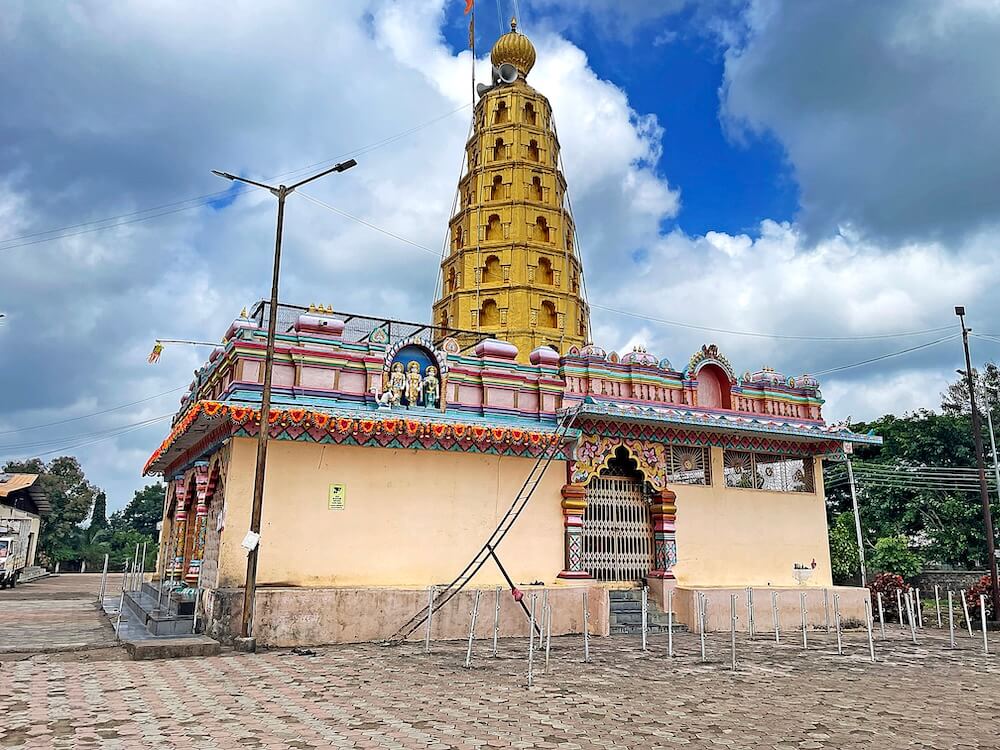
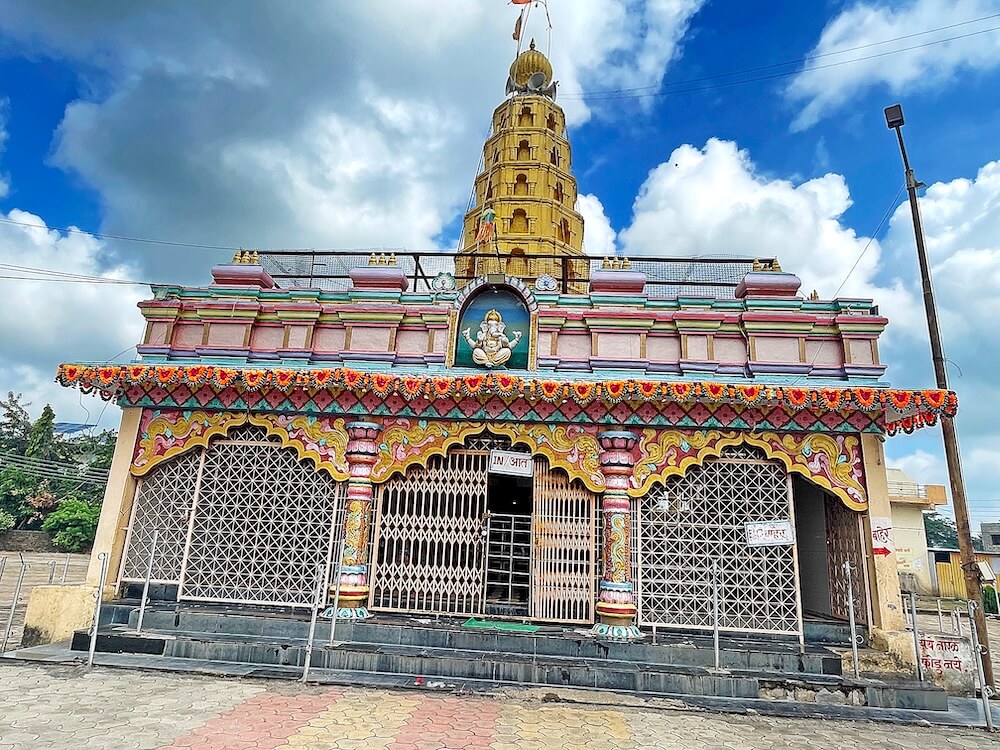
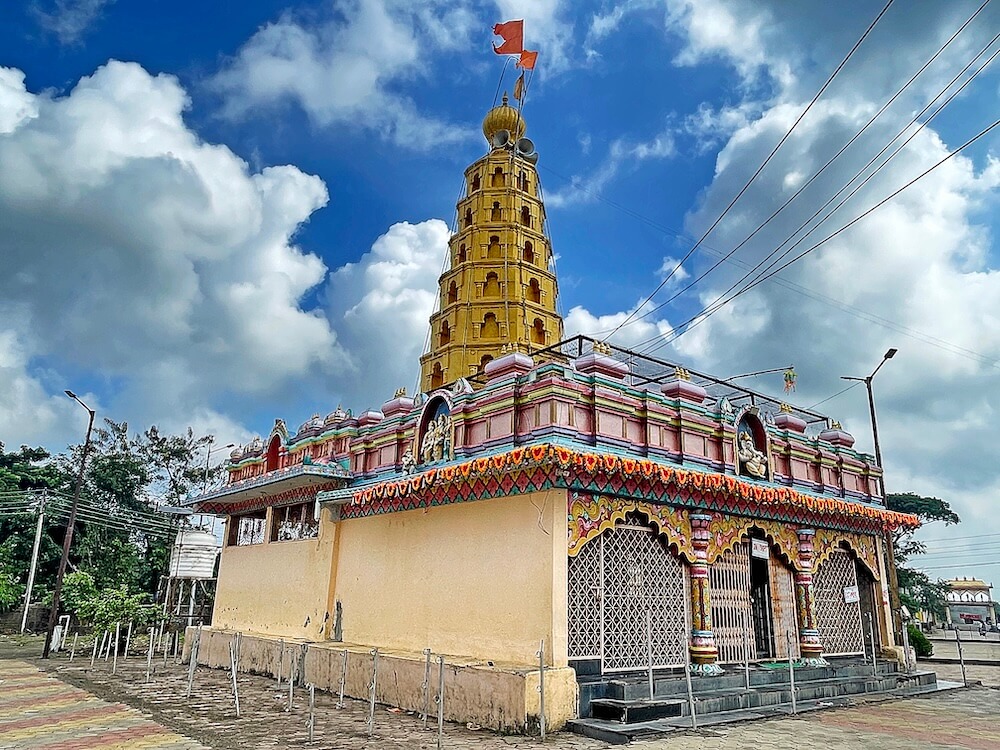
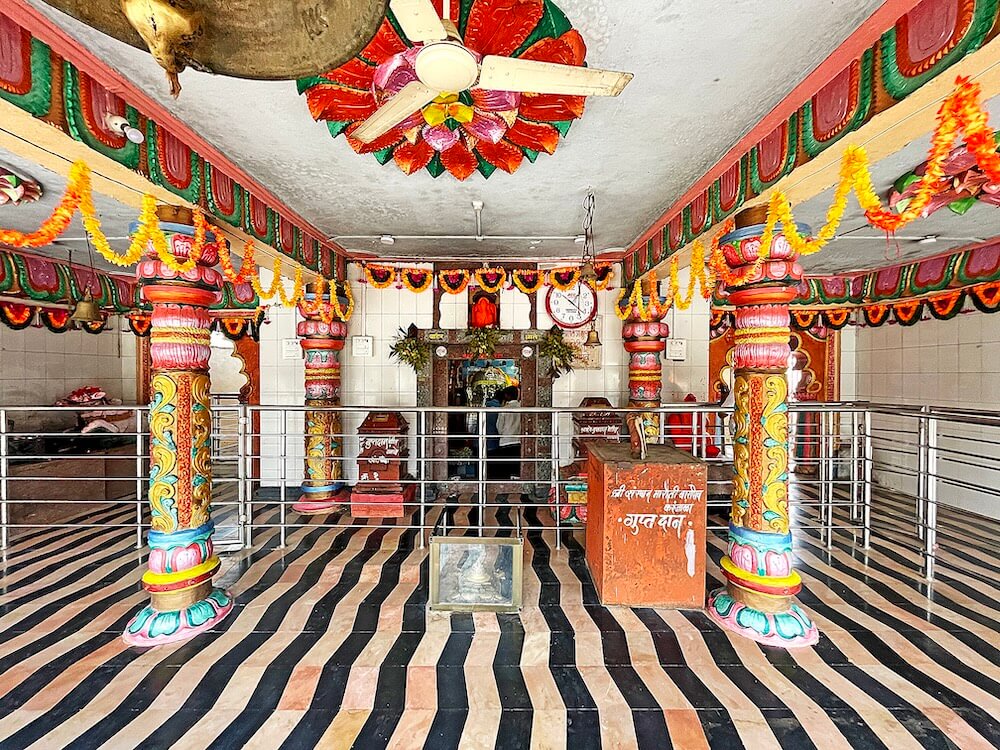
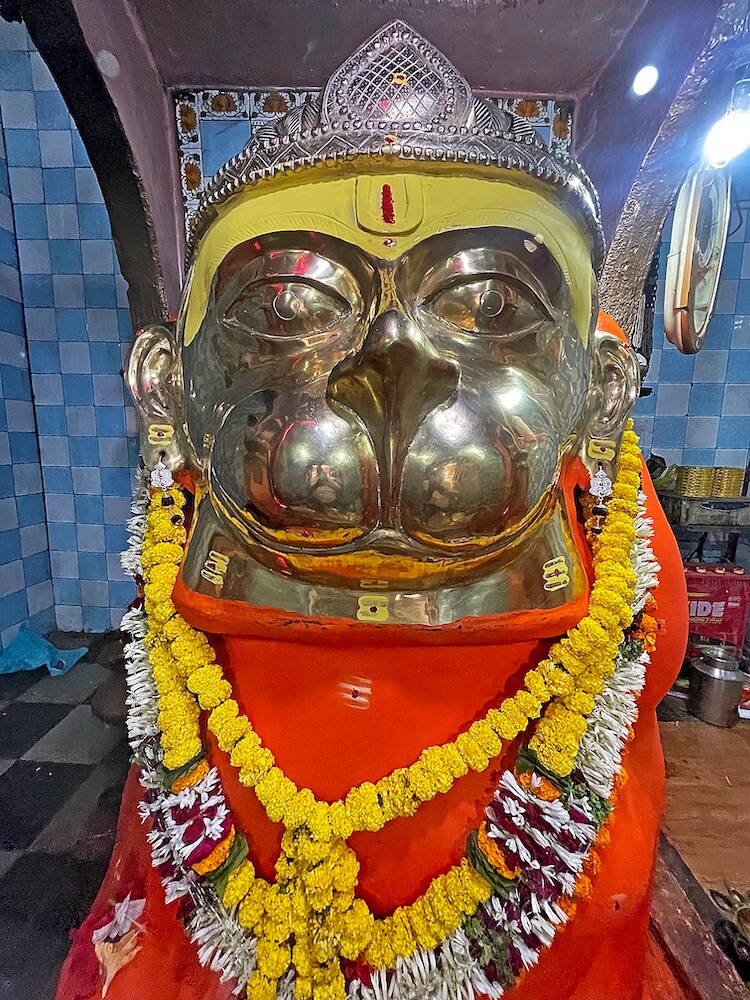
On the road leading to the temple, there is a large two-storey welcome arch of the temple. Above the four circular pillars are idols of Shri Rama, Lakshmana, Sita, and the servant Maruti. The roof of the arch has three dome-shaped spires. In front of the temple, there is a spacious parking area. In the temple courtyard, which is covered with paver blocks, there is a *deepastambha* (lamp pillar) on a raised platform. The temple’s structure consists of a *sabhamandapa* (assembly hall) and a *garbhagriha* (sanctum sanctorum). At the entrance of the *sabhamandapa* are two intricately carved pillars. Two more pillars are at the corners of the facade. All pillars are connected by arched *mahiraps*. In the centre of the *sabhamandapa* are four intricately carved circular pillars. All pillars stand on circular bases. The shafts of these pillars feature leaf and flower carvings and lotus capitals. The ceiling canopy displays a beautiful chakra design. In the *sabhamandapa*, an *antarala* (vestibule) has been created in front of the *garbhagriha* entrance with stainless steel railings. The doorframes of the *garbhagriha* show leaf and flower carvings, while the *lalatabimba* (lintel centre) features a Ganesha sculpture. Inside the *garbhagriha*, in a *makhar* (shrine) on a *vajra-pitha* (diamond pedestal), is the self-manifested stone idol of Hanuman. This large idol, smeared with vermilion, has a metal mask. There is a circumambulation path on the outer side of the *garbhagriha*. On this circumambulation path, there are two exit doors at the rear. The temple roof has a safety railing on all sides. Above the entrance, in a *devakoshthaka* (niche), there is a Ganesha sculpture. Square miniature spires are arranged at various points on the railing. The roof of the *garbhagriha* has a six-tiered hexagonal spire. Each tier of the spire has six *devakoshthakas*, and at the top is an *amalaka*. Above the *amalaka* are a *kalasha* (finial) and a flag.
In the temple courtyard, there is a recently built *bhaktaniwas* (devotee accommodation) and an ancient *dharmashala* (rest house). The temple priests state that many yogis, sadhus, and ascetics used to reside here in the past. In the courtyard, there is a *samadhi* temple of Omkarnath Maharaj. This temple consists of a *sabhamandapa* and a *garbhagriha*. Inside the *garbhagriha*, on a *vajra-pitha*, is the idol of Shri Omkarnath Maharaj. This temple was established at a later period. In the temple courtyard, there is an ancient *audumbar* tree, about one hundred to one hundred and fifty years old, planted by the late Mahant Gangagir Maharaj. Also in the courtyard is the *samadhi* temple of Swami Chinmayanand Maharaj. In the temple complex, there is an ancient Surya Mandir. This temple, with its *sabhamandapa* and *garbhagriha* structure, houses idols of Mahalakshmi and Suryanarayana riding a chariot drawn by seven horses in its *garbhagriha*. The priests state that for a few days each year, the rays of the rising sun anoint these idols.
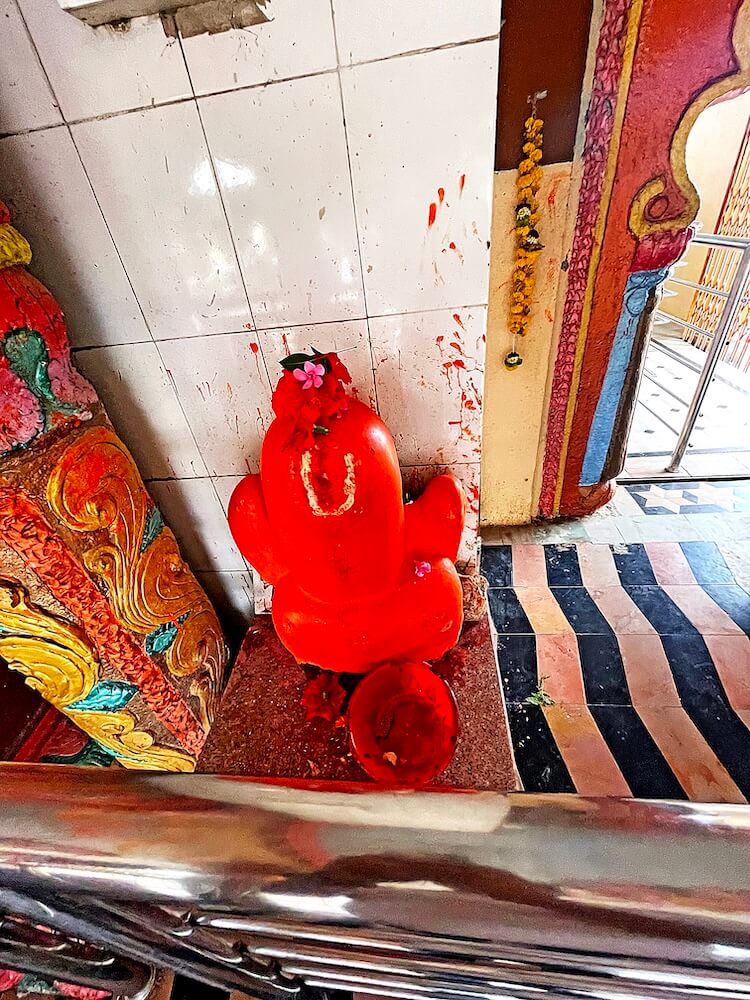
Next to the Surya Mandir is the residence of Chinmayanand Maharaj. Inside are Maharaj’s *gadi* (seat), *danda* (staff), and *khadawa* (wooden sandals). Outside the temple, there is a Chintamani stone for seeking *kaul* (divine guidance) that grants wishes. In the temple complex, there is an ancient rectangular stepwell, about fifty feet deep, built with carved stone. On both sides of the stepwell’s staircase path, there are *devakoshthakas* in the walls. One of these *devakoshthakas* contains a four-faced Shiva *lingam* and Nandi. The *devakoshthaka* on the other side contains a vermilion-smeared stone idol of Shri Ganesha. In ancient times, there was a *rahat* (water wheel) on the walls of this stepwell, and devotees would purify themselves with its water before going for the *darshan* of Maruti. Next to the stepwell, a recently built overhead water tank stands. In the courtyard, there is an auditorium for cultural programs.
The five-day Magha Pournima *Yatra* festival is celebrated with great enthusiasm at the temple. During this time, the special *puja* of the deity is performed by MLAs and MPs. For five consecutive days, programs such as *bhajan*, *kirtan*, *pravachan*, *Ramkatha*, and *mahaprasad* are organised at the temple. On the occasion of the festival, a camphor lighting ceremony is performed by the honoured individuals. Also, all the villagers collectively and devoutly pull the deity’s cart. For the *yatra*, agricultural exhibitions, grand wrestling matches, *Shankarpatt* (bullock cart races), and other sports are organised. Various shops adorn the area, and a temporary marketplace is set up. The buying and selling of goods generate a turnover of crores of rupees in the market. Thousands of devotees from within and outside the state attend this *yatra*. They offer their vows after having the *darshan* of the deity. Hanuman Jayanti is the second main festival at the temple. During this time, devotees sing lullabies while celebrating the birth anniversary of the deity. In addition, festivals and celebrations such as Chaitra Padwa, Ram Navami, Dussehra, Diwali, etc., are celebrated at the temple. Every Saturday during the month of Shravan, the temple is crowded with devotees coming for *darshan*. Many political leaders also regularly visit this deity for *darshan*.
This sacred temple stands as a testament to deep spiritual devotion, ancient architectural grandeur, and rich local cultural traditions.
The sanctum sanctorum houses the divine idol consecrated according to ancient Vedic traditions, surrounded by serene courtyards and traditional temple architecture.
Navratri, Maha Shivratri, Annual Temple Jatra & Deepotsav
Compare and book flights, secure top-rated local hotels near the temple, hire reliable guides, and rent cars instantly.
Extend your pilgrimage by visiting other highly sacred temples located nearby.


Add ₹999 more to unlock FREE SHIPPING!
Your sacred cart is currently empty.
Shop Photo FramesFill in your delivery details below to place your order.
Add comment