
Add ₹999 more to unlock FREE SHIPPING!
Your sacred cart is currently empty.
Shop Photo FramesMahur in Nanded district is renowned for the temple of Mata Renuka, one of the three and a half Shaktipeeths of Maharashtra. However, on this very sacred land lies a deeply divine and ancient abode of Lord Dattatreya, known as Dattashikhar. This shrine holds singular significance in the Datta Sampradaya. It is believed that Lord Dattatreya follows a daily routine: ‘Holy bath at Kashi, alms (bhiksha) at Kolhapur, and sleep (shayan) at Mahur.’ That is, no matter where He is during the day, Datta Maharaj returns to Mahurgad at night for rest. Hence, special importance is attached to the night ‘Shayan Aarti’ and devotional service (seva) here.
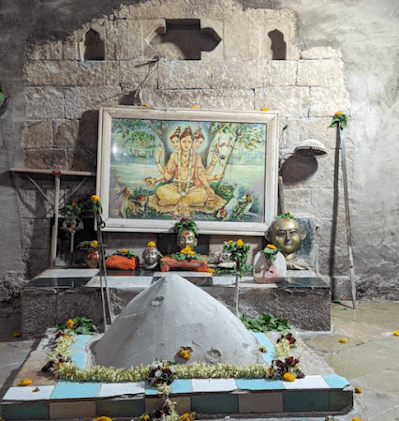
Devotees devoutly believe that Lord Dattatreya Himself was born on this hill fort as the fruit of the penance of Sage Atri and Mata Anasuya. The principal feature of the Datta Temple here is its Ekmukhi (single-faced) idol. Generally, Lord Dattatreya is depicted everywhere in His Trimukhi form (representing Brahma, Vishnu, and Mahesh); however, here Lord Dattatreya is enshrined in the Parabrahma form, that is, the Ekmukhi form. This form is considered a symbol of Advaita (non-duality) and Jnanamarga (the path of knowledge).
It is said that this temple was built by Mahant Mukund Swami in 1297 CE. References in old documents mention that Aurangzeb had granted a donation of forty thousand rupees to this temple. Lord Dattatreya is mentioned in the seventeenth and eighteenth chapters of the Markandeya Purana. Evidence shows that the Datta Sampradaya has been in existence since the fifth century CE. Sage Atri, the father of Dattatreya, is the composer of the hymns in the fifth Mandala of the Rigveda. Hence, the origins of the Shri Datta Sampradaya trace back to the Vedic era. Devotees firmly believe that Lord Dattatreya permanently resides at this holy pilgrimage site.
This temple is situated at an elevation of 1,900 feet above sea level. Two options are available to reach the temple from the base. Private vehicles can reach directly up to the temple via a paved motorable road, or pilgrims can walk up the stone-paved stairway. The stone-carved stairway is about twenty feet wide, flanked on both sides by stone protective railings. At the beginning of the steps, there is a Peepal tree on the left and a temple dedicated to Lord Mahadev on the right.
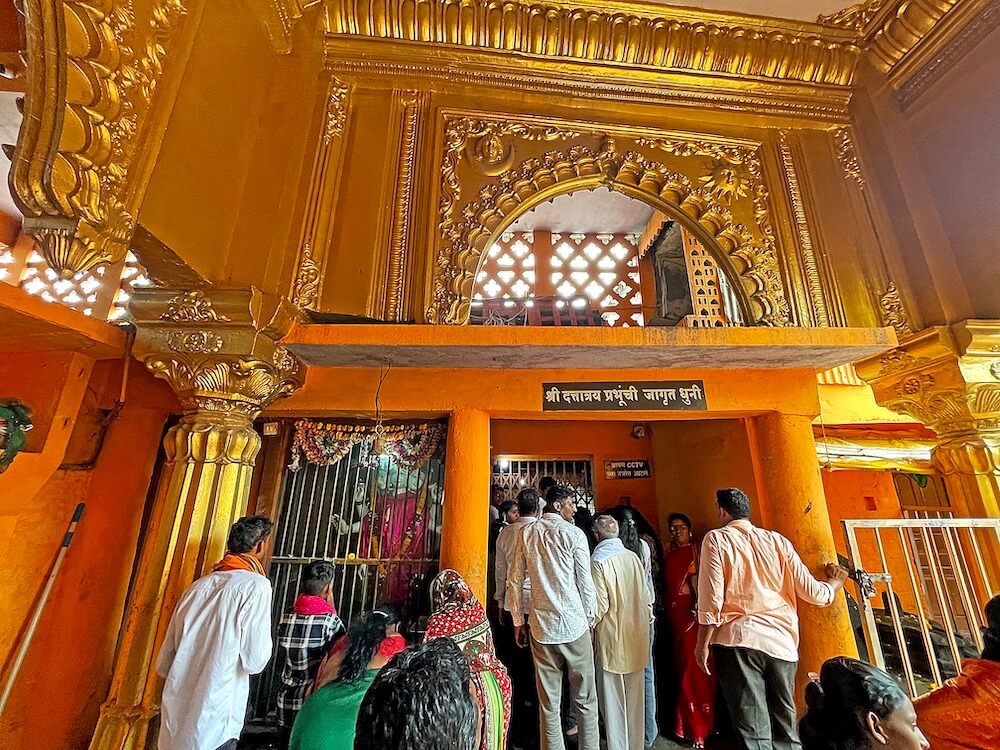
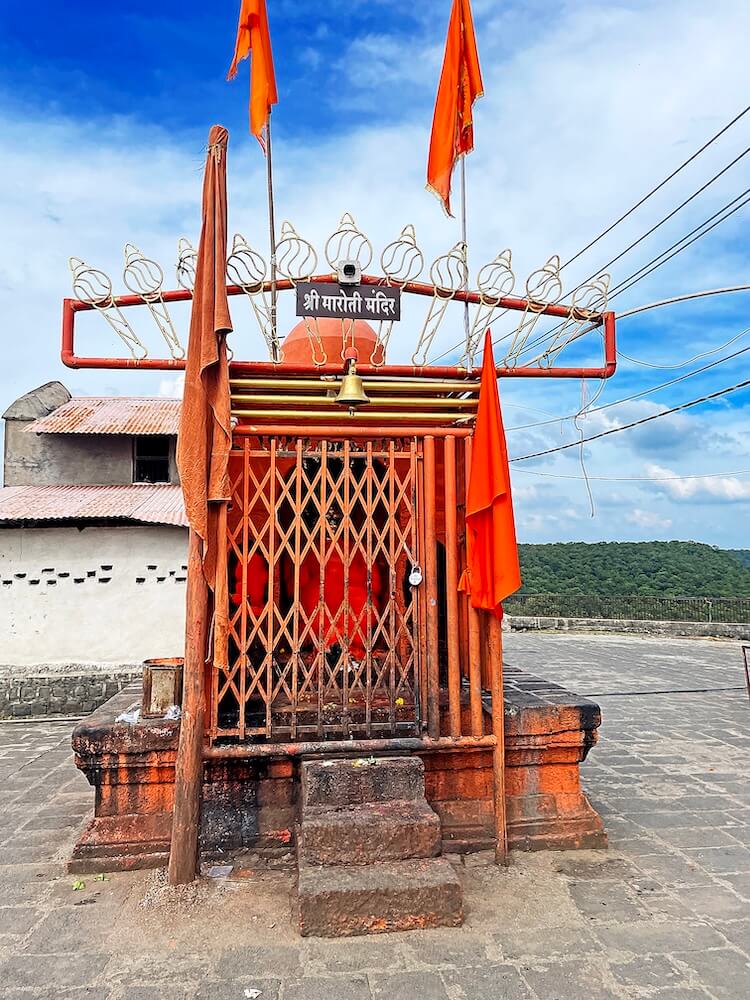
There is a spacious parking area in the open ground in front of the temple. In this complex lie several ancient Samadhis of the Bharati Mahants. Within the courtyard are shops selling food items, worship materials, and other articles, along with a spacious building for the Annachhatra (free food hall). Every day, Mahaprasad is served here from 11:00 AM to 2:00 PM. In the courtyard stands an ancient Chintamani Ganapati Temple built in the Hemadpanti style. The stone idol of Lord Ganesha here, smeared with vermilion (shendur), features a right-turned trunk. Close to this temple is the Kamakhya Devi Temple, enclosed within a separate fortified wall. In front of this temple are stones representing local deities and a vermilion-coated Ganesha idol, while inside, the black stone idol of Mata Kamakhya is enthroned on a Vajrapitha. Opposite the Datta Temple is the temple of Pahuna Maruti (Guest Hanuman). According to legend, Hanumanji once came to meet Lord Dattatreya in the evening. By the time they met, night had fallen. Lord Dattatreya insisted that Hanumanji stay overnight, and thus Hanumanji settled here permanently.
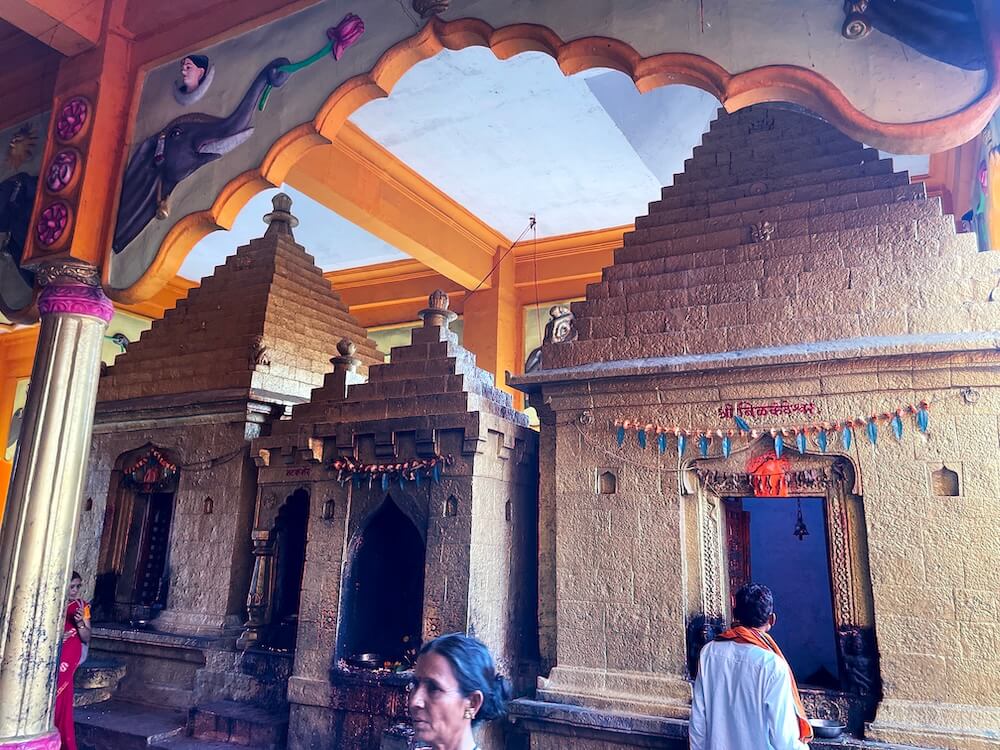
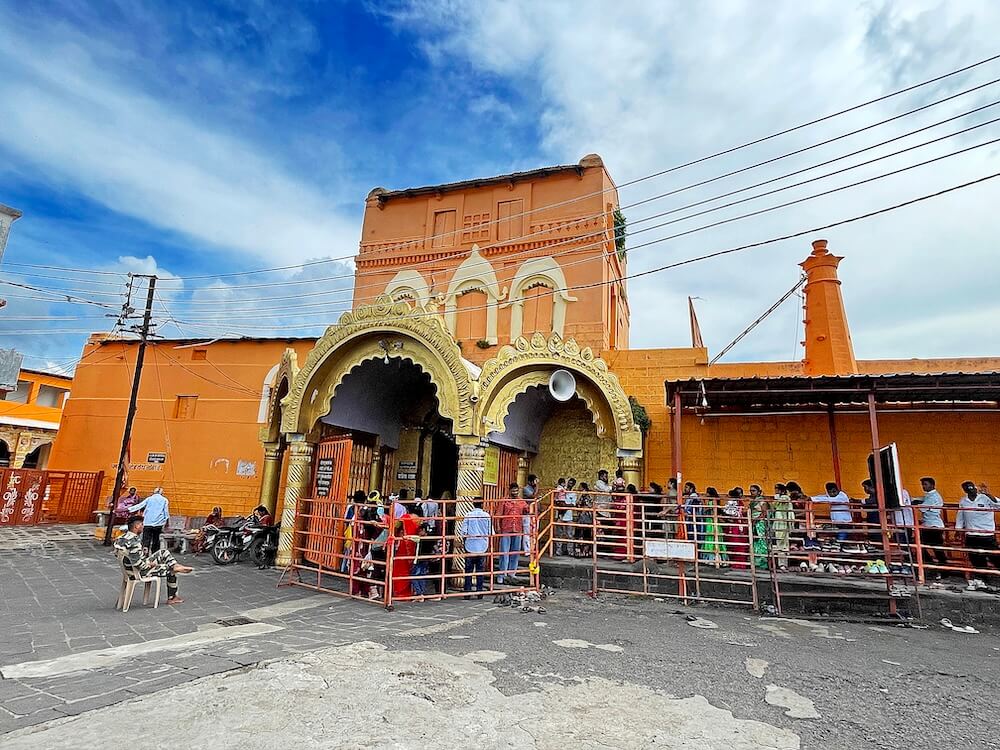
The main temple is surrounded by a strong fortified wall. In front of the two-storeyed entrance gate in the fortification lies a Mukhamandapa (front porch) supported by six carved pillars interconnected by arched motifs. The upper floor above the entrance houses a Nagarkhana (drum house), while the entrance itself features wooden doors with a smaller wicket gate (dindi darwaja). Inside, guard rooms are situated on both sides. Within the fortification, to the left in front of the temple, stands an octagonal Deepmal (lamp tower), and beside it is the Nilkantheshwar Temple. In this temple, a Shivlinga is enshrined on the floor at the centre. In the niches (devakoshtakas) along the walls on three sides are idols of Ganesha, Hanuman, and Parvati. Adjacent to the Nilkantheshwar Temple are shrines dedicated to Kal Bhairav, Bhatak Bhairav, Harihareshwar, and others. Sculptures of Dwarapalas (door guardians) are carved at the entrances of all these temples. Here, one also finds a Trimukhi Dattatreya temple, a perpetual holy fire (Akhand Dhuni), several Nandi sculptures, and a Shivlinga. It is also the site of the Samadhi of the first Mahant, Siddhhaji Bharati Maharaj. Inscriptions on the Samadhi record his lifespan as 500 years, from 759 CE to 1259 CE. Regarding the sacred Dhuni, legend has it that in the Treta Yuga, a sage named Pingalnaga performed severe penance here and received the divine vision (darshan) of Lord Datta. The sacred fire lit by him at that time continues to burn to this day. Beside the Samadhi stands a tree, which is said to be the wooden staff (kathi) of Siddhhaji Maharaj. It is believed that when Maharaj planted his dry staff in the ground, it blossomed into this tree. Beyond it lie the Samadhis of other Mahants.
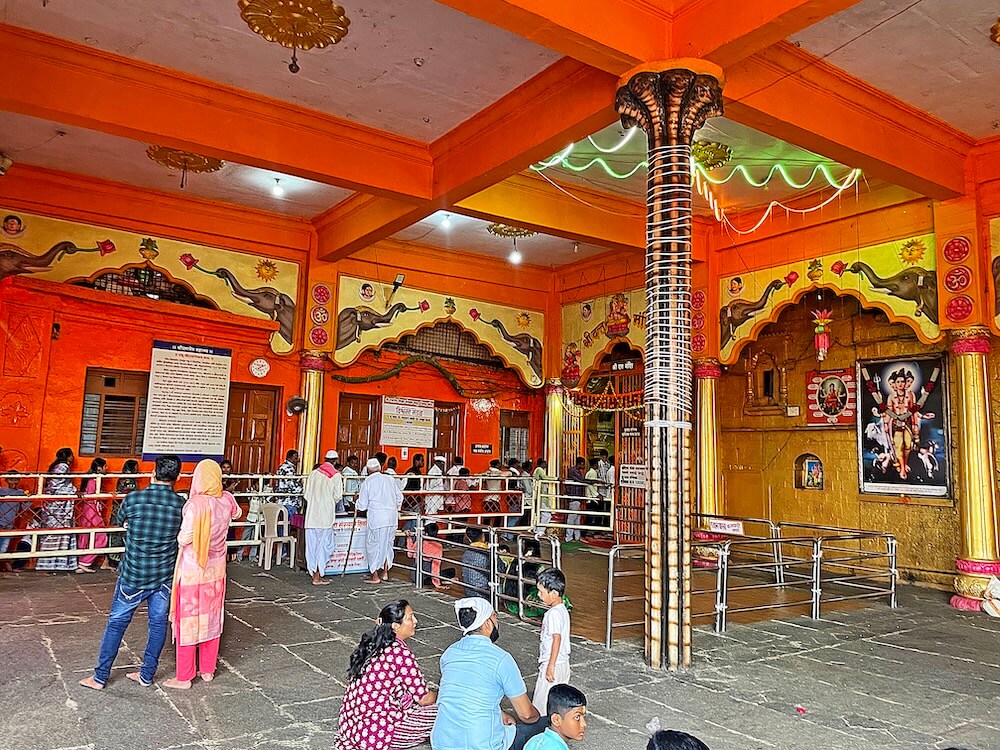
The structure of the main temple consists of an outer Sabhamandapa, the main Sabhamandapa, the Antarala (vestibule), and the Garbhagriha (sanctum sanctorum). The outer Sabhamandapa was built in recent times, adjoining the main Sabhamandapa. In this semi-open Sabhamandapa, four carved pillars each on the left and right sides are interconnected by arched motifs. In the center of the Sabhamandapa, there is another row of four carved circular pillars. In the enclosed main Sabhamandapa, semi-circular arches rest upon carved pillars, and the ceiling (vitana) within every four pillars is domed. At the top of the pillars are corbels with serpent sculptures (Naga sculptures) carved on the brackets. On the right side of the main Sabhamandapa is the traditional seat of the Mahants. In the niches here are idols of Lord Ganesha and other deities. To the right of the entrance to the Antarala is a Panchamukhi Shivlinga, while to the left are idols of Sage Atri, Mata Anasuya, Lord Dattatreya, and Anagha Devi. In the main Sabhamandapa, in front of the entrance to the Antarala, stands a Nandi sculpture. On both sides of the entrance are two carved pillars topped with a Torana (decorative arch). The entrance to both the Antarala and the Garbhagriha is clad in silver plating (rajatapatala), intricately carved with various artistic designs. The doorframes of the Garbhagriha feature floral motifs, and the image of Lord Ganesha adorns the lintel (lalatabimba). Above the lintel is a decorative arch of miniature spire sculptures. On the pedestal in the Garbhagriha rests a silver mask of Lord Dattatreya. This is revered as the principal abode of Lord Dattatreya. The roof of the Garbhagriha is crowned with a square Shikhara (spire) having a stepped pyramid structure. On the spire are some faintly carved sculptures and sub-spires (urushringas). The top of the main spire is adorned with a stupika and a Kalasha.
Shri Datta Jayanti, the main annual festival here, is celebrated with great fervor and enthusiasm. On the occasion of this festival, a week-long Harinam Saptah (sacred chanting) is organized. In addition, all major festivals and celebrations including Shravan Maas, Sharadiya Navratri, Dussehra, Diwali, Kojagiri Purnima, and Kartik Purnima are grandly celebrated in the temple. An ocean of devotees pours in during the month of Shravan and the festival of Datta Jayanti. Large crowds of devotees also gather at the temple on auspicious days like Thursdays, Purnima, and Amavasya. Devotees can take Darshan of the Lord at the temple every day from 6:30 AM to 7:30 PM.
This sacred temple stands as a testament to deep spiritual devotion, ancient architectural grandeur, and rich local cultural traditions.
The sanctum sanctorum houses the divine idol consecrated according to ancient Vedic traditions, surrounded by serene courtyards and traditional temple architecture.
Navratri, Maha Shivratri, Annual Temple Jatra & Deepotsav
Compare and book flights, secure top-rated local hotels near the temple, hire reliable guides, and rent cars instantly.
Extend your pilgrimage by visiting other highly sacred temples located nearby.


Add ₹999 more to unlock FREE SHIPPING!
Your sacred cart is currently empty.
Shop Photo FramesFill in your delivery details below to place your order.
Add comment