
Add ₹999 more to unlock FREE SHIPPING!
Your sacred cart is currently empty.
Shop Photo FramesAccording to Hindu Puranas, Narasimha or Nrisimha is considered the fourth avatar of Lord Vishnu. In this avatar, the Supreme Lord destroyed Hiranyakashipu in a fierce form that was half-human and half-lion. This form of Lord Narasimha, who rushes to the call of devotees in distress and destroys the wicked, is considered extremely powerful. By killing Hiranyakashipu, the Lord delivered the devotee Prahlada, which is why Lord Narasimha is regarded as the ‘Deliverer’ of devotees. There are various famous temples of this deity across Maharashtra and the country. Among this chain, the Narasimha Temple at Shankhtirth in Nanded district, a place of faith for thousands of devotees, is widely renowned.
Experts believe that this stone temple, built in the Hemadpanti style at Shankhtirth, dates back to approximately the thirteenth century. The village likely derived the name ‘Shankhtirth’ from the right-conch shells found in the local river. An inverted serpent sculpture is carved onto the ornate pillars of the temple. As this is the royal emblem of the Chalukya dynasty of Badami, it proves that the temple belongs to the Chalukya period. According to some experts, this temple was built during the reign of King Vikramaditya (VI) of the Chalukya dynasty, that is, in the latter half of the twelfth century.
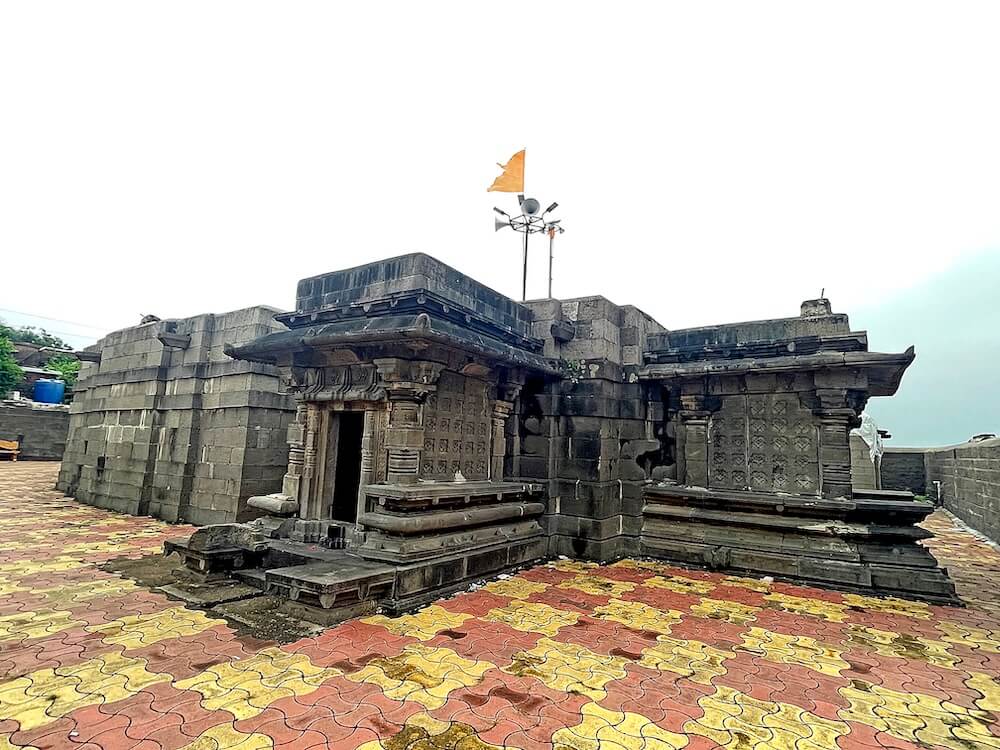
At the entrance of the village, there is a modern-style welcome arch built of cement concrete. On both sides of this arch are two square pillars, and there is a dome on the beam above. There is a paved road from the village to the temple. The temple is surrounded by a sturdy fortification made of carved stone, about seven feet high and two feet wide, which contains the main entrance of the temple. To descend into the temple courtyard, which is covered with paver blocks and situated lower than the road level, there are nine steps built of carved stone.
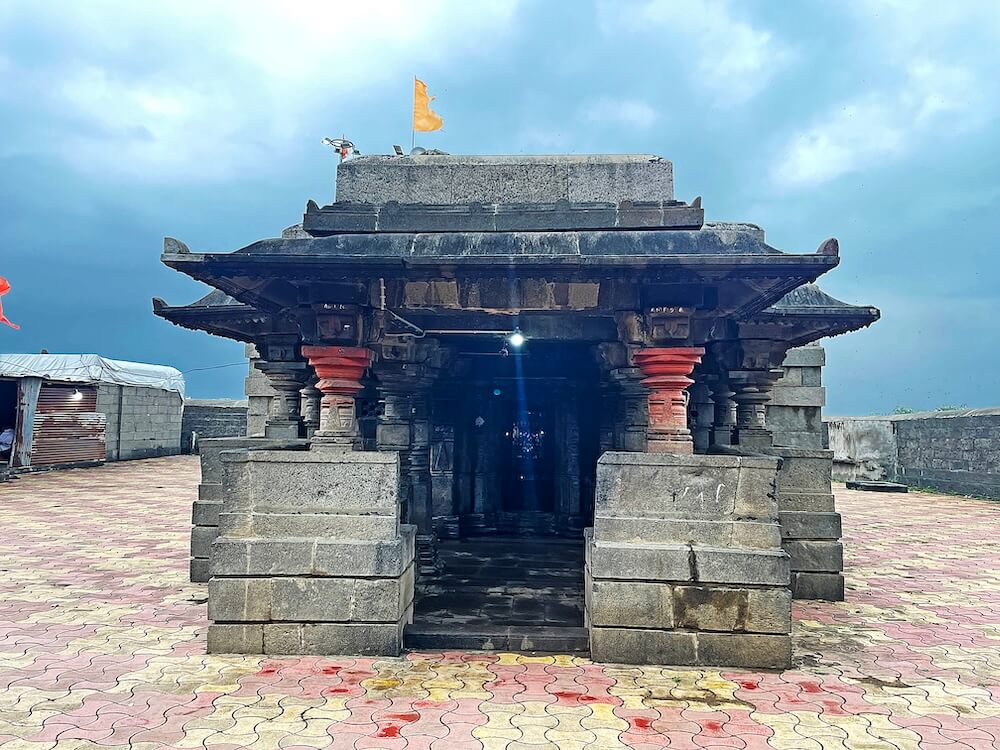
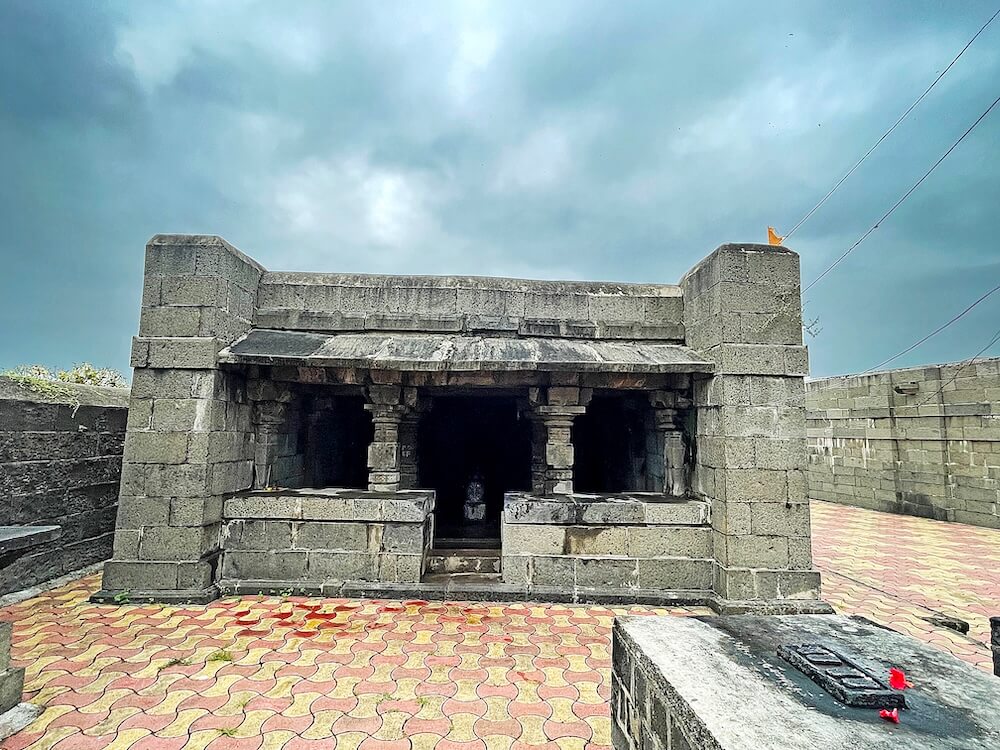
The structure of this temple consists of a Sabhamandapa (assembly hall), a main Sabhamandapa, an Antarala (vestibule), and a Garbhagriha (sanctum sanctorum). There are two steps to enter the Sabhamandapa, which is at a lower level than the courtyard. The part of the Sabhamandapa near the entrance is somewhat narrow. In this semi-open Sabhamandapa, there are stone benches (Kakshasanas) on the outer side for devotees to sit. The two ornate pillars in front of the Sabhamandapa are within the Kakshasanas. Furthermore, there are four rows of three ornate pillars each in the Sabhamandapa. The outer pillars are within the Kakshasanas. The bases and shafts of these pillars are in various geometric shapes such as square, hexagonal, octagonal, and circular. At the top, there are capitals (Kani) and above them are brackets (Hasta). On the brackets are capitals and serpent sculptures. It is said that this is the mark of the Chalukya dynasty of Badami. On the ceiling of the Sabhamandapa, there is a circular design.
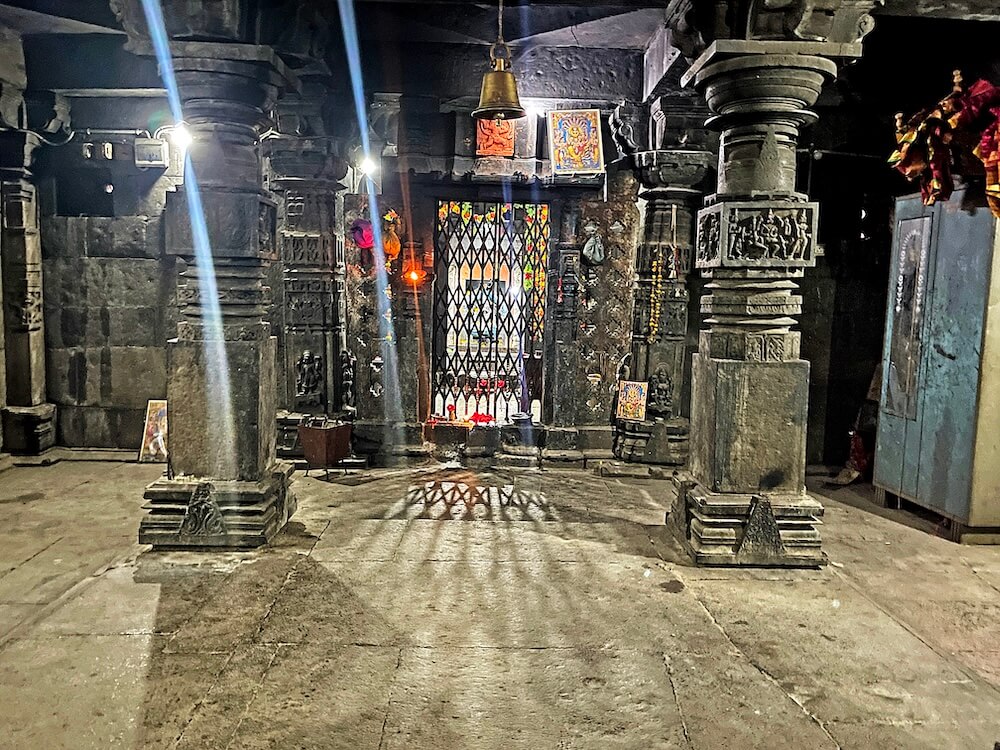
Further ahead is the entrance to the enclosed main Sabhamandapa. On the first three doorjambs of the entrance, there are carvings of foliage and floral vines. On the next two pillar-jambs, various geometric figures are carved. At the base of the doorjamb is a Chandrashila (moonstone) and on both sides are Kirtimukha sculptures. On the lintel, there is a torana of spire sculptures. In the main Sabhamandapa, there are four rows of three ornate pillars each. The outer pillars are embedded in the walls. On the ceiling, circular designs and chandeliers are depicted. On the square sections of the pillar shafts here, episodes from the Ramayana and Mahabharata, deities, and Kirtimukhas are carved on all four sides. On one pillar, Nrisimha is carved tearing open the stomach of Hiranyakashipu.
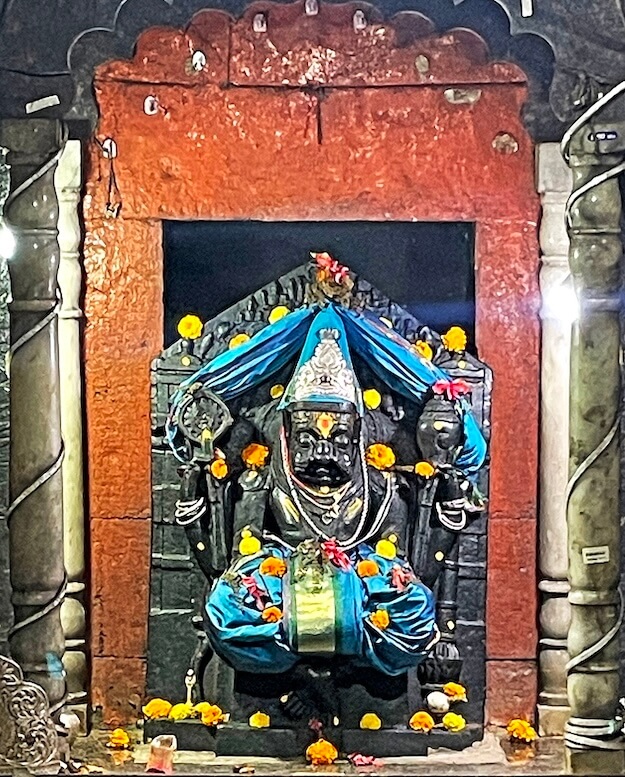
Further ahead is the entrance to the Antarala. The first doorjamb of the entrance is flat, and the side pillar-jambs are ornate. On both sides of the entrance, there are latticed stone windows. The entrance to the Garbhagriha has five doorjambs. Of these, three doorjambs have foliage and floral vine carvings, and two pillar-jambs have various geometric figures. On the central lintel (Lalatabimba) is an image of a deity, and on the lintel above is a torana of spire carvings. At the base of the doorjamb is a Chandrashila and on both sides are Kirtimukha sculptures. In the Garbhagriha, on a Vajrapitha (diamond throne), is a four-armed idol of Nrisimha in a calm posture, seated in meditation. The Lord holds a conch, discus, mace, and lotus. Near the feet of the Lord, a sculpture of the devotee Prahlada is carved. On the top panel of the idol’s Prabhavali (halo), the Dashavatara of Vishnu—Matsya, Kurma, Varaha, Narasimha, Vamana, Parashurama, Rama, Balarama, Krishna, and Kalki—are carved. The Lord wears a silver crown on his head. There is a safety railing on all sides of the temple roof. It has water spouts to drain rainwater from the roof. The roof of the Garbhagriha is dome-shaped.
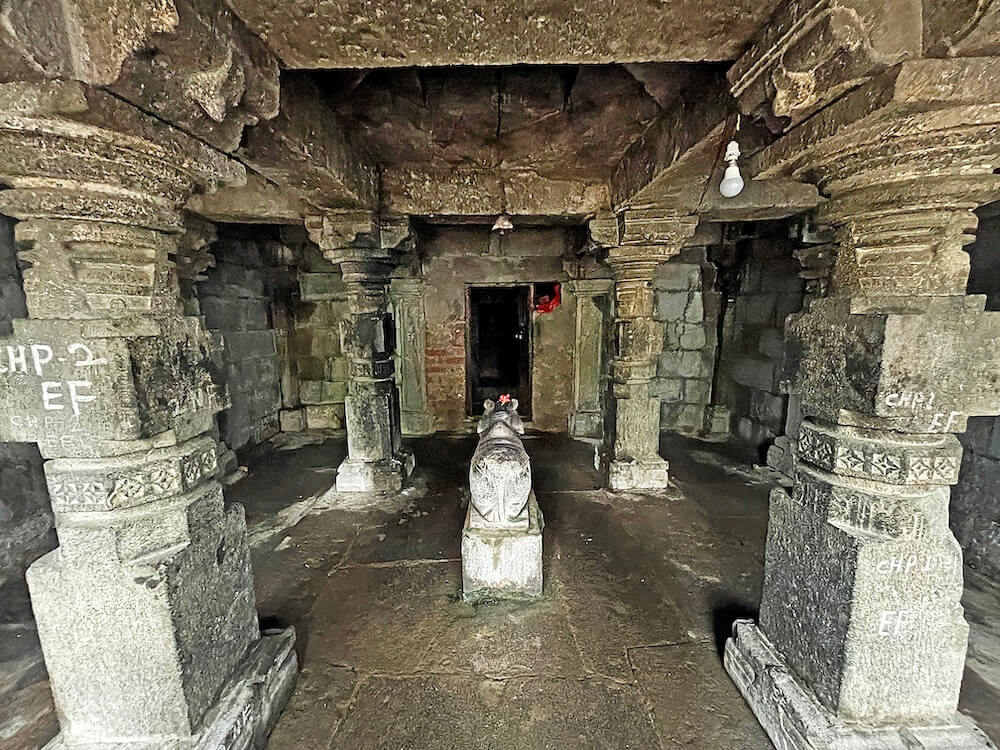
Beside the Narasimha Temple is a Mahadeva temple. This temple, which has a structure consisting of a Sabhamandapa and a Garbhagriha, has four rows of four ornate pillars each in its enclosed Sabhamandapa. The outer pillars are embedded in the walls. In the paved Sabhamandapa, there is a black stone idol of Nandi on a Vajrapitha in the center. In the Garbhagriha, there is a Shiva Linga on the floor. Above the Shiva Linga is a five-hooded brass serpent holding a canopy, and an Abhisheka vessel is hung from the ceiling to drip water. There are some ancient memorials (Samadhis) in front of this temple.
On the backside of the temple, there is a ghat on the banks of the Godavari River. One can go to the ghat by descending about thirty to forty steps from the entrance in the temple fortification. Inside this entrance, there are rooms for guards. This entrance must have been designed for devotees and royalty arriving by waterway in ancient times. There is a Naroba temple in the Godavari riverbed. There is a tradition here of performing a five-day Godavari circumambulation (Parikrama) from the Markandeya temple to Shankhtirth and back.
The annual festival of Nrisimha Jayanti is celebrated with great enthusiasm in the temple. On this day, a palanquin procession of the deity is taken out amidst the sound of drums and the throwing of Gulal, circumambulating the village. At this time, thousands of devotees come here for the darshan of the Lord and to fulfill their vows. Hundreds of devotees from the surrounding area participate in the palanquin ceremony.
This sacred temple stands as a testament to deep spiritual devotion, ancient architectural grandeur, and rich local cultural traditions.
The sanctum sanctorum houses the divine idol consecrated according to ancient Vedic traditions, surrounded by serene courtyards and traditional temple architecture.
Navratri, Maha Shivratri, Annual Temple Jatra & Deepotsav
Compare and book flights, secure top-rated local hotels near the temple, hire reliable guides, and rent cars instantly.
Extend your pilgrimage by visiting other highly sacred temples located nearby.


Add ₹999 more to unlock FREE SHIPPING!
Your sacred cart is currently empty.
Shop Photo FramesFill in your delivery details below to place your order.
Add comment