
Add ₹999 more to unlock FREE SHIPPING!
Your sacred cart is currently empty.
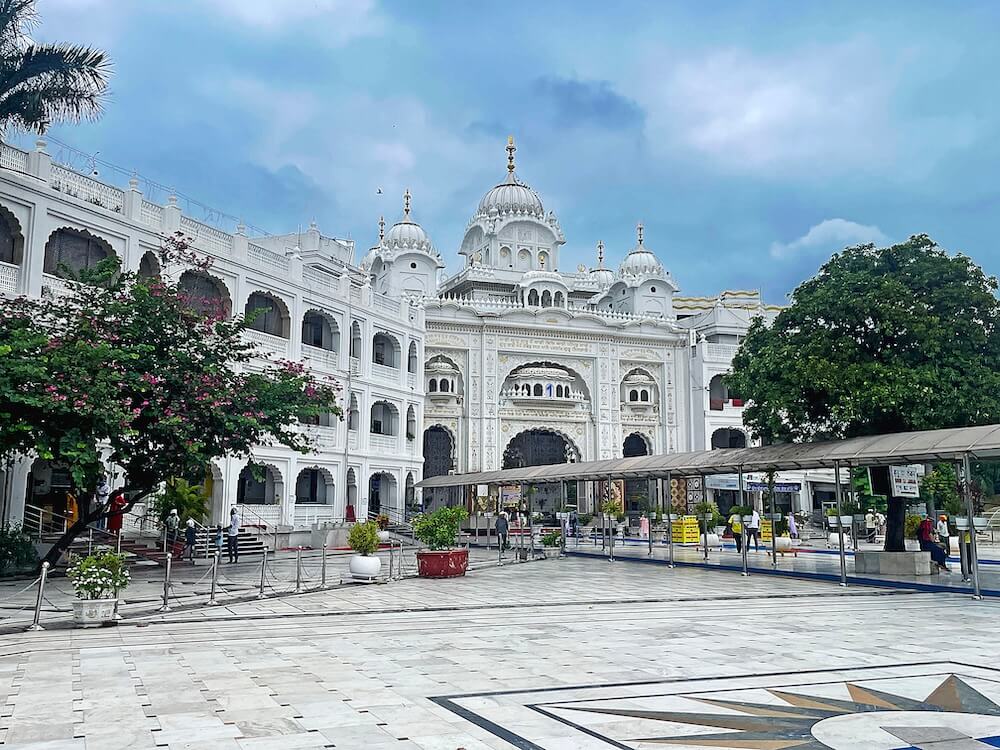
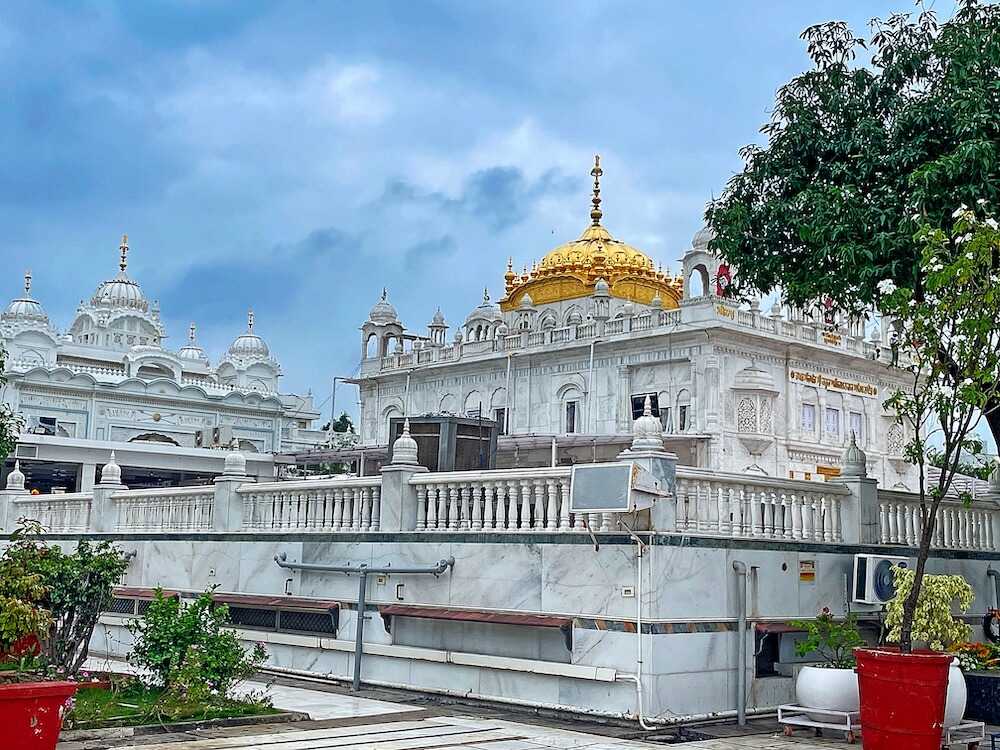
Shop Photo FramesTakht Sachkhand Sri Hazur Sahib Gurudwara is famous as a globally recognized landmark of Nanded city and a highly sacred place of faith for Sikhs. Situated on the banks of the Godavari River, this site is one of the five supreme religious seats (Takhts) of the Sikh religion, alongside Akal Takht (Amritsar), Takht Sri Harimandir Sahib (Patna Sahib), Takht Sri Keshgarh Sahib (Anandpur), and Takht Damdama Sahib (Talwandi). The tenth Guru of the Sikhs, Sri Guru Gobind Singh, spent the final period of his life in Nanded and attained eternal rest on this very land in 1708. Consequently, this place holds extraordinary significance.
Guru Nanak was the founder and the first Guru of the Sikh religion. According to information from the first volume of the renowned editor Khushwant Singh’s book ‘A History of the Sikhs’, he was born at Talwandi Rai Bhoi (present-day Nankana Sahib) on 15 April 1469. His father’s name was Mehta Kalyan Das Bedi, and his mother’s name was Tripta. At the age of seven, he was sent to a Pandit for primary education. Two years later, he learned Persian and Arabic from a Muslim Maulvi. He had a spiritual inclination from childhood. He was married at the age of twelve, but he had no interest in worldly life. He would spend his time in the company of fakirs and religious leaders. Over time, he moved from Talwandi to Sultanpur. He began working as an accountant for the local Nawab, Daulat Khan Lodi. During this period, his inclination toward spirituality grew. One morning, while bathing in the river, he received his first divine revelation. According to his biography, the ‘Janamsakhi’, God appeared to him and said, ‘You are me. Through you, the glory of my name will increase. Go among the people and teach them how to worship.’ During this time, he was invisible for three days. People thought he had drowned in the river, but he returned on the fourth day. He proclaimed, ‘There is no Hindu, there is no Musalman.’ After that, he renounced worldly life. He was thirteen years old at that time. Leaving home, he went on pilgrimages. It is said that he also visited Mecca, Medina, and Baghdad.
During his lifetime, he propagated the principle of ‘Ik Onkar’, meaning ‘God is One’. He rejected saguna bhakti (worship of deities with form) as well as the existence of evil spirits. He also rejected the concept of God’s incarnation. Guru Nanak taught that the entire universe is a creation of God and that He is self-existent, omnipresent, and unique. The Sikh religion, founded by Guru Nanak, rejected the caste system and idol worship. He preached a religion that emphasized the principles of service to humanity, tolerance, and brotherhood, while focusing on worldly life. After completing his four journeys, Guru Nanak came to Kartarpur Sahib. He resided there for the final 18 years of his life. It was here, on the banks of the Ravi River, that he gave the message: ‘Naam Japo, Kirat Karo, Vand Chako’, meaning remember the name of the Lord, work honestly, and share whatever you have with others. He attained Mahaparinirvana in the early hours of 22 September 1539.
Including Guru Nanak, there are a total of ten Gurus of the Sikhs. The last of them, the embodied Guru Gobind Singh (1666 to 1708), had a close connection with Maharashtra. He arrived in Nanded on 19 July 1707. On 18 August, two Pathans launched a fatal attack on him. These Pathans were sent by Wazir Khan, the Subedar of Sirhind. Following this attack, he departed from this world at this very place on 7 October 1708. Contemporary literature providing official records of this is available. The text ‘Gurushobha’ serves as an eyewitness account of his stay. Additionally, records are found in the ‘Akhbarat-e-Darbar-e-Mualla’, written on 11 November 1708, and in source books regarding Emperor Bahadur Shah, who succeeded Aurangzeb.
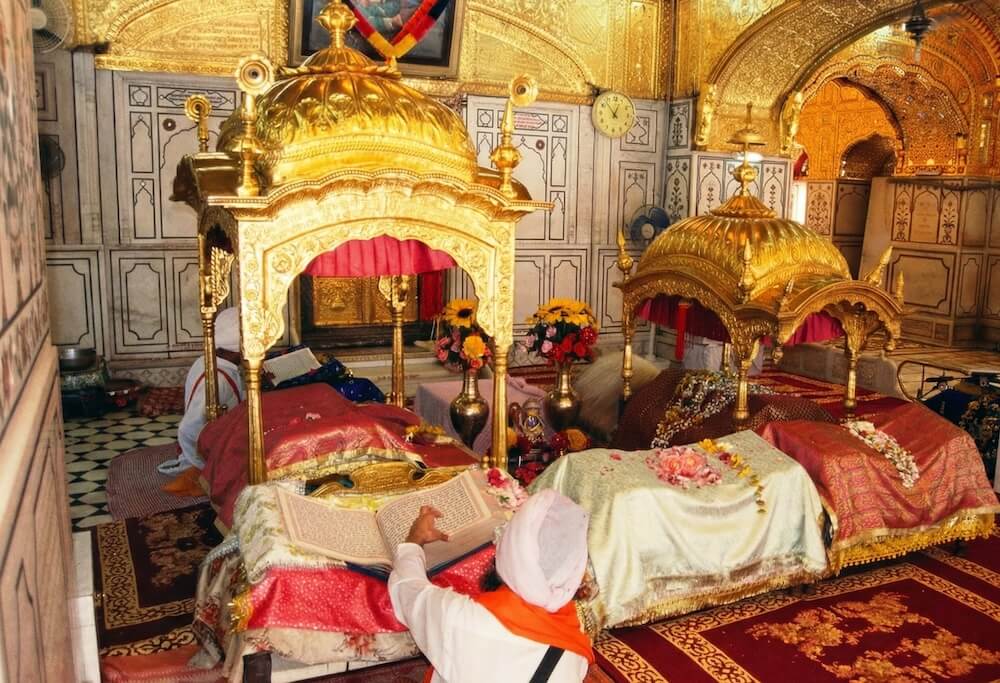
Three days before his departure, on 4 October 1708, Guru Gobind Singh ended the tradition of embodied Gurus and installed the Guru Granth Sahib as the Guru (Guruta Gaddi). Therefore, this place holds exceptional importance for the religion. The Guru Granth Sahib, consisting of 1430 pages and 2,68,547 words, contains the teachings and prayers of Guru Nanak as well as other Gurus. It also includes the compositions of Saint Namdev, along with those of Kabir, Ravidas, and Baba Farid. The current structure was built between the years 1832 and 1840 on the very site where the life-flame of Guru Gobind Singh merged into the infinite. The Nizam of Hyderabad had called upon the Sikh regiment from Lahore to suppress a rebellion in his territory. Some of those soldiers, along with the Nizam’s Diwan Chandulal Maharaj and Maharaja Ranjit Singh of Punjab, took the initiative to construct this edifice.
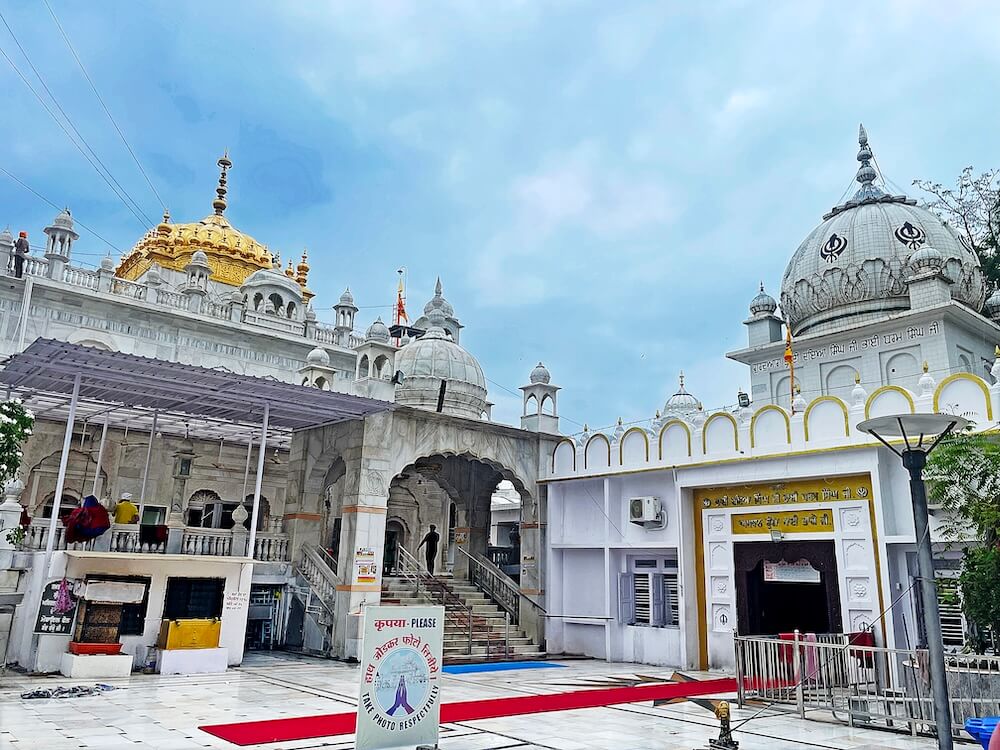
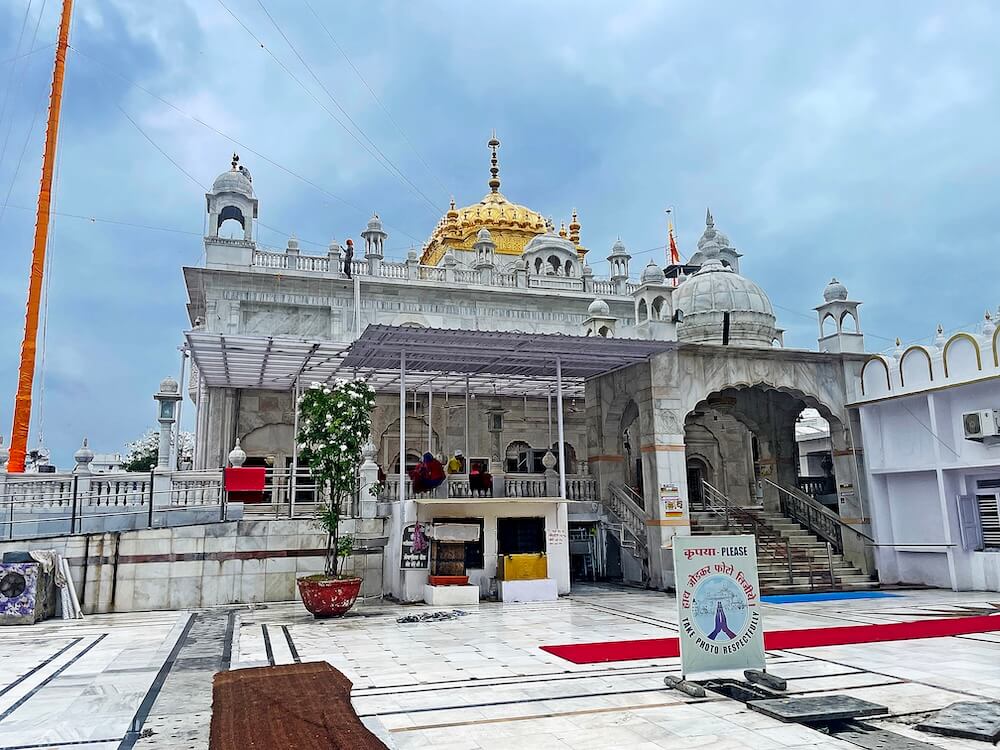
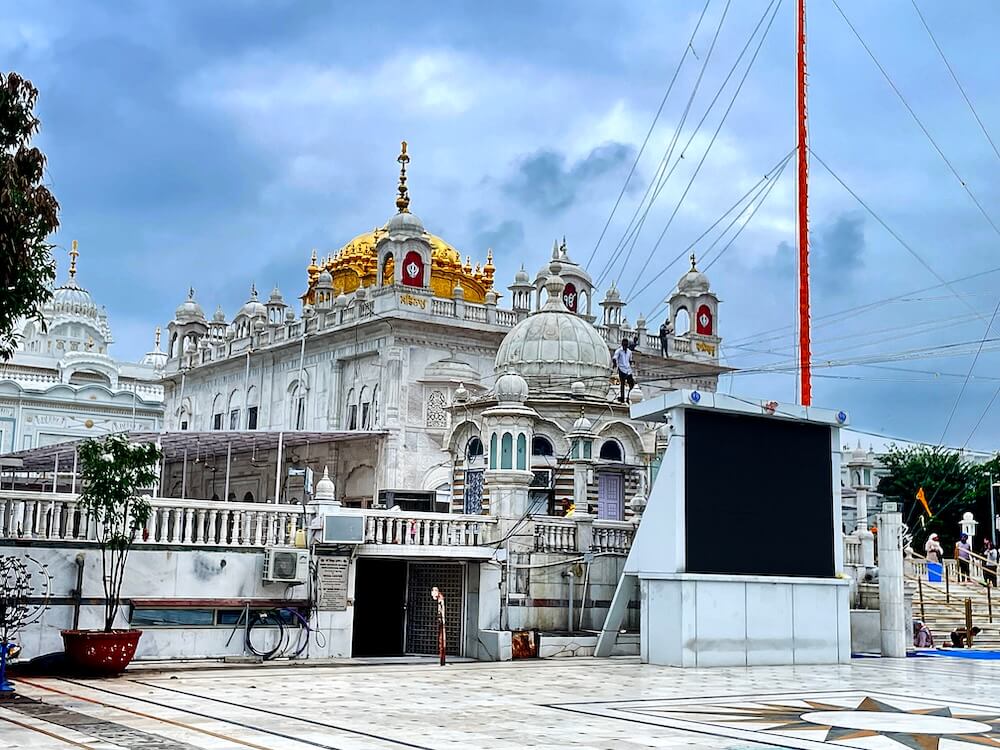
Built in the nineteenth century, this structure is a magnificent blend of Hindu and Mughal architectural styles. The west-facing Gurudwara has four grand entrances in its fortification. Developed over an area of approximately 1.82 lakh square meters, this complex provides hundreds of rooms for devotees, multi-purpose halls, and a Langar facility. In the Langar Bhavan, 2000 devotees can partake in Prasad at the same time. The beautiful gardens in the courtyard, the effective use of granite, and the greenery everywhere further enhance the beauty of the Gurudwara. The main structure stands on a high plinth in the center of the courtyard. The construction is made of brick and lime, finished with high-quality plaster. Octagonal minarets on all four corners further enhance the grace of this building. In the front of the structure, there is a flagstaff about 25 meters high on a platform. Atop it is a 1.82-meter-high gold-plated arrow.
The intricate carvings significantly contribute to the beauty of the Gurudwara. The paintings on the walls and ceilings appear to have been created using the ‘fresco’ technique. Red, yellow, and blue colors are primarily used. Mughal painting styles and glasswork are visible here. The interior of the dome and the ceilings and walls of the first floor are covered with copper sheets plated with gold. It is said that more than 50 kilograms of gold were used for this. Additionally, there are unique carvings on marble stones, featuring geometric patterns and images of birds inlaid with multicolored precious stones.
The main sanctum sanctorum located at the center of this structure is known as ‘Sinhasan Sahib’. It is at this very spot that Guru Gobind Singh Ji merged into the Infinite. Ever since the installation of the Guru Granth Sahib as the eternal Guru, an Akhand Nandadeep (a lamp fueled by pure ghee) has been burning here continuously. The continuous recitation of the Granth Sahib takes place here. Sacred weapons are preserved at this location. At the pinnacle of the Gurudwara, there is a beautiful dome that is five meters in height. The total height of this structure from the ground is approximately 15 meters.
The daily rituals at the Gurudwara commence at 2 o’clock in the middle of the night. Between 2 and 3 o’clock, the recitations of Sri Japji Sahib and Sri Sukhmani Sahib take place. While these recitations are ongoing, the Manji Sahib, weapons, and garments are bathed with the holy water of the Godavari. A person is specially appointed to fetch this water, and he is known as the ‘Ghagariya’. Between 3 and 6 o’clock in the morning, Kirtan is performed. At 6:15 in the morning, the Bhog Prasad is offered. Until 6:45 in the morning, the Hukamnama is read for 10 minutes. Thereafter, until 8 o’clock, the Kirtan Anand Sahib is performed. Between 8:30 and 10 o’clock in the morning, the Akhand Path concludes, and the Akhand Path for the next day is immediately initiated.
Apart from this, festivals such as Kartik Shuddha Dwitiya (the day Guru Gobind Singh Ji installed the Guru Granth Sahib as the eternal Guru), Kartik Shuddha Panchami (the day Guru Gobind Singh Ji departed for Sachkhand), Kartik Shuddha Purnima (the birth anniversary of Sri Guru Nanak Dev Ji Maharaj), Paush Shuddha Saptami (the birth anniversary of Sri Guru Gobind Singh Ji), and Vaisakhi (the foundation day of the Khalsa Panth) are celebrated here. During the festival period, thousands of devotees from across the country are present here.
This sacred temple stands as a testament to deep spiritual devotion, ancient architectural grandeur, and rich local cultural traditions.
The sanctum sanctorum houses the divine idol consecrated according to ancient Vedic traditions, surrounded by serene courtyards and traditional temple architecture.
Navratri, Maha Shivratri, Annual Temple Jatra & Deepotsav
Compare and book flights, secure top-rated local hotels near the temple, hire reliable guides, and rent cars instantly.
Extend your pilgrimage by visiting other highly sacred temples located nearby.


Add ₹999 more to unlock FREE SHIPPING!
Your sacred cart is currently empty.
Shop Photo FramesFill in your delivery details below to place your order.
Add comment