
Add ₹999 more to unlock FREE SHIPPING!
Your sacred cart is currently empty.
Shop Photo FramesThere are many spiritual and mythological references hidden behind the title ‘Siddheshwar’ of Mahadev. ‘Siddha’ means one who has attained perfection, is accomplished, and is endowed with all virtues, and ‘Ishwar’ means the Supreme Lord. According to Shaivism, Mahadev is considered the supreme form of philosophy, penance, yoga, and spirituality. Many temples dedicated to Mahadev under the name Siddheshwar are famous across Maharashtra. Among these, the approximately four-hundred-year-old Siddheshwar Temple in Kharatwadi, located in Hadgaon taluka, is a place of faith for thousands of devotees. Devotees believe that the awakened Mahadev here grants the wishes of those who pray with devotion.
The legend of this temple is that a Shiva devotee from this village used to regularly go to the nearby village of Ekala to worship Mahadev. However, he always faced obstacles while performing the worship. Disappointed, he sat down on a stone in one place. There, he fell into a trance and received a divine vision. When the shepherd woke up, he saw one of his cows releasing milk onto a stone hidden in the bushes. He realized that according to the divine vision, this was the abode of Mahadev, and when he cleared the bushes, a self-manifested (Swayambhu) Shiva Linga appeared from the ground. Later, by the grace of God, he built a Mahadev temple at this site.
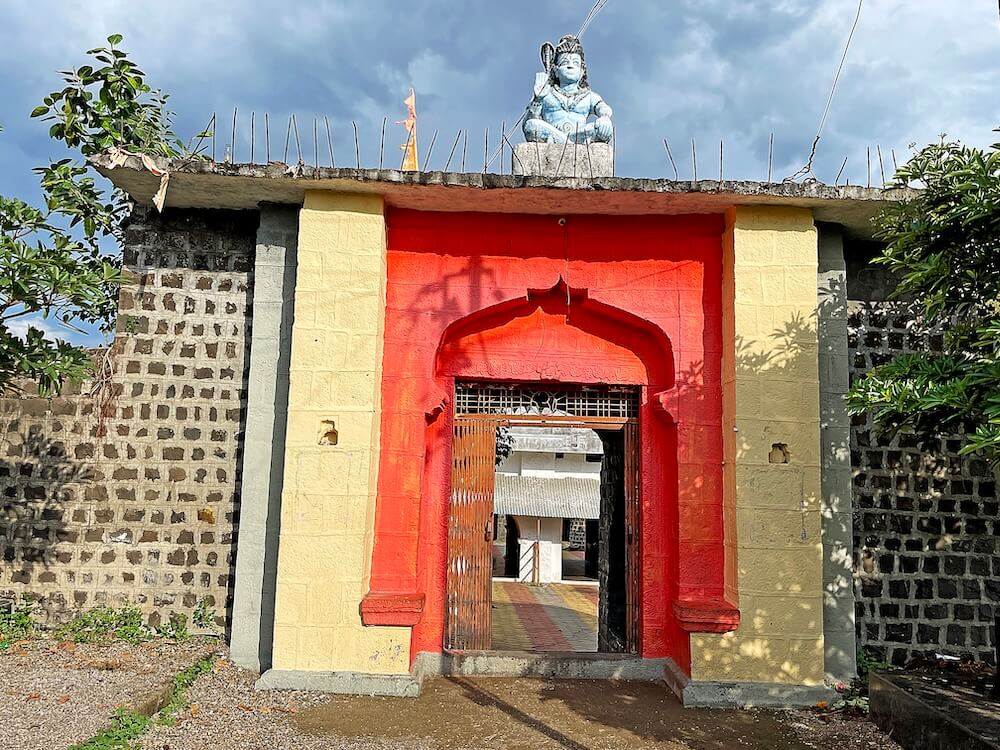
There is a welcome arch on the road leading from the main road to the temple. This arch features circular pillars on both sides, an arched lintel above, and a meditative idol of Mahadev in the niche above. The temple has a strong stone fortification with a large entrance gate. Since this entrance has been reconstructed, it displays a beautiful blend of the old and the new. Between the two ornate square pillars on either side of the entrance are lamp niches (Deep-koshtakas), and there are seats for guards on both sides below. There are faint floral carvings on the door frames and the lintel. There is an arched gateway above the entrance and guard rooms on the inside. There is a staircase to go onto the fortification from the back of the entrance. In the center of the ceiling of the entrance, there is a meditative idol of Mahadev on a Vajra-peetha.
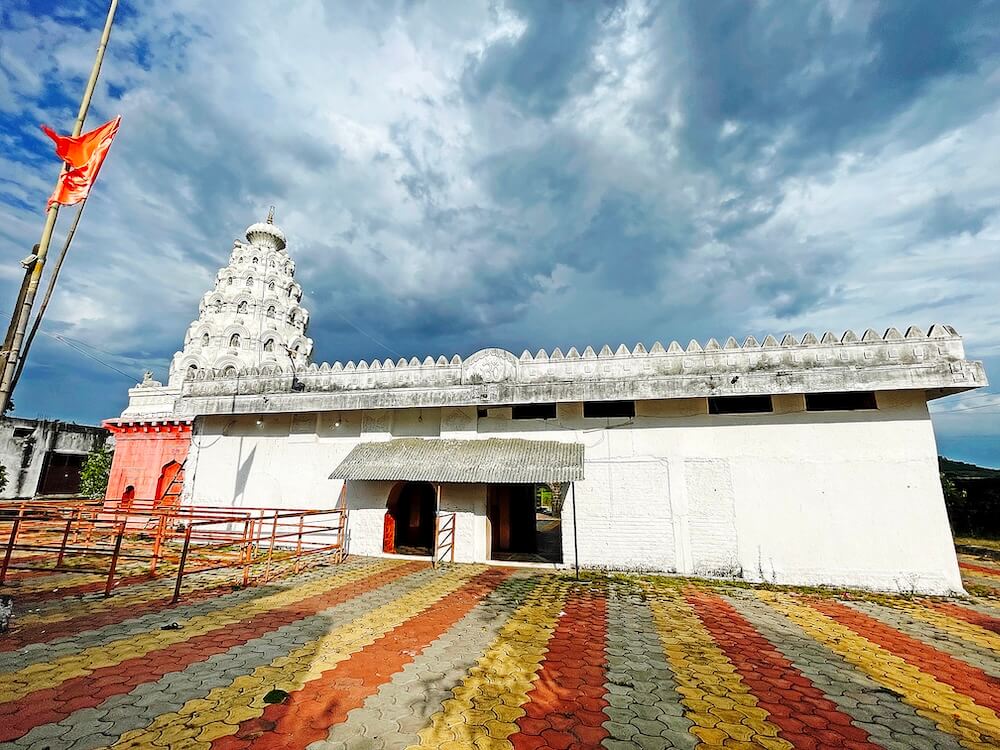
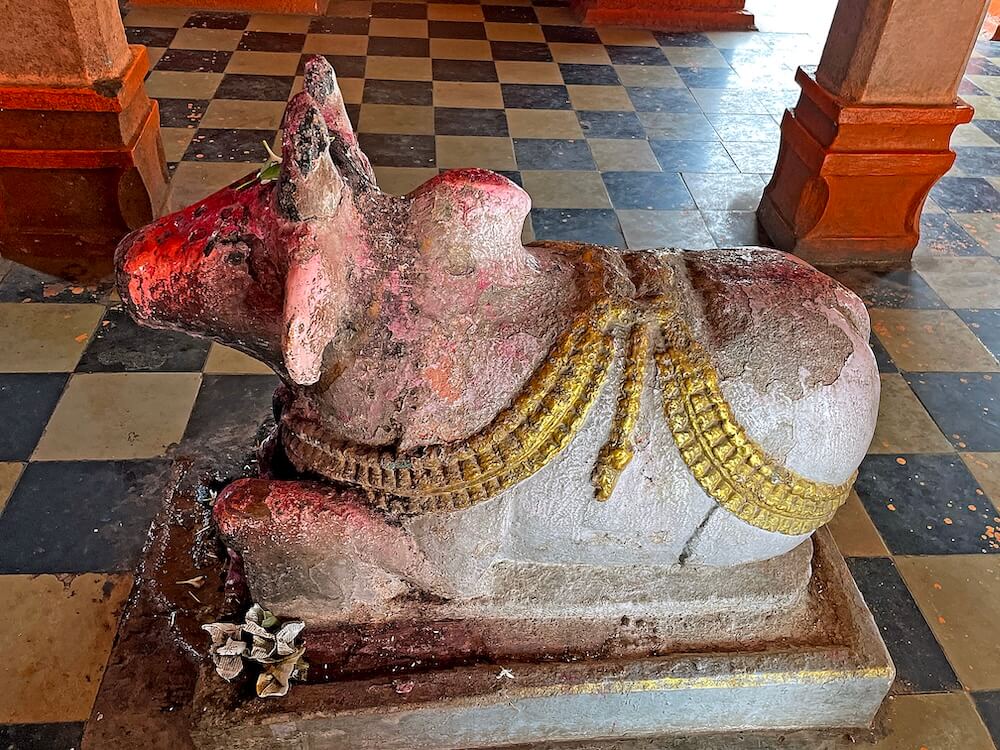
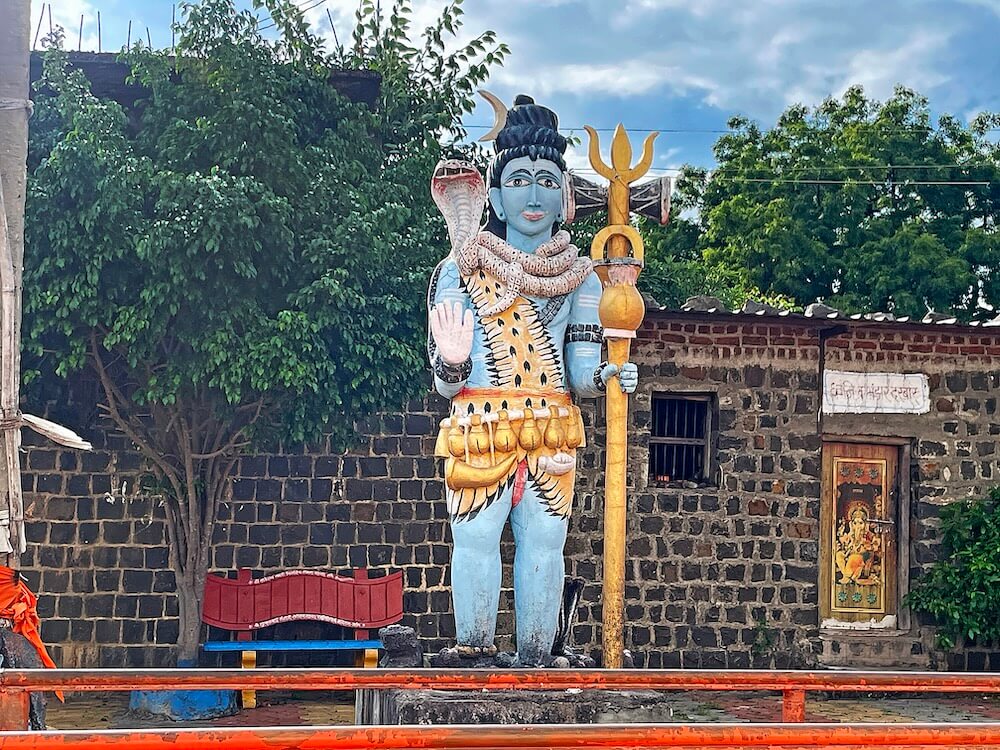
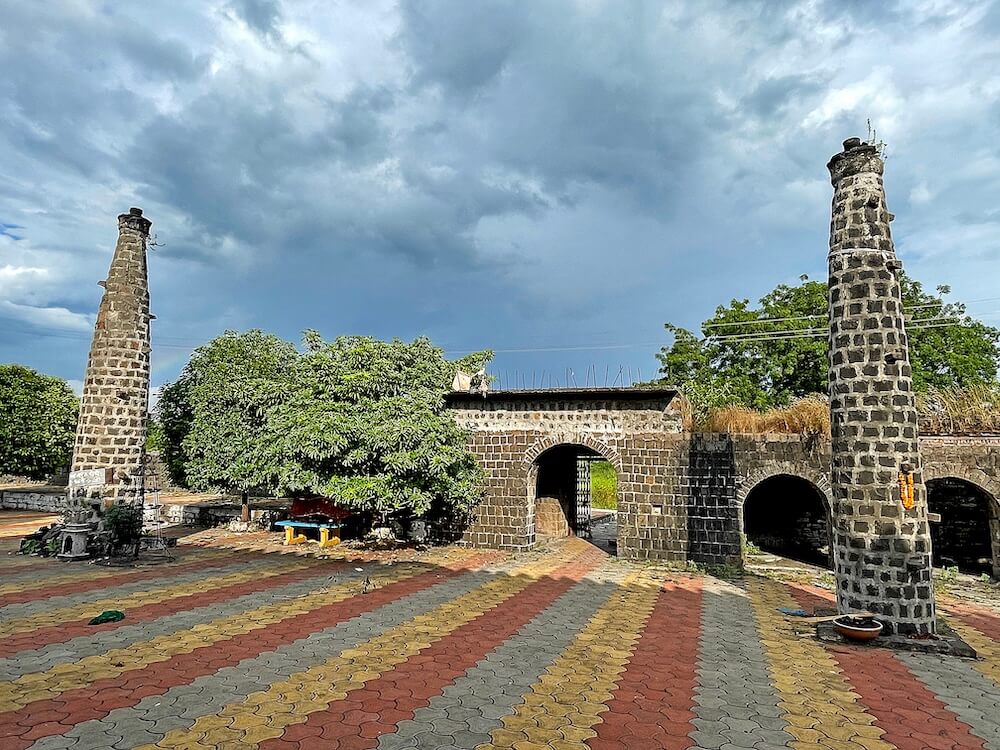
The temple courtyard is paved with paver blocks. There are many ancient structures along the fortification on all sides of the courtyard. These include a Dharmashala (pilgrim rest house), the temple’s storehouse, and the priest’s residences. There is seating arrangement for devotees in the courtyard. In the center of the courtyard, on a raised platform, stands a five-foot-tall idol of Mahadev. In one hand, Mahadev holds a Trishul with a Kamandalu attached to it, and the other hand is in a blessing posture. Next to the idol is a Shiva Linga. Beside this idol, there is another idol of Mahadev in a seated position. The queue for darshan is managed using iron barricades in the courtyard. There are two tall stone lamp pillars (Deep-stambhas) in the courtyard. The temple, originally consisting of a Sabha-mandap (assembly hall) and a Garbhagriha (sanctum sanctorum), was renovated a few years ago. Since a closed hall was built attached to the original Sabha-mandap, the original entrance from the front has moved inside. Therefore, one can enter the Sabha-mandap through doors on the left and right sides. This Sabha-mandap has four stone pillars and three semi-circular arches above them. It appears that this originally open-style Sabha-mandap was later enclosed by building walls. The enclosed Sabha-mandap has ventilators for airflow. In the center of the Sabha-mandap, there are two rows of four pillars each. These pillars stand on stone bases about one and a half feet high, with beams and a roof above them. Brass bells are hung from the ceiling. There are circular carvings on the ceiling. In the center of the floor of the Sabha-mandap, there is an idol of Nandi on a platform.
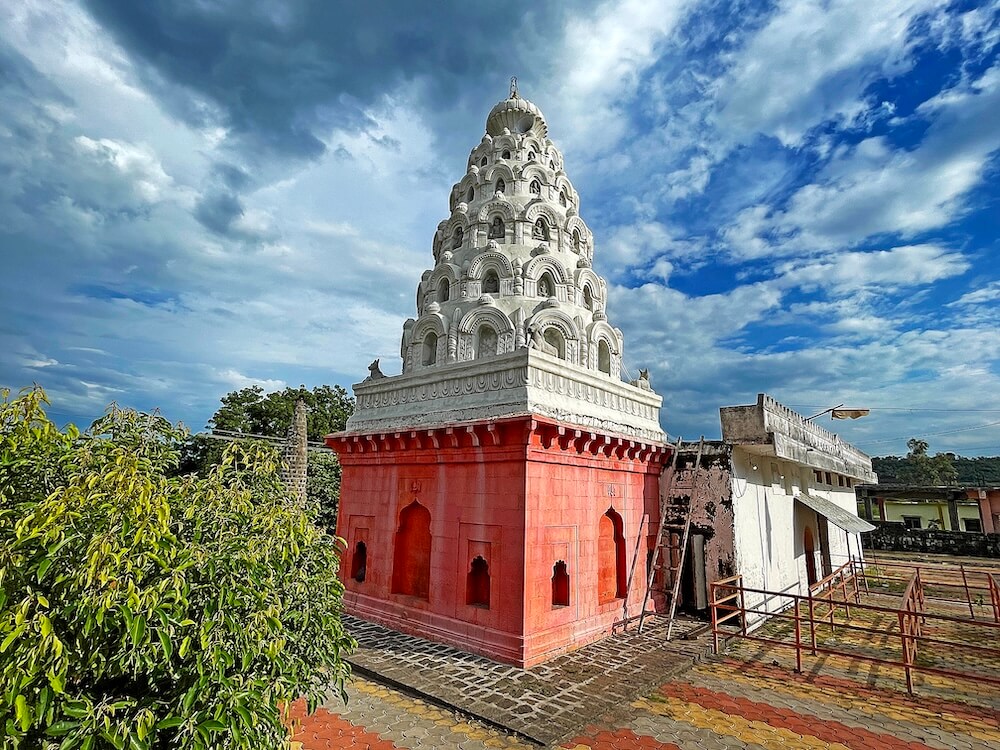
Further ahead is a semi-circumambulation path, a few inches higher than the Sabha-mandap, and beyond that is the Garbhagriha, which features stone construction in the Hemadpanti architectural style. There are doors on both sides behind the Garbhagriha on the circumambulation path. Further ahead is the entrance to the Garbhagriha. On both sides of the entrance, there are lamp niches in the walls of the Garbhagriha. The entrance has square pillars on both sides and an arched lintel above. The pillars have ring carvings at the bottom. There are faint carvings on the door frames and lintel of the Garbhagriha. In the center of the Garbhagriha, on the floor, is the self-manifested Shiva Linga with a naturally formed Shalunka (base) around it. A brass vessel for ritual bathing (Abhishek) is hung from the ceiling, dripping water onto the Shiva Linga. It is said that the size of this Shiva Linga is increasing day by day. Next to the Shiva Linga is a brass mask of Mahadev. The ceiling of the Garbhagriha is octagonal and dome-shaped. Brass bells offered by devotees are hung from the ceiling. The exterior of the Garbhagriha has a high plinth all around. The roof of the Sabha-mandap has a parapet wall on all sides, and the roof of the Garbhagriha has Nandi sculptures on all four corners. In the center above the Garbhagriha is a five-tiered circular Shikhara (spire). Each tier of the Shikhara has twelve niches containing divine images. At the top of the Shikhara is the Amalaka and the Kalasha.
Maha Shivratri and the month of Shravan are the main annual festivals celebrated with great devotion in the temple. During all annual festivals, programs such as Maha-Abhishek, Bhajans, Kirtans, discourses, and Maha-Prasad are organized in the temple. At this time, hundreds of devotees from the surrounding area come for the darshan of the deity and to fulfill their vows. The area takes on the appearance of a marketplace as shops selling various items are set up. The temple sees a rush of devotees every Monday, on full moon days (Purnima), and new moon days (Amavasya).
This sacred temple stands as a testament to deep spiritual devotion, ancient architectural grandeur, and rich local cultural traditions.
The sanctum sanctorum houses the divine idol consecrated according to ancient Vedic traditions, surrounded by serene courtyards and traditional temple architecture.
Navratri, Maha Shivratri, Annual Temple Jatra & Deepotsav
Compare and book flights, secure top-rated local hotels near the temple, hire reliable guides, and rent cars instantly.
Extend your pilgrimage by visiting other highly sacred temples located nearby.


Add ₹999 more to unlock FREE SHIPPING!
Your sacred cart is currently empty.
Shop Photo FramesFill in your delivery details below to place your order.
Add comment