
Add ₹999 more to unlock FREE SHIPPING!
Your sacred cart is currently empty.
Shop Photo Frames‘Kasar’ means a lake and ‘Pal’ is a suffix denoting a settlement or flood-plain. Kasarpal thus means the city of lakes. Situated in the scenic surroundings of Bicholim, this city of lakes is renowned for the ancient temple of Mahamaya Kalika Mata. Known in ancient times as Kalamba Devi, the Kalika deity here is the Kuladevata (family deity) of the Daivadnya Brahmin community. Although Goddess Kalika is a deity of fierce nature, here she assumes a gentle and serene form. A grand Yatra (procession) of the Goddess is held here on the day of Gudi Padwa.
According to mythological legends, Kalika is a form of Mahakali Devi. The ‘Kalika Purana’ states that Kalika Devi was born from the womb of Mahamaya. According to mentions in the Mahabharata, Kalika is the daughter of Daksha Prajapati and the wife of Sage Kashyapa. The ‘Devi Mahatmya’ states that the primordial nature, Adimaya Bhagavati Mahalakshmi, created two forms: Mahakali from Tamoguna and Mahasaraswati from Sattvaguna. Thereafter, Mahalakshmi asked Mahakali and Mahasaraswati to each produce a pair of male and female beings suitable to their respective qualities. From this, the universe and creation were formed. Thus, it is believed that just as Mahakali is the destroyer, she is also the Mother of the Universe and the sustainer.
The exact time of the establishment of this Kalika Mata temple is still unknown. However, a record has been found suggesting that this temple dates back to the fifteenth century or earlier. Major Le Grand Jacob, the Political Superintendent of the Sawantwadi State, received a ‘Tambyapatto’ (copper plate) from a person named Vaikunth Babani Sawant, belonging to the Kasar caste from Mapusa. He handed it over to the Bombay Government on 11 July 1850. Known as the ‘Nagdeva Copper Plate’, the final part of this original Sanskrit inscription mentions: ‘…Nagdeva, the powerful son of Kaindeva; a devotee of Shankara, wise, and always immersed in the meditation of Shankara. And he, standing before all the Kasar Mahajans in the village named Pallika (Kasarpal)… gave the village of Varade as an endowment to all. In the year of Sri Nala, in the month of Chaitra, Shaka 1358, this copper plate was given to Lakshmanseti, the son of Rupaseti, who was a son born by the grace of Sri Kalika Devi…’ This clarifies that in Shaka 1358, i.e., 1436 AD, a king named Nagdeva Samant of the Kudaldeshkar Gaud Brahmin caste was ruling here. Similarly, the temple of Kalika Devi existed in Kasarpal village since before 1436 AD, and the temple was so famous that people made vows to the Goddess for the birth of a son. Some believe that the idol of Kalika Devi in this temple is in the sculptural style of the Gupta period. Therefore, it is said that this temple belongs to the Gupta period, specifically between 380 and 413 AD, during the reign of Chandragupta II Vikramaditya. This conjecture is based on the fact that the great poet Kalidasa was in the court of this Chandragupta and was a devotee of Kali Mata, and the idol of Kalika Mata is in the Gupta style. Although the worship of Kali Devi has been popular in the Malwa region since the second or third century AD, Mahamahopadhyaya V. V. Mirashi has shown in his biographical work ‘Kalidasa’ that Kalidasa was not a devotee of Kali. Because of this, the confusion regarding the establishment date of this temple remains. Nevertheless, the antiquity of this temple goes back at least six centuries. The ancient village of Kasarpal and this temple were not affected by the atrocities of the fanatical Portuguese. The reason for this is that the momentum of the Portuguese campaign for Christianization had largely broken by around 1600 AD. The talukas of Bicholim and Sattari came under Portuguese control in 1781 AD. Consequently, the ancient temple here remained intact. It attained its present form after periodic renovations.
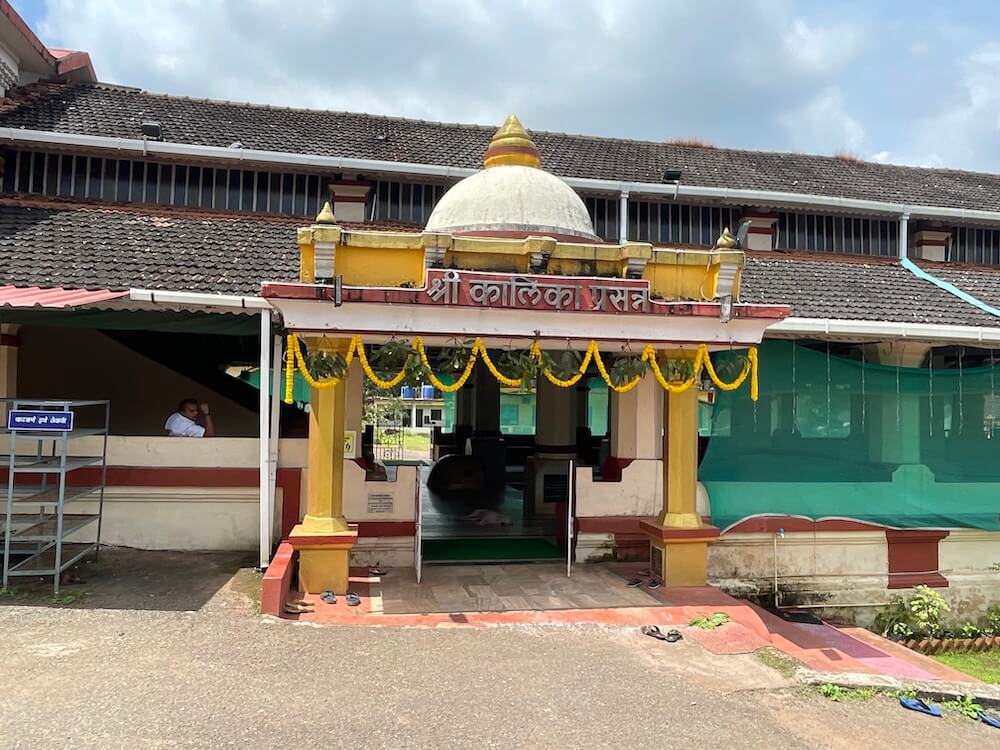
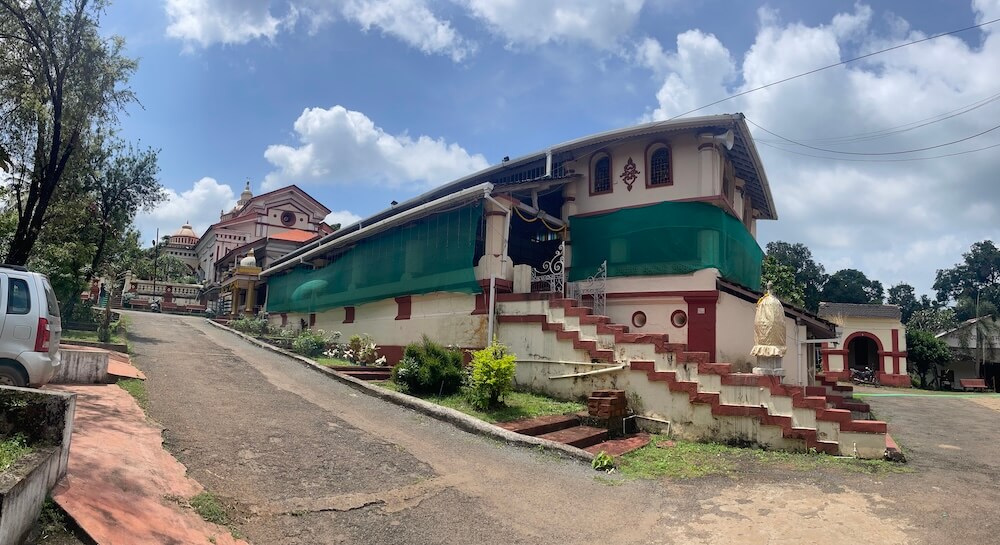
The temple is built on the slope of a high, hill-like area of the village. The temple complex has a grand entrance gate built of red laterite stone. On the upper part of this arched gate, built in 2016, there are three bell-shaped spires. As one enters from here, there is a tall, eight-tiered octagonal lamp pillar (Deepastambha) on the left side. On the lower tier of this tower-like pillar, Vyala sculptures holding lamps are seated. The impression is created as if they are balancing the pillar on their heads. On the tiers above it, four-armed divine figures are carved on all sides. This pillar was constructed in 1986.
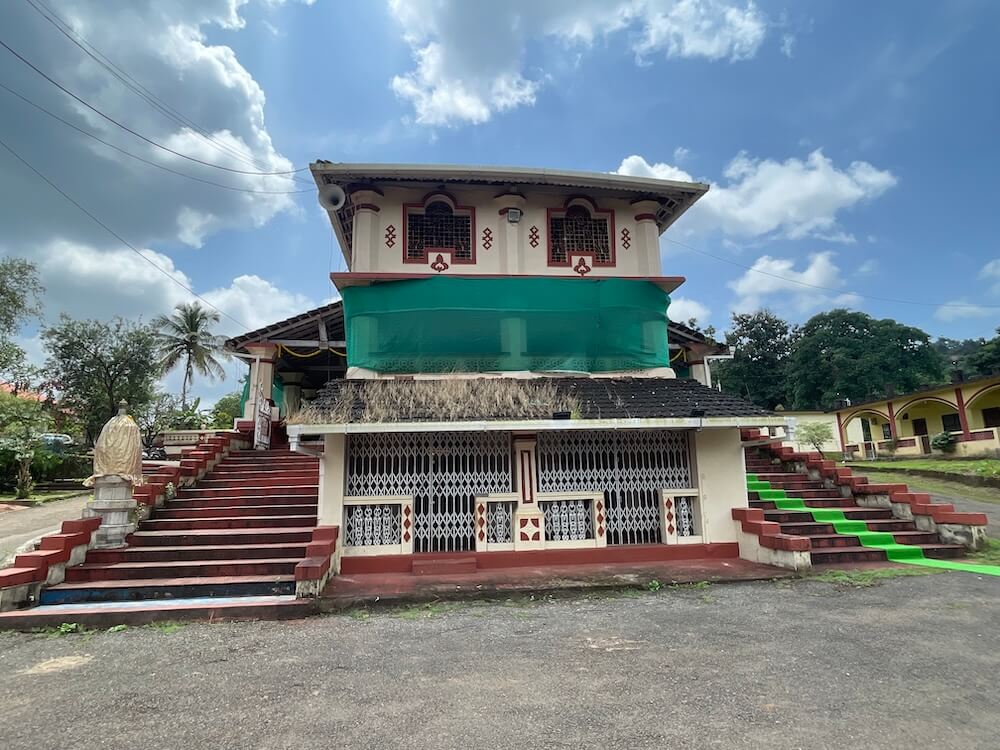
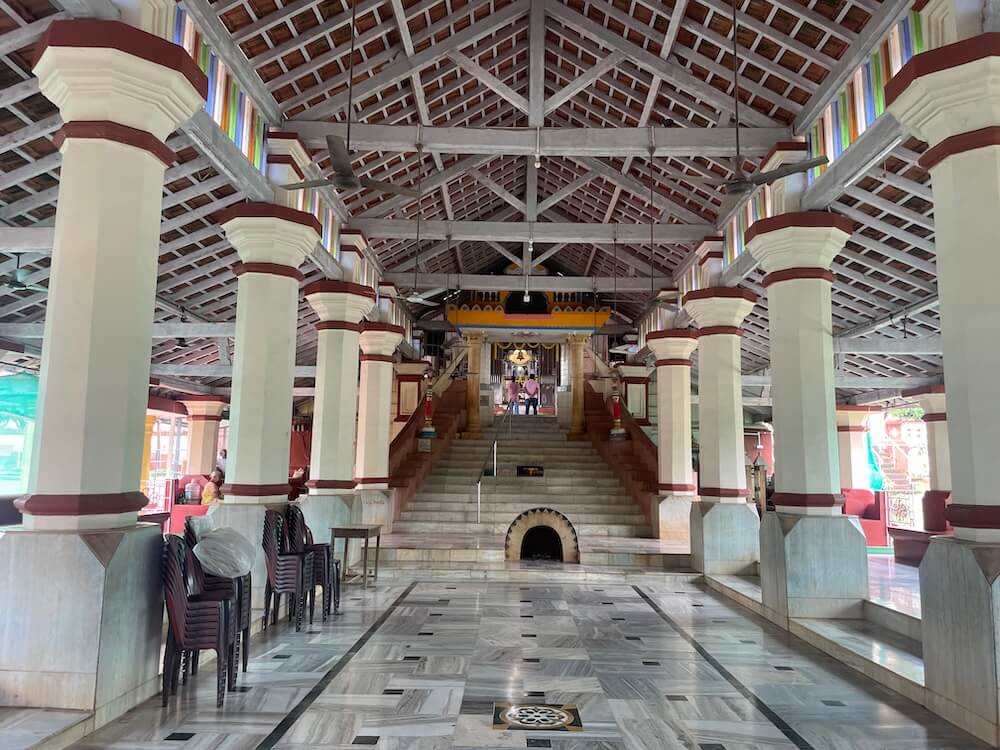
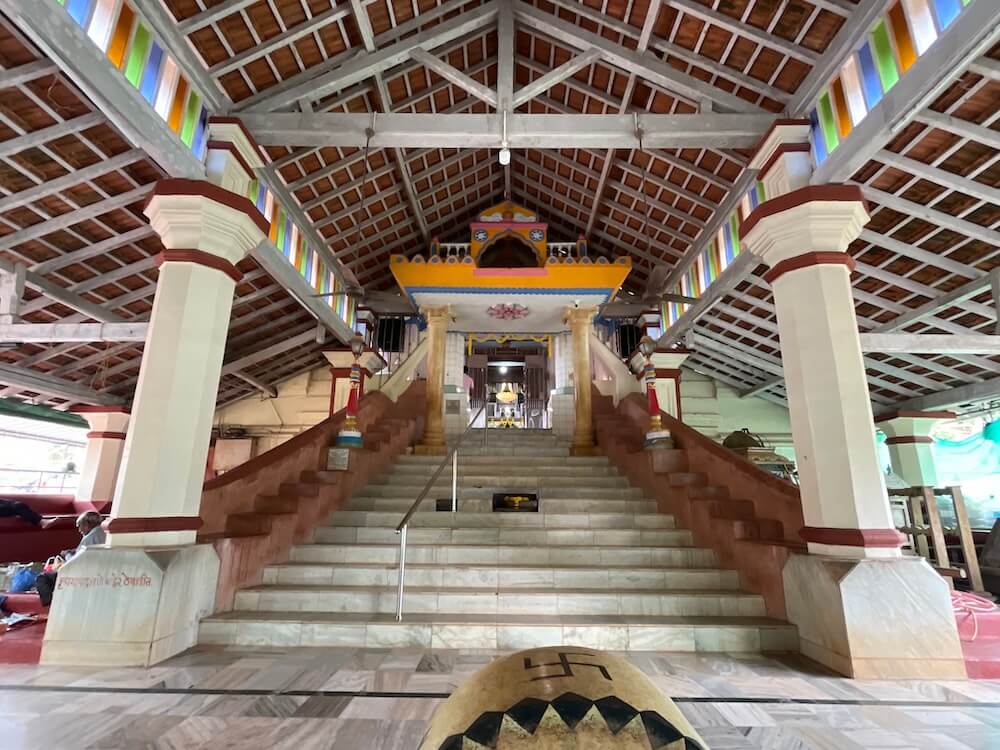
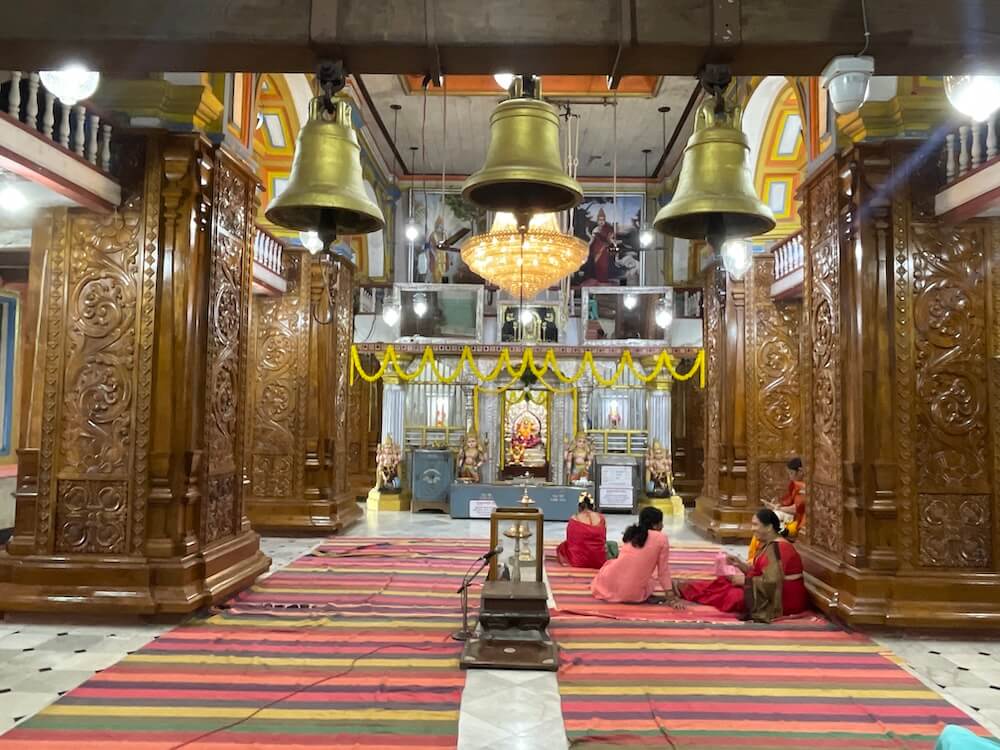
A short distance from here stands the grand two-storied structure of the temple. One enters the main Sabha Mandap (assembly hall) of this temple by climbing stairs on both sides. The Sabha Mandap is of a semi-open type. The structure of the Sabha Mandap consists of a stage in the front, seating benches (Kakshasanas) on both sides, rows of stone pillars on both inner sides, and a sloping roof supported by wooden beams. Here, colored glass panes are fitted in the space between the beams above the pillars and the roof. From here, one climbs 17 steps to enter the Ardha Mandap (half-hall). On the first step, in the center, is a small shrine of a local folk deity, while in the middle of the stairway path is a flat stone of the deity. This Ardha Mandap also has a large entrance. This semi-open Ardha Mandap has seating benches on all four sides. From here, one climbs three steps to enter the Upa-Sabha Mandap (sub-assembly hall). In this Upa-Sabha Mandap, there is a row of wide wooden pillars with floral carvings in the middle. Above them is a balcony with a wooden railing. Three large brass bells are hung from the beams above. Similarly, a crystal chandelier is hung from the ceiling. In the center of the Upa-Sabha Mandap, a brass lamp (Samai) is kept in a glass cabinet. The Mukha Mandaps (front halls) on both sides of the Upa-Sabha Mandap have dome-shaped spires.
In the center of the front of the sub-assembly hall (Upasabha Mandap) lies the Antarala (vestibule) of the temple. The outer walls and pillars of the Antarala are adorned with silver-plated sheets featuring intricate carvings. On both sides of the entrance, as well as in front of the side pillars of the Antarala, there are a total of four statues of Dvarapalas (gatekeepers). Above the entrance, images of Kalika Mata, as well as Lakshmi and Narayana, are installed. Inside the Antarala, on the right side in a niche, is the idol of Ganesha, and on the left side is the idol of Shankara. In the sanctum sanctorum (Garbhagriha), the idol of Kalika Devi is seated on a silver throne within a silver-plated Makhar (shrine canopy) intricately carved with floral and leaf patterns, along with figures of lions and Yakshas. The Goddess holds a sword in her right hand and a shield in her left. The Goddess is adorned with garments and ornaments, and wears a crown upon her head. Behind the idol is a silver Prabhaval (halo). On the step in front of the throne, a small metal replica of the original idol of the Goddess is placed. On both sides of the Makhar, there are three tall brass lamps (Samai) each.
The Garbhagriha is topped by a distinctive Shikhara (spire) in the Goan architectural style. This Shikhara consists of a dome-shaped base, followed by a squat tower-like structure, a smaller dome above it, an Amalaka, and a large golden Kalasha at the very top, shaped like a coconut. The temple premises house the shrines of the Panchayatan deities: Bhumika Devi, Shripalnath, Ravalnath, and Shetyo. There is also the Kalambadevi Museum, an Agrashala (pilgrim residence), and a Bhojan Mandap (dining hall). The museum preserves traditional items used in the temple, such as ancient musical instruments, Laman lamps, Samais, and Kasali drums.
Among the various festivals celebrated at the Mahamaya Kalika Mata temple, the Shishirotsava holds a special place. This festival is celebrated over seven nights, from Phalguna Vadya Dashami to Chaitra Shuddha Dwitiya. On the day of Dashami, the Goddess is adorned in a yellow garment (Haldula). Traditional religious rituals are performed at the Bhumika temple. Suvari music is played to invoke Lord Ganapati. On the day of Dashami, the temple trustees (Mahajans) take the Bhivri to the nearby lake. It is said that this is the only temple in Goa where the ancient tradition of the Bhivri ceremony is still practiced. Women participate in this procession dressed in their finest attire. A major attraction for devotees during the festival is the chariot procession of the Gudis, which takes place on Chaitra Shuddha Dwitiya. The Goddess is mounted on this chariot and taken to the Bhumika temple, from where the chariot is brought back to the base of the temple steps. There, a community prayer (Garhane) is offered. Following this, Gulal is offered to the Goddess, after which a ritual of throwing Gulal at one another takes place. Countless devotees from the surrounding five-village region attend this festival. A Shibikotsava (palanquin procession) is held at the temple every month on the night of the Shukla Paksha Chaturdashi. During this festival, a procession of Kalika Devi is taken out in a palanquin. Additionally, Navaratri and other important festivals and celebrations are observed here with great enthusiasm.
This sacred temple stands as a testament to deep spiritual devotion, ancient architectural grandeur, and rich local cultural traditions.
The sanctum sanctorum houses the divine idol consecrated according to ancient Vedic traditions, surrounded by serene courtyards and traditional temple architecture.
Navratri, Maha Shivratri, Annual Temple Jatra & Deepotsav
Compare and book flights, secure top-rated local hotels near the temple, hire reliable guides, and rent cars instantly.
Extend your pilgrimage by visiting other highly sacred temples located nearby.


Add ₹999 more to unlock FREE SHIPPING!
Your sacred cart is currently empty.
Shop Photo FramesFill in your delivery details below to place your order.
Add comment