
Add ₹999 more to unlock FREE SHIPPING!
Your sacred cart is currently empty.
Shop Photo FramesShaped like a peacock and globally renowned for the Olive Ridley turtles, the village of Morjim is situated in the vicinity of the Chapora hill. Blessed by the presence of the Chapora River and the sea, the village worships the Satpurush as its guardian deity. Famous in history as a center for the trade of Arabian horses, the village is also home to the Morjai Mata Temple, well-known for its exquisite Kavi art carvings. Much like that temple, the Satpurush Temple is also adorned with intricate Kavi art. Because of this, it attracts not only devotees but also temple scholars and tourists in large numbers.
Satpurush is a folk deity of Goa. He is a symbol of nature and is also considered the protector of the village. The Satpurush of Morjim is believed to be the creator of the village. According to local folklore, there was a poor family in Shirgao, Bicholim, consisting of seven sisters and one brother. The sisters were named Kelbai, Mahamaya, Shitala Devi, Mirabai alias Milagres, Ajadipa, Lairai, and Morjai. Khetoba, alias Khetlo, was their younger brother. The parents of these siblings had passed away. Among them, Lairai had a short temper. Once, when Morjai did not follow her command, an enraged Lairai threw her into the sea. At that time, the Satpurush was residing in this village. He saved Morjai from drowning and brought her to the hill in the village.
According to another legend, once the village of Morjim was plagued by many disasters. At that time, a villager was sitting by the sea, lost in deep worry. Suddenly, he saw a person walking on the waves of the sea. There was a divine aura around that person’s face. The villager informed him about the calamities befalling the village. The person then showed him the way to escape those troubles. That person came to be known as Satpurush. Later, the villagers built a temple for him.
There are many Satpurush temples in Goa. Many tales and folk stories are told about them. According to one such story, a devotee who loved singing bhajans lived in a village. He was always immersed in devotion. Whenever a bhajan started anywhere, he would lose track of his surroundings. Once, two men came to the village. They lured him by saying, “Come, we will let you listen to a bhajan,” and took him along. When the man realized they were not taking him to any temple but were leading him elsewhere, he became frightened. He started praying to Satpurush. Then, Satpurush appeared to him in a vision and told him to grab the tufts of hair (shendi) of those two men. As soon as he did so, he held the tufts of both men in his hands, and they vanished. Seeing this, the man fainted. When he regained consciousness, he was in front of the Satpurush temple in his village. Thus, devotees believe that Satpurush always protects the people of the village.
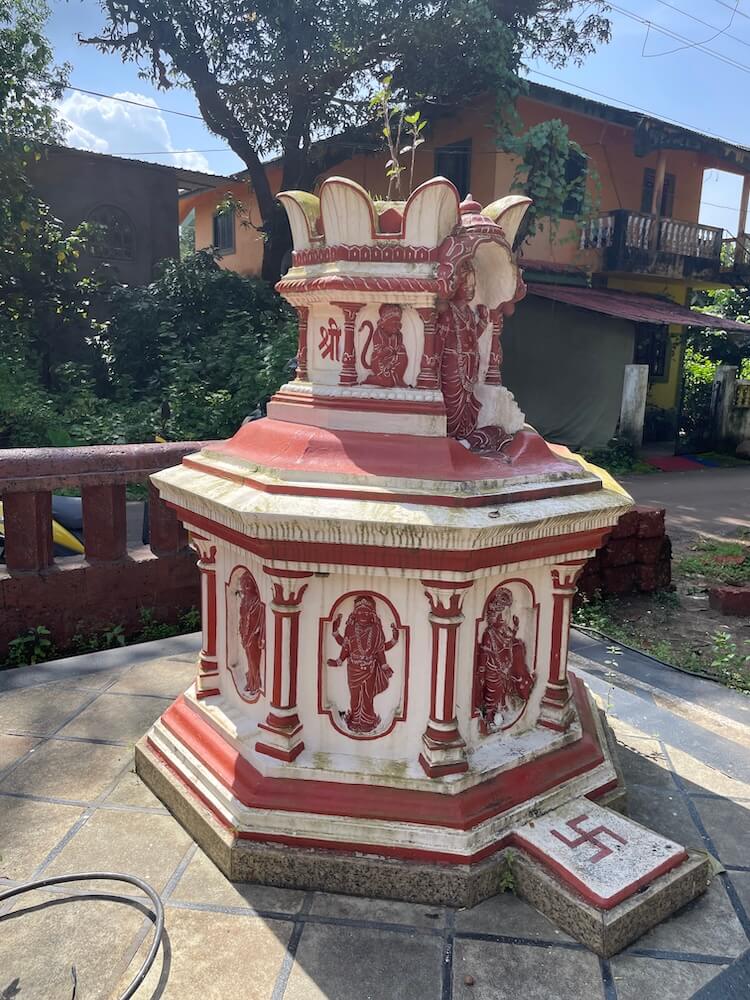
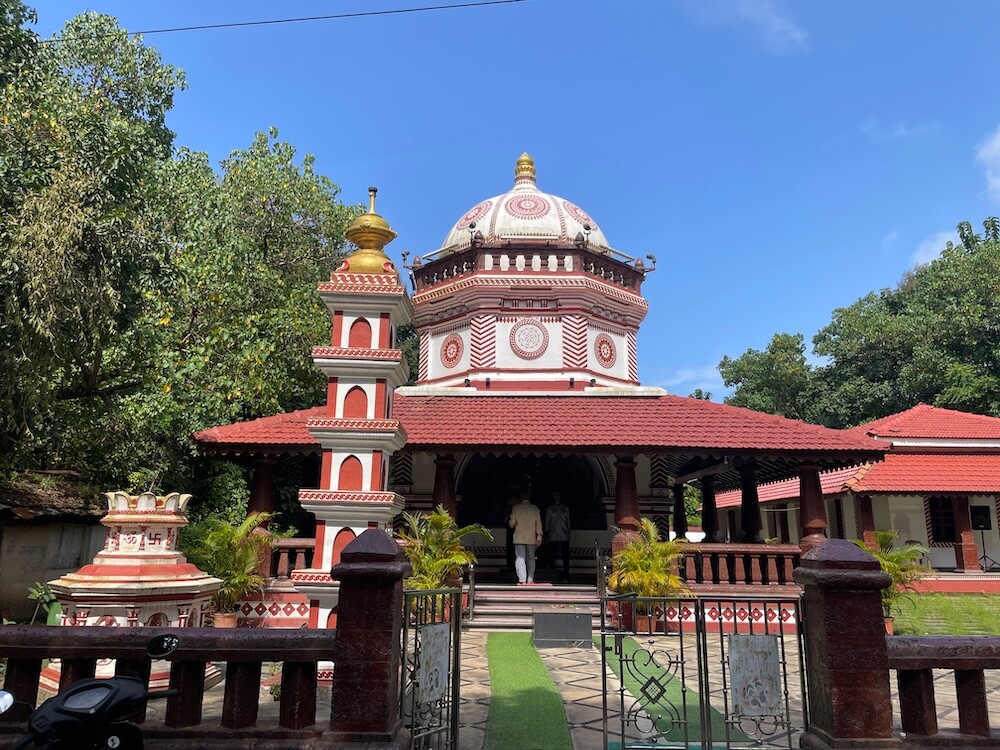
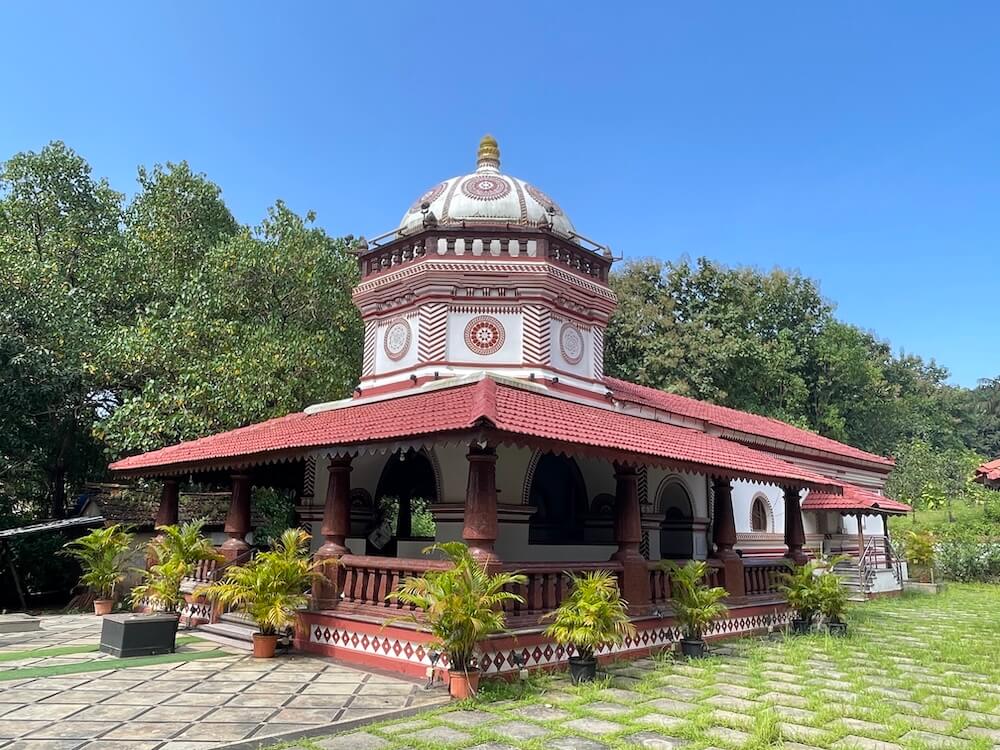
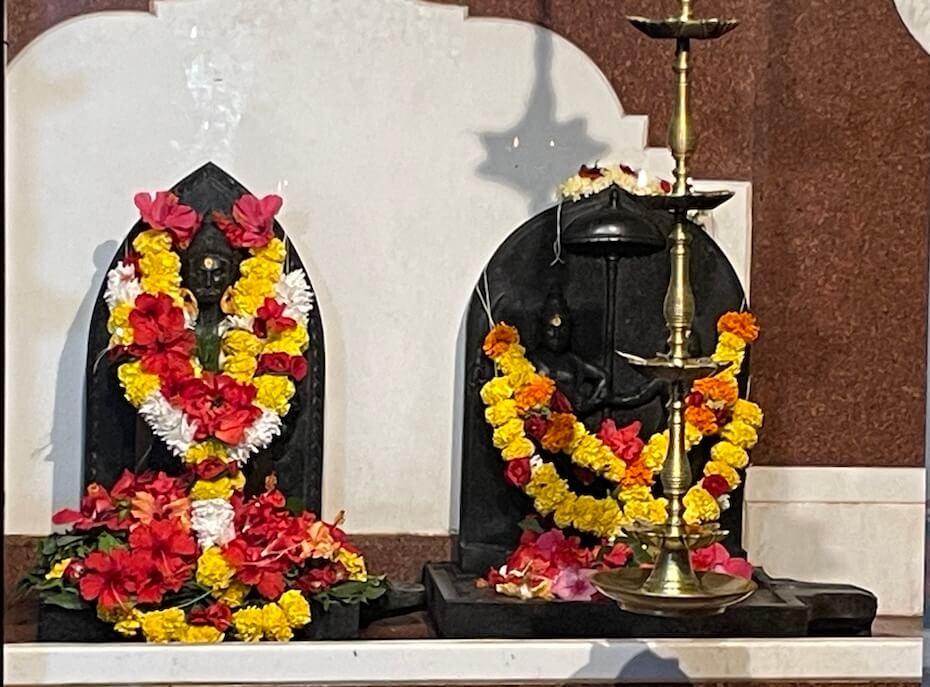
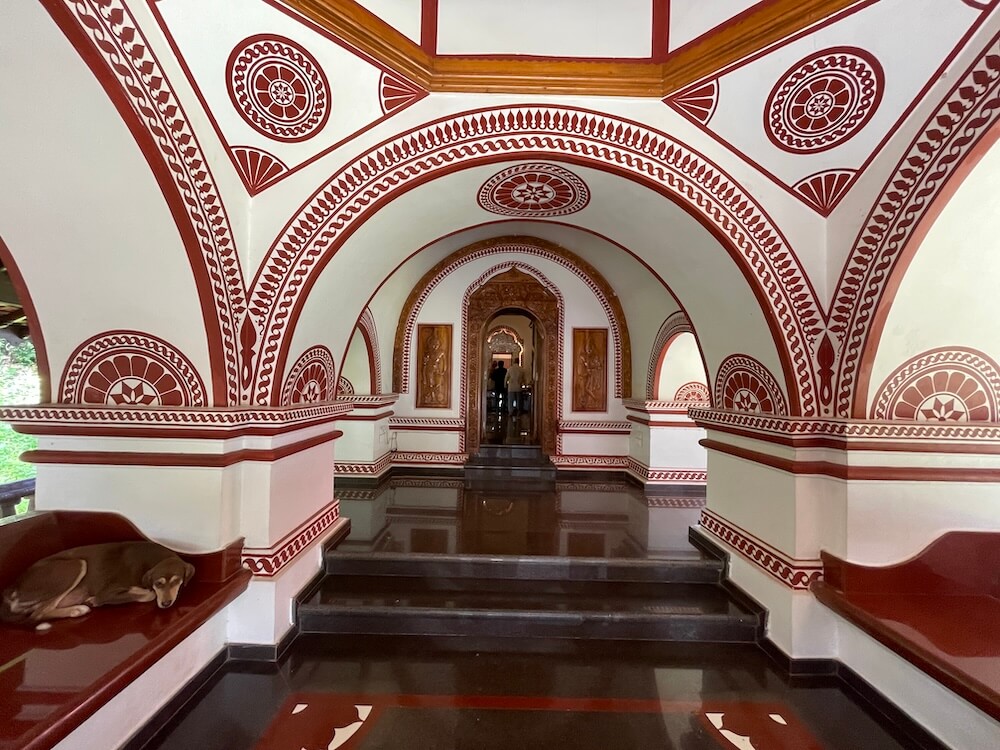
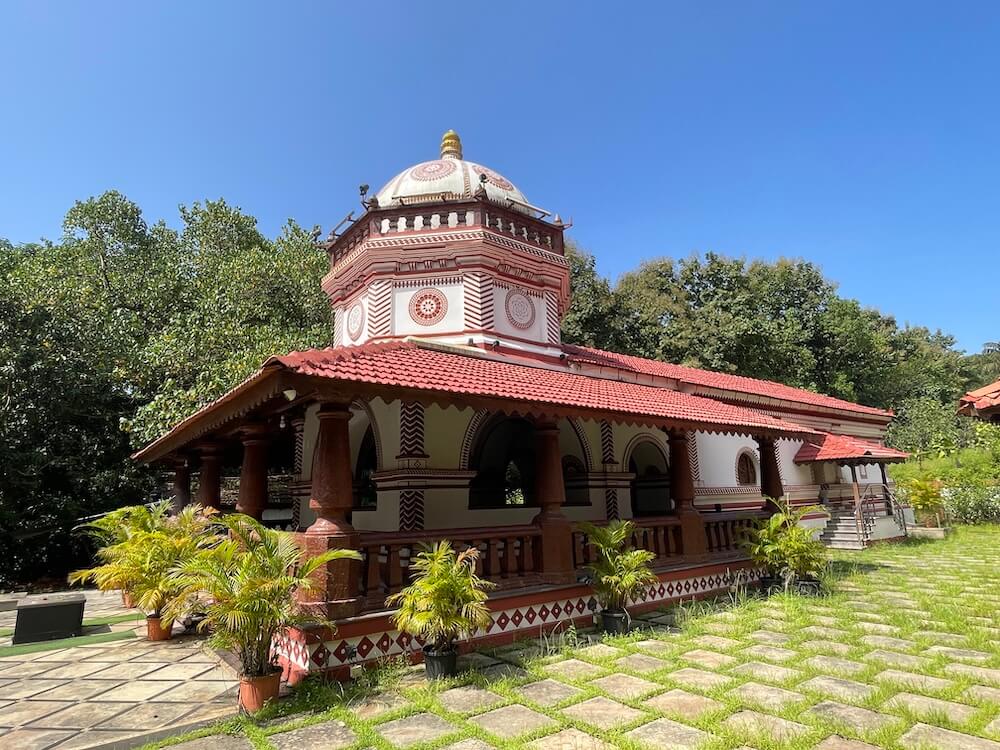
The Satpurush Temple is located in a large courtyard on a high spot in Morjim village, surrounded by lush green trees. Upon entering the courtyard, which is enclosed by walls on all four sides, one sees a six-tiered lamp pillar (Deepstambha) on the left. Next to it is a large octagonal Tulsi Vrindavan. In the niches on all sides of this Vrindavan are carved idols of various deities and saints. These include idols of Saint Tukaram and Samarth Ramdas. The temple structure consists of a veranda on all four sides, a central assembly hall (Sabhamandap), an Ardhamandap, an Antarala, and the sanctum sanctorum (Garbhagriha). An open arched entrance, an open assembly hall with stone seats (kakshasanas), large pillars connected by arches, sloping tiled roofs, and a tower-like spire are some of the characteristics of Goan temple architecture, which can be seen here as well. The arches and pillars of this temple feature geometric carvings in the Kavi art style. A Kirtimukh is placed above the entrance arch of the assembly hall. The hall has a dome-shaped ceiling, on which images of the Ashta-Dikpalas (guardians of the eight directions) are carved. On the front wall of the Antarala, on both sides of the entrance, are wooden carvings of Vaishnava Dwarapalas (gatekeepers). The entrance to the Antarala is decorated with wooden carvings. The entrance to the sanctum sanctorum is covered with gold plating, which also features intricate carvings. On the door frame, there are elephant figures and images of gatekeepers at the bottom, while a Kirtimukh is carved at the top center. Above this, in the upper section, the Omkar symbol is carved between two peacock figures. Inside the sanctum, two black stone idols of Satpurush are seated on a marble pedestal. One of these idols holds a sword in its hand and has a canopy above it. Some stones are also kept next to these idols. A unique feature of these stones, which are generally square or rectangular, is that their upper parts are pointed. Above the sanctum sanctorum is a large, hexagonal, tower-like spire with a dome at the top. On this dome sits a three-tiered Kalash.
Daily worship of Satpurush is performed in this temple. Like the Morjai temple, special decorations are made during the Navratri festival. Along with Navratri, various Hindu festivals and celebrations are observed here with great enthusiasm. Devotees from other villages who come for the darshan of Morjai, as well as tourists, make it a point to visit this temple to seek the blessings of Satpurush.
This sacred temple stands as a testament to deep spiritual devotion, ancient architectural grandeur, and rich local cultural traditions.
The sanctum sanctorum houses the divine idol consecrated according to ancient Vedic traditions, surrounded by serene courtyards and traditional temple architecture.
Navratri, Maha Shivratri, Annual Temple Jatra & Deepotsav
Compare and book flights, secure top-rated local hotels near the temple, hire reliable guides, and rent cars instantly.
Extend your pilgrimage by visiting other highly sacred temples located nearby.


Add ₹999 more to unlock FREE SHIPPING!
Your sacred cart is currently empty.
Shop Photo FramesFill in your delivery details below to place your order.
Add comment