
Add ₹999 more to unlock FREE SHIPPING!
Your sacred cart is currently empty.
Shop Photo FramesThe famous temple of Goddess Mhalasa, who is the Mohini form of Lord Vishnu and the consort of Lord Khandoba, is situated at Madhalamaj in Pernem Taluka. This Goddess is the Kuladevata (family deity) of many families, including the Gaud Saraswat, Karhade, Padhye, Daivadnya, Kalavant, and Bhandari communities, spanning across Goa, Western Maharashtra, and North India. There are many temples of the Goddess in the coastal regions of Karnataka, Maharashtra, and Gujarat. It is believed that the original seat of this Goddess is at Mardol in Goa. This temple in Pernem is ancient and renowned, and devotees hold a firm belief that the awakened Goddess here grants their prayers.
According to the eighth canto of the Shrimad Bhagavata Mahapurana, Lord Khandoba is an avatar of Lord Shiva. In this avatar, Mhalasai and Banai were his two wives, with Mhalasai being his first wife. Mhalasai is also known by the names Jogeshwari and Bhairavi. Mhalasai is also famous as the Mohini avatar. During the churning of the ocean (Samudra Manthan), to obtain the nectar (Amrita) from the demons, Lord Vishnu assumed the form of Mohini (a beautiful woman) and attracted the demons. Enchanted by Mohini’s beauty, the demons handed over the pot of nectar to her. This allowed the gods to consume the nectar. However, at that time, the gods themselves were also captivated by the divine form of Mohini.
One day, Lord Mahadeva insisted that Lord Vishnu show him the Mohini form. Lord Vishnu refused, but Mahadeva persisted. Finally, Lord Vishnu assumed the Mohini form once again for Mahadeva. Seeing that form, Mahadeva became enchanted by her. At that moment, Mohini entered the body of Goddess Parvati. Seeing Parvati in the form of Mohini, Mahadeva named her ‘Mhalasa’. When Mahadeva was attracted to the Mohini form, she promised him that in the future, when he would incarnate on Earth as Martand Bhairava (Khandoba), she would incarnate as Mhalasa and become his wife.
In Nevasa Budruk, Maharashtra, there lived a wealthy Lingayat Vani named Timseth. He had no children. Timseth was a devout worshipper of Lord Mahadeva. Mahadeva suggested to Mhalasai that she should be born in his house. One day, while Timseth was absorbed in worship, Goddess Parvati appeared before him. Parvati asked Timseth to close his eyes. When he did, Parvati assumed the form of a child. Timseth named this girl ‘Mhalasa’. When she came of age, one night, Lord Mahadeva appeared in Timseth’s dream and instructed him to marry Mhalasa to Lord Khandoba. As per Mahadeva’s instruction, the wedding of Khandoba and Mhalasa took place on Pausha Purnima at Pali in the Satara district of Maharashtra. The same Mohini form of Vishnu, which led to these events, is worshipped in many places as Goddess Mhalasa. One of the important and famous places of the Goddess is at Madhalamaj in Pernem Taluka.
This temple is said to be about four hundred to five hundred years old. Devotees who migrated from Mardol re-established the Goddess in their new settlements, and this is one such temple. The idol here was previously in a temple at Verem. However, after that temple was destroyed during the Portuguese invasion, the villagers brought the idol with them to Mandrem and built this temple.
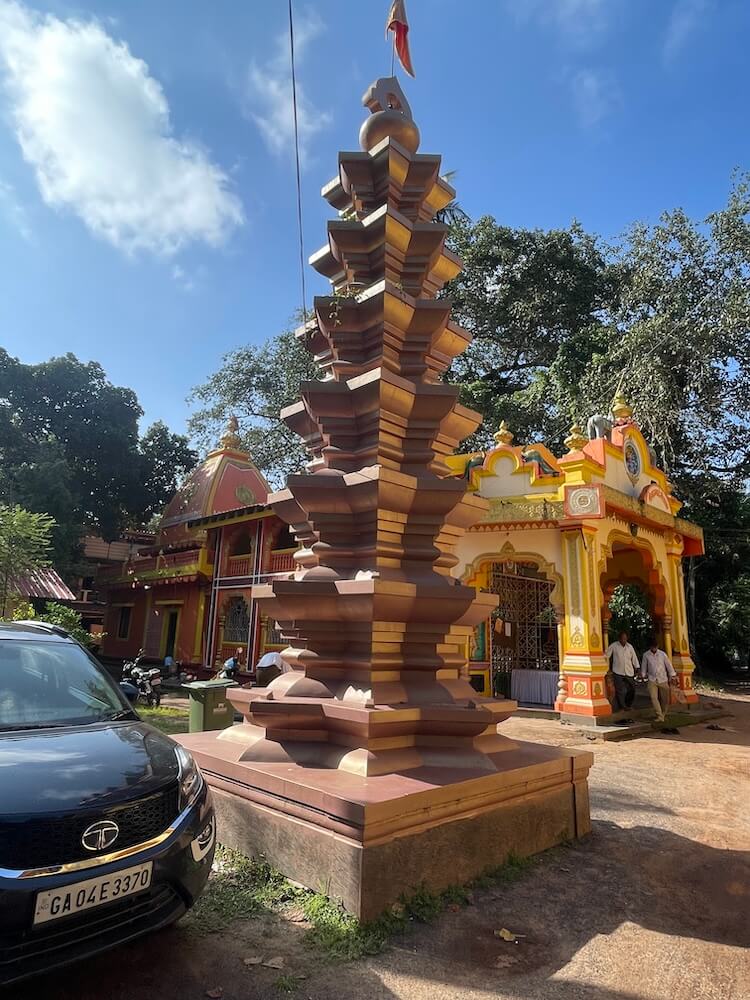
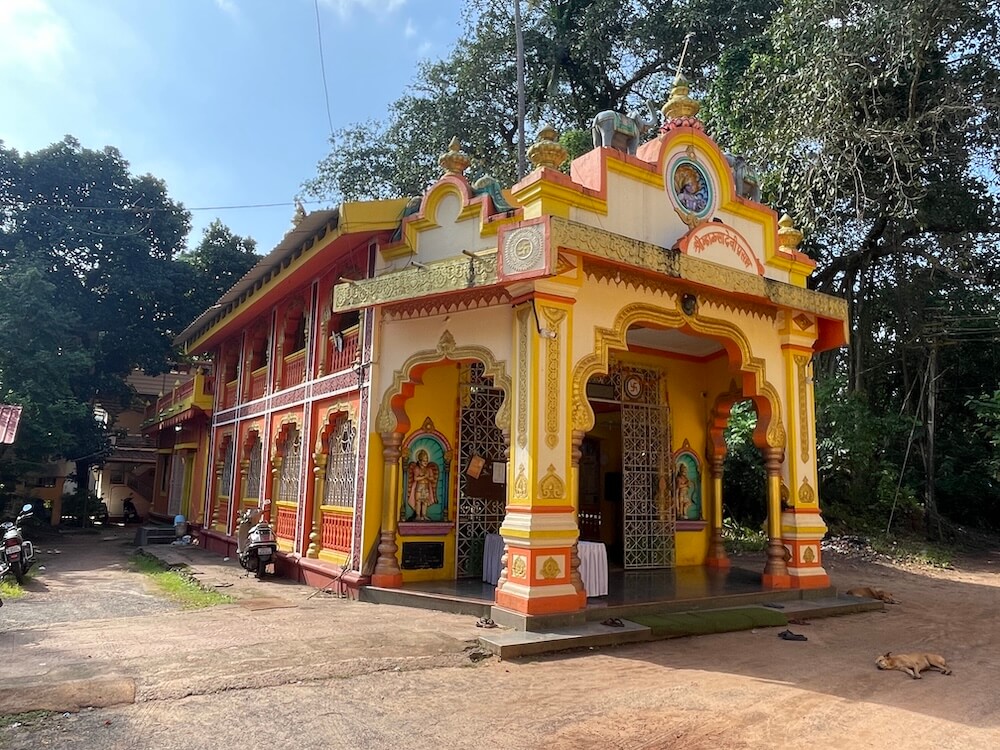
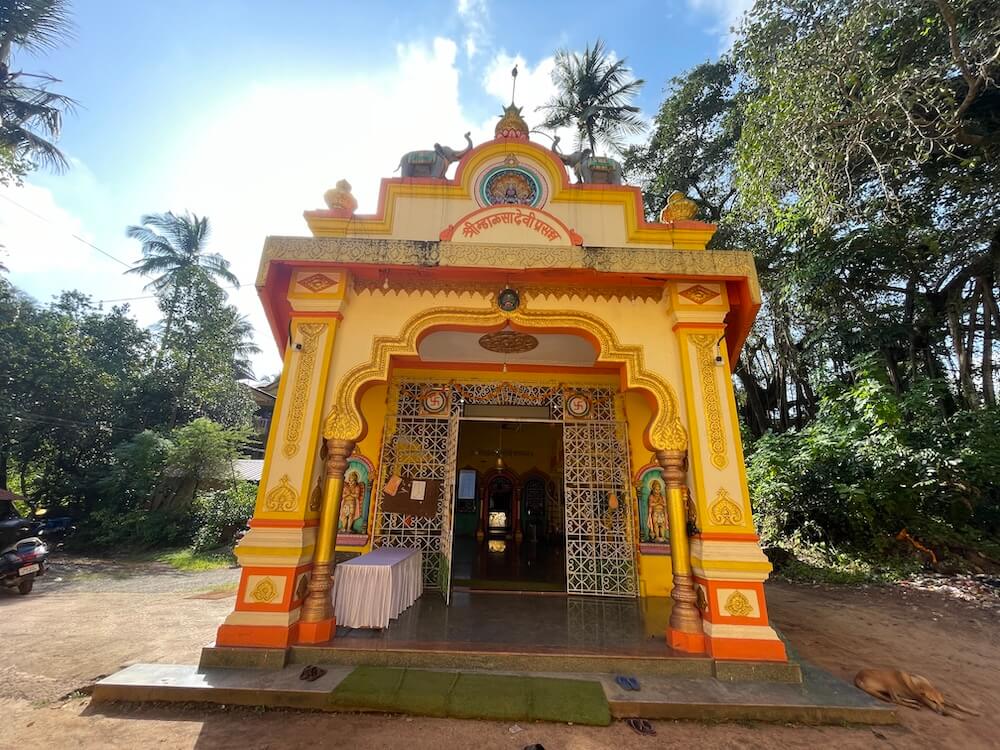
The temple is situated in a nature-rich area near the seashore, some distance from the village. The temple courtyard is adjacent to a spacious parking lot. In the courtyard, there is a Tulsi Vrindavan and a Deepmal (lamp tower). The design of this nine-tiered lamp tower, standing on a two-foot-high pedestal, is unique. Each tier of the lamp tower is shaped like a Samai (traditional lamp), with a ring and a finial at the top. The temple structure consists of a Mukhamandapa (entrance hall), Sabhamandapa (main hall), and Garbhagriha (sanctum sanctorum). The Mukhamandapa has two ornate square pillars at the front. The Mukhamandapa also has two ornate circular pillars each on the left and right sides. All pillars are connected by arched gateways. There are niches on both sides of the entrance in the front wall of the Sabhamandapa, containing idols of Garuda and Hanuman. The entrance of the Sabhamandapa has ornate wooden shutters.
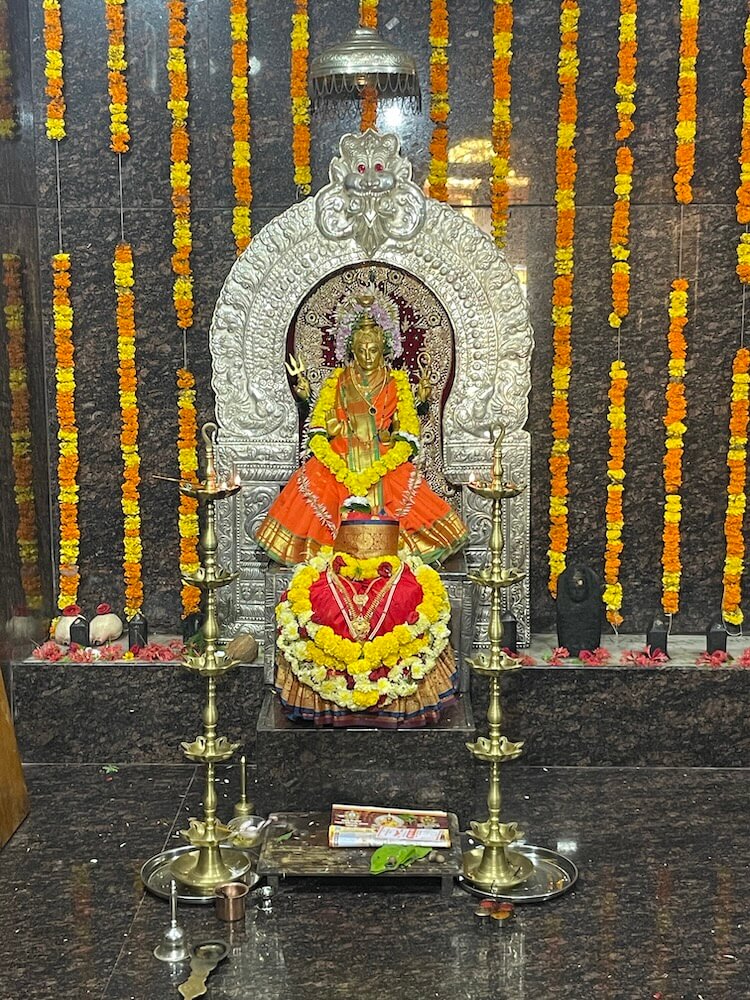
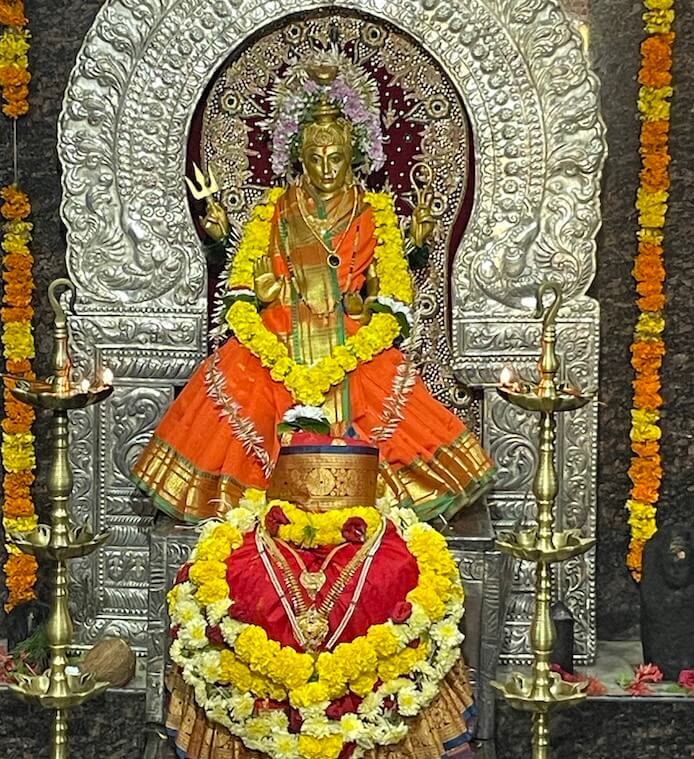
The Sabhamandapa here is semi-open. It has six ornate pillars each on the left and right sides, connected by arched gateways. There are stone benches in the Sabhamandapa for devotees to sit. The ceiling of the Sabhamandapa, which slopes on both sides, features circular carvings. There are balconies on the left and right sides of the Sabhamandapa, accessible by curved staircases. Further ahead is the entrance to the Garbhagriha. On the front wall of the Garbhagriha, there are ornate pillars on both sides of the entrance. These pillars support crescent-shaped toranas (arches). The torana features a lotus flower in the center and floral patterns on both sides. In the Garbhagriha, on a Vajrapitha (diamond pedestal), stands the four-armed carved idol of Goddess Mhalasa made of black stone. The Goddess holds weapons like a Trishula (trident) and Pasha (noose). The Goddess is adorned with a silver mask and a crown on her head. The silver Prabhavali (halo) behind the idol features a peacock arch with a Kirtimukha at the top.
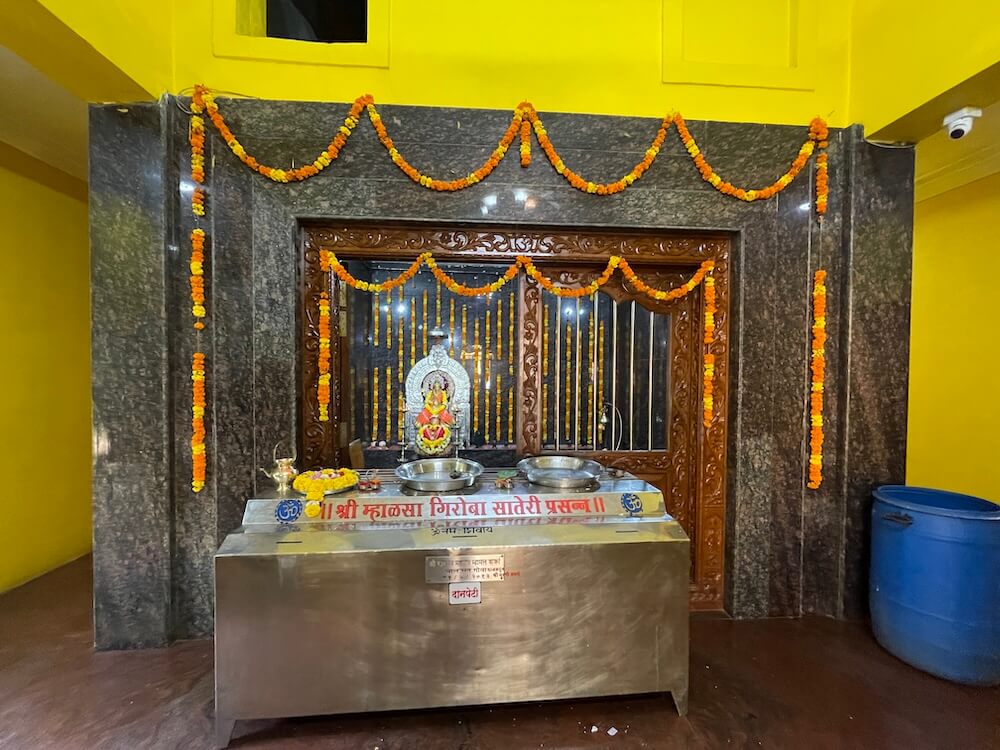
The temple roof has a parapet on all four sides. The roof of the Mukhamandapa has Bashings (decorative crests) on three sides. The front Bashings feature sculptures of elephants and peacocks. There is a square Shikhara (spire) on the roof of the Garbhagriha. Nearby, in the vicinity of the Mhalasa Devi temple, are the Giroba Deva and Sateri Devi temples.
Gudi Padwa is the main annual Jatra festival here. On this day, the Goddess’s Palkhi (palanquin) procession is celebrated. Thousands of devotees from the surrounding areas come here for the Goddess’s Darshan and to fulfill their vows. The visiting devotees participate in the Palkhi procession. Amidst the sound of drums and the throwing of Gulal, the Goddess departs in the Palkhi for a village circumambulation. The temple’s anniversary celebration is observed with great enthusiasm on Margashirsha Krishna Ashtami. All festivals throughout the year, including Sharadiya Navratri, Shravan month, Dussehra, Diwali, and Kojagiri Purnima, are celebrated in the temple. During all festivals, programs such as Bhajans, Kirtans, discourses, music, dance, Jagaran, Gondhal, and Mahaprasad are organized. There is a large crowd of devotees visiting the temple on Tuesdays, Fridays, Purnima, Amavasya, and Ashtami. Tourists visiting the area also make it a point to visit the temple for the Goddess’s Darshan.
This sacred temple stands as a testament to deep spiritual devotion, ancient architectural grandeur, and rich local cultural traditions.
The sanctum sanctorum houses the divine idol consecrated according to ancient Vedic traditions, surrounded by serene courtyards and traditional temple architecture.
Navratri, Maha Shivratri, Annual Temple Jatra & Deepotsav
Compare and book flights, secure top-rated local hotels near the temple, hire reliable guides, and rent cars instantly.
Extend your pilgrimage by visiting other highly sacred temples located nearby.


Add ₹999 more to unlock FREE SHIPPING!
Your sacred cart is currently empty.
Shop Photo FramesFill in your delivery details below to place your order.
Add comment