
Add ₹999 more to unlock FREE SHIPPING!
Your sacred cart is currently empty.
Shop Photo FramesThe tradition of worshipping seven sisters and their younger brother continues to this day in Maharashtra, Karnataka, Andhra Pradesh, Tamil Nadu, Gujarat, as well as Goa. Morjai, who resides in the village of Morjim, is one of these seven sisters of Goa. Morjai is considered the mother, or Gramadevata (village deity), of Morjim village. A grand temple of the Goddess is situated here. Excellent examples of the characteristic Kavi art of Goa and the Konkan region can be seen in this temple. Consequently, besides its religious significance, this temple has become a center of attraction for temple scholars and tourists alike.
In Hindu folk religion, these eight siblings—the seven sisters and their brother—hold an important place. There are temples of the seven sisters at Chaul in the Konkan region. These deities are known by the names Champavati, Shitala, Ekvira, Padmavati, Kallagi, Hingulaj, and Chatursiti. In Telangana, their names are Peddamma, Isodamma, Mariamma, Ankamma, Ellamma, Nakulamma, and Arikamma, while in Andhra Pradesh, they are known as Poleramma, Ankamma, Mudhilamma, Dellipolasi, Bangaramma, Mathamma, and Renuka. In the Mysore region of Karnataka, this family of seven sisters is known as the Mari-sisters. There, the name of their brother is Pottu Raju. In Gujarat, they are worshipped under the names Aval, Jogal, Togal, Holbai, Bijbai, Sosai, and Khodiyar.
In Goa, these siblings are addressed as Kelbai, Mahamaya, Shitala Devi, Mirabai alias Milagres, Ajadipa, Lairai, and Morjai, along with their brother Khetoba (Khetlo). It is said that all eight of these deities arrived in Goa during the Kadamba dynasty. According to traditional belief, these siblings were the children of a sage and came to Goa seeking refuge after facing certain hardships. The legend regarding this is that many years ago, these eight siblings arrived in Bicholim, Goa, from Kashi, riding on an elephant while on a pilgrimage. They stopped for hospitality at the home of Shantadurga Devi. At that time, Shantadevi advised them to go and reside in Mayem village. From there, the siblings came to a place called Vadne in Mayem. They rested there, and that spot is known today as ‘Sat Mayechi Baskha’. Thereafter, Kelbai began residing in Mayem, and upon her instruction, Mirabai in Mapusa, Ajadipa on Anjediva Island, Shitalai on the seashore, Mahamai in her native village, Morjai in Morjim, and Khetoba in Vayangani. The grand temple of Morjai is still situated in Morjim today.
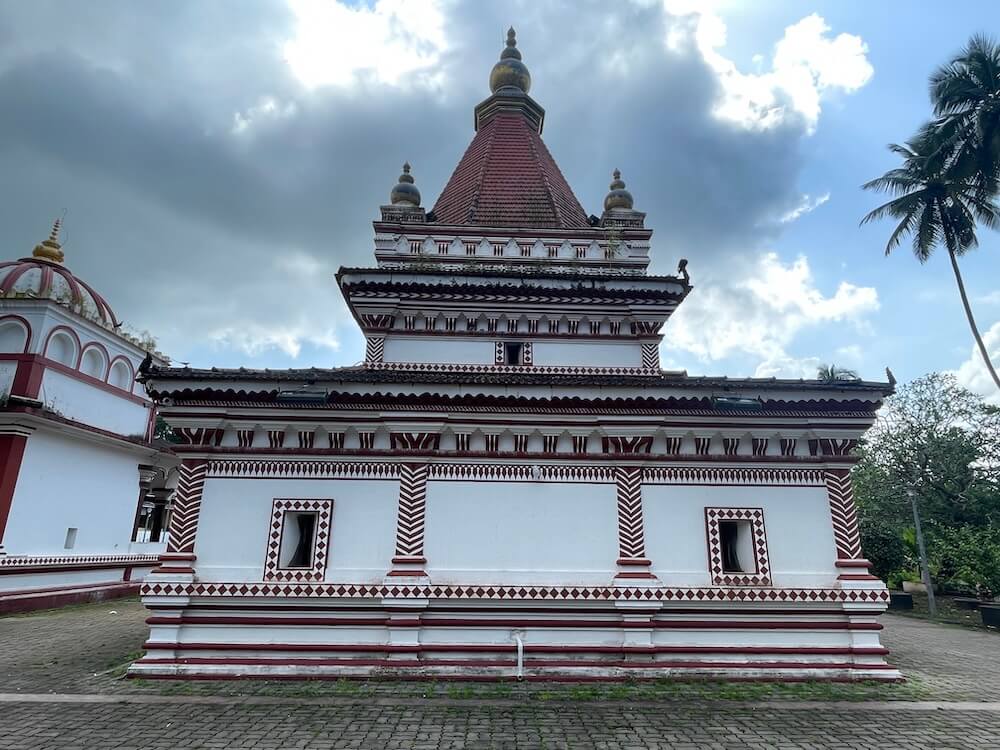
According to local lore, the village of Morjim is shaped like a peacock (mor), which is why the Goddess was named Morjai. It is said that the site of Morjai here dates back hundreds of years. However, the exact history of the temple’s establishment remains unknown. The temple is situated on a large plot of land in the village. The temple courtyard is enclosed by a wall. There are large arched gateways to enter the courtyard from three directions. On one side, the original Mahadwar (main gate) from ancient times has been preserved. There is a Nagarkhana (drum house) above this Mahadwar, which is built of red laterite stone. Currently, a large stage has been built in front of this Mahadwar. In front of the temple, there is a Tulsi Vrindavan and a five-tiered lamp pillar (Deepastambha) on a pedestal. Like some other temples in Goa, this temple is grand and built in the Goan architectural style. The most remarkable feature of this temple is the Kavi art (sgraffito) carving on it. This is a characteristic art form found especially in the Konkan and Goa regions. In this process, a layer of red soil is first applied to the wall, followed by a layer of lime plaster. While the lime plaster is still wet, intricate designs are carved into it so that the red color underneath stands out. Such Kavi work was done on the outer walls of the ancient temple of Mother Morjai, on the arches of the windows, on the inner pillars, and also on the ceiling. This carving has been preserved even during the renovation.
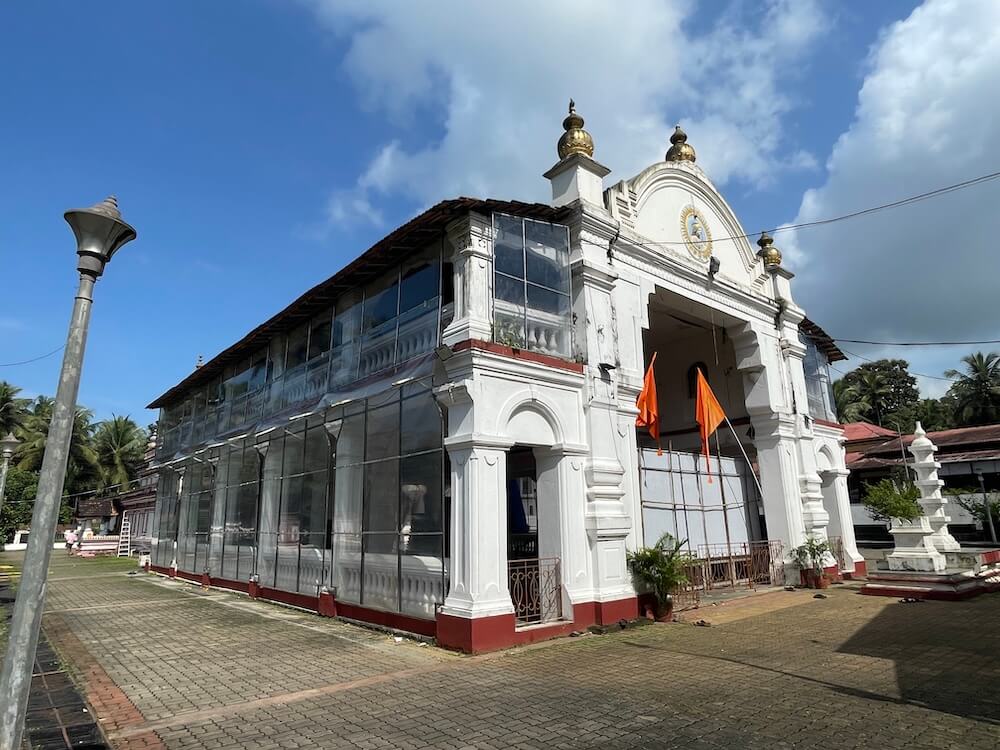
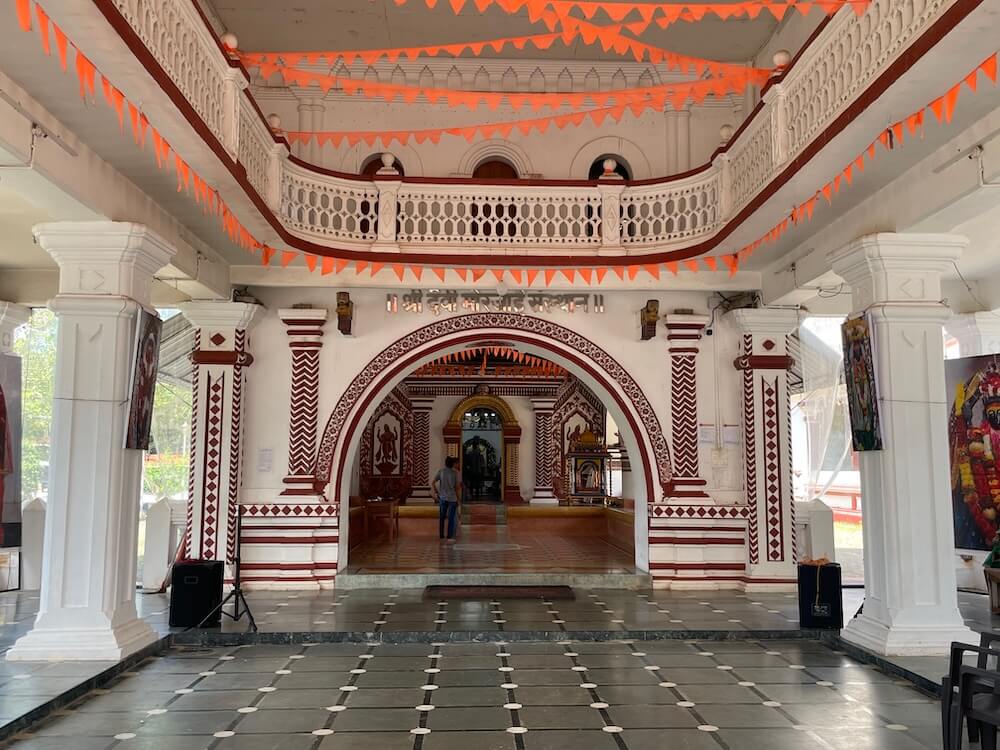
The structure of the temple consists of a Mukhamandapa (front hall), Sabhamandapa (main hall), Ardhamandapa (half hall), and Garbhagriha (sanctum sanctorum). The entrance to the Mukhamandapa is grand and tall. On both its sides are two smaller, narrower entrances. In the upper part of the main entrance of the Mukhamandapa, there is a relief sculpture of Suryanarayana. The Sabhamandapa of the temple is spacious and two-storied. This semi-open Sabhamandapa has low railings on the outer side. Square pillars are erected a few feet away from the left and right sides, upon which a balcony (sajja) is built. Images of the Goddess in various forms are placed on the pillars of the Sabhamandapa. From this Sabhamandapa, one enters the Ardhamandapa of the temple. A large semi-circular arch is built for entry into the Ardhamandapa. Kavi art carvings are done on this arch as well as on the pillars beside it. The Ardhamandapa has a seating arrangement like a bench along the sides. The Makhar (palanquin/shrine) of the Goddess is kept on one side here. Kavi art carvings are also etched on the inner pillars, walls, and ceiling of this Ardhamandapa. Notably, on the front wall of the Garbhagriha, on both sides of the entrance, there are images of two dwarapalas (gatekeepers) and peacocks painted in the Kavi art style. The arched entrance of the Garbhagriha has stone pillars on both sides. In the center of the arch, at the lalata-bimba (lintel) position, is a Kirtimukha.
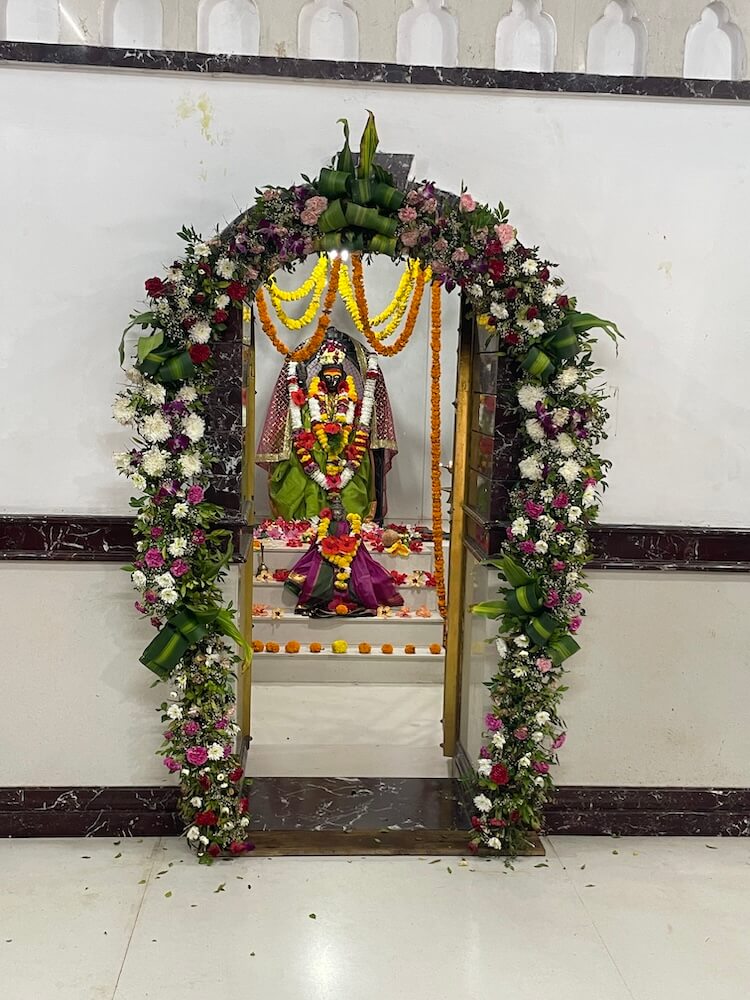
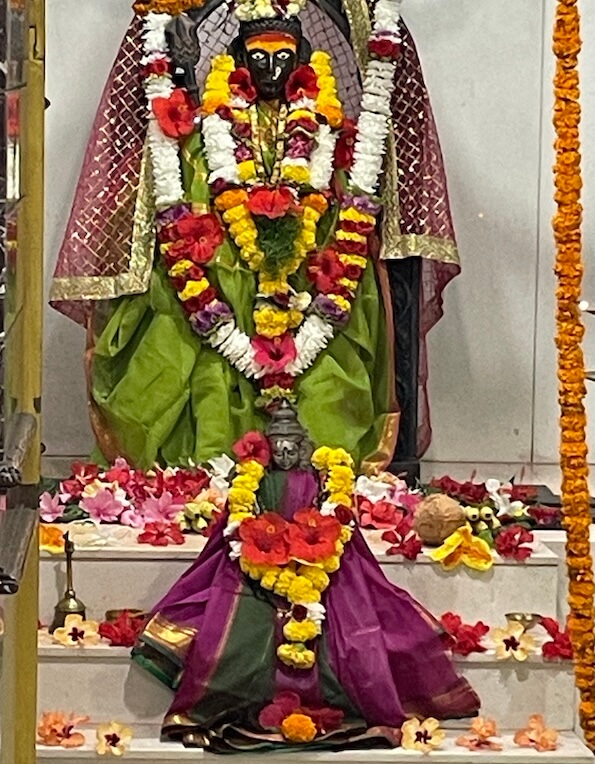
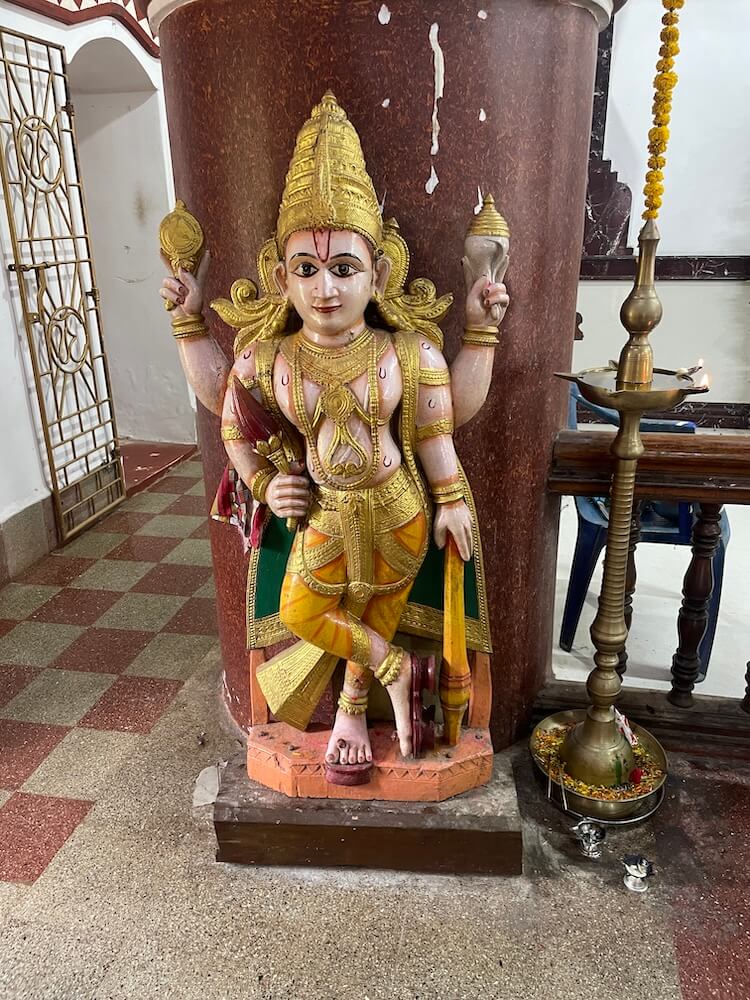
The Garbhagriha of this temple is also spacious, befitting the grandeur of the temple. It has grand circular pillars placed at a distance from the left and right walls. These pillars are connected to each other by arches. Carvings are done on these arches as well as on the elephant-back (gajaprishtha) shaped ceiling of the Garbhagriha. Large brass bells are hung from a large horizontal beam here. Two tall statues of dwarapalas are placed against the pillars on the front side. Inside, on a marble pedestal, stands the idol of Mother Morjai, carved in black stone in the form of Mahishasuramardini. The idol of the Goddess, holding a trident, is adorned with garments and ornaments. In front of this main idol, a smaller idol of the Goddess is seated. The Sabhamandapa of the temple has a sloping tiled roof. Above the Garbhagriha, there is a hexagonal shikhara (spire) that tapers upwards. On top of it is an octagonal amalaka and a tall kalasha (finial) above it. Four small kalashas are erected on all four sides of this shikhara. To the left of this temple, a large temple of Mahadeva has been built. There is also a temple of a dwarapala on the right side.
Navaratrotsav is the most significant festival celebrated at the Morjai Mata Temple. This nine-day festival is observed here on a grand scale. During this period, rituals such as Devpuja, Saptashati Path, Kirtan, Palkhi procession, and various cultural programs are held. At the conclusion of the daily worship, Panchakhadya Prasad, brought by devotees according to their capacity, is distributed to everyone. Every year, from Devshayani Ashadhi Ekadashi to Prabodhini Ekadashi, a Bhajan program is organized at the temple every Monday evening. Following the Bhajan, which takes place from 7:30 PM to 10:30 PM, a Palkhi procession of the Goddess is carried out. Apart from this, various other festivals and celebrations are also observed in this temple with deep devotion. It is the firm belief of the devotees that by seeking the Goddess’s Prasad Kaul, one’s problems and difficulties are resolved. Consequently, thousands of devotees gather here for the darshan of the Goddess during the festival period.
This sacred temple stands as a testament to deep spiritual devotion, ancient architectural grandeur, and rich local cultural traditions.
The sanctum sanctorum houses the divine idol consecrated according to ancient Vedic traditions, surrounded by serene courtyards and traditional temple architecture.
Navratri, Maha Shivratri, Annual Temple Jatra & Deepotsav
Compare and book flights, secure top-rated local hotels near the temple, hire reliable guides, and rent cars instantly.
Extend your pilgrimage by visiting other highly sacred temples located nearby.


Add ₹999 more to unlock FREE SHIPPING!
Your sacred cart is currently empty.
Shop Photo FramesFill in your delivery details below to place your order.
Add comment