
Add ₹999 more to unlock FREE SHIPPING!
Your sacred cart is currently empty.
Shop Photo FramesIn the Konkan region, the ‘Rakhandar’ (guardian deity) holds special significance. This is a local deity from the Bhairav lineage, and its primary function is to protect the region. In Konkan, a hierarchy illustrating the importance of the Rakhandar is well-known: the guardian of a village, the guardian of a cluster of five villages, the guardian of forty villages, and the guardian of a hundred villages. This Rakhandar protects villages, homes, fields, forests, animals and birds, grass and twigs, and crops and water. It shows the way to lost travelers and protects devotees caught in difficult situations. It is worshipped in various forms in different villages. In Keri village of Goa, it is famous by the name Ajoba. Devotees believe that the awakened Lord Ajoba fulfills their vows.
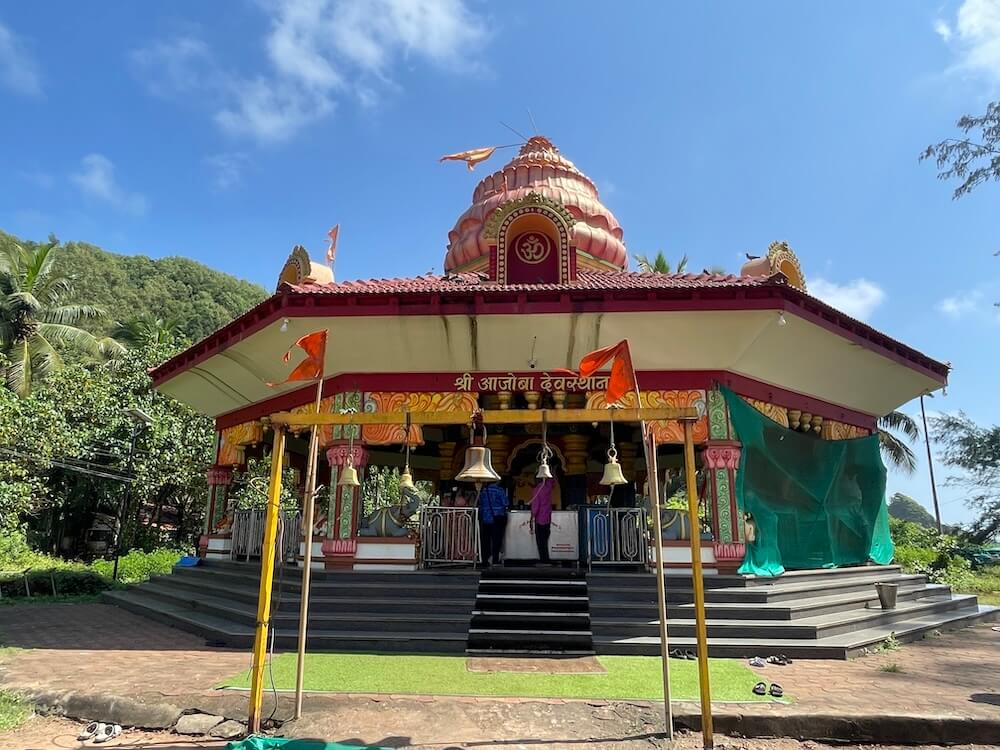
Although this temple has been built in recent times, the deity’s abode is said to be thousands of years old. Fisherfolk used to worship this deity, present in the form of a rock on the seashore, before venturing into the sea for fishing. Many legends associated with this divine abode are prevalent. Fishermen returning from the sea late at night often lose their way. It is believed that when Ajoba is invoked at such times, the deity appears with a torch and a staff with bells, guiding the lost ones. There is a belief that the deity safely escorts them back to their homes. This temple, which was formerly a wooden pavilion, has been solidly constructed in recent times.
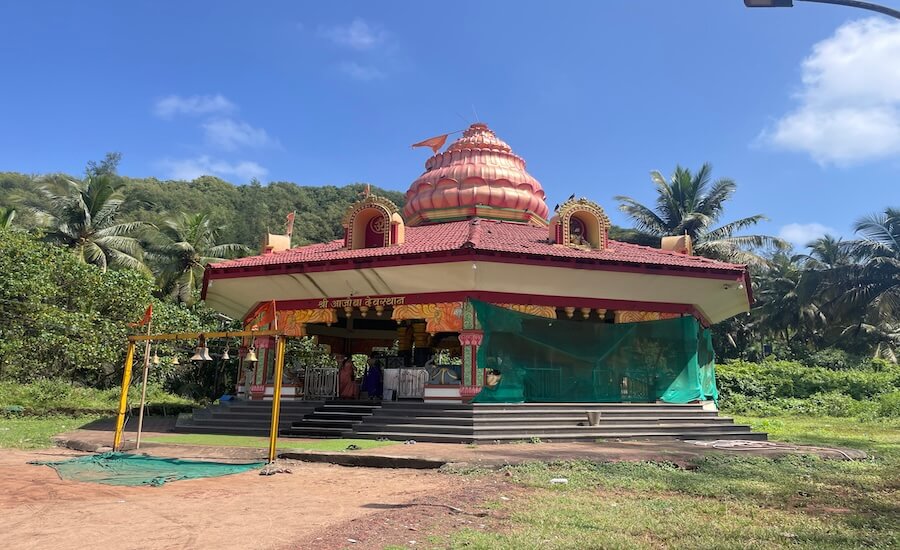
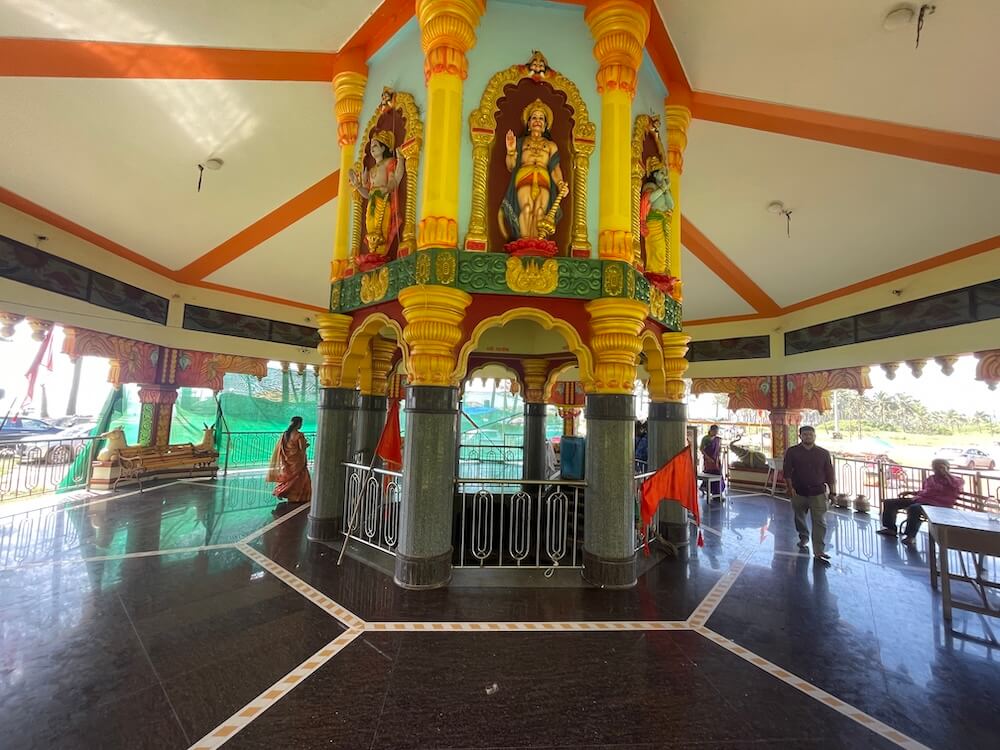
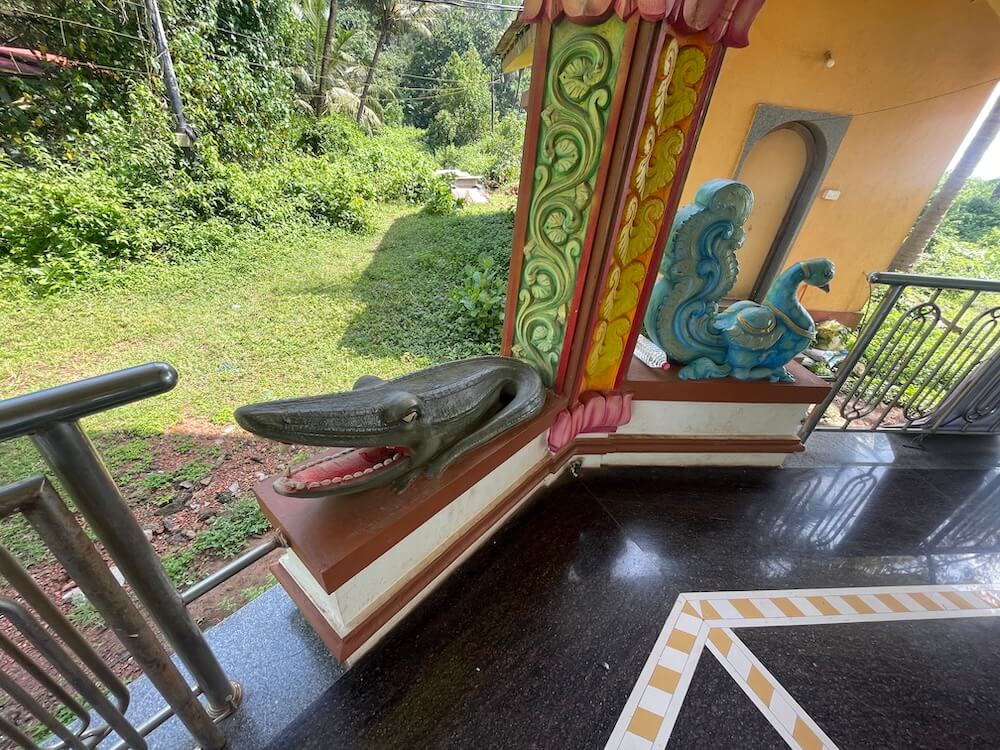
The first welcoming arch of the temple is located at the village entrance. This octagonal temple is situated near Keri village, on the seashore. A paved road leads from the village to the temple’s parking area. Shops selling puja materials are available at the parking lot. In front of the temple, brass bells offered as vows are hung on a bamboo archway. The temple stands on a plinth about four feet high from the ground, with five steps surrounding it. The temple’s structure comprises a semi-open assembly hall (Sabhamandap) and a sanctum sanctorum (Garbhagriha) of the same style. In the Sabhamandap, there are two rings, each with eight intricately carved pillars. All pillars stand on their bases. The outer pillars feature lotus flower motifs at their base and capital. At the top of the outer pillars are ‘Kani’ (brackets) and ‘Hasta’ (hands/supports) on the Kani. Beams rest on the Hastas, and on each beam, there are three stone chandeliers. The pillars in the inner ring are connected to each other by arched toranas (decorative archways). In the Sabhamandap, the pillars of both rings are connected by stainless steel railings. On both sides of each outer pillar, there are platforms. These platforms feature sculptures of various animals and birds such as elephants (Gajraj), tigers (Vyaghra), lions (Simha), deer (Mruga), peacocks (Mayur), crocodiles (Makar), and horses (Ashva). On the visible wall above the arched toranas of the inner ring of pillars, there are idols of various deities like Ganapati, Mahadev, Shri Krishna, Parashuram, Hanuman, and Vishnu.
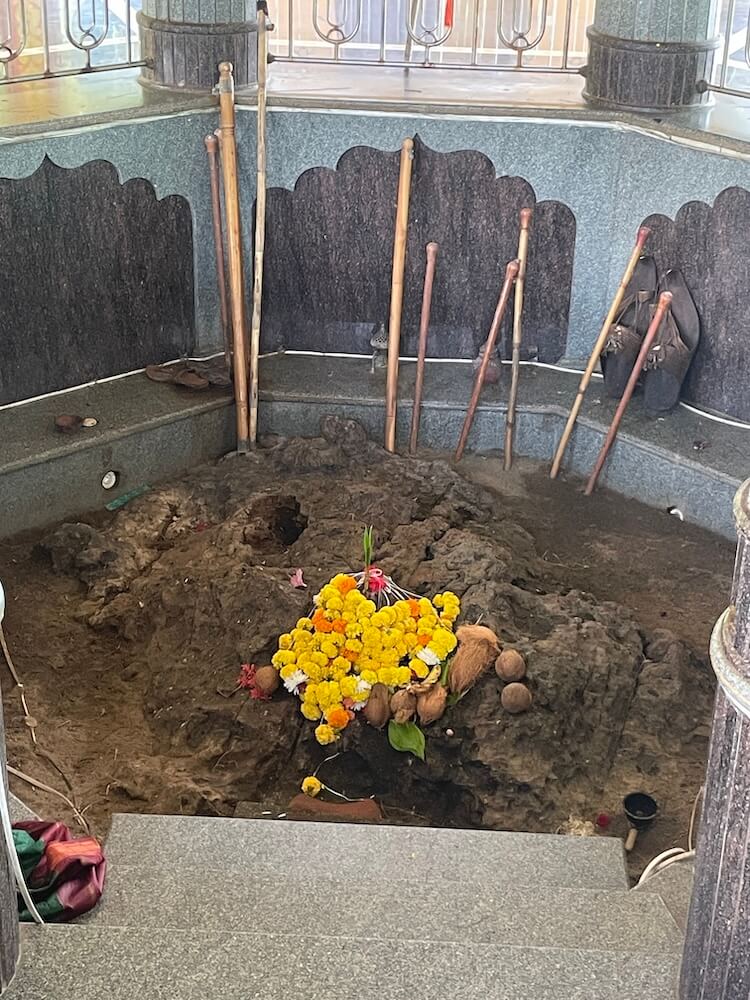
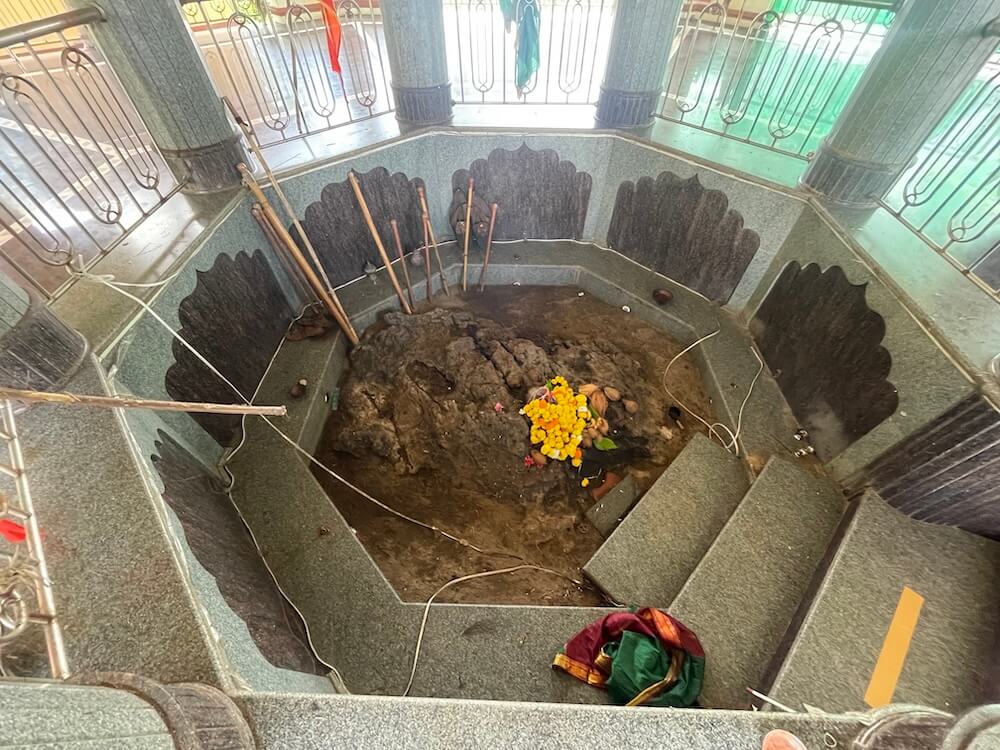
In the center of the Sabhamandap, within the inner ring of pillars, lies an octagonal Garbhagriha (sanctum sanctorum). This Garbhagriha is four feet deep. There are steps to descend into this semi-open Garbhagriha. At the entrance of the Garbhagriha, on a table, are the Padmapadukas (lotus footprints). Devotees must have darshan (sacred viewing) of the deity from this point. Within the Garbhagriha, Lord Ajoba resides in the form of a self-manifested (Swayambhu) stone on the ground. The dome-shaped roof of the Garbhagriha is supported by eight pillars. As the roof is partially open in the center, on certain days of the year, the midday sun rays and nighttime moonbeams perform an ‘abhisheka’ (ritual bathing) for the deity. An circumambulation path (Pradakshina Marg) runs around the exterior of the Garbhagriha within the Sabhamandap.
The temple’s eight-sided roof is tiled. On the roof, in the ‘Meghadambari’ (small pavilions) located in the eight directions, there are idols of various Rishis and Munis (sages). Above the Garbhagriha’s roof, there is a five-tiered dome-shaped ‘Shikhara’ (spire). The first, lowest tier of the Shikhara is octagonal. The upper four circular tiers feature ‘Padmadalamandal’ (lotus petal designs). There is no ‘Kalasha’ (finial) at the apex of the Shikhara; that part is open. This unique design of the Shikhara is distinctive.
Near the temple, on the seashore, stands a vertical rock. This rock is said to be the original abode of Lord Ajoba. Near this rock, there is a flag and a lamp is lit every evening. Near this temple, in the cliffs facing the sea, there are caves believed to be from the Pandava era. During high tide, the path leading to the caves becomes inaccessible and they fill with water. Entry into the caves is only possible during low tide.
Every year in February, a five-day ‘Jatrotsav’ (temple festival) of Lord Ajoba is celebrated. The dates for the Jatrotsav are decided by the Temple Committee and announced two months in advance. During these five days, various religious programs such as Bhajans (devotional songs), Kirtans (narrative singing), and Mahaprasad (sacred food offering) are organized at the temple. At this time, thousands of devotees from the surrounding area come for darshan of the deity and to fulfill their vows. All other festivals and celebrations throughout the year are also observed at the temple. On Sundays, Thursdays, Purnima (full moon), Amavasya (new moon), and other auspicious days, a large number of devotees visit the temple for darshan. Tourists visiting Keri beach also make it a point to come for darshan of the deity.
This sacred temple stands as a testament to deep spiritual devotion, ancient architectural grandeur, and rich local cultural traditions.
The sanctum sanctorum houses the divine idol consecrated according to ancient Vedic traditions, surrounded by serene courtyards and traditional temple architecture.
Navratri, Maha Shivratri, Annual Temple Jatra & Deepotsav
Compare and book flights, secure top-rated local hotels near the temple, hire reliable guides, and rent cars instantly.
Extend your pilgrimage by visiting other highly sacred temples located nearby.


Add ₹999 more to unlock FREE SHIPPING!
Your sacred cart is currently empty.
Shop Photo FramesFill in your delivery details below to place your order.
Add comment