
Add ₹999 more to unlock FREE SHIPPING!
Your sacred cart is currently empty.
Shop Photo FramesThe magnificent temple of Ramnath, the beloved deity of Lord Shri Rama, is situated in Bandivade. Originally established in Lotli by the Vatsa and Kaundinya Gotra Brahmin community, the Ramnath temple was relocated here in the sixteenth century due to Portuguese atrocities. Ramnath is considered the divine symbol of the unity of Hari (Vishnu) and Hara (Shiva). This temple, which is the family deity (Kuldevata) of the Gaud Saraswat Brahmins and Daivajna Brahmins of Gomantak, also houses the shrines of Santeri, Kamakshi, Laxminarayan, and Siddhanath Ganapati.
Ramnath is one of the names of Shankara. Rameshwar is his synonymous name. The mythological story regarding this is that Shri Rama killed Ravana. However, Ravana was a Brahmin. Therefore, Shri Rama incurred the sin of Brahmahatya (killing a Brahmin). To cleanse this, sages advised Shri Rama to install a Shivalinga and worship it. Then, Sita prepared a sand linga on the seashore. That very Shivalinga came to be known as Rameshwaram. The sages requested Shri Rama to explain the meaning of the name Rameshwar. At that time, Shri Rama said, ‘Ramasyeshvarah sah yah Rameshvarah’, meaning he who is the Lord of Rama is Rameshwar. Shiva-Shankara is my Lord. Thus, Rameshwar or Ramnath means Shankara. However, here Ramnath is enshrined in the form of both Hari and Hara.
The history of this temple is that originally, this temple of Ramnath was in the village of Lotli on the banks of the Zuari River in Salcete Taluka. In the year 1567, Captain Diogo Rodrigues was the commander of the Raitur Fort, located a short distance from the village of Lotli. One day, he ordered the prominent villagers of Lotli to appear at the Raitur Fort. However, they did not follow that order. Then, some officials advised him that as a punishment, the houses of these people should be burnt down. At that time, Rodrigues ordered that instead of their houses, their main temple should be burnt down. Accordingly, the temple of Ramnath here was burnt down. After this, the villagers of Lotli rushed to the Portuguese court in Goa and filed a lawsuit against that official. Significantly, at that time, the Portuguese court found that Portuguese official guilty. Not only that, but it also ordered him to rebuild that Hindu temple at his own expense. Against this, Captain Diogo Rodrigues appealed to the higher court. At the same time, this official, through the Archbishop and a clergyman, convinced the Viceroy of Goa that burning the temple was an important religious act. Then the Viceroy called the captain and ordered him to burn down all the temples found in Salcete. At that time, he burnt down 280 temple structures in one night. In this way, this captain burnt down the Ramnath temple in Lotli. However, according to the scholarly opinion of Vinayak Narayan Shenvi Dhume, author of the book Devbhumi Gomantak, the villagers of Lotli had already relocated the idol from this temple before the incident of burning the temple occurred in 1567. He estimates that this event must have taken place between 1 May 1560 and 1567.
It is said that the villagers of Lotli secretly took this idol and crossed the Zuari River. From there, they first went to Durbhat and then through Adpai to Bandode. At that time, the region where Bandode was located in Antruz Mahal (Ponda Taluka) was under the rule of the Adilshahi regime. That Muslim regime had permitted the establishment of Hindu temples at that time. Therefore, the temple of Ramnath from the original Lotli was established in the area of today’s Ramnathi in Bandode. Eventually, on Shake 1826, Krodhi Nama Samvatsara, Phalguna Shukla Dashami, Thursday, 16 March 1905, the new temple was inaugurated here. The deities Ramnath, Laxminarayan, Santeri, and Kamakshi were consecrated in it.
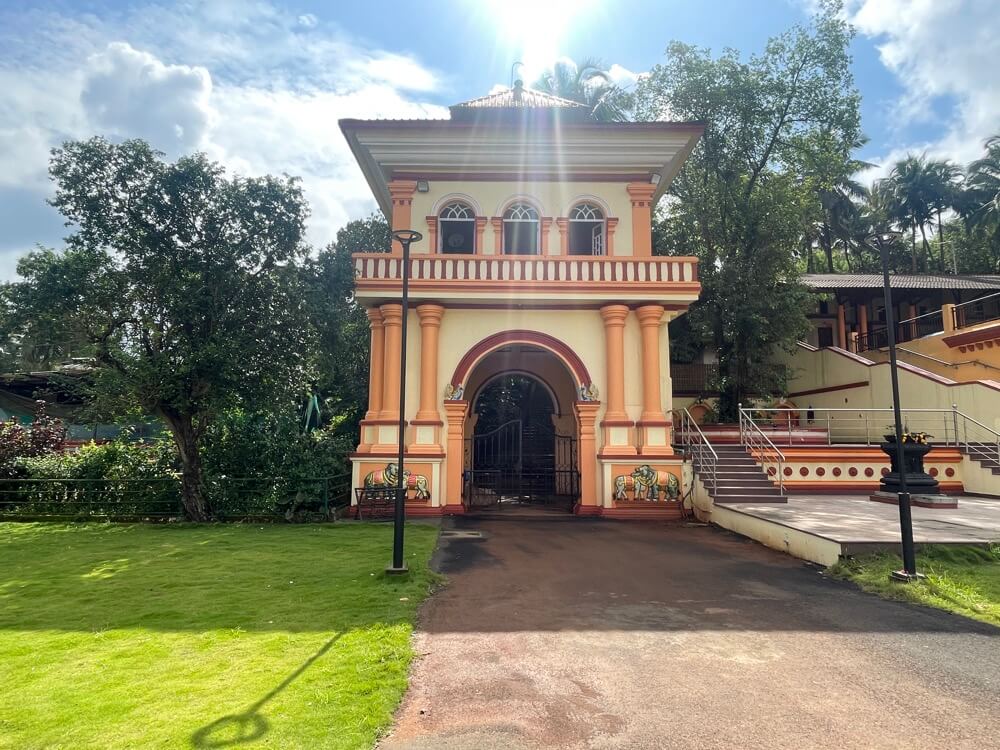
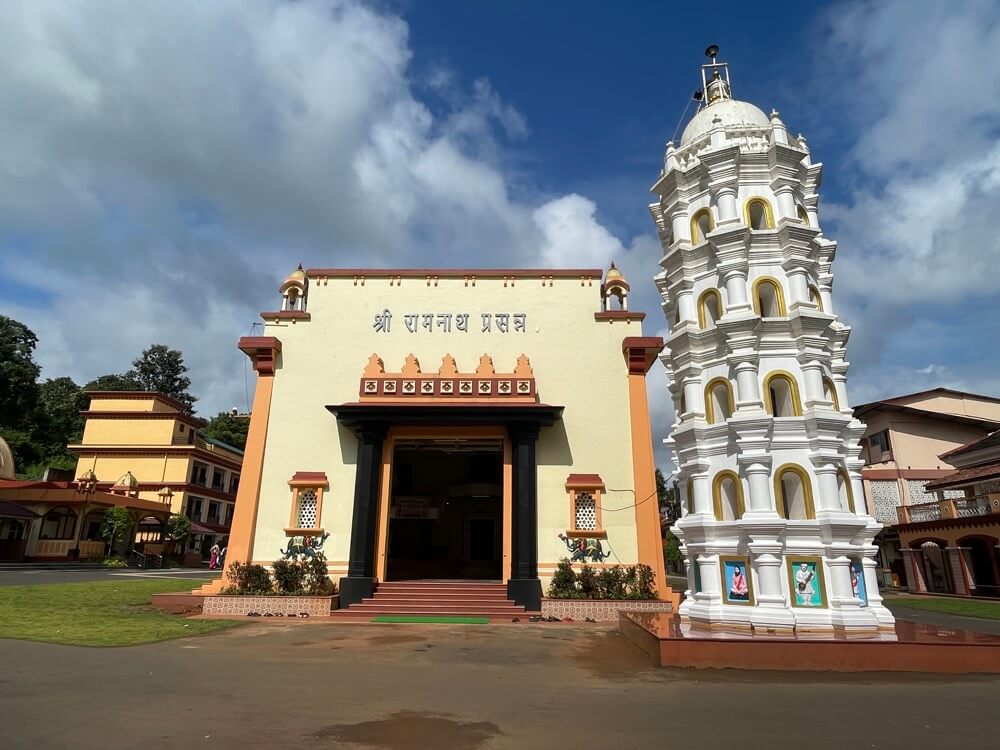
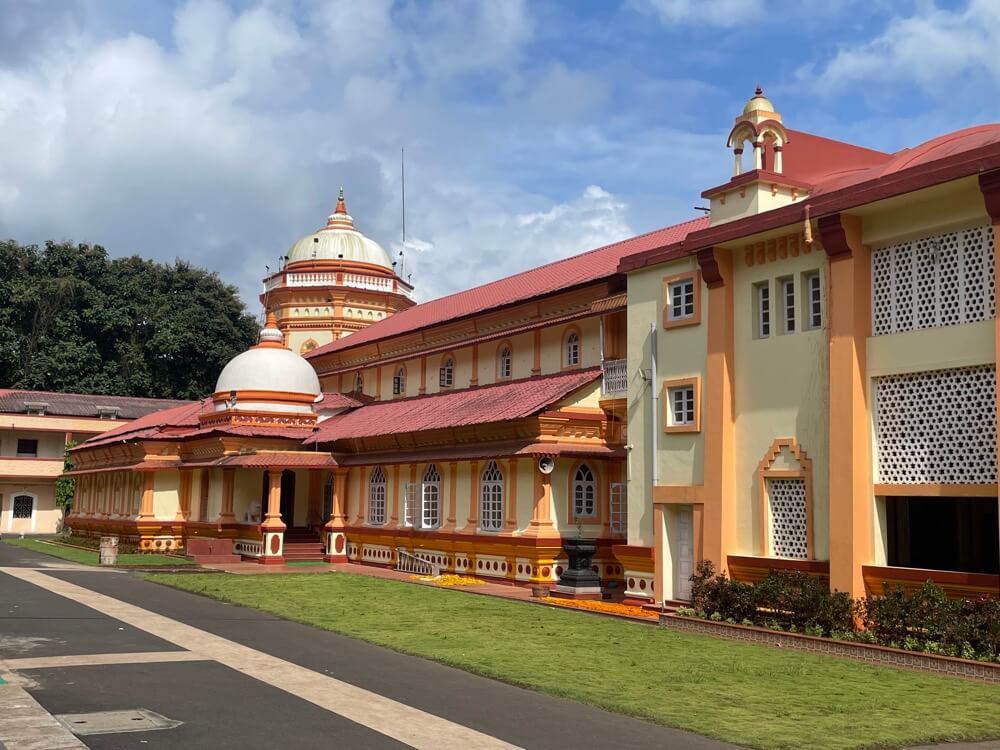
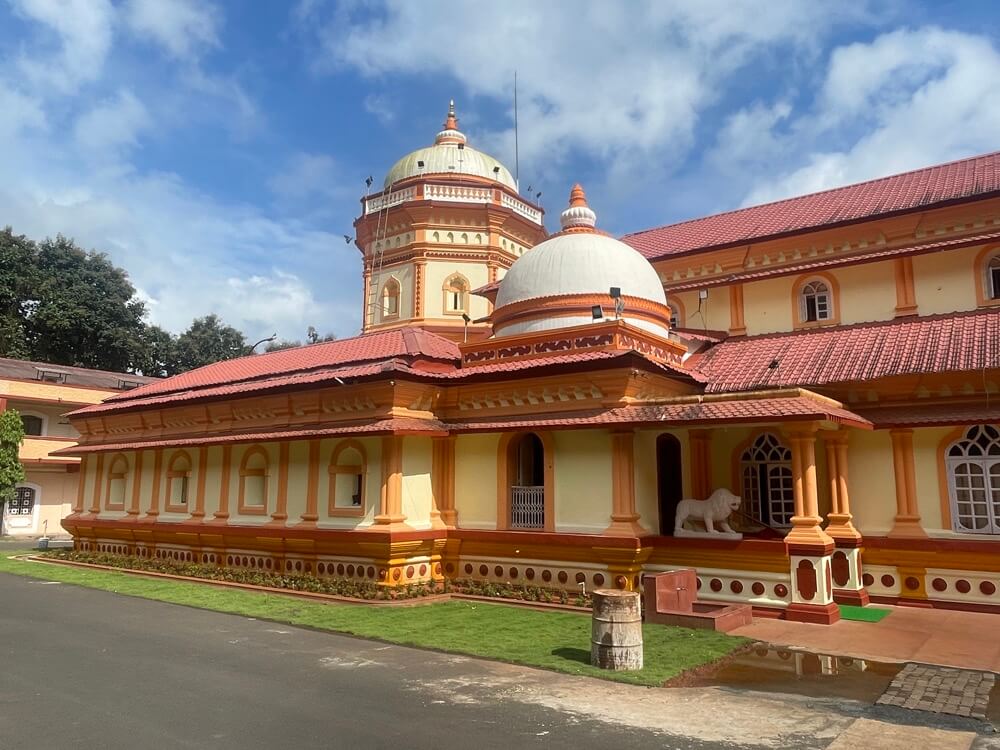
Upon entering the spacious premises through the grand main gate, one sees the towering structure of the Ramnath temple directly in front. In front of the temple stands a tall and magnificent six-tiered Deepastambha (lamp pillar). In the small niches of the lower tier of the Deepastambha are relief sculptures of saints and great souls like Saint Namdev, Saint Tukaram, Samarth Ramdas, Swami Vivekananda, and Ramakrishna Paramhansa. Nearby is the Tulsi-Nag Vrindavan. The structure of this temple consists of a Mukhamandapa, Sabhamandapa, Ardhamandapa, Mahamandapa, and Garbhagriha. The Mukhamandapa of the temple has a flat wall in front. It has a square entrance. Here, in the roof area, there are two small chhatris (canopies) on both sides. The building of the Sabhamandapa and Mahamandapa of the temple is two-storied. It has a tiled roof. On both sides of the Mahamandapa, there is an entrance pavilion with a dome-shaped kalasha on top.
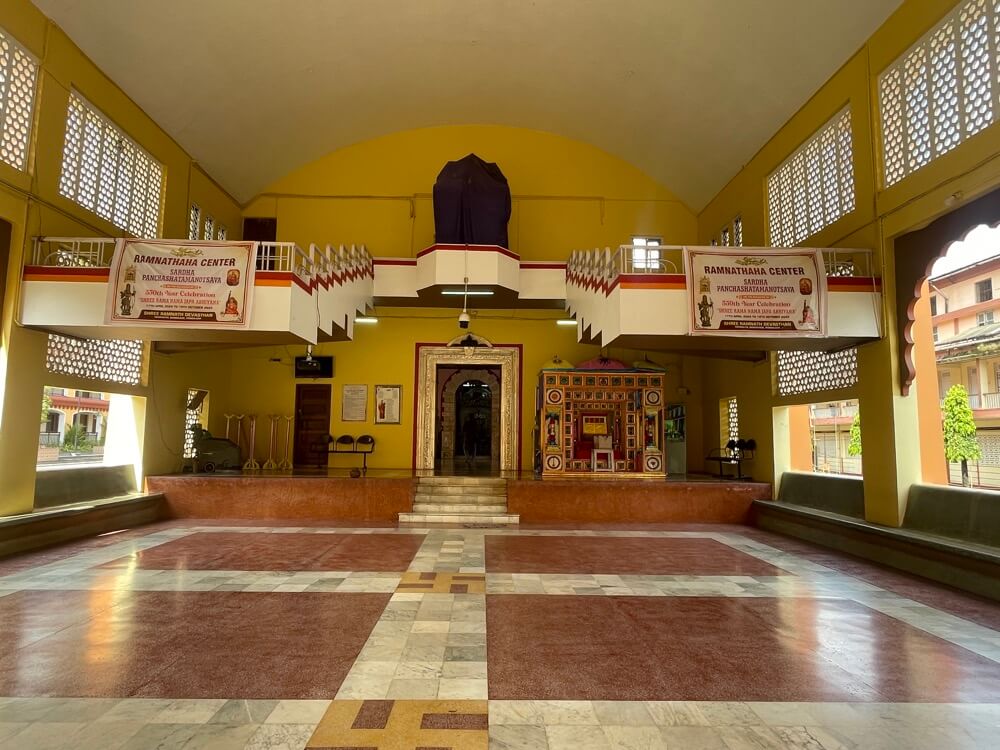
The Sabhamandapa is of a semi-open type. On its lower side, there are large arched doors and windows. In the upper part, cement lattices have been installed. There are stone benches (kakshasanas) inside. On the front platform, on the right side, there is a large decorated Makhar (palanquin) used in the Makharotsava. Above this, there is a chhajja (eave) shaped like steps. From here, one enters the Ardhamandapa. The Ardhamandapa has a square entrance covered with golden patterned metal sheets. The entrance to the wall of the Mahamandapa is arched. It is covered with silver sheets. Here, there are elephant sculptures on the lower parts of the door pillars. Above them, sculptures of Garuda and Hanuman are carved. Sculptures of goddesses are carved on the pillar shafts. On the upper arch part, there are Naga (serpent) sculptures. On the sides of this entrance are statues of Vaishnava door-keepers.
The long Mahamandapa of the temple is divided into two parts by an arched entrance and two wide windows on its sides. The circular pillars here are decorated as if they were made of brass. These pillars are connected to each other by large arches. Hanging from the ceiling of the temple are lamps and a large chandelier. In the center of the Mahamandapa, there is a beautiful brass Samai (lamp). The entrance to the Antarala (inner sanctum area) and the wall around it are completely covered with silver sheets. Various images of gods and goddesses are carved on it, and there is a Kirtimukha at the center of the lintel. On the upper part, the scene of Shri Rama-Lakshmana-Sita and Hanuman worshipping a Shivalinga, and Shiva-Parvati blessing them, is carved. Notably, the image of Anantashayi Vishnu and Lakshmi is carved on its upper section. On the walls of the Antarala (vestibule), there are statues of Dvarapalas (gatekeepers) housed in niches on both sides. Above these niches, statues of Lakshmi and Saraswati are seated on lotuses. The entrance to the sanctum sanctorum of the temple is also covered with ornate silver plating. On the door pillars, there are carved statues of Garuda and Hanuman in the center. Inside, there is the Shiva Linga of Ramanath Mahadeva, topped with a silver Abhishek patra (consecration vessel). Usually, the Nandi is placed outside the sanctum of a Shiva temple, but here, it is located inside the sanctum. According to available information, the old structure of the Ramanath temple contained a stone Nandi. During the renovation, it was moved, and in its place, a relatively smaller stone Nandi was installed inside the sanctum near the Ramanath Pindi. Behind this Shiva Pindi, on a high pedestal, sits a black stone idol of Ramanath, adorned with rich garments, ornaments, and flower garlands on a silver throne.
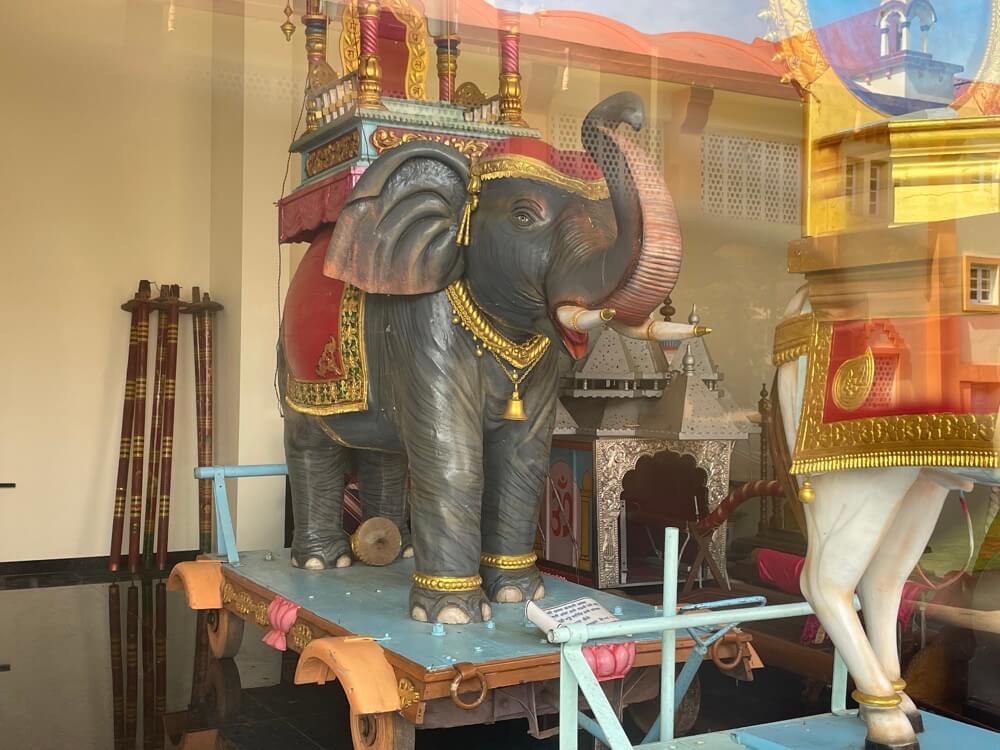
According to some scholars, the teachings of Madhvacharya, the proponent of the Dvaita-Vedanta philosophy of the Vaishnava tradition, spread extensively in Karnataka during the twelfth and thirteenth centuries. During that same period, the Ramanathi temple became part of the Vaishnava tradition. Consequently, Ramanath began to be considered an avatar of Vishnu, while the goddesses Santeri and Kamakshi were regarded as avatars of Lakshmi. The sculpture of Anantashayi Narayana on the Antarala, the Vaishnava Dvarapala statues in the temple, and the Tulsi Vrindavan outside provide an explanation for this. Idols of Goddess Santeri, Goddess Kamakshi, Lakshminarayana, and Ganapati are also enshrined in this temple. Above the sanctum sanctorum, there is a magnificent Shikhara with an octagonal tower, topped by a dome, Amalaka, and Kalasha. In the temple courtyard, there is a temple dedicated to Vetal and Kalabhairava. To the left of the Ramanath temple, on the ground floor of a three-story building, is the ‘Siddhanath Rathagriha’ (chariot house) in a large glass hall. It houses a horse-drawn chariot, an elephant howdah, and a palanquin. Additionally, there is a large dining hall here.
Every Monday at 8:30 PM, the Palkhi (palanquin) procession of Lord Ramanath is taken out. The annual grand festival, Maha Shivaratri, begins on Magh Krishna Dwadashi and continues until Phalguna Shuddha Dwitiya. During this festival, the deity is taken out in a procession in the Palkhi. On the day after Maha Shivaratri, the Rathotsava (chariot festival) of Lord Ramanath takes place in the early morning and evening. Apart from this, various festivals and celebrations are observed in the temple with traditional religious rituals and great enthusiasm. Devotees can have Darshan at this temple daily from 6 AM to 9 PM.
This sacred temple stands as a testament to deep spiritual devotion, ancient architectural grandeur, and rich local cultural traditions.
The sanctum sanctorum houses the divine idol consecrated according to ancient Vedic traditions, surrounded by serene courtyards and traditional temple architecture.
Navratri, Maha Shivratri, Annual Temple Jatra & Deepotsav
Compare and book flights, secure top-rated local hotels near the temple, hire reliable guides, and rent cars instantly.
Extend your pilgrimage by visiting other highly sacred temples located nearby.


Add ₹999 more to unlock FREE SHIPPING!
Your sacred cart is currently empty.
Shop Photo FramesFill in your delivery details below to place your order.
Add comment