
Add ₹999 more to unlock FREE SHIPPING!
Your sacred cart is currently empty.
Shop Photo FramesAshvatthama Balirvyaso Hanumanscha Vibhishanaha |
Krupaha Parashuramashcha Saptaite Chiranjivinaha ||
Saptaitan Samsamarennityam Markandeyamathamatmam
Jivedvarshashatam Sopi Sarvavyadhivivarjitaha ||
This shloka mentions the seven immortal beings (Chiranjivis): Ashvatthama, Mahabali, Vyasa, Hanuman, Vibhishana, Kripacharya, and Parashurama. Along with them, it is believed that the eighth is Sage Markandeya. It is widely held that Sage Markandeya currently resides at the Markandeya Tirtha in Uttarakhand. There are hundreds of temples dedicated to this sage across India. One such famous temple is located in Siddheshwar Peth in the city of Solapur. Devotees believe that by having darshan of Markandeya here, one is freed from sorrows and ailments and is blessed with a long life.
In the year 1924, on the day of Narali Purnima, the idol of the patron deity, Sage Markandeya, was installed in the temple by the Padmashali community. Since then, the tradition of celebrating the Rathotsav (chariot festival) of Sage Markandeya on Narali Purnima has been observed. According to the Markandeya Purana, Sage Mrikandu and his wife Manasvini, through the blessings of Lord Shiva, were blessed with a virtuous, righteous, and wise son, Markandeya, who was destined to have a short life. With his innate intellect, Markandeya mastered the four Vedas, eighteen Puranas, and all the scriptures. However, as he was destined to die at the age of sixteen, his parents became sorrowful and anxious. When Markandeya learned the reason for his parents’ grief, he went to a high mountain, embraced the Shiva Linga, and began his penance. As the moment of his death arrived, Yama came to the mountain to claim Markandeya’s life. Because the noose thrown by Yama encircled both Markandeya and the Shiva Linga, Lord Shiva was enraged and took Yama’s life. This caused chaos across the three worlds. At the request of all the gods, Lord Shiva revived Yama and granted Markandeya the boon of immortality, blessing him to be a Chiranjivi.
The temple is located along the road in the bustling area of Siddheshwar Peth in the city. There is a spacious parking area in front of the temple. The temple has a recently constructed perimeter wall, followed by another two-story fortification. There are three steps in front of the entrance of the second fortification. The door frames feature vertical carvings, and there is an idol of Lord Ganesha on the lintel. The entrance has ornate wooden shutters, and there are windows on both sides. Above the entrance is a balcony, and lion sculptures are carved into the front walls of the fortification on both sides. The second floor of the entrance once housed a Nagarkhana (drum house).
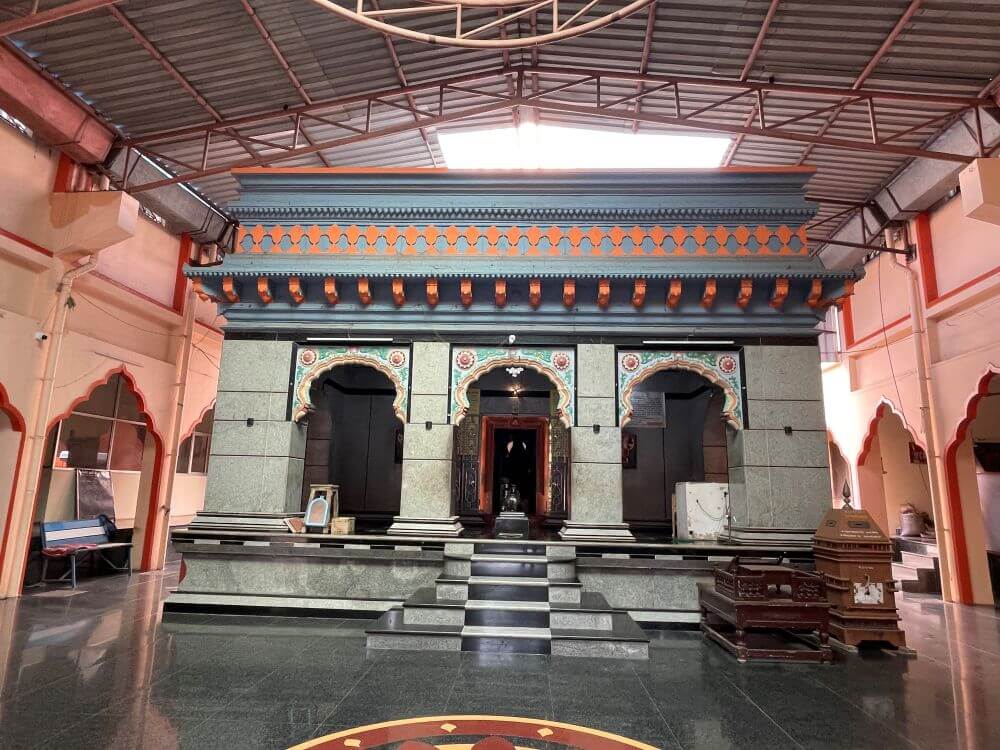
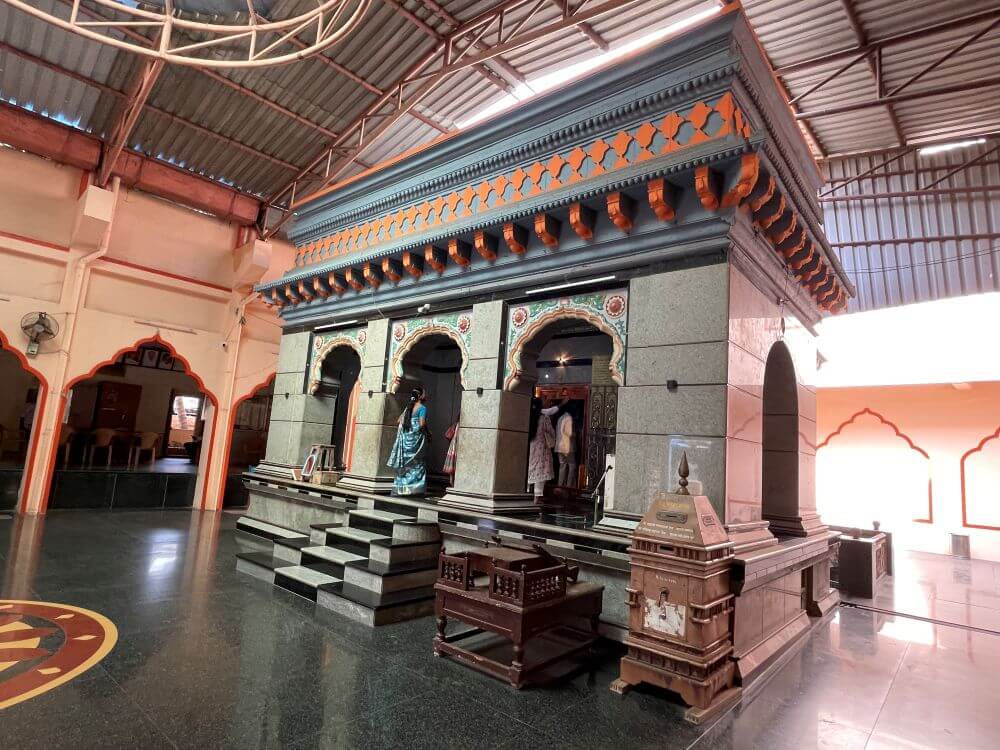
Entering through the gateway, one reaches the temple courtyard. Along the perimeter wall are corridors and buildings that house the residences of the priests and attendants, the temple office, and the Bhakta Niwas (pilgrim accommodation). There is also an Annachhatra (free food service) and a kitchen here. Iron beams connect the buildings on both sides of the courtyard, covered by a corrugated iron roof, creating a large assembly hall (Sabhamandap). Further ahead, on a platform about 4 feet high, is the Antarala (vestibule) and the Garbhagriha (sanctum sanctorum). There are three entrances to reach the Antarala. The entrance has four square, pyramid-shaped steps. The entrance features four ornate pillars connected by arched designs, which are decorated with lotus carvings.
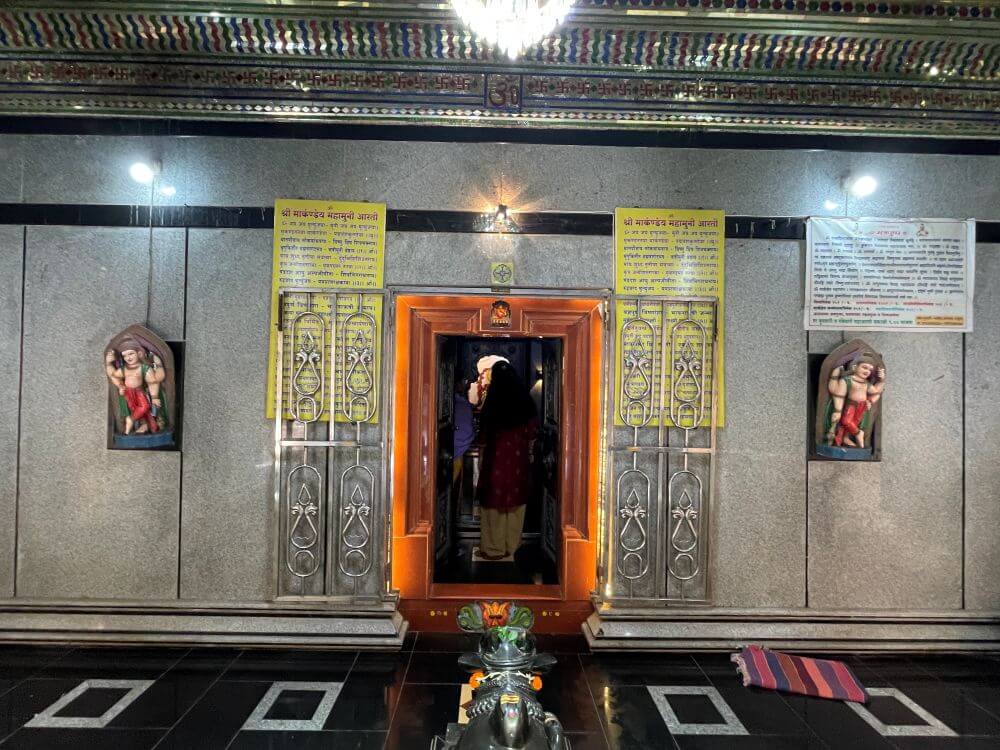
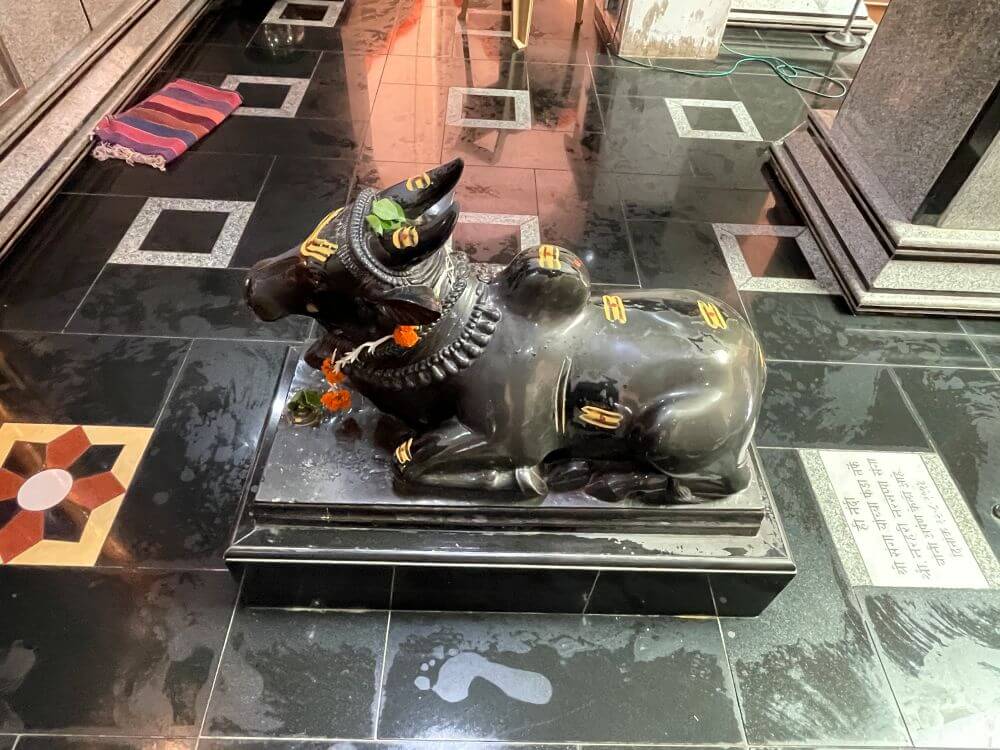
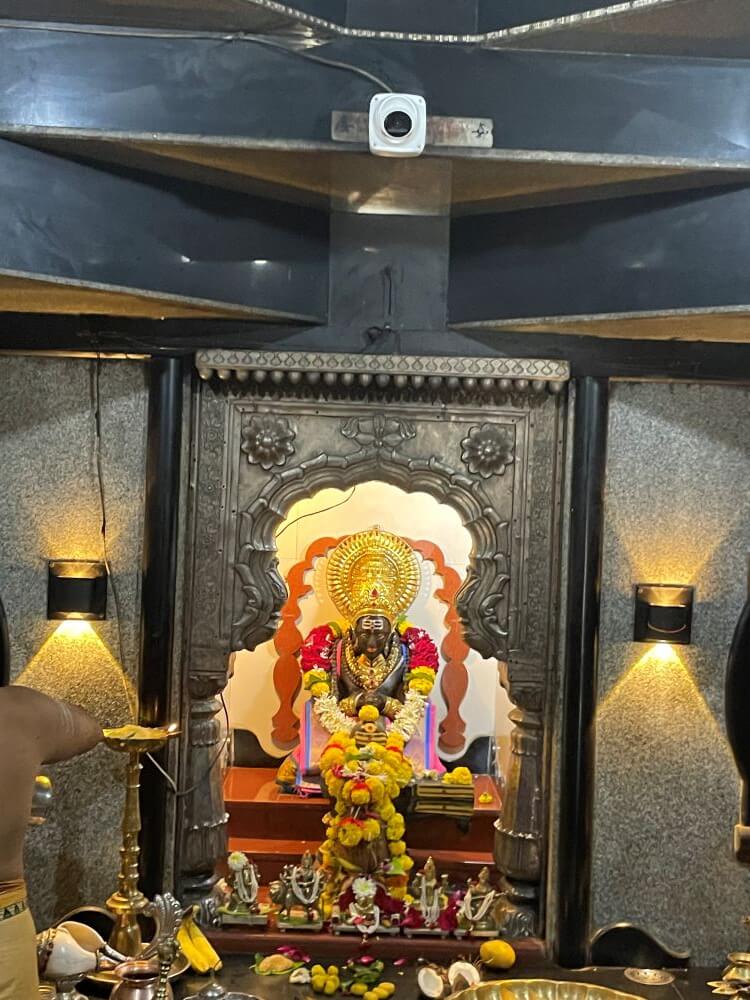
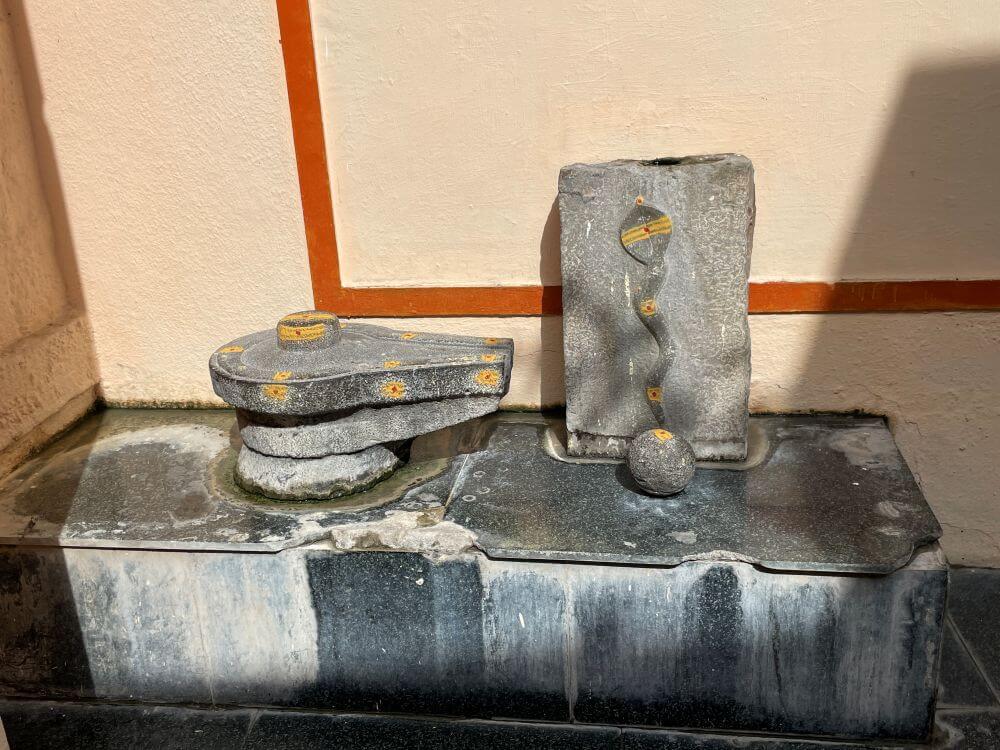
The ceiling of the Antarala is supported by pillars and walls. The ceiling features glass inlay work and a brass bell. In the center of the Antarala floor is a tortoise idol, and in front of it, on a pedestal, is a black stone idol of Nandi. The Nandi is carved with a decorative cloth (jhul) and a garland of bells around its neck. On a table in the Antarala are the Paduka (footprints) and a silver crown of the deity. This crown is placed on the heads of visiting devotees to bless them. Further ahead is the entrance to the Garbhagriha. The door frames have vertical carvings, and there is a Ganesha idol on the lintel. A Kirtimukha is carved on the Chandrashila (moonstone) at the threshold. The entrance has ornate silver shutters. The Garbhagriha is enclosed, and its octagonal ceiling features a circular design in the center. Inside the Garbhagriha, on a Vajrapitha (diamond throne) within a golden arch, is the Shiva Linga, and in front of it is a black stone idol of Sage Markandeya in a devotional posture. The idol wears a golden crown. A tunnel-like staircase leads from the Garbhagriha to a meditation hall in the basement. There are two niches in the walls of the meditation hall, one of which contains black stone idols of Shri Bhavana Rishi and Goddess Bhadravati.
One can exit the temple through a door after performing a half-circumambulation (ardha-pradakshina) from the basement, or take a staircase leading from the other door in front of the Garbhagriha to complete a full circumambulation. This design of the circumambulation path is unique. Above the Garbhagriha is a circular, tapering Shikhara (spire). The lower part of the Shikhara is decorated with lotus petal designs, and the upper part has vertical carvings. At the pinnacle of the Shikhara is an Amalaka, topped with a Kalasha and a flag.
Shravan Purnima is the main annual festival celebrated here with great enthusiasm, during which the Rathotsav of Sage Markandeya is held. The tradition of the Rathotsav is about 100 years old. The chariot procession, which initially took four hours, now lasts for nearly 24 hours. The chariot used for this procession, built of teak wood by the temple committee around the year 1954, is still in use today. Initially, the deity’s Paduka were placed in the chariot for the procession, but nowadays, the Utsava Murti (processional idol) of the deity is carried in the chariot. Thousands of devotees from the city participate in this procession.
All festivals, including Mahashivratri, Gudi Padwa, the month of Shravan, Dussehra, and Diwali, are celebrated in the temple. During these festivals, thousands of devotees come for darshan and to fulfill their vows. Programs such as Bhajans, Kirtans, discourses, plays, and dance performances are organized in the temple on these occasions. There is a large crowd of devotees visiting the temple on Mondays, Purnima, Amavasya, Pradosh, and Ekadashi. Devotees can have darshan of Sage Markandeya in this temple daily from 6:00 AM to 8:45 PM.
This sacred temple stands as a testament to deep spiritual devotion, ancient architectural grandeur, and rich local cultural traditions.
The sanctum sanctorum houses the divine idol consecrated according to ancient Vedic traditions, surrounded by serene courtyards and traditional temple architecture.
Navratri, Maha Shivratri, Annual Temple Jatra & Deepotsav
Compare and book flights, secure top-rated local hotels near the temple, hire reliable guides, and rent cars instantly.
Extend your pilgrimage by visiting other highly sacred temples located nearby.


Add ₹999 more to unlock FREE SHIPPING!
Your sacred cart is currently empty.
Shop Photo FramesFill in your delivery details below to place your order.
Add comment