
Add ₹999 more to unlock FREE SHIPPING!
Your sacred cart is currently empty.
Shop Photo FramesIn Indian philosophy, four Purusharthas (goals of human life) are described: Dharma, Artha, Kama, and Moksha. Dharma means understanding one’s moral duties correctly and performing them systematically. Artha means earning wealth through one’s own efforts, necessary for one’s goals, future, and life. Kama means procreating with a joyful heart for the creation of an advanced society in the future, and Moksha means remaining detached while performing all these duties, without letting one’s mind become entangled in them. To introduce students to all these principles, sculptures were created at some famous temples, using scriptures and sculptural art as a basis. In this context, the name of the temple at Khajuraho is prominently mentioned. One such ancient and famous temple is in the village of Jagji in Dharashiv district. The erotic sculptures located on the Pushkarini (stepped well) here and in the niches within the Pushkarini are especially famous.
Based on the architectural style of the temple and the sculptures found in the vicinity, scholars estimate that this temple dates back to the twelfth century. In folk songs, this village is associated with the demon Jakasur, and in the Aarti of this Goddess, she is referred to as ‘Jakasur Mardini’. It is believed that the Mahalakshmi Devi here is a replica of the Ambabai of Kolhapur.
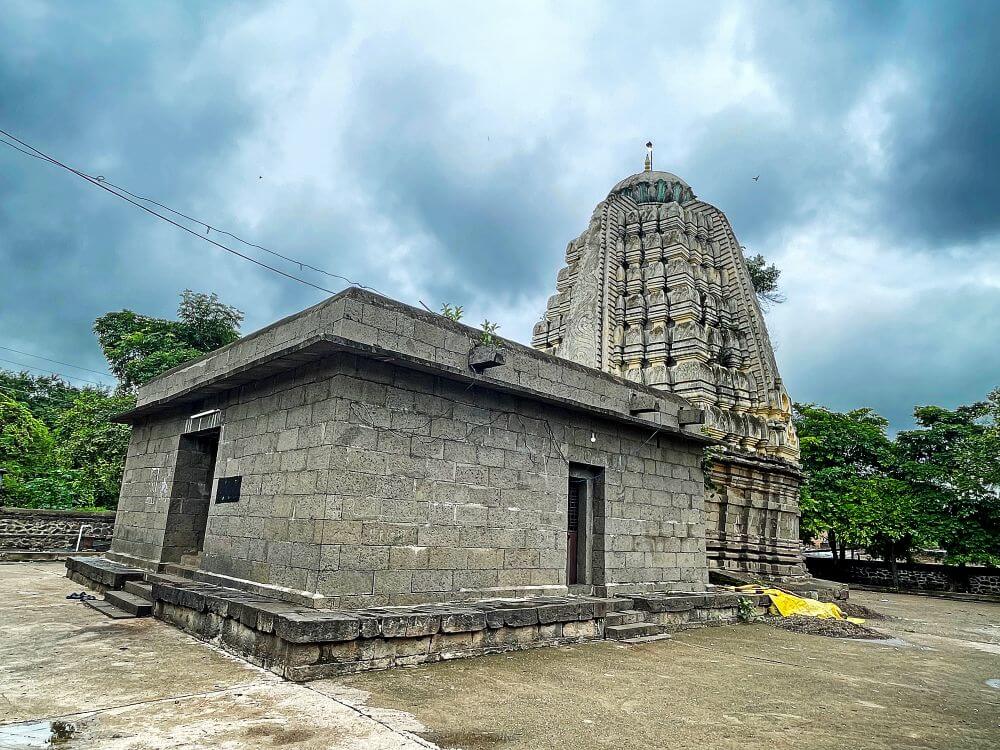
There is a boundary wall around this temple. In the paved courtyard of the temple, there are seats for devotees to sit, and the surroundings are filled with greenery. The temple stands on a platform about three feet high. The structure of the temple consists of a Sabhamandapa (assembly hall), Antarala (vestibule), and Garbhagriha (sanctum sanctorum). There are six steps in front of the entrance to the Sabhamandapa. The design of the entrance on the inner side is unique compared to the front walls. Although the Sabhamandapa has been renovated, it is said that the door frames are ancient. Sculptures of Dvarapalas (gatekeepers) and Dvarapalikas (female gatekeepers) are carved on the lower side of the door frames. The door frames feature floral patterns and pillar carvings. There is another door on the right side of the Sabhamandapa.
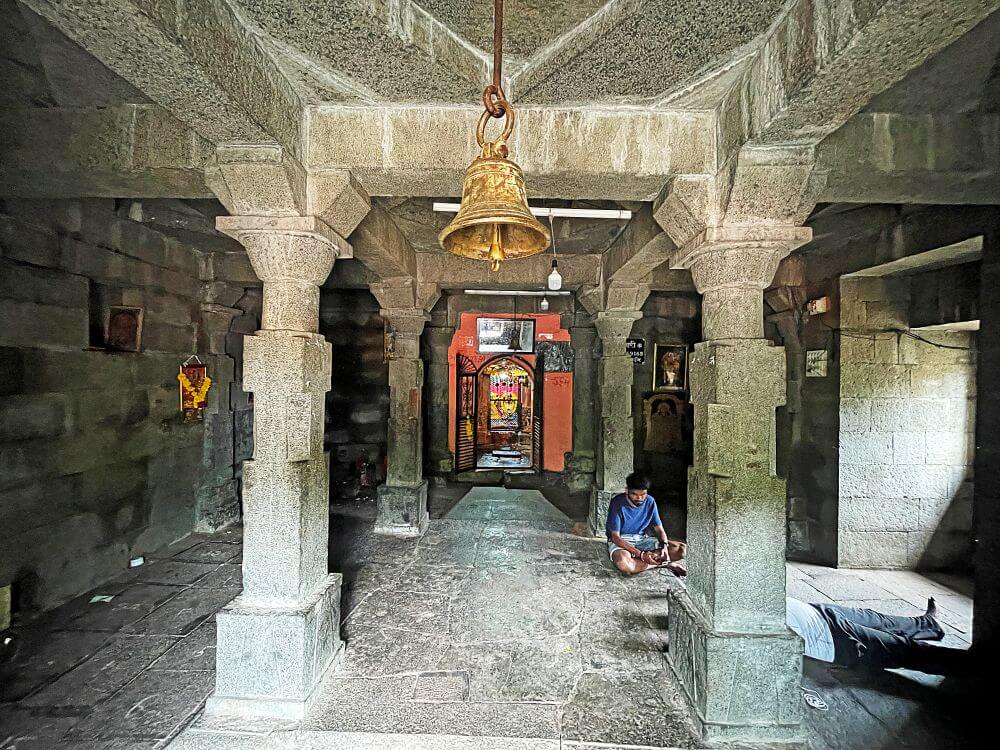
The enclosed Sabhamandapa has windows for ventilation. There are four rows of four ornate pillars each in the Sabhamandapa. The outer pillars are embedded in the walls. Between the four central pillars, there is a rectangular Rangashila (performance stone). In ancient times, programs like dance and singing were organized on this stone for the deity’s Rangabhoga. The pillars in the Sabhamandapa stand on square bases and are of various geometric shapes such as square, hexagonal, and octagonal. There is a circular design in the center of the hexagonal ceiling of the Sabhamandapa.
On the left side of the Sabhamandapa, near the front wall of the Antarala, there are idols of Vitthal-Rukhumai, Maruti, and a Panchamukhi Shivling on a Vajrapitha (stone pedestal). Further ahead, there is a semi-circular arch at the entrance of the Antarala. Some markings can be seen on the stone-paved floor of this enclosed Antarala. It is said that these are boards for indoor games.
On the door frames of the Garbhagriha entrance, there are Bhairava and Bhairavi Dvarapala sculptures at the bottom. The Bhairavi in Yogic posture stands with her hands folded over her head in a Vakrakati posture, and there is a Nagapasha (serpent noose) around her thighs. She is adorned with ornaments and transparent, fine garments, through which her graceful physique is visible. On the side is a four-armed Bhairava sculpture. In his four hands, he holds a Trishula (trident), Damaru (drum), Khadga (sword), and Amrit Patra (nectar vessel), and there is a Nagapasha around his thighs. He is adorned with ornaments. This is a naked Bhairava. Some faces are carved next to the Bhairava sculpture. It is speculated that these might be human skulls or Bhairava Shaktis. Torana (arch) patterns are carved on the upper side of the Dvarapala sculptures. On the other side of the door frame, the Bhairava holds snakes in both upper hands and a human skull and nectar vessel in the lower hands. On this side of the Dvarapala sculpture, a Shakti sculpture is clearly visible next to the Bhairava. The door frames feature floral and pillar carvings. There is an indistinct sculpture on the Lalatabimba (lintel). There is a Chandrashila at the threshold.
In the Garbhagriha, which has sixteen ornate pillars, there are idols of Shri Vishnu and Mahalakshmi Devi on a Vajrapitha between four ornate pillars in the center. Vishnu, in the four-armed Hrishikesha form, holds a Shankha (conch), Chakra (discus), Gada (mace), and Padma (lotus). Sculptures of Garuda on one side and Lakshmi on the other are carved near Vishnu’s feet. The four-armed Mahalakshmi holds a sword, Trishula, Damaru, and Amrit Patra in her hands. In the hand holding the Amrit Patra, the Goddess holds a human skull, and under her thigh is the head of a ram. The Goddess is adorned with various garments and ornaments, and there is a garland of human skulls around her neck. There is a crown on the Goddess’s head with a Kirtimukha on it. Based on the iconography, idol scholars say it is Durga Devi. However, locals believe it to be Mahalakshmi. There are stone Padukas (footprints) in front of the idols. There is a circumambulation path (Pradakshina Path) around the four central pillars in the Garbhagriha. This design of the circumambulation path is considered rare and unique.
There is a spire about 14 meters high on the roof of the Garbhagriha. In this spire, built in the Saptaratha and Bhumija style, there are three Kutastambharathas on each side. There is a Shukanasika (ante-fix) on the spire, and there is a floor at the level of the Shukanasika. It is still possible to enter this floor in the spire. The floral patterns on the spire are particularly noteworthy. At the top of the square spire is a stupika and a Kalasha (finial) above it.
There is an ancient inscription in the temple courtyard. However, the letters are worn out and cannot be read. A Devata Chakra (Akashpindi/celestial disc) is lying in front of the temple. It is said that about fifty years ago, it was on the spire of the temple and used to rotate at that time. The Akashpindi is about one meter in diameter and twenty centimeters thick in the center. The surface of the Pindi is flat and tapers towards the bottom. Due to the groove at the bottom, it can balance and rotate if placed on a pillar. There are images of deities on the Akashpindi. However, they have also faded. According to some experts, these might be images of the Navagrahas (nine planets).
There is an ancient square Pushkarini in front of the temple. The area around the Pushkarini is covered with paver blocks. There are various sculptures on the surrounding stone railing. It features sculptures of Gajraj (elephants), Padma (lotus), Vyala (mythical beasts), Hamsa (swans), Kirtimukha, childbirth scenes, tortoises, horses, musicians, King Bali offering alms to Vamana, episodes from the Mahabharata, the Dashavatara of Vishnu, and some erotic sculptures. There are about 8 steps on each of the two sides to descend into the Pushkarani (stepped tank). There are niches for deities on both sides of both stairways.
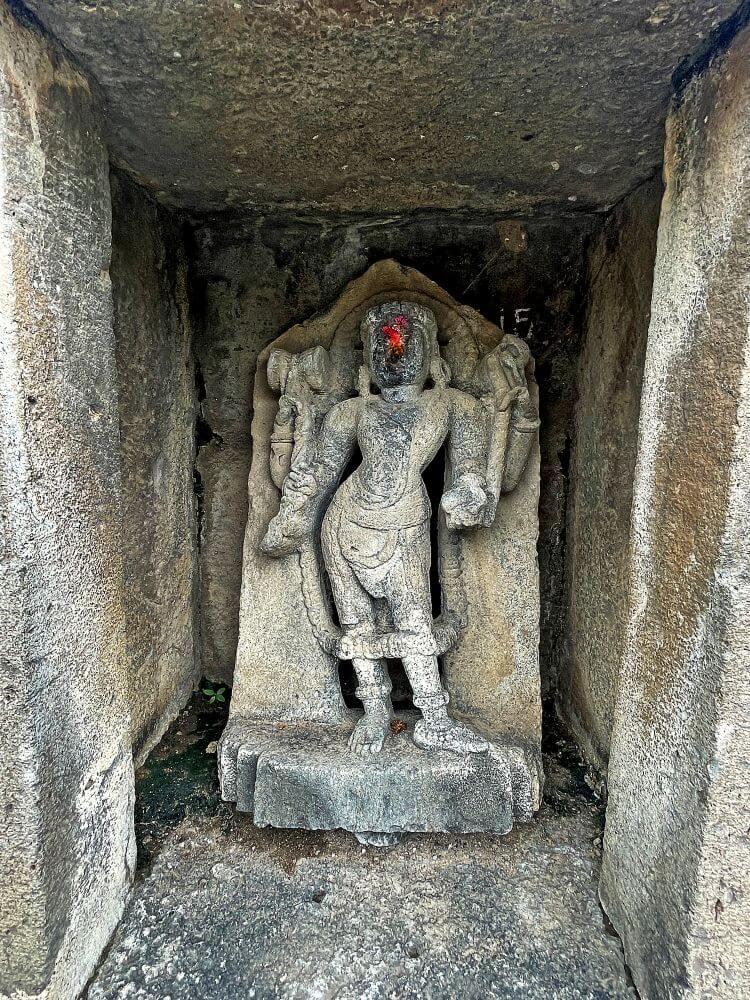
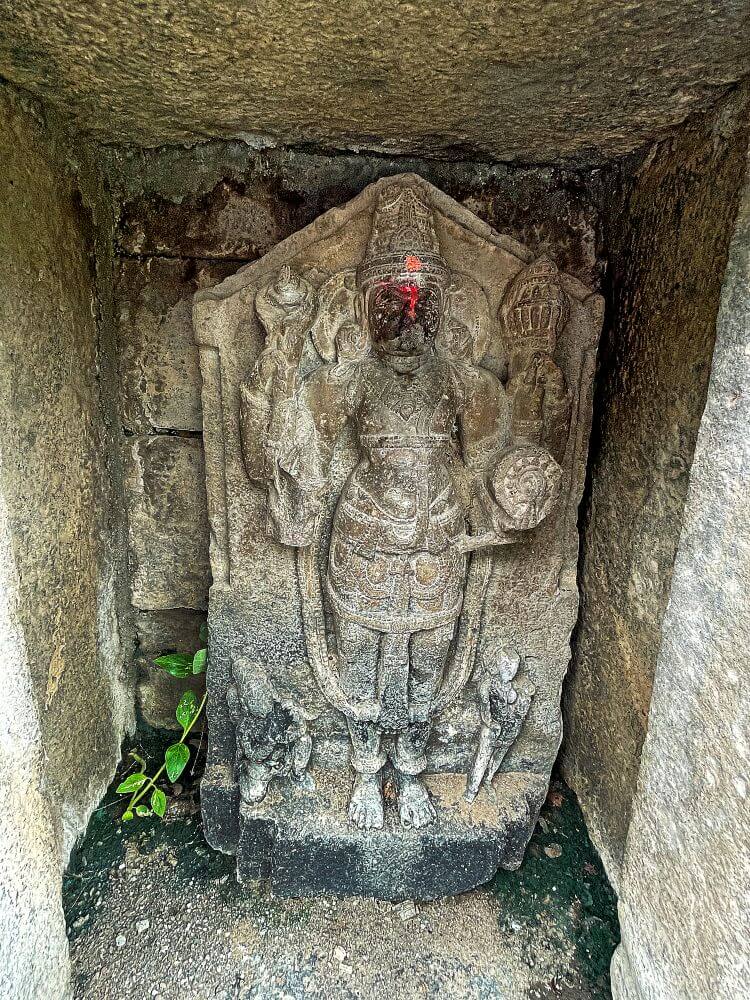
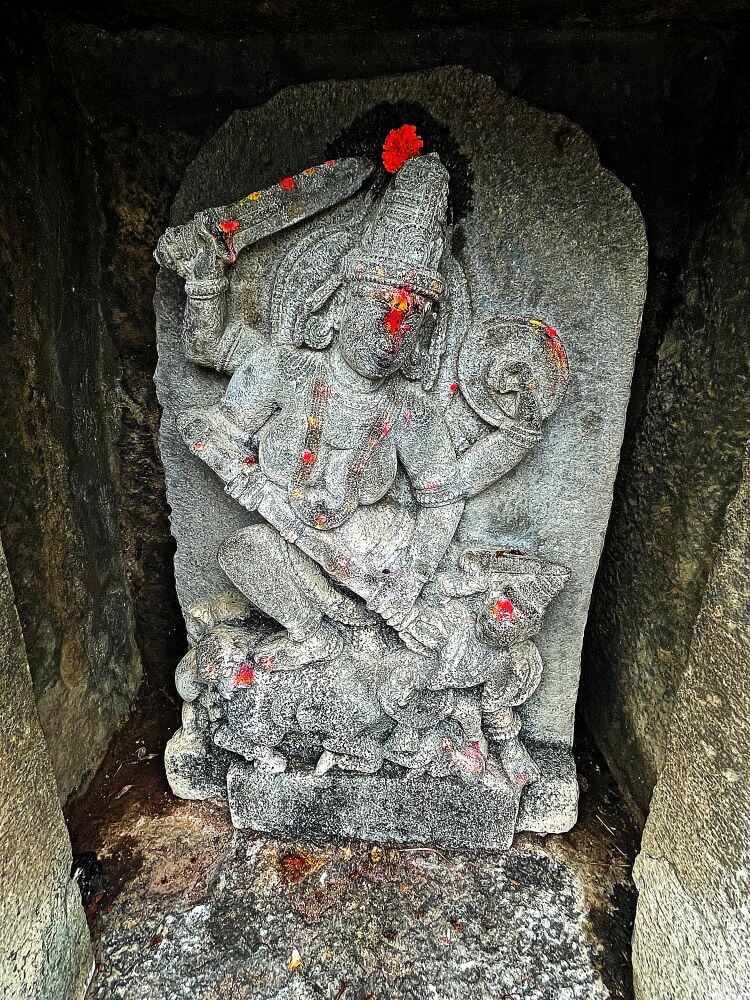
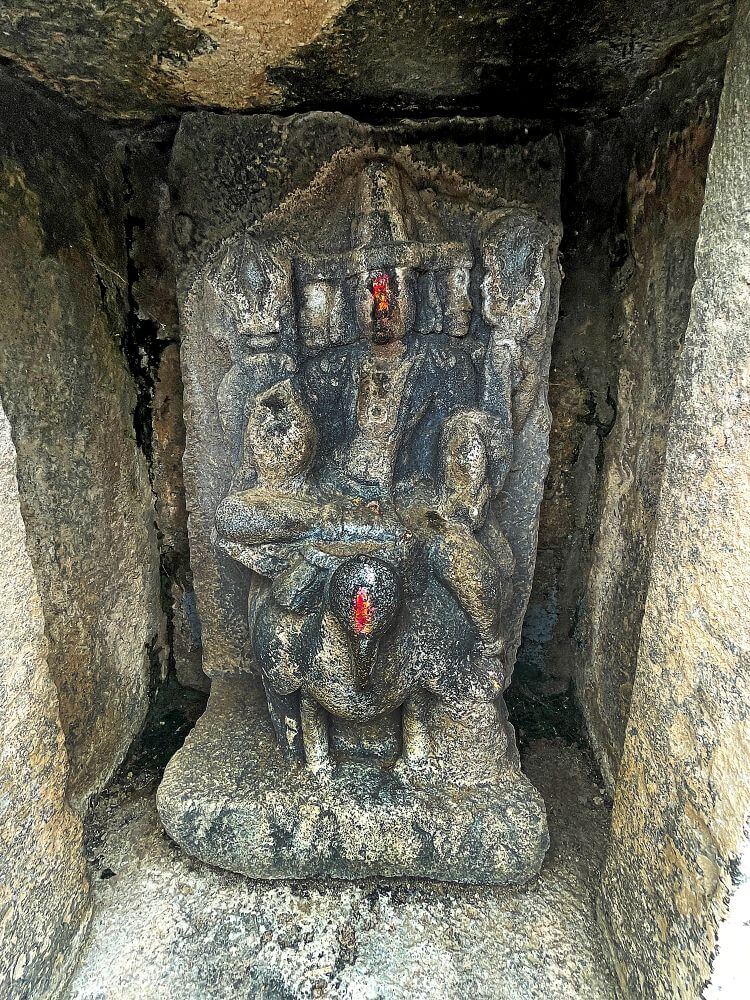
Inside the Pushkarani, there are about 20 niches. These contain sculptures of Bhairava, Viragal (hero stones), Narayana, Yaksha in the form of a serpent, Narasimha in a yogic posture mounted on Garuda, Madhava, Padmanabha, the four-armed Mahishasuramardini, Kartikeya, and others. In the second stage of the Pushkarani, there are about 22 steps on all four sides leading to the bottom. At the base, there is a square-shaped tank. On the side of the Pushkarani wall, there is a square well. The depth of this well is equal to the depth of the central tank in the Pushkarani. This well is connected to the tank via an underground passage. Beside the Pushkarani, there is an ancient Samadhi temple.
Annual festivals such as Navaratri, Chaitra Padwa, Dussehra, Diwali, Mahashivratri, and the holy month of Shravan are celebrated with great enthusiasm in this temple. Various religious programs are organized in the temple during all these festivals. On the occasion of these festivals, thousands of devotees come for the Darshan of the deity and to fulfill their vows. Tourists and scholars visit the temple to observe its architecture and sculpture.
This sacred temple stands as a testament to deep spiritual devotion, ancient architectural grandeur, and rich local cultural traditions.
The sanctum sanctorum houses the divine idol consecrated according to ancient Vedic traditions, surrounded by serene courtyards and traditional temple architecture.
Navratri, Maha Shivratri, Annual Temple Jatra & Deepotsav
Compare and book flights, secure top-rated local hotels near the temple, hire reliable guides, and rent cars instantly.
Extend your pilgrimage by visiting other highly sacred temples located nearby.


Add ₹999 more to unlock FREE SHIPPING!
Your sacred cart is currently empty.
Shop Photo FramesFill in your delivery details below to place your order.
Add comment