
Add ₹999 more to unlock FREE SHIPPING!
Your sacred cart is currently empty.
Shop Photo FramesChangdev village and its surrounding area, known after the deity Changdev who was popular during the Yadava period, is considered the original land of Yogiraj Changavatheshwar, also known as Changdev. The ancient temple of Changdev stands in Muktainagar Taluka, near the place where Muktabai attained Samadhi, at the confluence of the Purna and Taposhni rivers. This temple, dating back approximately 800 years, is built in the Hemadpanti architectural style. It is said that Changdev, who lived for 1400 years, performed his yogic penance in the vicinity of this temple. Furthermore, according to scholars, this is also the site of Changdev’s Samadhi.
It is said that the village of Changdev was formerly known as Sundarpuri. This village is also mentioned in the biography of Sarvadnya Chakradhar Swami. Leela number 417 in the first part of the ‘Leelacharitra’ states: ‘Mag tethauni Gosavim Changdevasi bijen kele: Changdevi jagatiantuli madhim avasthan jale:.’ In the ‘Rameshwarbabanchi Vasana’ manuscript of the Leelacharitra, it is mentioned that he stayed here for ‘Panchratri’ meaning five nights. Two origins are cited for the name of this village. One origin story states that between the years 1000 and 1216, the region was under the rule of the Nikumbh dynasty kings from Patne. They held control over approximately 1600 villages in Khandesh.
Changadeva was a minister in the court of Indradeva, who was the grandson of King Nikumbha (the second) and the son of Krishnaraja (the second). This king and Changadeva are mentioned in an inscription carved in the Mahadeva temple at Patne. The name of this village was given after this Changadeva. According to another origin story, the village was named Changadeva after the great yogi Changadeva. However, the renowned researcher Ra. Chi. Dhere clearly states in his book ‘Shriparvatachya Chhayet’ that, “The name of this place is derived from the deity named Changadeva residing there, not from Changa Vateshwara. The deity named Changadeva was popular during the Yadava period. People used to make vows to Changadeva for the birth of a son.” It is said that this village is the original place of Changa Vateshwara and that he was first seen here.
According to traditional hagiography, the great yogi Changdev had become proud of his spiritual powers. Saint Dnyaneshwar humbled this pride by making a wall move. Later, he accepted Saint Muktabai as his guru. Changa Vateshwar composed many Abhangas. His work, the Tattvasar, is well-renowned. There is a popular belief regarding Changdev that he preserved his body for 1,400 years through the power of his soul. In the Gatha of Saint Namdev, it is stated: “He preserved his body for fourteen hundred years; without true realization, he only increased his fatigue.” Regarding this, R. Ch. Dhere has noted that many stories about the longevity of yogis are told with wonder in ancient literature. However, Ratnakar, an author in Changdev’s tradition, states in his text Deepratnakar: “Muktabai imparted Brahma-Jnana to Changdev, through which he kept his body at the age of fourteen, defying time.” According to this testimony by Ratnakar, it is not true that Changdev lived for 1,400 years; rather, he performed Vayastambhan (arresting of age) at the age of fourteen and, by defying time, maintained a youthful body equivalent to that of a fourteen-year-old for a long period. It is said that Changdev’s Samadhi is in Puntambe. However, the Samadhi there is not of Changa Vateshwar, but of his grand-disciple Changa Keshavdas or Changa Mudhesh. After research, R. Ch. Dhere concluded that the Samadhi of Changa Vateshwar is at the village of Changdev, at the confluence of the Tapi and Purna rivers. In Shyamji Marudgan’s Changdev Charitra, there is a record stating, “The body disappeared at Vateshwar.” Near this village is the place where Changdev’s guru, Saint Muktabai, attained Mahasamadhi. Because of this, the village of Changdev and the Changdev temple there are of exceptional importance.
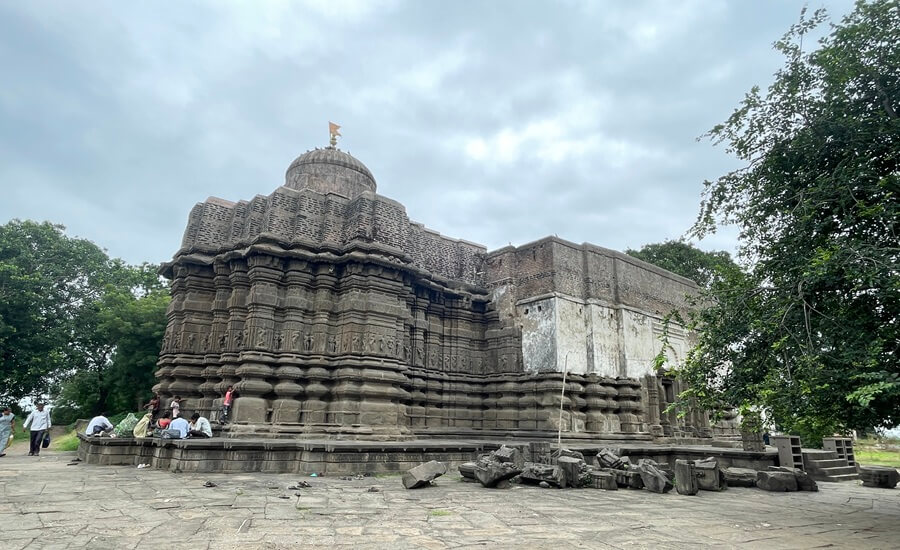
Situated on the banks of the confluence within a large courtyard on a plinth several feet high, this temple is built in the Nagara style prevalent in the twelfth century. Its structure consists of a Sabha Mandap, Antarala, and Garbhagriha. The length of the temple is 97 feet. This The temple had to endure the repeated blows of Muslim invaders as well as the devastation caused by floods due to its location near the river. Consequently, a large portion of this temple has fallen into ruin and is in a dilapidated state. According to the information board provided here by the Archaeological Survey of India, the temple standing today was built during the era of Punyashlok Ahilyabai, between the years 1766 and 1795. Some of the older parts of the temple are constructed with bricks.
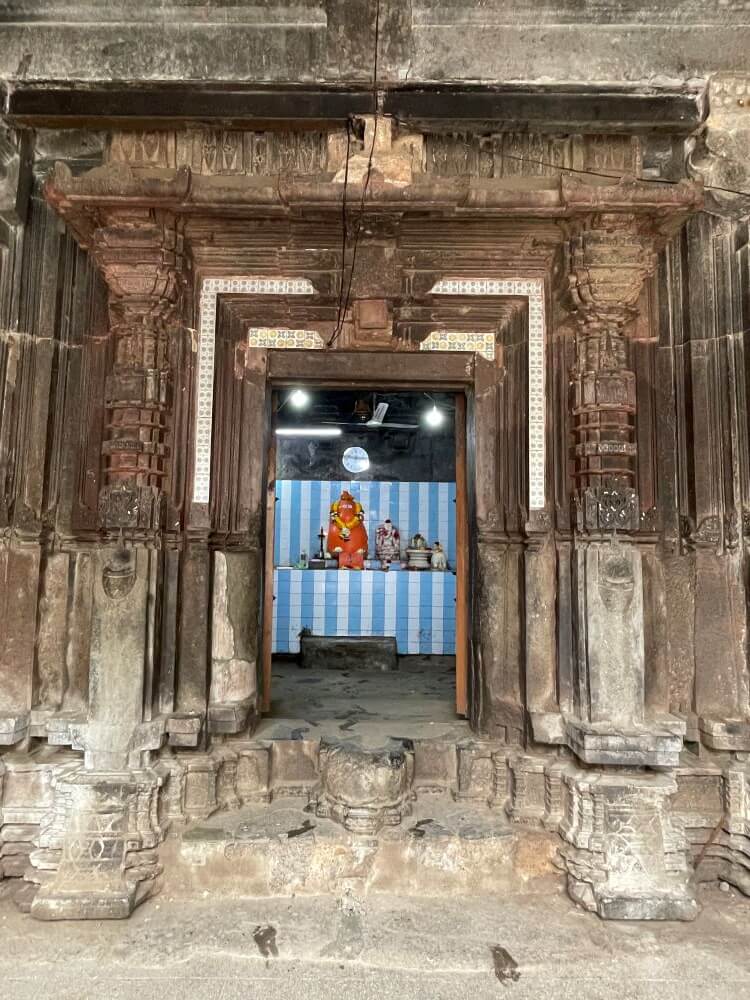
This east-facing temple has three entrances. On the lintel of the main entrance, there is an image of Lord Ganesha. An intricately carved figure is also visible in the area above it, but it is beyond recognition. Some carved figures can be seen at the base of the door frame. Looking at the pillars adjacent to the frame, it is clear that the original entrance of the temple was grand. Figures of gatekeepers are carved on the lower parts of these pillars. An inscription is carved on one of the pillars here. Due to fading over time, it could not be read.
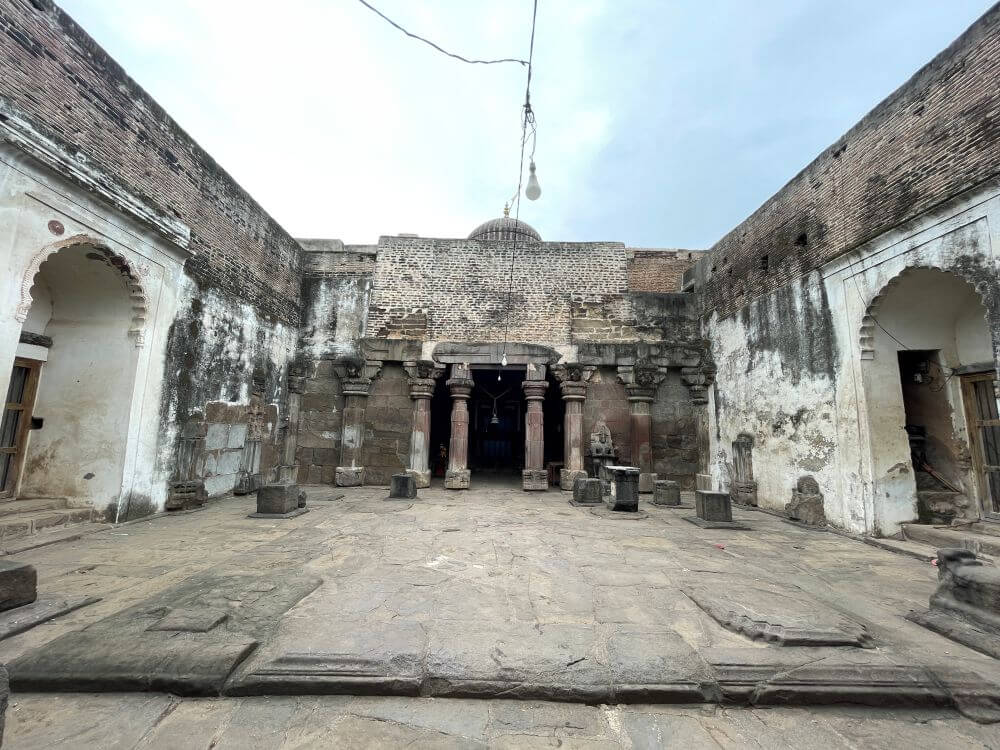
Since the original assembly hall (Sabhamandapa) of the temple was destroyed, a hall was later erected using modern construction. This hall originally had 16 pillars arranged in four rows. Now, only their remains are visible here. The vestibule (Antarala) of the temple has six external stone pillars. On some of these pillars, sculptures of load-bearing Kichakas are clearly visible. Near the outer wall of the vestibule, there is an ancient idol of Lord Hanuman, while inside, on a raised platform, there is a colored idol of Yogiraj Changdev mounted on a tiger. This idol is modern.
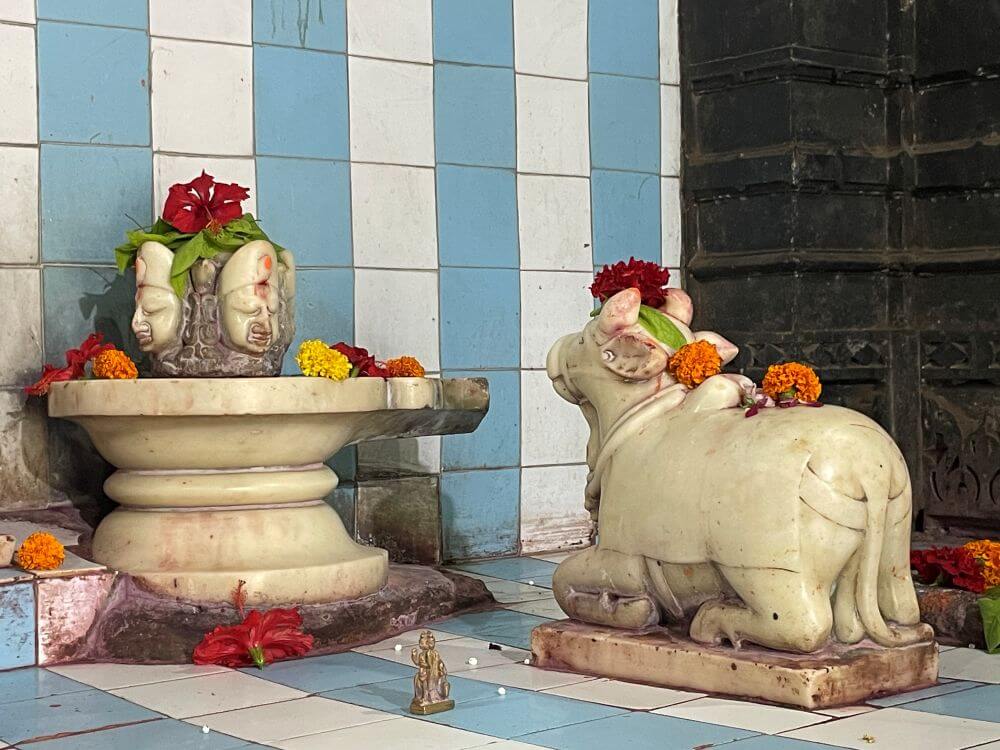
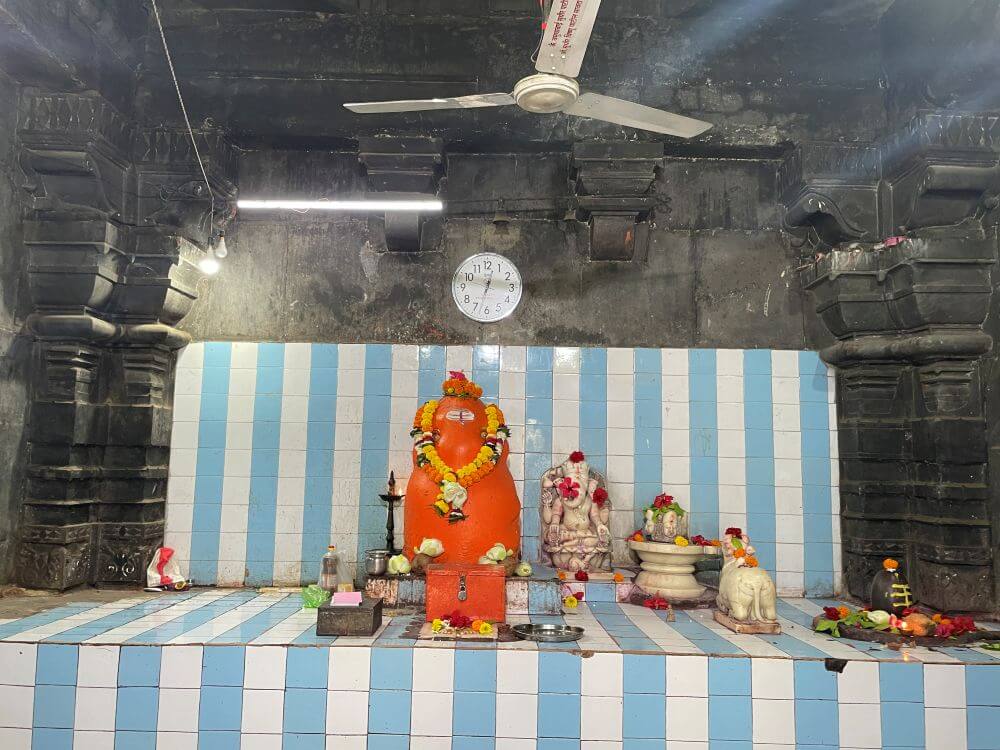
The sanctum sanctorum (Garbhagriha) has a three-branched stone entrance. The pillars of the door frame are adorned with intricate carvings. The position for an idol is visible on the lintel of the frame, but it has now become flat. A wheel is carved in the area above it. Inside, on a platform covered with marble tiles, there is a stone Shivalinga-like form (Tandala) smeared with vermilion. Eyes are carved upon it, and a Tripundra mark is applied to the forehead. This is believed to be the idol of Changdev. Beside it There is an idol of Ganesha, as well as a Shiva Linga in the form of a Mukha-linga, with Nandi placed before it. These idols and the Linga are carved in marble. On the side of the sanctum sanctorum’s ceiling, there is a circular dome carved in stone. Above it sits a dome-shaped Shikhara that was installed later.
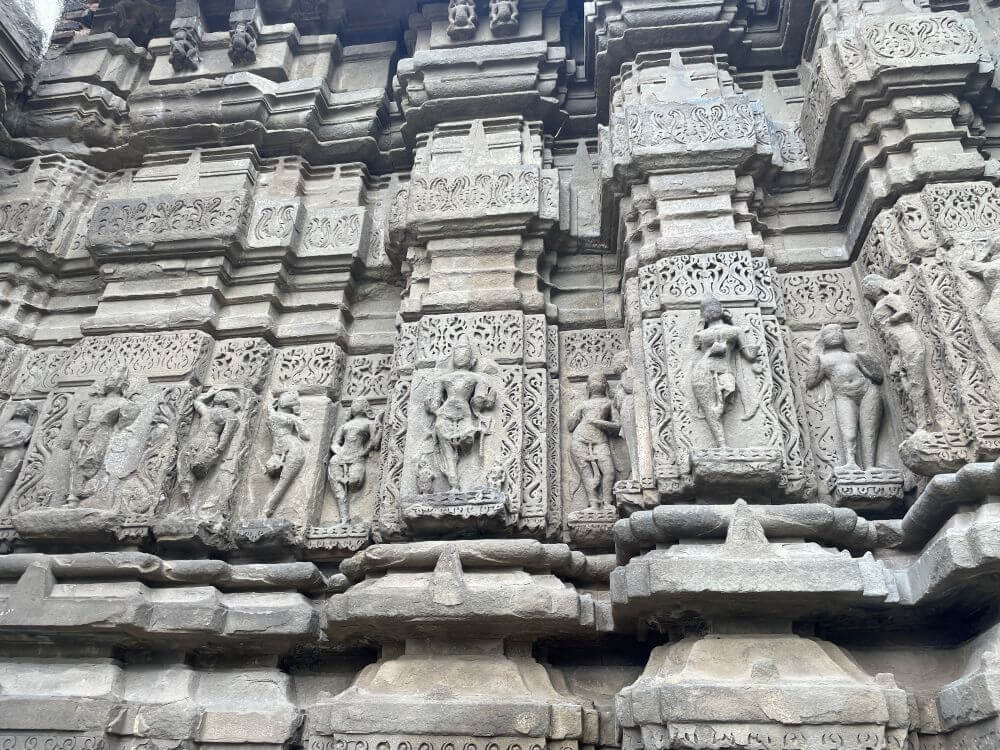
The architectural beauty of this ancient temple of Changdev can be seen on the outer walls of the sanctum sanctorum. On these walls, in the central section, are carved sculptures of numerous Surasundaris in various poses. Notably, some of these sculptures are in a nude state. Sculptures of some male deities are also visible here. One of these sculptures is of Vishnu. At the top of these pillars are small sculptures of load-bearing Kichakas. A beautiful Makara-pranala (crocodile-shaped water chute) has been installed for the drainage of the Abhishek water from the temple, and in front of it is a small square-shaped pond.
Behind the temple, one can see the ruined remnants of a temple that previously stood there. There is a small temple of Hanuman here. Similarly, an ancient It is a Shiva temple. In its main hall, there is a large stone idol of Nandi. In the sanctum sanctorum, there is an ancient stone Shiva Linga situated at a level below the ground. In the year 2008, the Archaeological Survey of India conducted excavations on the western and southern sides of the Changdev temple. During that time, various broken remnants of the stone temple were discovered one after another. Among these are many exquisite sculptures. Considering the antiquity, architectural style, and history of this temple, the Archaeological Survey of India has declared it a protected monument. However, many sculptures of deities and remnants of the temple are seen lying scattered in the open without any protection. This temple is also linked to social movements in Maharashtra. During the pre-independence era, Changdev was a center for movements seeking temple entry for the untouchables. This information was provided in an article written by Dinesh Mahajan in the August 2015 issue of the ‘Historicity Research Journal’. According to it, a temple entry Satyagraha was conducted here in 1930. However, it could not succeed. In a confidential letter sent to the government on 22 May 1930, the then District Collector of East Khandesh provided details on how this Satyagraha failed.
A grand fair is celebrated at the Changdev temple on the day of Mahashivratri. At that time, thousands of devotees from various parts of North Maharashtra come here for the darshan of Changdev Maharaj. For the past few years, this place has also been attracting tourists. There is a boating facility at the confluence here.
This sacred temple stands as a testament to deep spiritual devotion, ancient architectural grandeur, and rich local cultural traditions.
The sanctum sanctorum houses the divine idol consecrated according to ancient Vedic traditions, surrounded by serene courtyards and traditional temple architecture.
Navratri, Maha Shivratri, Annual Temple Jatra & Deepotsav
Compare and book flights, secure top-rated local hotels near the temple, hire reliable guides, and rent cars instantly.
Extend your pilgrimage by visiting other highly sacred temples located nearby.


Add ₹999 more to unlock FREE SHIPPING!
Your sacred cart is currently empty.
Shop Photo FramesFill in your delivery details below to place your order.
Add comment