
Add ₹999 more to unlock FREE SHIPPING!
Your sacred cart is currently empty.
Shop Photo FramesMuktabai was the younger sister of Saint Nivruttinath, Saint Dnyaneshwar, and Saint Sopandev. Among the assembly of Varkari saints, she was the youngest in age but the greatest in spiritual authority among the female saints. Saint Janabai sang of her greatness in these words: “Adishakti Muktabai, Dasi Jani bows at her feet.” Muktabai, who propounded the spiritual philosophy, “Know the ignorant, be ignorant of the knower; be ignorant of both the knower and the ignorant,” suddenly attained ‘Antardhan’ (disappeared into the divine) on the banks of the Tapti River. This place is located at Kothali, a short distance from Muktainagar. A magnificent temple of Muktabai has been erected here.
‘Know that person to be a Saint in this world, who embodies compassion and forgiveness. In whose mind there is no place for greed or ego; know that person to be truly detached in this world.’ The ‘Tatiche Abhang’ (Songs of the Door) by the primordial energy Adi Shakti Muktabai, which describe such characteristics of a Saint, are world-renowned. Unable to bear the relentless persecution inflicted upon the siblings—Nivritti, Dnyandev, Sopan, and Muktabai—by the orthodox religious zealots, Dnyandev once shut himself away in anguish. At the Siddhabet in Alandi He sat inside his hut, having fastened the door. The earnest, pleading advice that Muktabai offered him at that time is known as the ‘Tatiche Abhang’. Just like the ‘Tatiche Abhang’, Muktabai has composed many other abhangs as well. Her work ‘Dnyanbodh’, a collection of conversational abhangs, is well-known. She was the guru to Changdev, who had become proud of his yogic powers.
According to the book ‘Brahmachitkaladarshan arthat Shri Muktabai Charitra va Gatha’ by H.B.P. Nivrutti Maharaj Vakte, Muktabai was born in Apegaon, two years after the birth of Sopandev, on the first day of the bright fortnight of Ashwin, Pramathi Nama Samvatsara, Shaka 1201 (Friday, 12 October 1279). After Saint Dnyaneshwar, Saint Sopandev, and Yogi Changdev attained Samadhi, a deep sense of detachment filled Muktabai’s heart. This has been described in the Abhangs of Saint Namdev. He says, Muktai became very despondent. Feeling that there was no need to sustain this body any longer, she renounced food and water. Seeing this, Saint Nivrutti Nath was filled with deep anguish. He began telling everyone to chant the name of Muktai. In the course of his travels, he arrived at the village of Mahatgram on the banks of the Tapi River. There, Nivruttinath asked Muktabai, “What day have you decided for your departure?” To this, she replied, “Muktai says, where is there to go or come? Everything is but my own essence,” meaning, “Where would I go and from where would I come? Everything is my own form.” On the day of Vaishakh Vadya Dashami, they all went to the Tapi River for a bath. At that moment, the ten directions were suddenly engulfed in darkness. Lightning, as if during a cosmic dissolution, began to strike. As they emerged from their bath and sat down, a storm broke out. Suddenly, a bolt of lightning struck, and Muktabai vanished.
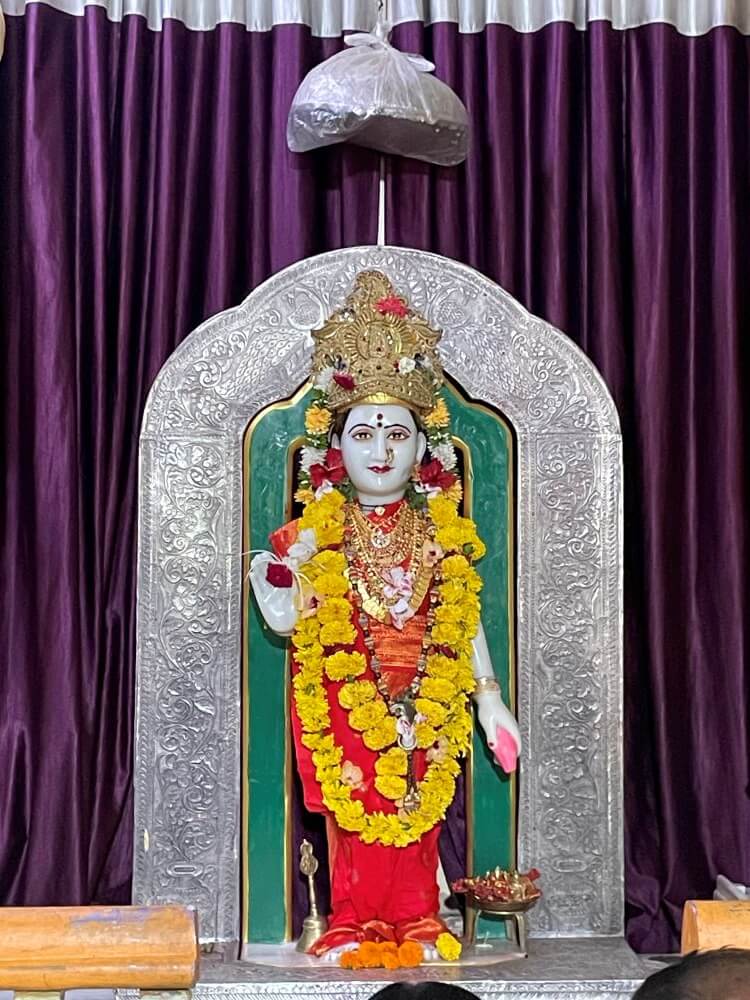
According to the descriptions in Saint Namdev’s Abhangs, it is said that this place is located at Mehun. A large temple of Muktabai has been built there as well. However, according to Nivruttimaharaj Vakte, Mahatnagar, which is Muktainagar (formerly Edlabad), is the place where Muktabai attained Samadhi. There is a Parashganga at Edlabad, which is known as Gangadhar. There was a Someshwar temple there. Muktabai disappeared when lightning struck this Gangadhar. Vakte, in his The book states that the lightning struck near Edlabad. A large crater was formed there, from which a spring of living water emerged, creating a Pushkarani (sacred pond). Along with the spring formed by the same lightning that caused Muktabai to disappear, she manifested at Edlabad in the form of a small, one-foot-tall doll-like figure. Govindbuva Utrankar built a temple for this Swayambhu (self-manifested) doll-like idol. Over time, Tikaram Swami Sannyasi of Tembhurne installed a second idol, one and a half feet in height, at that location. In the year 1900, the temple was renovated, and a white marble idol of Muktabai was consecrated there. This idol was brought from Jodhpur by Raja Ramchandra Rao Deshmukh Raverkar.
Dr. Raghunath Shukla, who worked as a scientist at a chemical laboratory in Pune, has stated that Kothali is the very place where Muktabai attained Samadhi. In 1972, he conducted scientific research at Kothali. Information regarding this has been provided in the article ‘Veej Mhanali Kothalich’ by Amruta Desarda, published in the Sant Muktabai special issue of ‘Ringan’, an annual journal that traces the socio-cultural history of the saint tradition. According to this, Dr. Shukla tested the soil from the site in Kothali in the laboratory. Based on this, the exact spot where the lightning struck was identified. The ash formed from the soil due to the lightning was tested in the laboratory, and its age was determined using the ‘Isotope C-14 Carbon Dating’ method. It was revealed that this ash was formed 700 to 750 years ago. This period aligns with the time when Muktabai attained Samadhi. Based on this, Dr. Shukla expressed the opinion that Kothali is indeed the place where Muktabai departed.
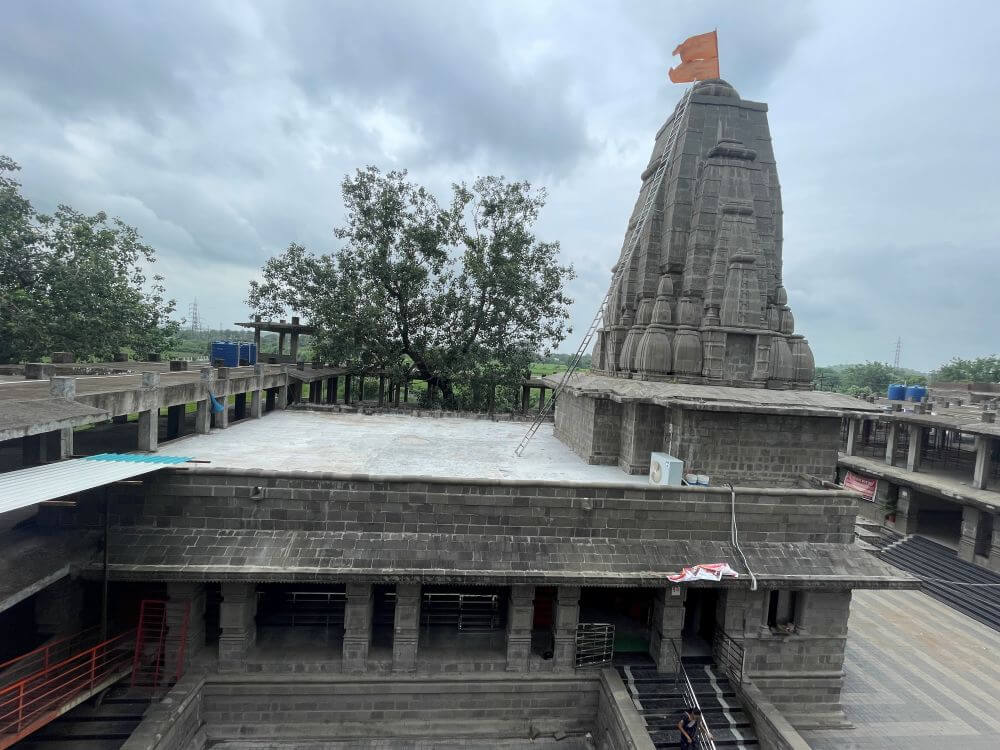
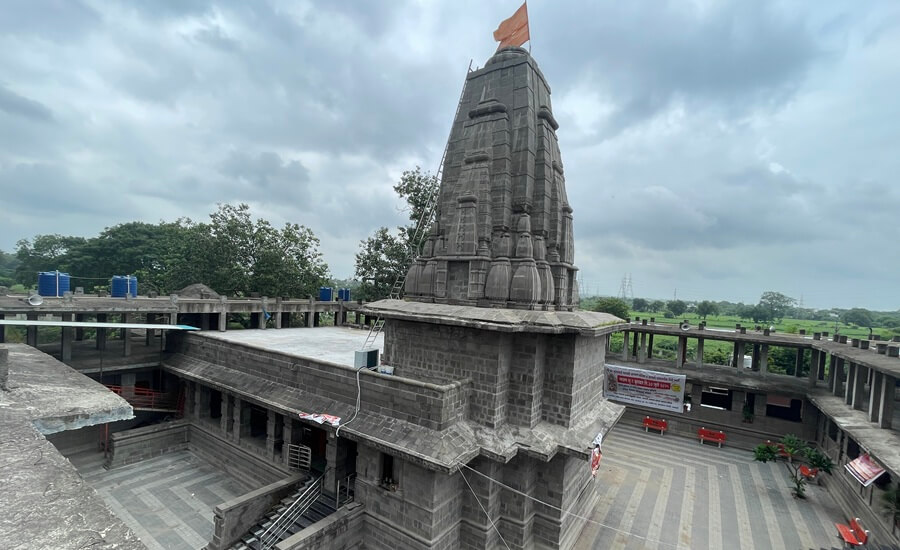
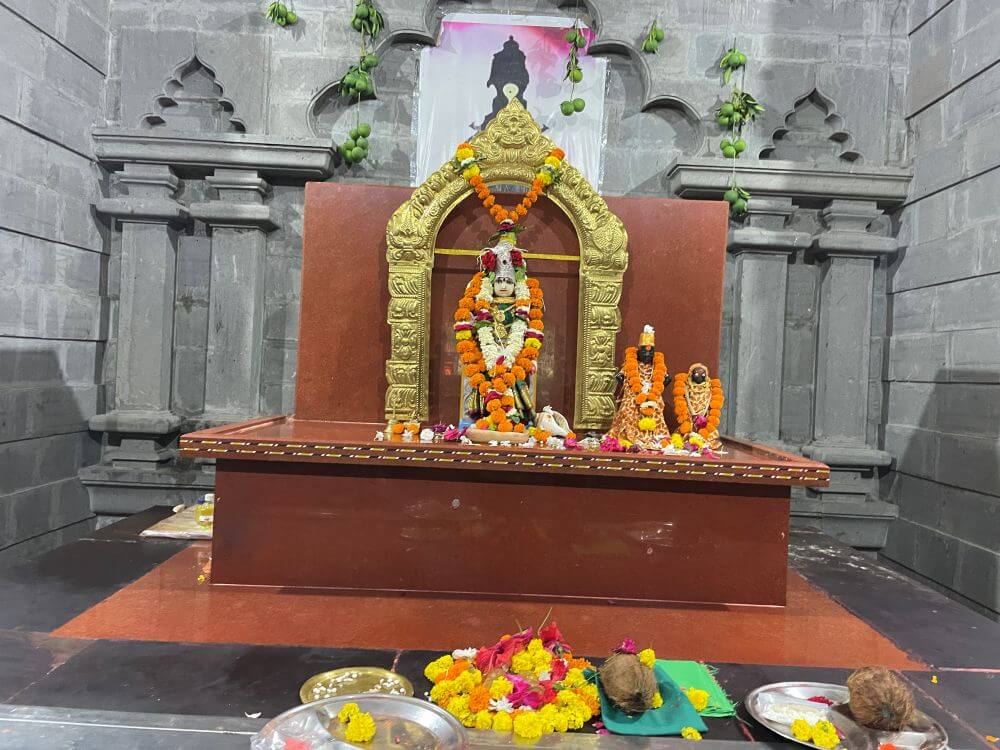
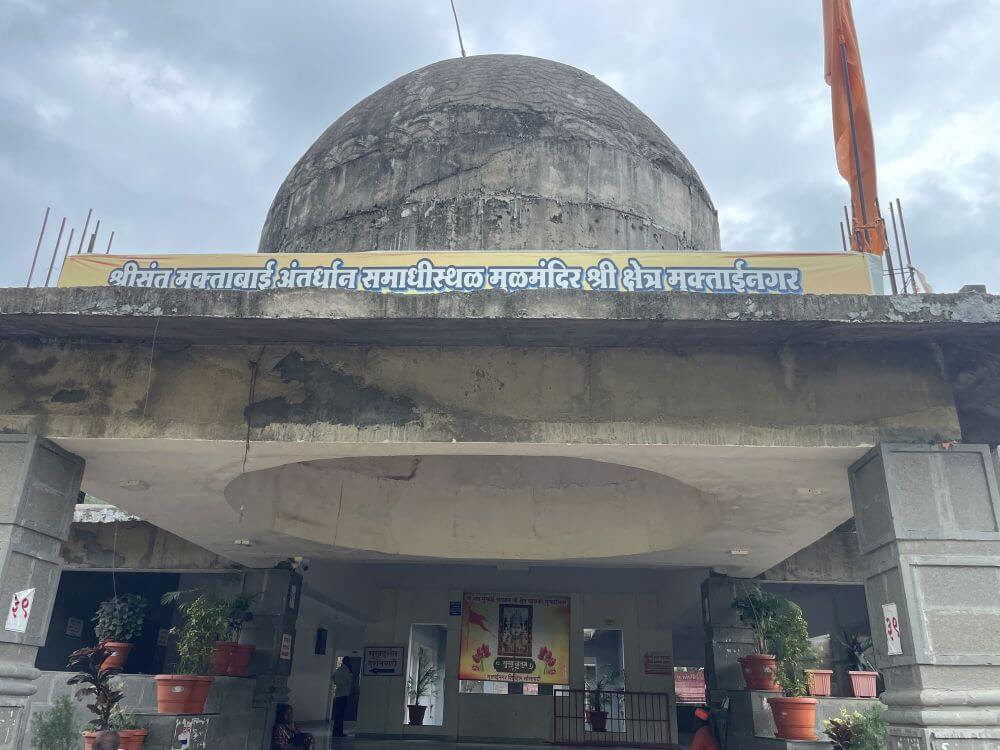
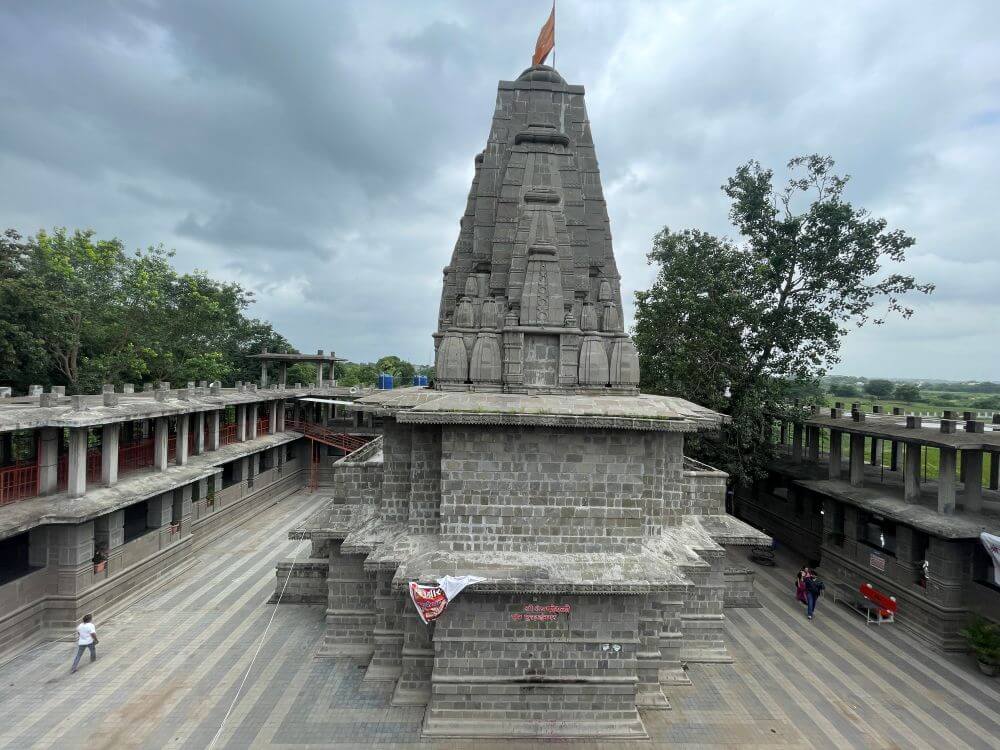
This Samadhi site of Muktai’s disappearance is situated on the riverbank, two kilometers away from Muktainagar. Over the past one hundred and twenty-five years, this temple has undergone renovation four times. The backwaters of the Hatnur Dam lie behind the temple. Since the original temple used to get submerged during floods, a new temple was constructed in Muktainagar in 1989-1990. At the entrance of the temple courtyard, there is a large mandap topped with a dome-shaped shikhara. From there, one enters the temple’s spacious darshan-bari (queue hall). Large corridors have been built around the temple for the stay of devotees. In the center stands a magnificent temple built of stone. The structure of the temple consists of a long and wide sabha-mandap (assembly hall) and a garbhagriha (sanctum sanctorum). This sabha-mandap, supported by large square stone pillars, is open on all sides. From here, one descends a few steps to enter the garbhagriha. Inside, on a marble vajrapitha, resides the serene and radiant pure white marble idol of Muktabai. The idol is adorned in a nine-yard saree, with a silver crown on her head and various ornaments around her neck. Behind the idol is an intricately carved arch with a golden finish. Near the idol are small black stone idols of Vitthal-Rukmini.
The sanctum sanctorum of this beautiful temple in Nagarshauli features an Urushringa-style shikhara, upon which a Vaishnava flag flutters. A separate room has been prepared in the temple corridor for female devotees arriving with small children, which has been named Hirkani. Ritual worship, as well as bhajans and kirtans, are held there on Ashadhi and Kartiki Ekadashi. Every year, the Palkhi of Muktai departs from here for Pandharpur for the Ashadhi pilgrimage. At the base in Wakhari, this Palkhi is accorded the honor of being the Palkhi of Muktai. The Palkhi departs from here on Jyeshtha Chaturthi and reaches Pandharpur three days before Ashadhi Ekadashi. The Changdev-Muktai Yatra takes place on Mahashivratri.
This sacred temple stands as a testament to deep spiritual devotion, ancient architectural grandeur, and rich local cultural traditions.
The sanctum sanctorum houses the divine idol consecrated according to ancient Vedic traditions, surrounded by serene courtyards and traditional temple architecture.
Navratri, Maha Shivratri, Annual Temple Jatra & Deepotsav
Compare and book flights, secure top-rated local hotels near the temple, hire reliable guides, and rent cars instantly.
Extend your pilgrimage by visiting other highly sacred temples located nearby.


Add ₹999 more to unlock FREE SHIPPING!
Your sacred cart is currently empty.
Shop Photo FramesFill in your delivery details below to place your order.
Add comment