
Add ₹999 more to unlock FREE SHIPPING!
Your sacred cart is currently empty.
Shop Photo FramesThe Nath Sampradaya holds a unique and unparalleled place in the cultural and religious history of Maharashtra. To propagate the teachings of the Sampradaya, Gorakshanath traveled across the entire country, establishing maths and temples in various places. Consequently, there are many temples dedicated to the Nath Sampradaya and the Navnath throughout Maharashtra. The temple of Gorakshanath, situated on the banks of the Arunavati River in Karvand, located in the Shirpur taluka, is one such sacred site. Devotees firmly believe that even today, Gorakshanath resides here in a subtle form within this temple, which was sanctified by the touch of his holy feet.
Srisailam Kardalivan in Andhra Pradesh is considered the birthplace of the Nath Sampradaya, and Andhra, Karnataka, and Maharashtra are regarded as its primary sites of divine play (leelasthali). Guru Gorakhnath is the founder of this tradition, and Matsyendranath (Macchindranath) is his Guru. According to the book ‘Nath Sampradayacha Itihas’ by the great researcher Dr. R. C. Dhere, the period of Gorakhnath is between 1050 and 1150 A.D. Gorakhnath authored ‘Amanaska’, He authored texts in Sanskrit and Hindi, such as ‘Amaraughaprabodha’. ‘Gorakhbodh’ is a renowned treatise of his philosophical thoughts. According to Dhere, by launching a movement against Vamachari tantric practices such as Vajrayana, Sahajayana, Shakta, and Kapalika, Gorakhnath purified Indian spiritual practice. The temple of such a great revolutionary Siddha-Purusha at Karvand is an important pilgrimage site for the followers of the Nath Sampradaya.
The Gorakshanath Temple in Karvand dates back approximately eight hundred years. It is said that Gorakshanath, a devotee of Shiva, personally established the Shiva temple here. Since then, the Guru-Shishya tradition has been continuously maintained. For this reason, there are ten Sanjeevan Samadhis of Gurus from the Nath Panth tradition within the temple premises. Devotees believe that the water flowing from the Gomukh here cures many ailments. According to legend, in ancient times, there were three continuous streams of curd, milk, and ghee near this Gomukh, which ceased over time.
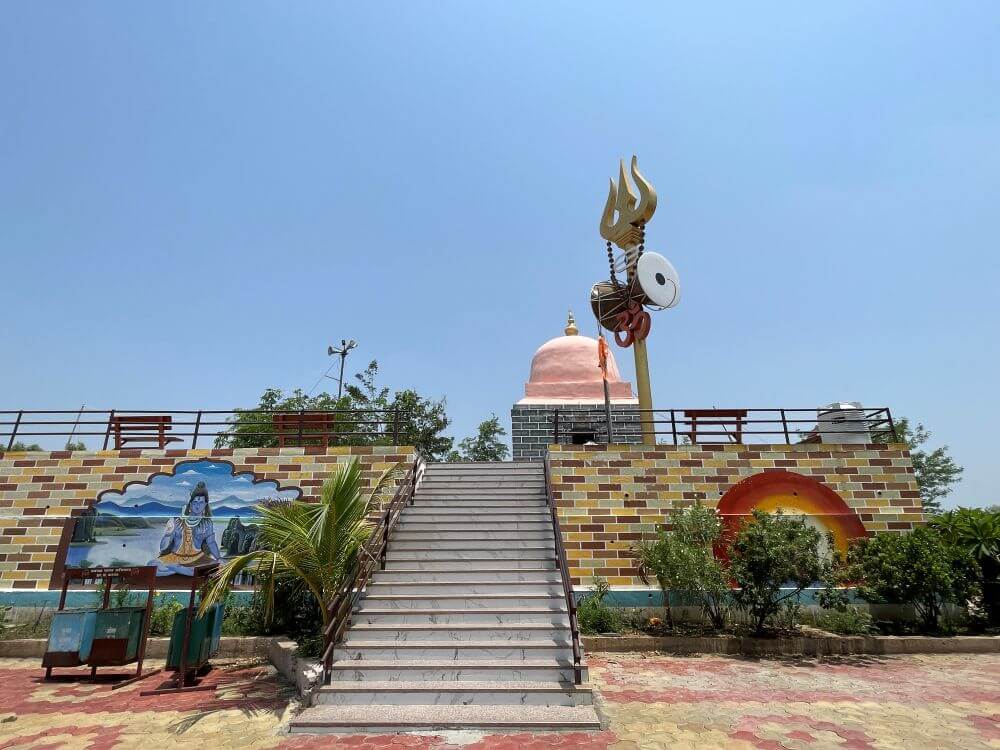
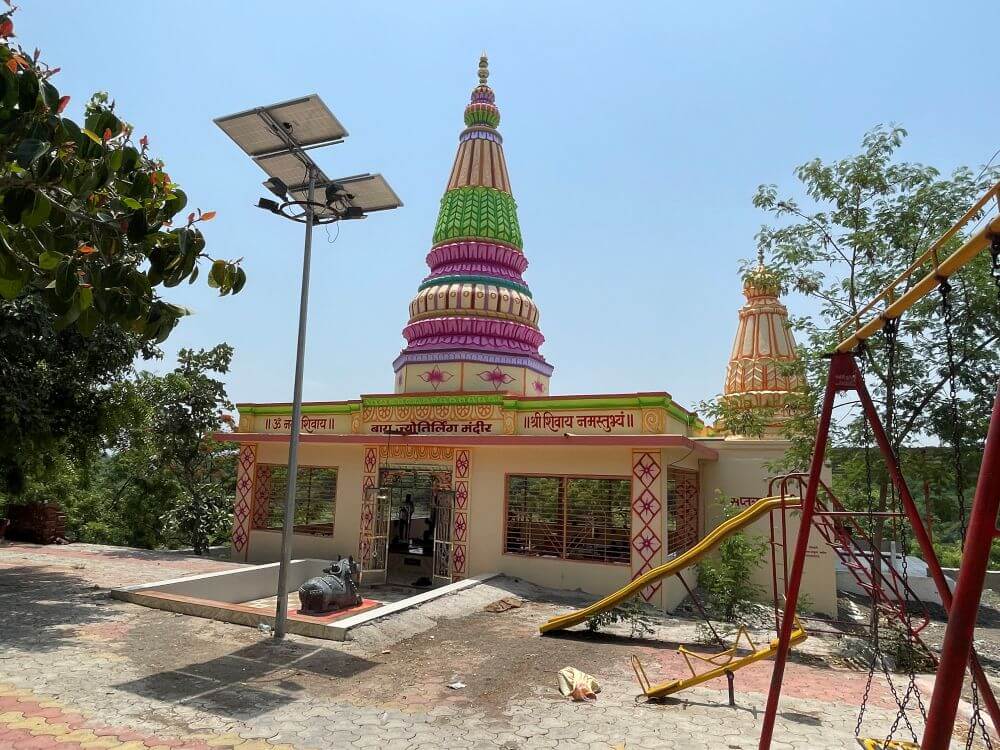
In front of this temple, located at the outskirts of Karvand village, lies a spacious, uneven courtyard without any fortification. The entire courtyard is paved with paver blocks. To reach the Mahadev temple, situated on the elevated area ahead of the courtyard, there are about 25 steps with safety railings on both sides. A Nandi is seated on a platform in front of the temple entrance, and next to it stands a trident (Trishul) and a damaru, approximately 15 feet in height. This ancient temple has been painted in a modern style. The main entrance of the temple is somewhat narrow. In the sanctum sanctorum (Garbhagriha), the self-manifested (Swayambhu) Shiva Linga, located in the center on the floor, is encased in brass plating. There is a brass serpent holding a canopy over the Shiva Linga, and a trident stands to the side. Near the back wall, there is an idol of Lord Ganesha. The roof of the temple features a dome-shaped spire (Shikhara) topped with a finial (Kalash).
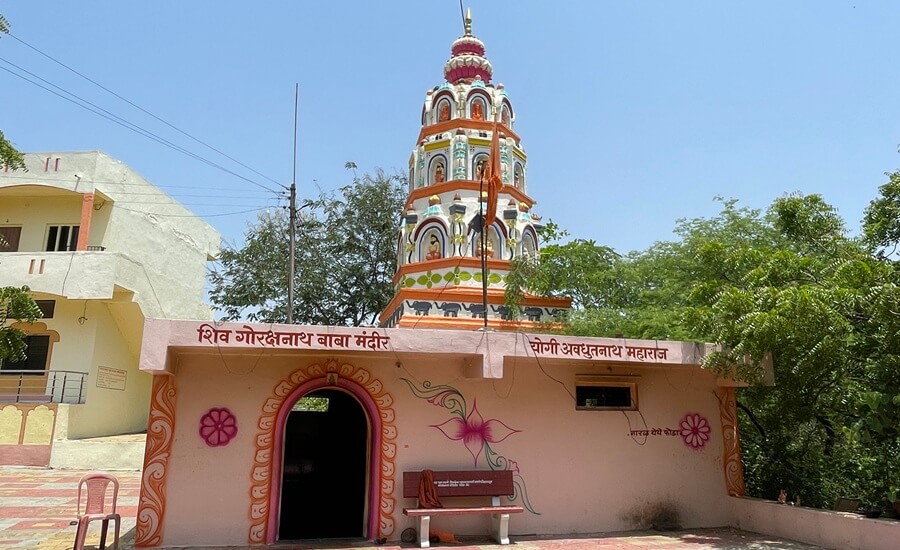
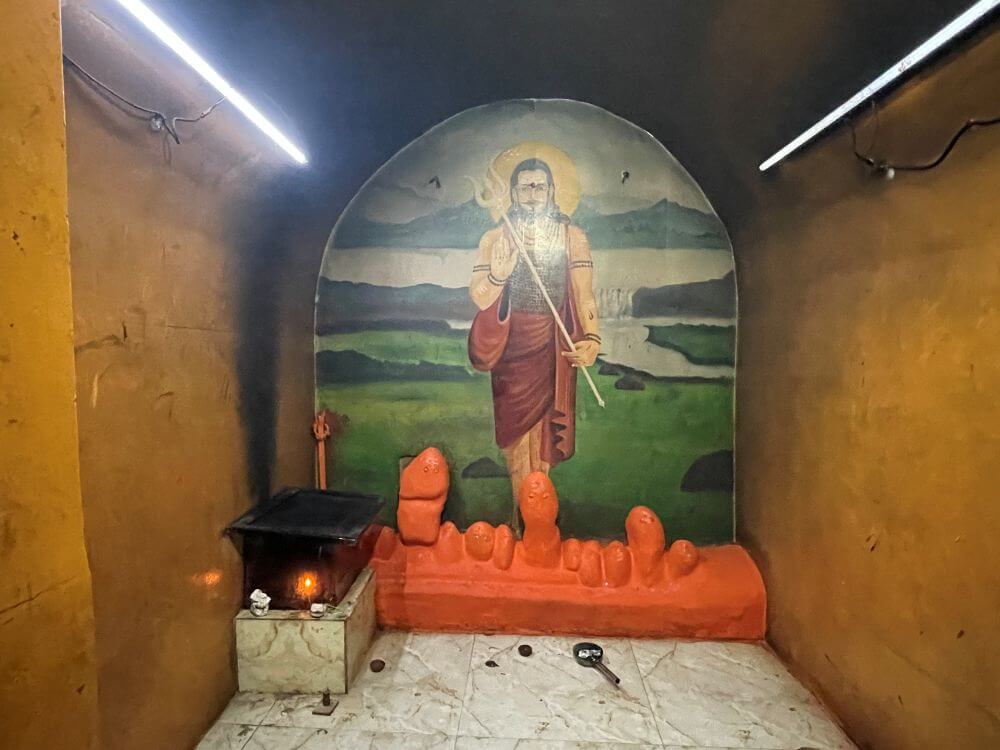
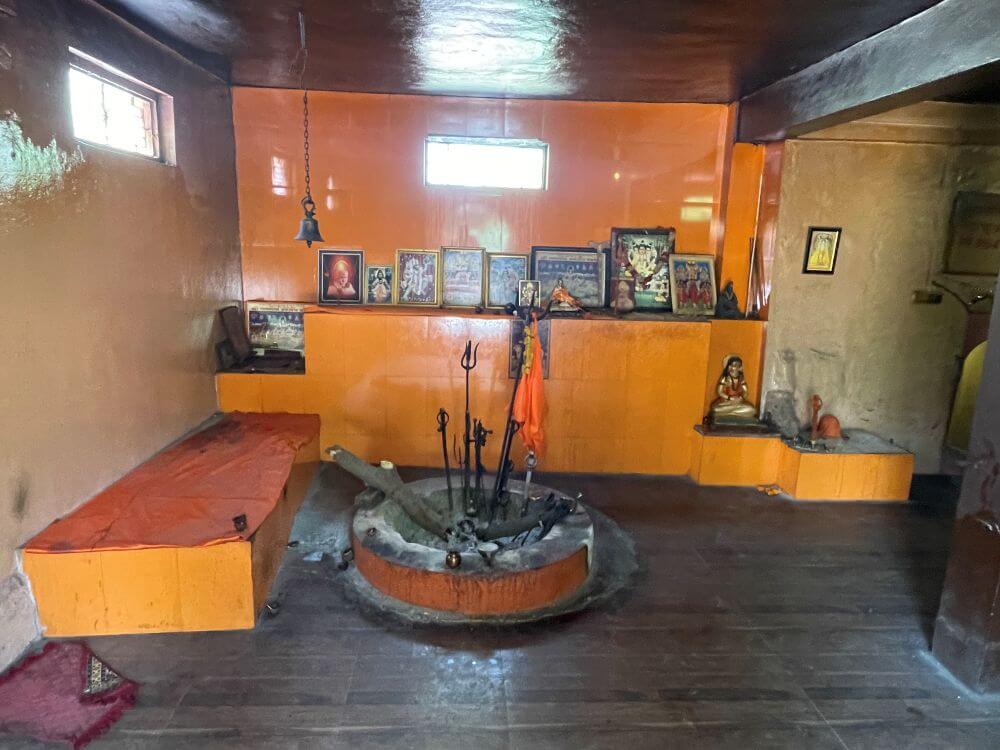
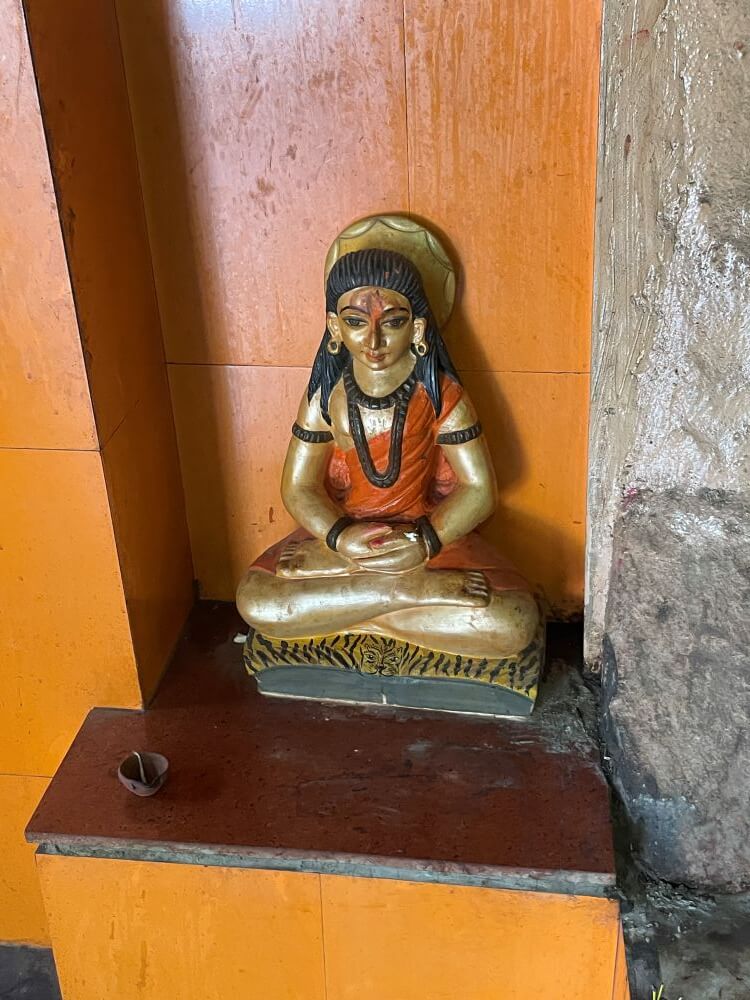
One can reach the courtyard of the Gorakshanath Temple by descending about 15 steps from the rear side of the Shiva temple. The structure of this temple consists of a Sabhamandapa (assembly hall) and a Garbhagriha (sanctum sanctorum). There are windows in the enclosed assembly hall (Gudhamandapa) to ensure proper ventilation. In the center of the assembly hall, there is a Dhuni (sacred fire) that remains perpetually lit. In front of the Dhuni, against the wall on a stone pedestal (Vajrapitha), are the portraits of the Gurus of the Nath Sampradaya. Further ahead is the narrow entrance to the cave-like sanctum sanctorum (Garbhagriha). Inside the narrow cave, on a stone pedestal (Vajrapitha) along the wall, are the vermilion-anointed Swayambhu (self-manifested) stones of the Navnath. Behind the Vajrapitha, in a wall niche (Devakoshtaka), is a colorful painting of Gorakshanath.
The temple roof features a four-tiered octagonal shikhara. Each of the first three tiers contains eight niches, housing the idols of the Nath Gurus. The fourth tier consists of two amalakas placed one above the other, topped by a kalasha. In front of the temple lies the samadhi of a disciple of Gorakshanath. Opposite this temple is the Saptarishi Temple. In the sanctum sanctorum (garbhagriha) of this temple, along the three walls, are the idols of sages Jamadagni, Vishwamitra, Atri, Vashistha, Bharadwaja, Kashyapa, and Gautama. Adjacent to this temple is the site of the twelve Jyotirlingas. Within the temple premises, a bhaktanivas (pilgrim lodging) and a sheltered pavilion are available for devotees.
One can reach the Gomukh by descending about 25 steps from the rear side of the Gorakshanath Temple. On the parapet of the rectangular tank located here, there are two ancient idols of local deities. A natural stream of water flows incessantly from the Gomukh into the tank. Near the Gorakshanath Temple, in the village of Karvand, there is a Nath Panth monastery. Here, there are the Sanjeevan Samadhis of ten gurus from the Nath Panth guru-disciple lineage. Annual festivals such as Mahashivratri, Guru Purnima, and Datta Jayanti are organized at the temple. A large number of devotees gather here on Shravani Mondays and other festive occasions.
This sacred temple stands as a testament to deep spiritual devotion, ancient architectural grandeur, and rich local cultural traditions.
The sanctum sanctorum houses the divine idol consecrated according to ancient Vedic traditions, surrounded by serene courtyards and traditional temple architecture.
Navratri, Maha Shivratri, Annual Temple Jatra & Deepotsav
Compare and book flights, secure top-rated local hotels near the temple, hire reliable guides, and rent cars instantly.
Extend your pilgrimage by visiting other highly sacred temples located nearby.


Add ₹999 more to unlock FREE SHIPPING!
Your sacred cart is currently empty.
Shop Photo FramesFill in your delivery details below to place your order.
Add comment