
Add ₹999 more to unlock FREE SHIPPING!
Your sacred cart is currently empty.
Shop Photo FramesGoddess Choundeshwari is believed to be Chamunda Devi, one of the forms of Navadurga. In North India, She is worshipped as Chamunda, whereas in South India, She is revered by the names Choundeshwari, Chaudeshwari, or Chamundeshwari. There are many famous temples of the Goddess across India, including those at Mohadi in Bhandara district, Sigandur in Karnataka, as well as the temple at Nandavaram in Andhra Pradesh built by King Nandana Chakravarthy. One such famous temple of Goddess Choundeshwari is located in the town of Vita. Devotees firmly believe that the divine presence here is alive (*Jaagrut*) and grants their prayers and vows.
According to scriptural texts, along with Brahmani, Vaishnavi, Aindri, Maheshwari, Kaumari, Varahi, and Yogeshwari, Goddess Chamunda holds a revered place among the Ashta Matrikas (the Eight Divine Mothers). According to the 7th chapter of the ‘Devi Mahatmya’ in the ‘Markandeya Purana’, the demons Shumbha and Nishumbha conquered the three worlds from Lord Indra. To slay them, Goddess Ambica emerged from the divine sheath of Mother Parvati’s body. Chanda and Munda were servants of Shumbha and Nishumbha. They saw Ambica and described Her transcendent beauty to Shumbha. Shumbha sent a message proposing that Ambica become his wife. When Ambica rejected this proposal, Shumbha and Nishumbha sent Chanda and Munda to capture Her. At that moment, Goddess Kali, who manifested from the body of Ambica, vanquished Chanda and Munda. Hence, Goddess Bhagavati bestowed the name ‘Chamunda’ upon Goddess Kali. Over time, Chamunda or Chamundeshwari came to be known by the vernacular variations Choundeshwari or Chaudeshwari.
Goddess Choundeshwari is widely worshipped in states like Maharashtra, Karnataka, Andhra Pradesh, and others. In some temples, Goddess Choundeshwari is revered as Goddess Shakambhari. According to the legend of Goddess Shakambhari, a severe drought lasting a hundred years once struck the region of Tilakavana in Karnataka. The Divine Mother then nourished vegetation, plants, and vegetables using water brought forth from the subterranean realm (*Patala*). The Goddess saved the lives of the people by producing green vegetables from Her own body and bringing water from Haridratirtha in Patala, earning Her the name ‘Shakambhari’ (*Shakan Vibharti iti Shakambhari* – She who sustains with vegetation).
The temple of Goddess Choundeshwari was established in the historic town of Vita in the year 1970. The history of its founding traces back to 1955, when the ‘Devanga Samaj Trust’ took a sacred pledge to build a temple for Goddess Choundeshwari, the revered presiding deity of the local weaver community. Accordingly, contributions were collected at the rate of one paisa for every saree woven by the weavers of the town. With these funds, the foundation stone of the temple structure was laid in the Savarkar Nagar area on 3rd November 1967. On 26th February 1970, the idol of the Goddess was consecrated according to sacred rituals (*Prana Pratishtha*), and the temple was opened to devotees. This shrine of the Goddess stands beside the road in a bustling neighborhood of Vita.
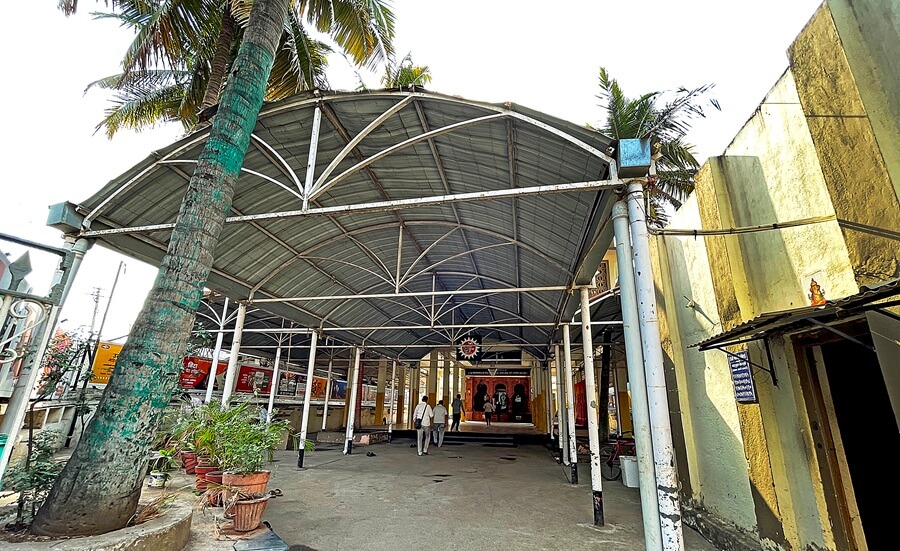
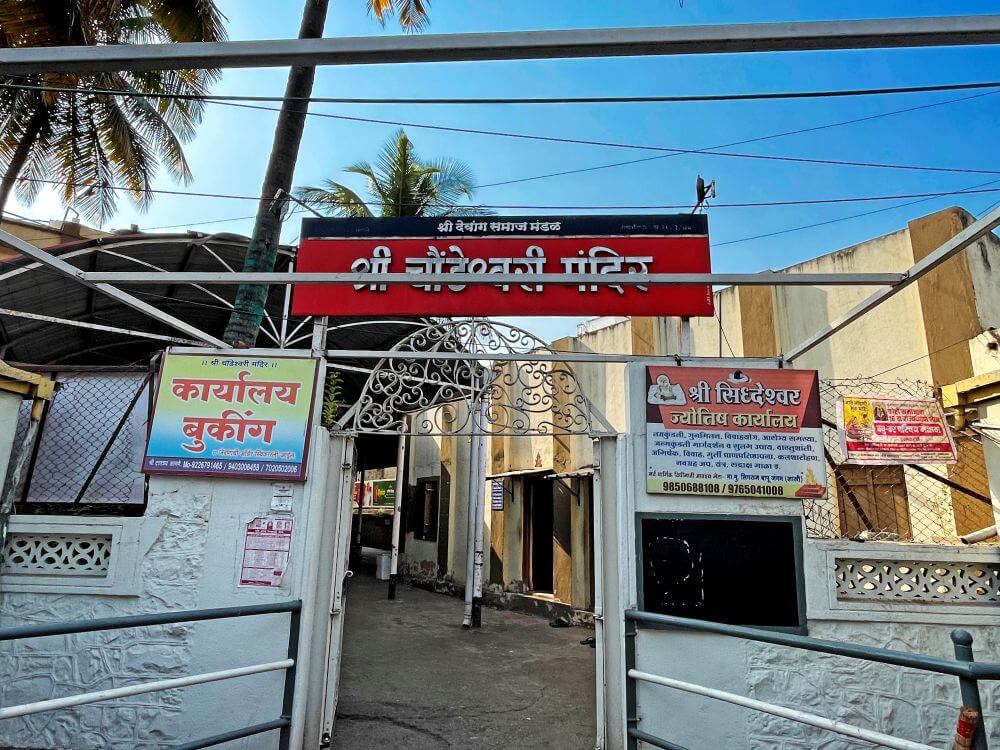
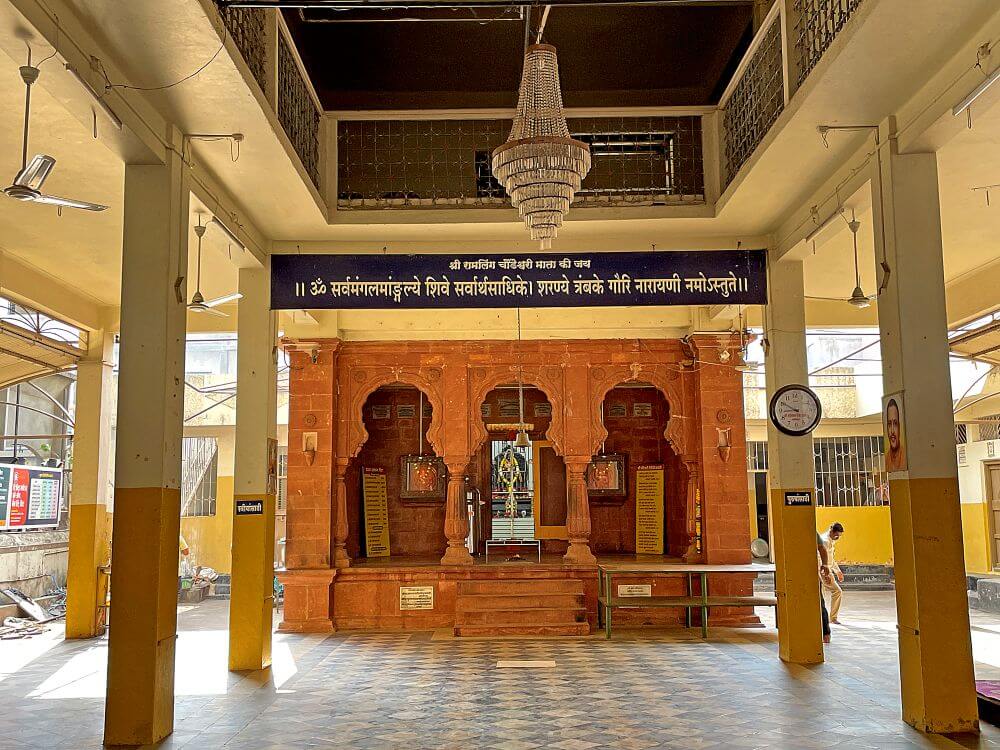
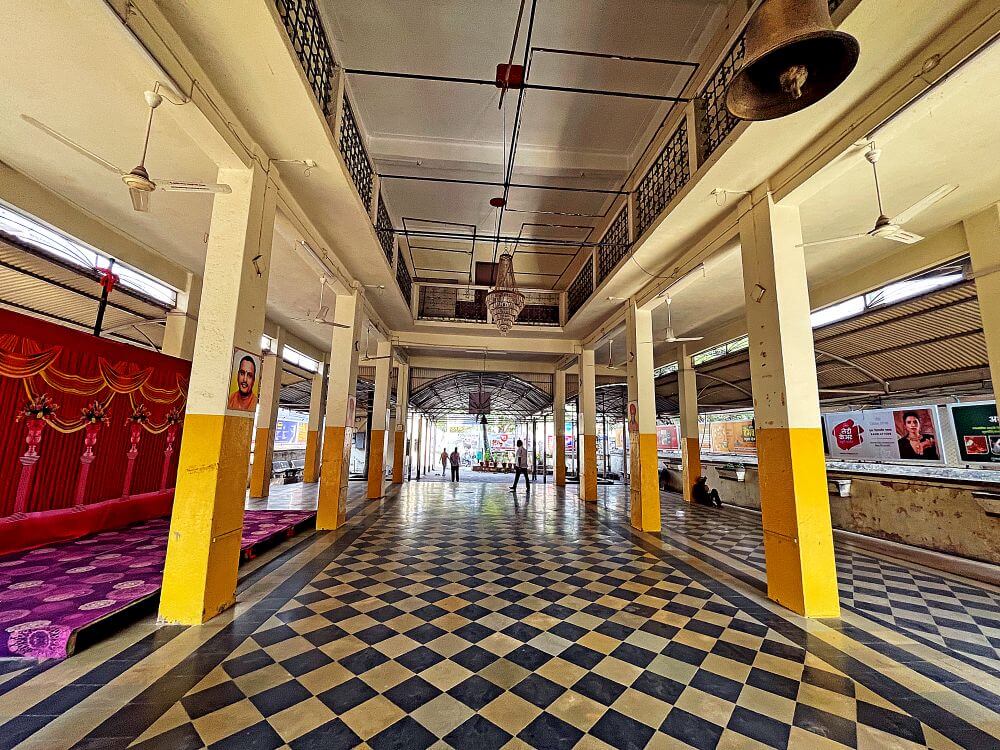
The temple complex is enclosed by a boundary wall with an entrance gate. Passing through the entrance gate leads into the paved courtyard of the temple. In the center of the courtyard, supported by iron pillars, is an arched corrugated metal roof shaped like an elephant’s back (*Gajaprishtakara*). On both sides of this main roof are sloping tin roofs. The temple features an open two-storeyed *Sabhamandap* (assembly hall) constructed of reinforced cement concrete. Inside the Sabhamandap, the central two rows have five square pillars each, while the outer two rows contain six square pillars each.
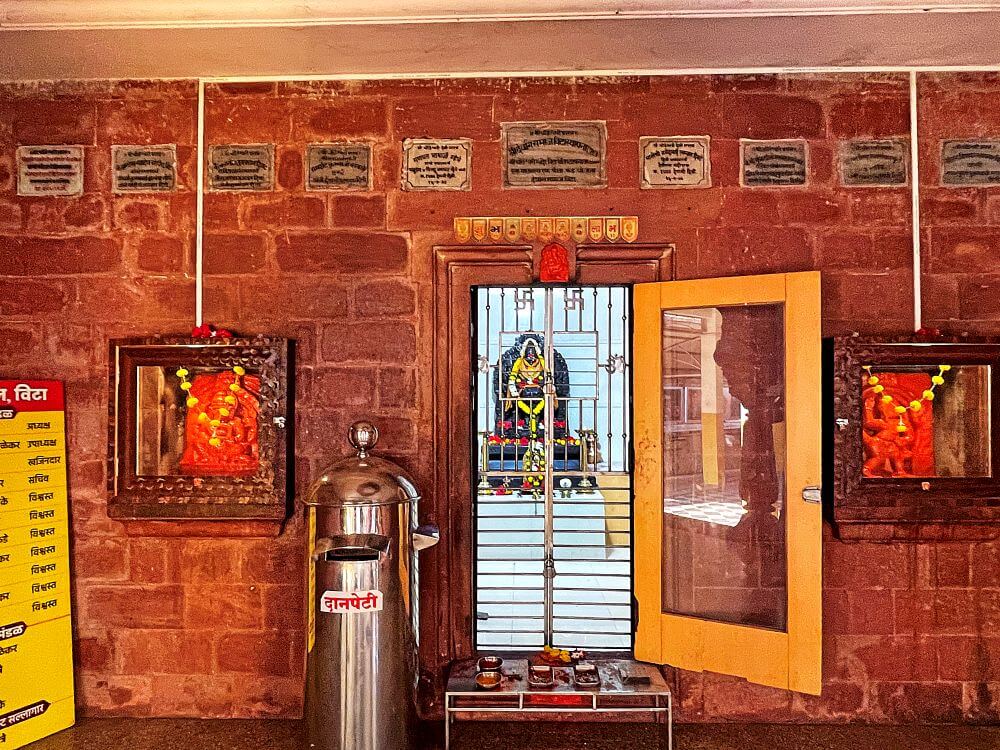
Beyond the Sabhamandap lie the *Antarala* (vestibule) and the *Garbhagriha* (sanctum sanctorum), built from carved red stone. As the Antarala is raised higher than the Sabhamandap, three steps lead up to it. The front side of the Antarala is open. Here, four ornate pillars are interconnected by three cusped arches. The circular pillars, which taper towards the top, rest on square pedestals. At the top of these pillars are square capitals. The shaft of the pillars features circular motifs at the top and bottom, while the middle section is adorned with lotus petal carvings. The cusped arches above the pillars carry circular patterns on both sides, and the ceiling is decorated with wheel motifs. On the floor of the Antarala, there is a carved turtle motif at the center. Within the Antarala, on either side of the entrance to the Garbhagriha, are niche shrines (*Devakoshtas*). The niche on the right houses a vermilion-anointed idol of Lord Hanuman, while the left niche enshrines Lord Ganesha.
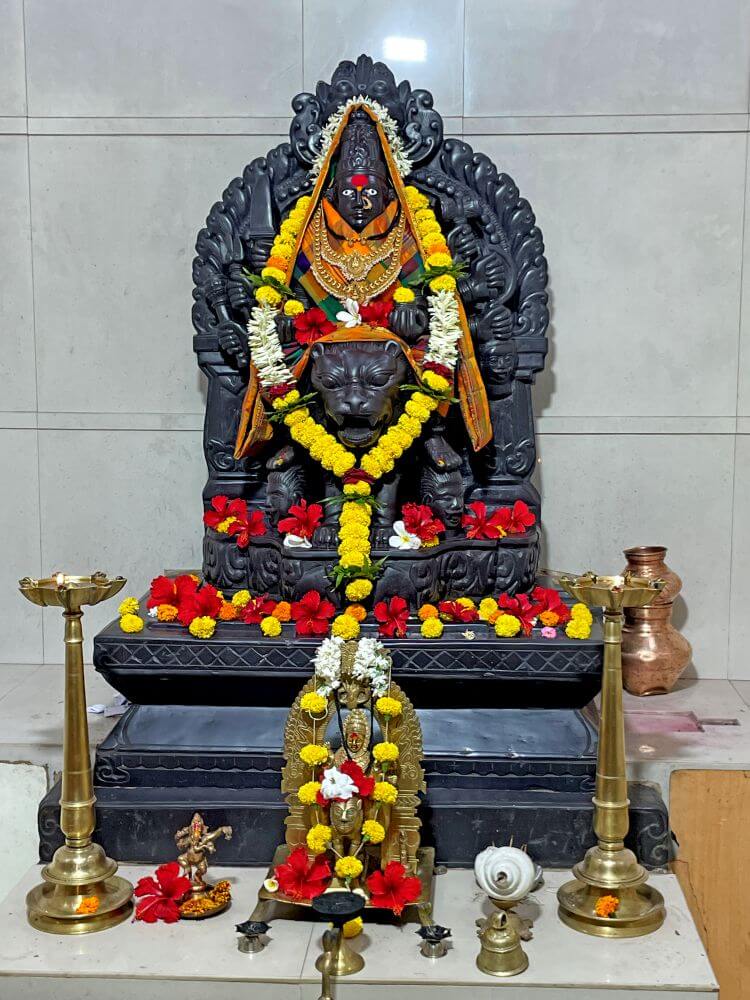
Further ahead is the entrance to the Garbhagriha. The doorframes feature vertical carved bands, and an image of Lord Ganesha graces the central lintel (*Lalatabimba*). A *Kirtimukha* is carved at the base threshold (*Mandaraka*). Inside the Garbhagriha, seated upon a *Vajrapitha* (pedestal), is an eight-armed black stone idol of the Goddess seated on a lion. In Her hands, the Goddess holds weapons such as a sword, mace, and bow, along with a sacred fire altar (*Agnikunda*) and a vessel of nectar (*Amritapatra*). Adorned with a divine crown on Her head and elegant garments and ornaments, the back slab behind the idol features a five-hooded serpent at the top center, flanked by intricate floral and vine carvings on both sides. The Vajrapitha and the idol of the Goddess are covered with an intricately carved silver plating. The idol stands about five feet high and was sculpted by the artisan Lingappa Dasappa. In front of the main deity on the pedestal rests a brass ceremonial idol (*Utsava Murti*) of the Goddess. The ceiling of the Garbhagriha is octagonal with a central wheel motif, and above the sanctum roof rises an ornate *Shikhara* surmounted by a sacred *Kalasha*.
Every year on 26th February, the anniversary day of the temple is celebrated with grand enthusiasm. On this occasion, religious, cultural, educational, and entertainment programs are organized over eight consecutive days. The temple also celebrates the 11-day annual festival of Shakambhari Navratri and Shakambhari Purnima. In addition, festivals like Shardiya Navratri, Dasara, Diwali, Chaitra Padwa, and others are celebrated with great devotion. A ceremonial palanquin (*Palkhi*) procession of the Goddess circles the town. During this procession, accompanied by the thunderous beats of *Dhol-Tasha*, shower of vermilion powder (*Gulal*), and dancing elephants and horses, the grand Palkhi ceremony takes place. Thousands of devotees from the surrounding areas gather during all these festivals for holy *Darshan* and to fulfill their sacred vows (*Navas*).
This sacred temple stands as a testament to deep spiritual devotion, ancient architectural grandeur, and rich local cultural traditions.
The sanctum sanctorum houses the divine idol consecrated according to ancient Vedic traditions, surrounded by serene courtyards and traditional temple architecture.
Navratri, Maha Shivratri, Annual Temple Jatra & Deepotsav
Compare and book flights, secure top-rated local hotels near the temple, hire reliable guides, and rent cars instantly.
Extend your pilgrimage by visiting other highly sacred temples located nearby.


Add ₹999 more to unlock FREE SHIPPING!
Your sacred cart is currently empty.
Shop Photo FramesFill in your delivery details below to place your order.
Add comment