
Add ₹999 more to unlock FREE SHIPPING!
Your sacred cart is currently empty.
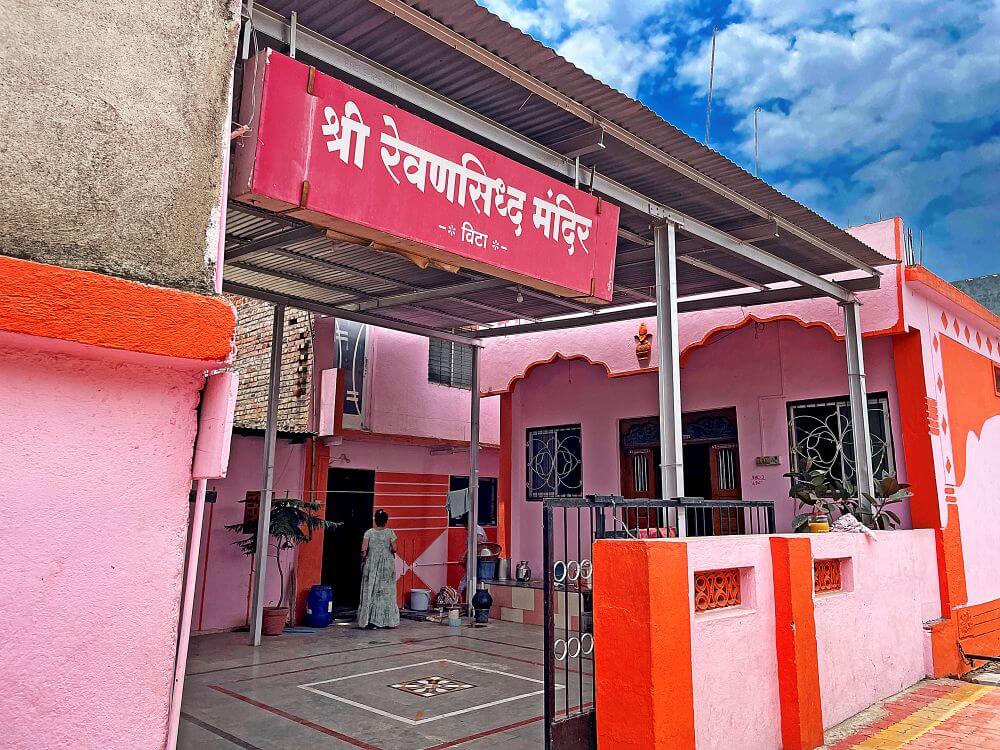
Shop Photo FramesRevanasiddha was one of the Navnath and one of the eighty-four Siddhas. He had received the blessings and spiritual powers of Shri Dattatreya, Shiva, and Matsyendranath. Following the command of his Guru Matsyendranath, he arrived at Moolsthan, near Vita or Vithagram in the Mandesh region. By establishing a monastery here, he continued his divine mission. Every place he visited from there later became famous as a temple. The house of Sakharebuva in the city of Vita is one such place. Today, thousands of devotees come here daily for darshan.
Based on Gorakshanath’s text ‘Kimayagar’, the poet Dhundisut Malu later composed the ‘Navnath Bhaktisar’. Even today, in the month of Shravan, it is recited in countless homes across Maharashtra. According to this text, Revannath Siddha is an incarnation of Chamasnarayan. Similarly, according to the Kadsiddheshwar tradition of the Lingayat Shaivas, Revansiddhanath is considered the founder and the first Kadsiddheshwar of the Kadsiddheshwar tradition. According to scholars, Revansiddha is Gorakshanath’s They are contemporaries. The era of Gorakshanath is from 1050 to 1150 AD. He was found by a farmer named Sahanasaruk on the banks of the Reva River. Therefore, the text ‘Navnath Bhaktisar’ states that he was named Revan. In the 36th chapter of this text, the story of his residence in Vitegram is narrated, and it is said that he ‘still resides in the Vite region.’
The legend of the temple of Revansiddha here states that the ancestor of the Sakharebuva family was a devout follower of Revansiddha. He would regularly travel from here to the Moolsthan to seek the blessings of Revannath. However, as he grew older, it became impossible for him to make the journey for darshan. At that time, Revannath himself came to his home and said, “From now on, you do not need to come to Moolsthan; instead, I myself will stay at your home for fifteen days every year and visit you four times.” On this occasion, Revannath placed his padukas in the hands of Sakharebuva and gave him some coins as a blessing. With those coins, Sakharebuva A silver mask of Revananath was crafted, and the house was transformed into a temple. In recent times, this temple has undergone renovation.
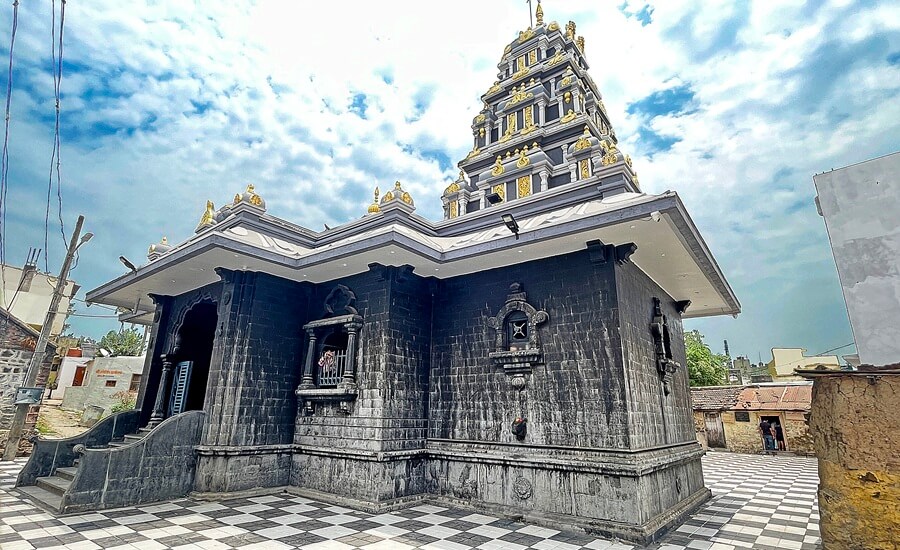
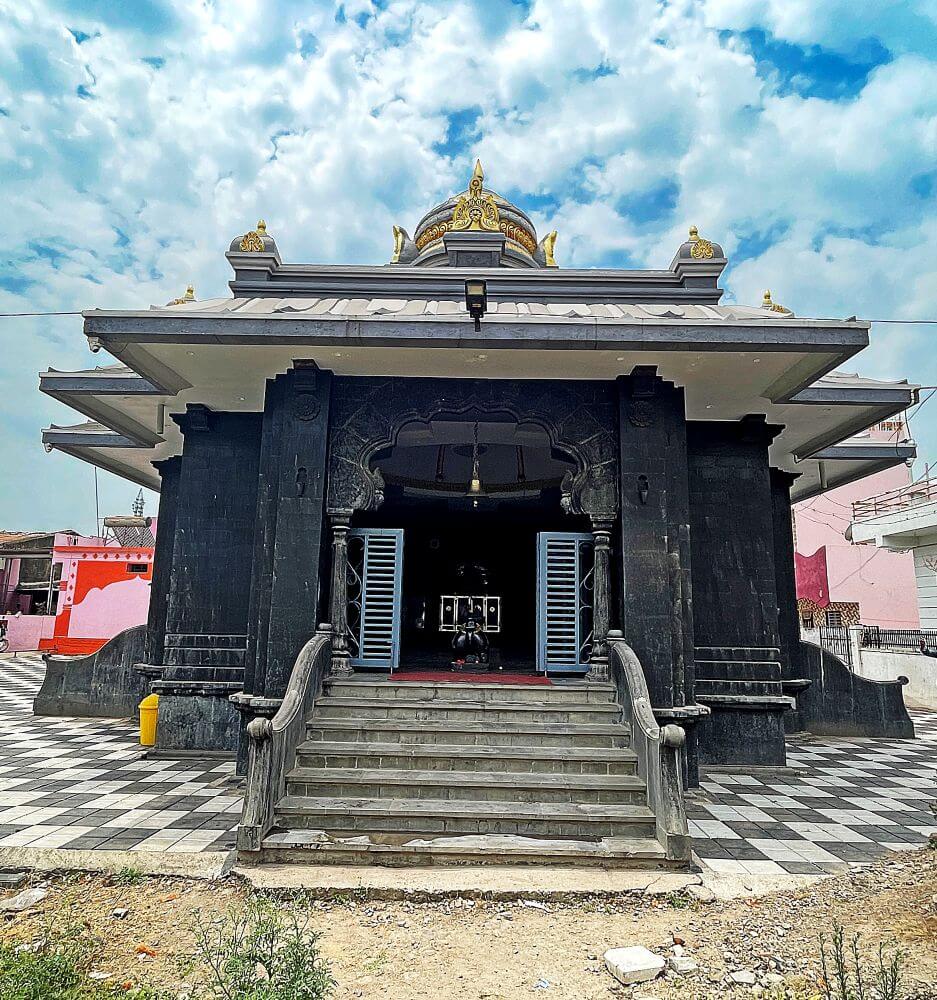
This temple is located along the roadside in Sonar Galli of Vita city. In the courtyard, in front of the temple, there are ancient twin samadhis. Along with the temple, these samadhi shrines have also been renovated. The temple structure consists of a sabhamandapa (assembly hall) and a garbhagriha (sanctum sanctorum), situated on a platform approximately three feet high. There are a total of three entrances to the sabhamandapa: one in the front, and one each on the left and right sides. Since the sabhamandapa is elevated above the courtyard, there are seven steps leading up to each of the three entrances. There are safety railings on both sides of the steps. On the ornate square pillars flanking the entrances, there are lotus flower carvings and lamp niches at the top. Near the door frames, on both sides, there are circular pillars with vertical fluted carvings that taper towards the top. These pillars are connected by an arched gateway.
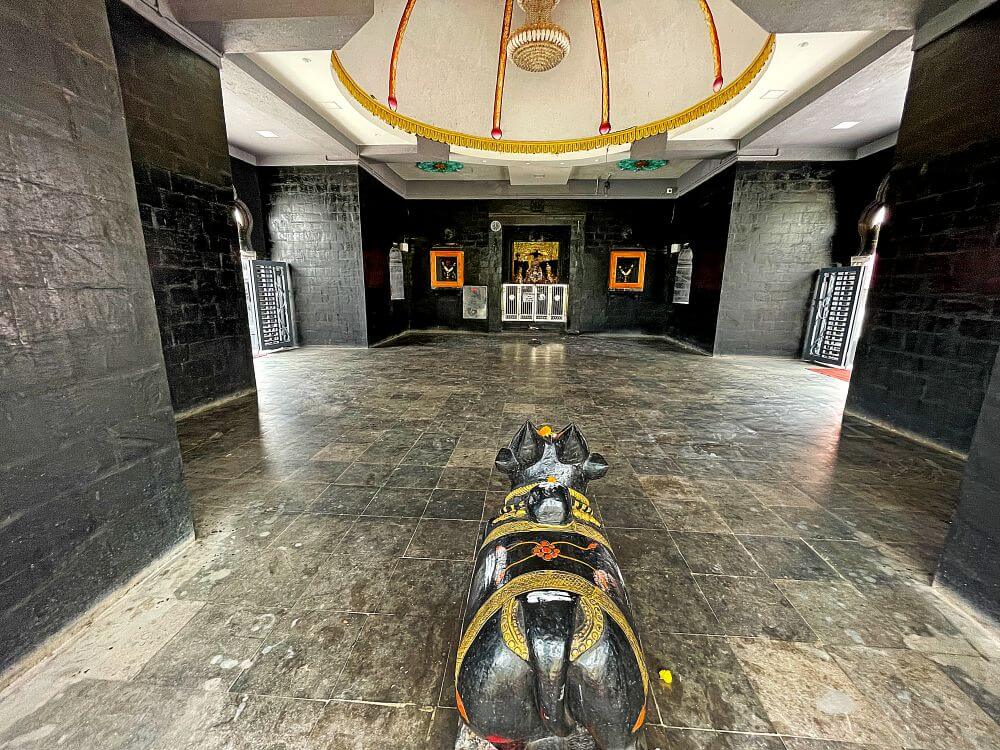
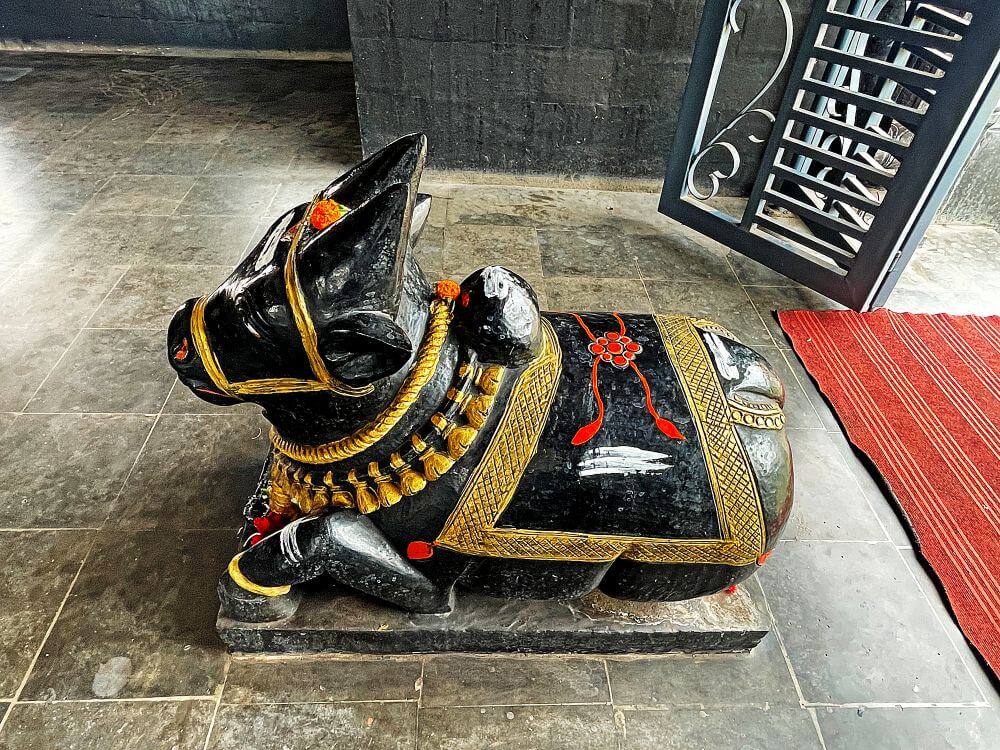
The assembly hall here is of an enclosed nature. The ceiling is dome-shaped, and brass bells are hung from it. In the assembly hall, there is a tortoise sculpture on the floor, and an idol of Nandi is placed on a pedestal in front of the entrance to the sanctum sanctorum. The door frames of the sanctum sanctorum entrance are adorned with floral and leaf carvings. There is an idol of Lord Ganesha on the lintel, and the architrave is decorated with carvings of vines and flowers. There are lamp niches on both sides of the entrance.
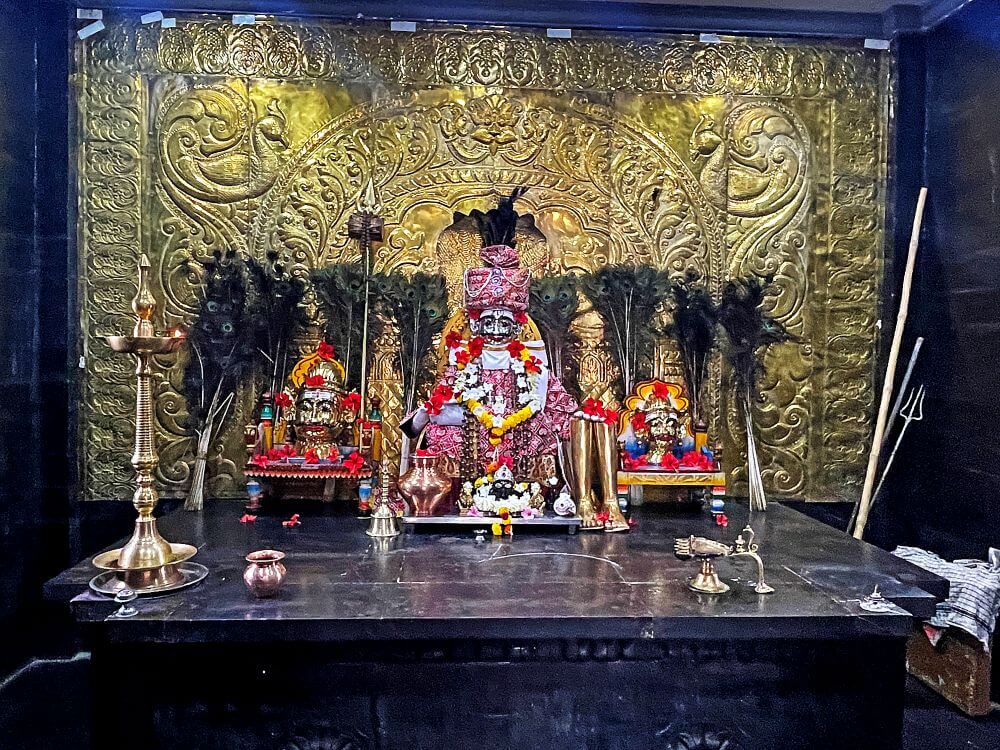
In the sanctum sanctorum, upon the Vajrapitha, stands the shrine containing the deity’s mask. Here, the deity is worshipped in various forms, such as seated upon a throne or mounted on a horse. The deity is adorned with fine garments, ornaments, and a turban upon the head. The brass lotus feet of the deity are placed here. Behind the deity, on a silver arch, there is a Kirtimukha in the center. On both sides, there are floral and leaf carvings. On either side of the shrine are the brass masks of the deity, which are used during festival times and palanquin processions. In front of the Vajrapitha, on the lower side, is the vermilion-anointed idol of Maruti. It is a stone idol. There are brass lamps on both sides of the Vajrapitha. There is an entrance on the right side to exit the sanctum sanctorum. The ceiling of the sanctum sanctorum is an ornate octagon.
On the exterior of the temple, each window is flanked by ornate pillars, with a balcony above them. The Mandovara features niches for deities, and at the base, there is a Gomukha water drainage system. The roof of the temple is adorned with twelve miniature spires situated on twelve corners. The roof of the Sabha Mandapa features a central dome-shaped spire topped with a Kalasha. The roof of the Garbhagriha displays a three-tiered spire in the Bhumija style, which includes pillar carvings, vertical Kuta spires, and horizontal Shala spires. At the pinnacle of the main spire sits a Kalasha, crowned with a temple flag.
Mahashivratri is the main annual festival celebrated here with great enthusiasm. On Mahashivratri, the Deity arrives from the temple at the Moolsthan to reside in this temple for fifteen days. Apart from this, the Deity arrives at this temple in a palanquin procession during four annual festivals: Navanna Purnima in the month of Ashwin, Dussehra, Guru Purnima, and Dattatreya Jayanti. During each palanquin ceremony, elaborate musical worship of the Deities is performed in the temple. Two palanquins, one of the Deity from here and one of the Deity from the Moolsthan, proceed to the Kaleshwar Mahadev Temple. There, a race of the palanquins takes place. The palanquin from this temple and five other palanquins from the village return to the village from there. The palanquin from the Moolsthan reaches its original temple again. During all the festivals, thousands of devotees from across the state arrive to seek the blessings of the Deity and to participate in the palanquin procession. The temple remains crowded with devotees on days such as Monday, Thursday, Purnima, and Amavasya.
This sacred temple stands as a testament to deep spiritual devotion, ancient architectural grandeur, and rich local cultural traditions.
The sanctum sanctorum houses the divine idol consecrated according to ancient Vedic traditions, surrounded by serene courtyards and traditional temple architecture.
Navratri, Maha Shivratri, Annual Temple Jatra & Deepotsav
Compare and book flights, secure top-rated local hotels near the temple, hire reliable guides, and rent cars instantly.
Extend your pilgrimage by visiting other highly sacred temples located nearby.


Add ₹999 more to unlock FREE SHIPPING!
Your sacred cart is currently empty.
Shop Photo FramesFill in your delivery details below to place your order.
Add comment