
Add ₹999 more to unlock FREE SHIPPING!
Your sacred cart is currently empty.
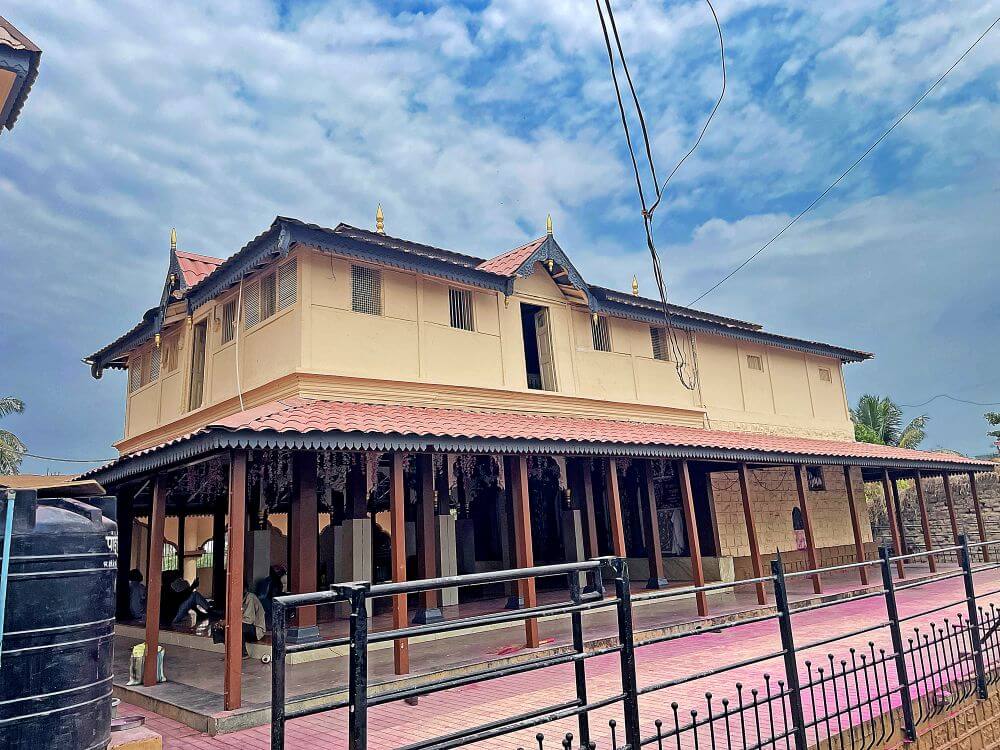
Shop Photo FramesThe town of Vita, which is mentioned in the ‘Navnath Bhaktisar’ with the words, ‘In the village of Vita, in the land of Maan, there resided Revannath,’ possesses a rich history. Vita is situated in the Maandesh region, which was referred to as the Ambika province in the Ramayana. This area was ruled by the Maurya, Satavahana, Rashtrakuta, Chalukya, Kalachuri, Shilahara, and Yadava dynasties. As these changes in power occurred, the imprints of history continued to be etched upon this land. Ancient temples in this region bear witness to the architectural styles of their respective eras. The Bhairavnath Mandir, standing on wooden pillars, is one such sacred edifice.
Bhairavnath is the Gramdevata, the village deity, of this town, which is known as ‘Pratinidhinchye Vite’. A legend associated with this temple recounts that Bhairavnath was originally the deity of Vasube village, near Vita. He would often stay at the home of the Kulkarnis here. Later, He became the Gramdevata of Vita itself and was enshrined here. Subsequently, about one hundred and twenty-five years ago, Vitthal Babasaheb Patil, a prominent personality from Vita, constructed this temple with the help of the villagers. The ‘Sangli Gazetteer’ records that this temple was recently renovated through public contributions. The gazetteer was newly compiled in the year one thousand nine hundred and sixty-nine. This indicates that the temple’s renovation took place approximately fifty to fifty-five years prior to that.
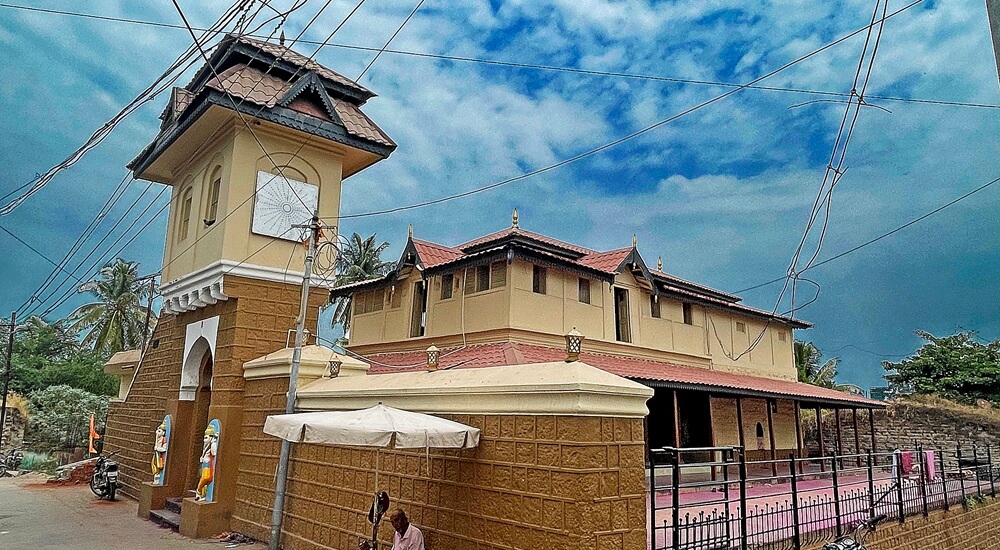
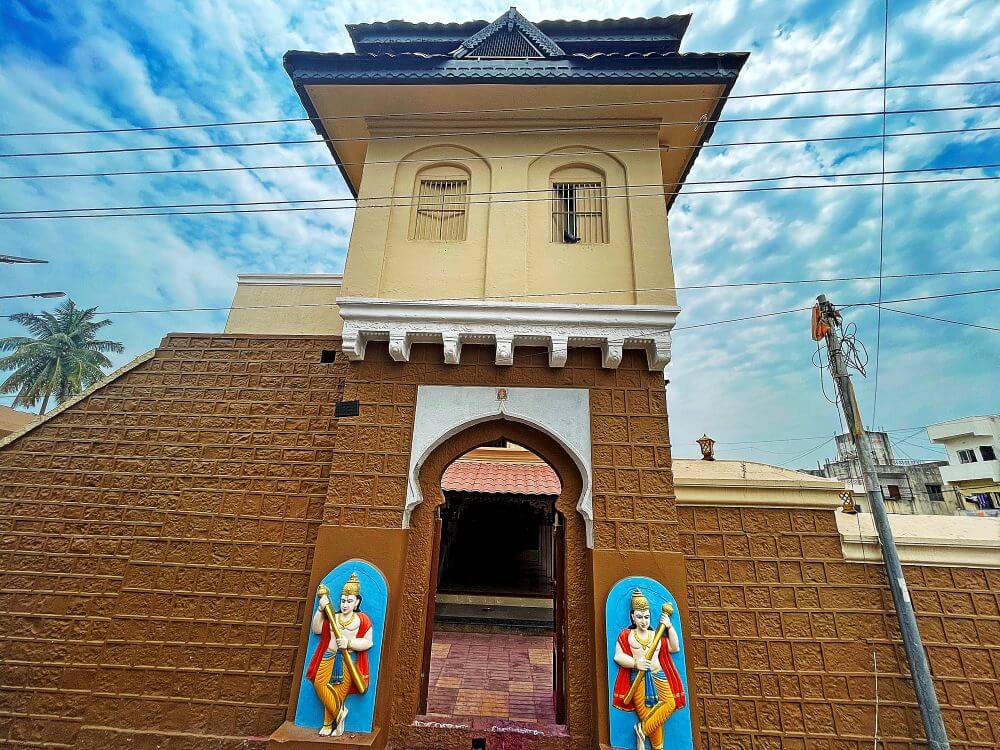
Today, this area, which is centrally located in the town, was formerly known as the ‘Pandhari’ of the village. Due to this, Siddhanath is also referred to as ‘Pandharicha Dev’. Deities known as Pandhariche Dev are usually established around the time of the settlement of that village. This clearly indicates the ancient origins of Bhairavnath here. This temple, situated alongside the road, has a sturdy rampart built of carved stone on its front side. The rampart features a two-storied entrance. On both sides of the entrance are platforms, upon which stand two-armed dwarapala sculptures holding staffs. As the paved courtyard of the temple is elevated, there are three steps leading to the entrance. The entrance has iron latticed doors and guardrooms on both sides. From the guardrooms, there are stairs leading to the nagarkhana (drum house) on the upper floor of the entrance. The nagarkhana has windows on all four sides for ventilation. The tiled roof of the nagarkhana is divided into two parts, upper and lower. On the upper part of the roof, there are two kalashas (finials) on the left and right sides. The entrance roof has a total of six kalashas.
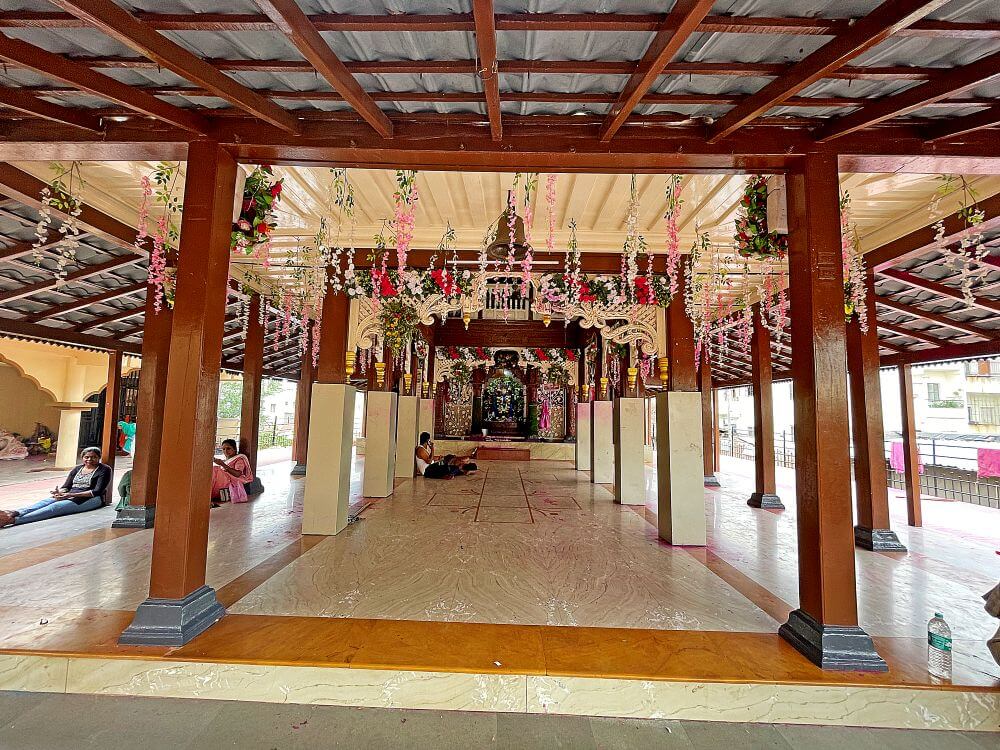
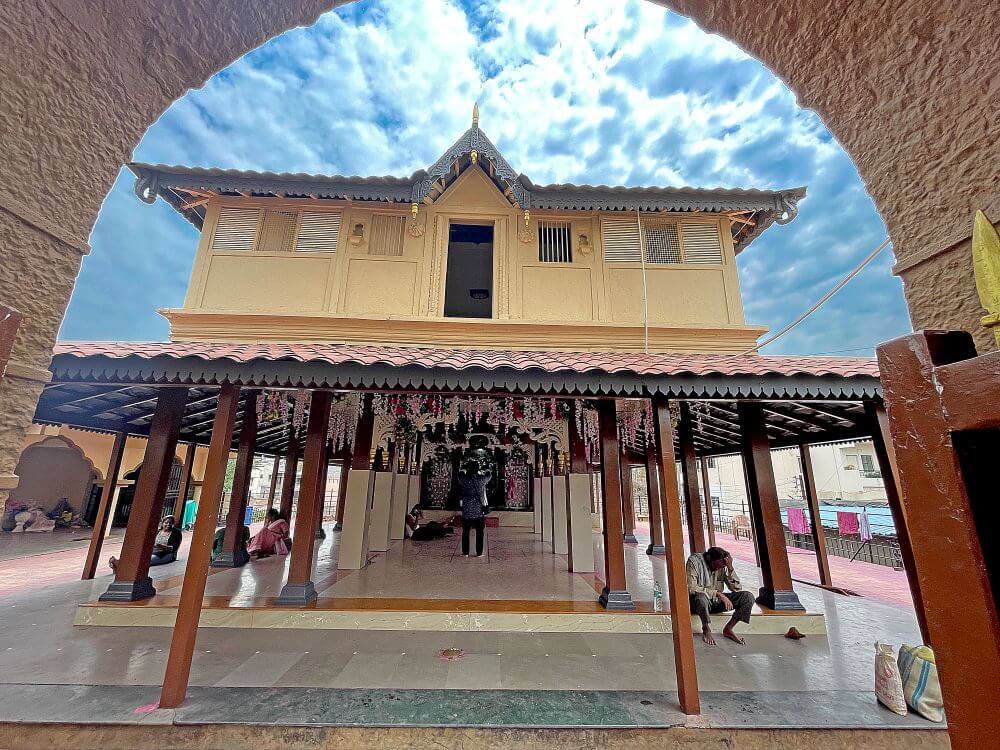
This two-storied temple is structured with a sabhamandapa (assembly hall) and a garbhagriha (sanctum sanctorum). The three outer sides of the sabhamandapa have a sloping roof supported by approximately twenty-four square wooden pillars. These pillars stand on stone pillar bases. The sabhamandapa, which is a few inches higher than the courtyard, is open-sided. It has four wooden pillars on each side. All pillars are connected by ornate wooden arched mihrabs. At both ends of each arch are wooden chandeliers. Beams rest on the pillars, and a wooden takhtposhi (platform) rests on the beams. Brass bells are hung from the takhtposhi. The central part of the takhtposhi is open, and it has railings for the balcony of the upper floor. The pillars and beams in the sabhamandapa are adorned with artistic carvings. There is a tortoise sculpture on the floor of the sabhamandapa.
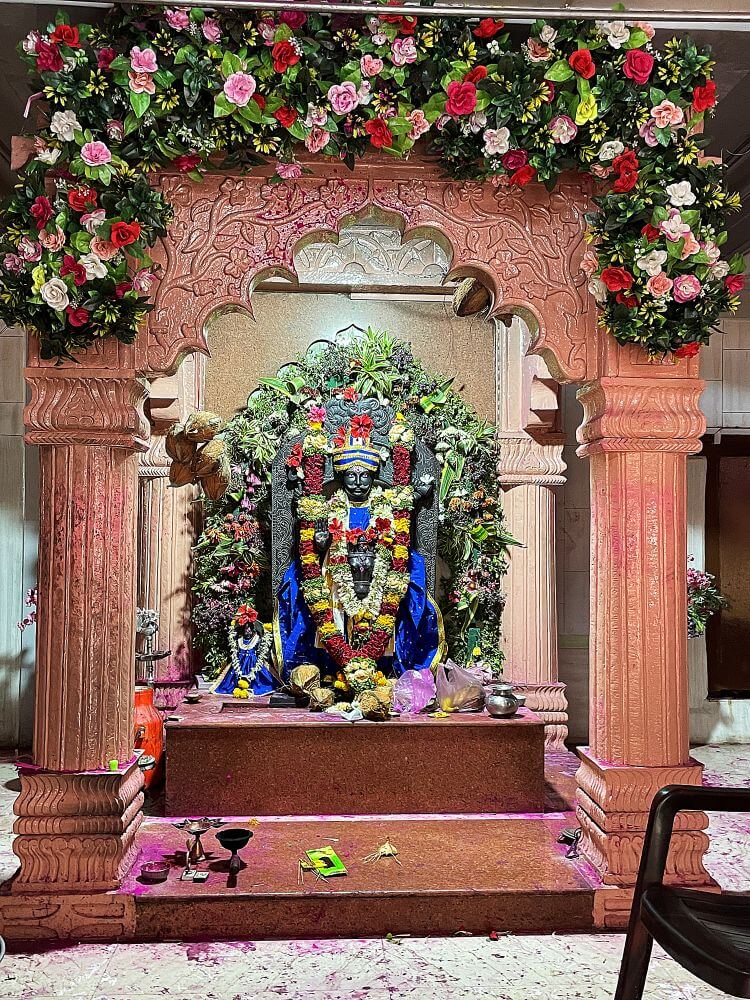
The garbhagriha here is taller than the sabhamandapa. On both sides of the garbhagriha entrance are four ornate wooden pillars. In the center of the garbhagriha, within a shrine formed by four ornate wooden pillars, stands a four-foot-tall idol of Lord Bhairavnath on a vajra-pitha (diamond throne). The Lord holds a khadga (sword), trishul (trident), damaru (drum), and amritpatra (nectar cup) in His hands, and is adorned with rich garments and ornaments. He wears a turban on His head. On the back-slab of the equestrian deity, there is a Kirtimukha in the center, flanked by leaf and flower motifs on both sides. To the right of the Lord is an idol of Shakti. The garbhagriha’s roof, supported by wooden pillars, and the central shrine structure create a pradakshina path (circumambulatory path) around the shrine.
On the outer walls of the temple, ancient veergalas (hero stones) are affixed. The temple has a tiled roof divided into two parts, lower and upper. In the lower part of the roof, there are triangular structures with kalashas above them, over three windows in three directions. The upper part of the roof slopes down on the left and right sides. On this part, there are two kalashas, one at the back and one at the front. The temple roof has a total of five kalashas.
In the month of Chaitra, the Lord’s main annual Jatrotsav (fair festival) is celebrated with great enthusiasm. On Chaitra Vadya Ashtami, the Nath’s birth anniversary is celebrated. On Navami, the Lord’s palanquin procession commences. Five palanquins participate in the palanquin procession, leading to a palanquin race. At night, a festival of lights is celebrated by setting off fireworks. Thousands of devotees gather to participate in this palanquin festival. The palanquin procession proceeds with the resounding beats of drums and cymbals, and the showering of gulal (coloured powder). The tradition of dancing elephants and horses in the palanquin procession continues to this day.
The Navratrotsav is celebrated with devotion in the temple. For nine days, the Lord is worshipped in various forms. On the day of Dussehra, five palanquins set out. These include three palanquins of the Gaikwad, Shitole, and Patil families, who are respected dignitaries of the village, and two palanquins of the Siddhas. A race is held between the Siddhas’ palanquins. Thousands of devotees come to witness and participate in this palanquin procession. The palanquins that set out from here proceed to the mosque at Chavadi Chowk in the village. During this palanquin procession, Hindu and Muslim brethren participate together.
Every Thursday, devotees seek the Lord’s counsel (kaul) to ascertain divine support for their undertakings. On Mondays, Purnima (full moon), Amavasya (new moon), and other auspicious days, the temple is crowded with devotees.
This sacred temple stands as a testament to deep spiritual devotion, ancient architectural grandeur, and rich local cultural traditions.
The sanctum sanctorum houses the divine idol consecrated according to ancient Vedic traditions, surrounded by serene courtyards and traditional temple architecture.
Navratri, Maha Shivratri, Annual Temple Jatra & Deepotsav
Compare and book flights, secure top-rated local hotels near the temple, hire reliable guides, and rent cars instantly.
Extend your pilgrimage by visiting other highly sacred temples located nearby.


Add ₹999 more to unlock FREE SHIPPING!
Your sacred cart is currently empty.
Shop Photo FramesFill in your delivery details below to place your order.
Add comment