
Add ₹999 more to unlock FREE SHIPPING!
Your sacred cart is currently empty.
Shop Photo FramesBanashankari Devi is worshipped as the supremely compassionate Goddess who annihilates demons and protects Her devotees. She is known by the name Banashankari because She resides in the forest (vana). In the Mahabharata, Arjuna, in his hymn to the Goddess before the war, addressed Her as ‘Durga Kantaravasini’ (Durga, the dweller of the forest). It is also said that Banashankari Devi is none other than Shakambhari. The original abode of Banashankari Devi is in Badami, Karnataka, and She is the tutelary deity of the Chalukya dynasty. Temples dedicated to this Goddess are found all over Bharatavarsha. Among these, one significant shrine is located in Banali village, Jat taluka.
According to the ‘Karavīra Māhātmya’ and other ancient Paurāṇic legends, Devī Banashankarī is an avatāra of Śrī Jagadambā. When Maharṣi Agastya arrived in Karavīra and began worshipping Mahālakṣmī, the Devī, pleased with his devotion, instructed him thus: ‘Just as you are in My sacred abode here, so too should you proceed southwards to Tilakavana and reside in the holy Kṣetra of Śrī Shankarī (Banashankarī) for the welfare of the world.’ (Vidyate Shankarīkṣetraṁ Tilakāraṇyamadhyagaṁ. Tatra vāsastathā kāryo jagatkalyāṇahetave.) This Tilakavana is located in Karṇāṭaka. It is said that this region once suffered a drought lasting one hundred years. At that time, the Devī caused trees, shrubs, and vegetables to grow there, nourished by water that emerged from the netherworld. Seeing this, the daityas began to desecrate that sacred area. Thereupon, the Devī, mounted upon a tiger and accompanied by Her nine crore companions, advanced upon the daityas and utterly vanquished them.
The Divine Mother, by manifesting nourishing greens from Her own sacred form and by bringing forth life-sustaining waters from the Haladī Tīrtha in the nether regions, saved the lives of Her devotees. Thus, She came to be known as Śākambharī (meaning, ‘She who bears vegetables’). As this Divine Mother resided in the forest, She was also known as Vanaśaṅkarī or Banaśaṅkarī. The Divine Mother Banaśaṅkarī then It is mentioned in the Skanda Purana, Padma Purana, and other sacred texts that the Devi vanquished the demons Durgamanasura and Shambhasura. The Chalukya kings constructed a magnificent temple in the seventh century at the original abode of Shri Banashankari Devi in Badami, Bagalkot district, Karnataka. The Chalukyas of Badami worshipped Shri Banashankari as a manifestation of Shakti.
Regarding this Devi temple in Banali, the following legend is recounted: A devotee from Shegaon village in this region would regularly go to Badami for Darshan of the Devi. Later, due to old age, he was unable to travel to Badami. He then requested the Devi to accompany him to Shegaon. The Devi accepted his request and agreed to come with him. However, the Devi laid down a condition: he must not look back while walking. The devotee agreed to this condition, and they began walking, with the devotee in front and the Devi behind. Upon reaching Banali village, the devotee’s faith wavered, and he looked back to see if the Devi was indeed following him. At that very moment, the Devi became स्थिर in the form of an idol here. Subsequently, the villagers of Banali at this spot The temple has been constructed.
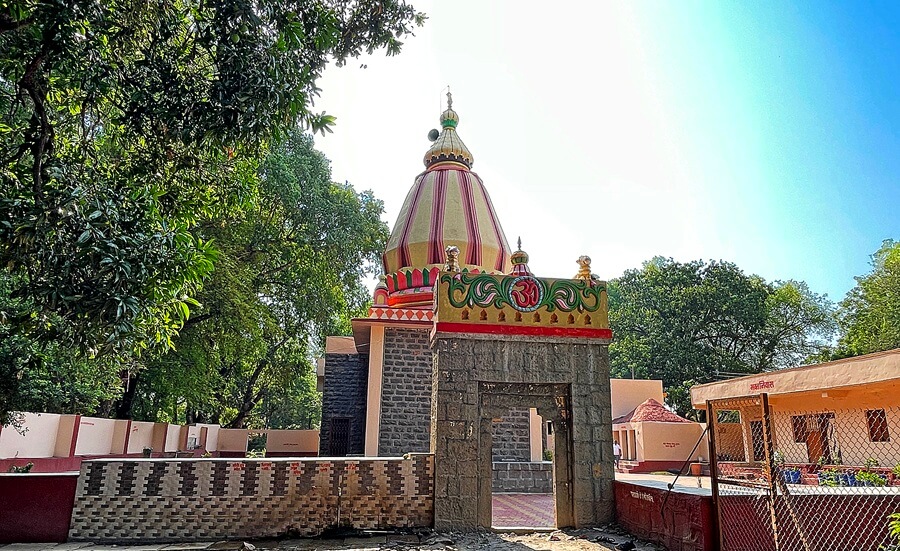
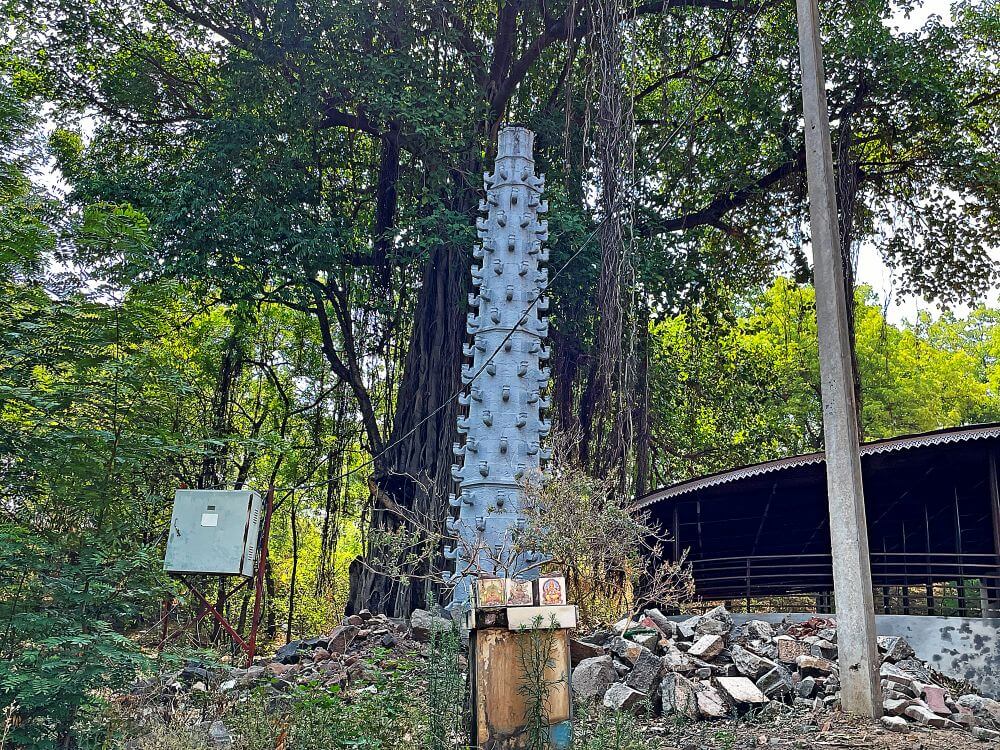
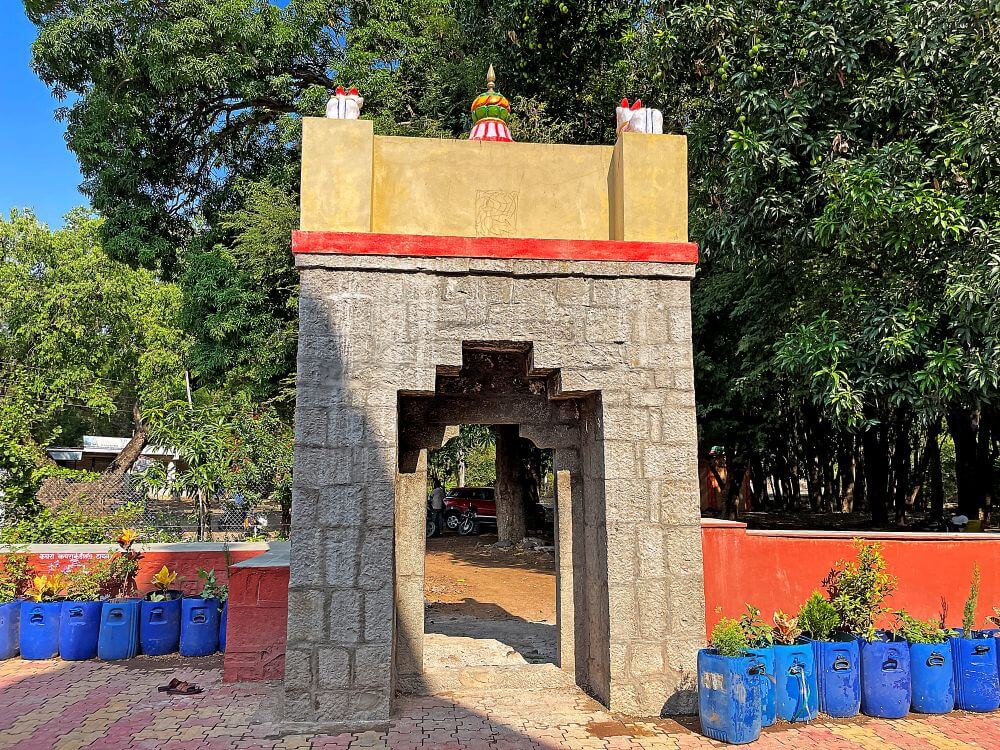
This temple is said to be four hundred to five hundred years ancient. Outside the temple, there is a spacious parking area paved with paver blocks. In front of the parking area, there is a platform and upon it, a three-tiered Deepmala (lamp tower). The tiers of the Deepmala are divided by circular rings. Beside the Deepmala is a Tulasi Vrindavan. The compound wall surrounding the temple has four entrances in all four directions. The entrance on the right side of the temple has three doorframes (dwarashakha), pillars on both sides, and a balcony (sajja) above them. The sajja has seven lamp niches (deepakoshthake), and in the upper part, there is an Om symbol in the centre, flanked by raised floral and leaf patterns on both sides. From here, one enters the temple courtyard (prangan). In the prangan, there is a Shivlinga on a platform. This is said to be the samadhi sthal (final resting place) of some great saintly personality.
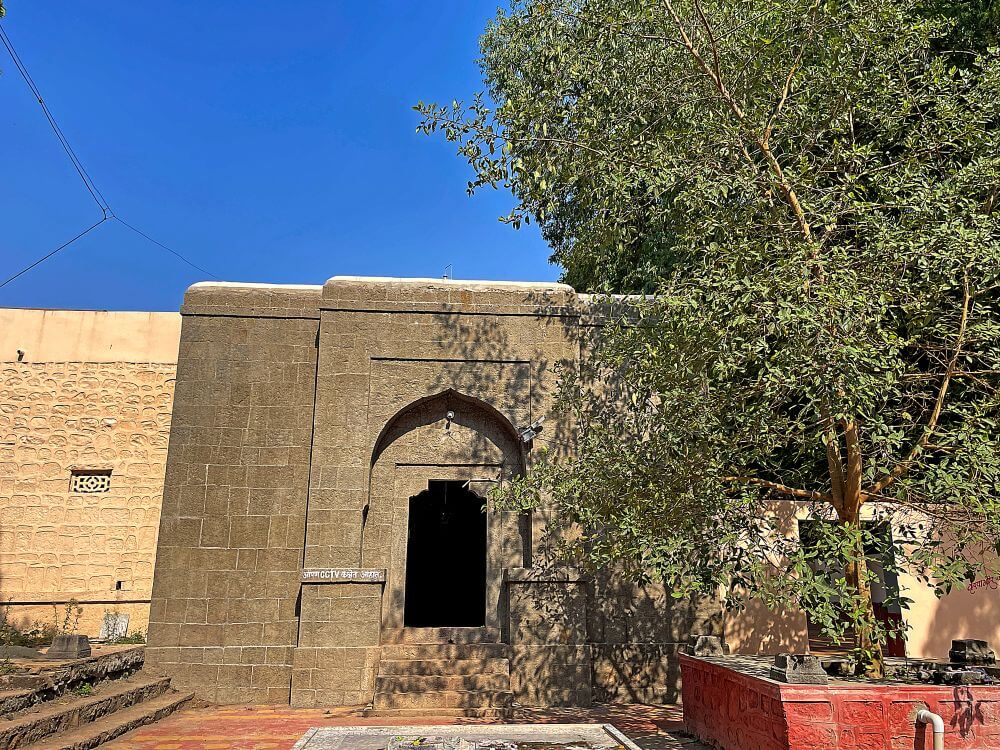
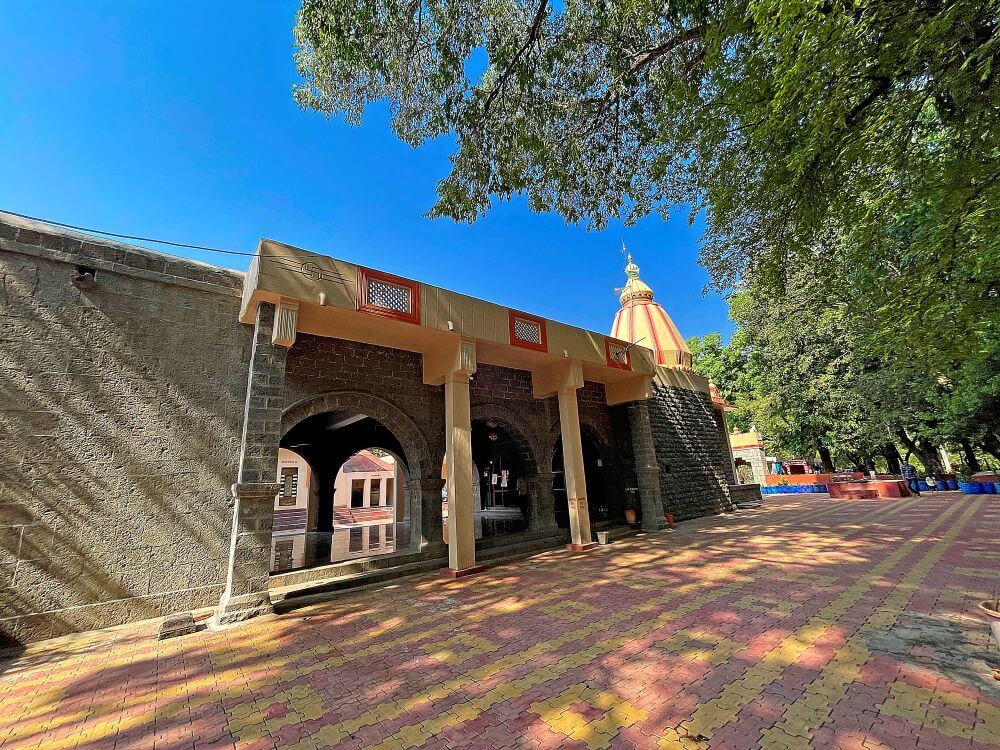
In front of the temple’s main entrance are several samadhis and ancient Shivlingas on a raised platform. The temple’s main entrance is built of stone and, being elevated, one ascends five steps to enter the temple. Of the entrance… On both sides are raised platforms and pillars. Within, there are chambers for the guards. Through this entrance, one proceeds into the Sabhamandapa. Within the Sabhamandapa, there are four square pillars on each side. Upon these pillars are mouldings, and above them are crescent-shaped brackets. Beams rest upon these brackets, and a roof covers the beams. The Antarala is somewhat higher than the Sabhamandapa. In the Antarala, on the front side, there are four pillars. Upon these pillars are mouldings, and above the mouldings are arches. The pillars are adorned with latticed screens. In the centre of the Antarala is a tortoise sculpture. Further ahead, on a table before the entrance to the Garbhagriha, are the Devi’s silver Pādukās. Devotees must take Darśana of the Devi in the Garbhagriha from this very spot.
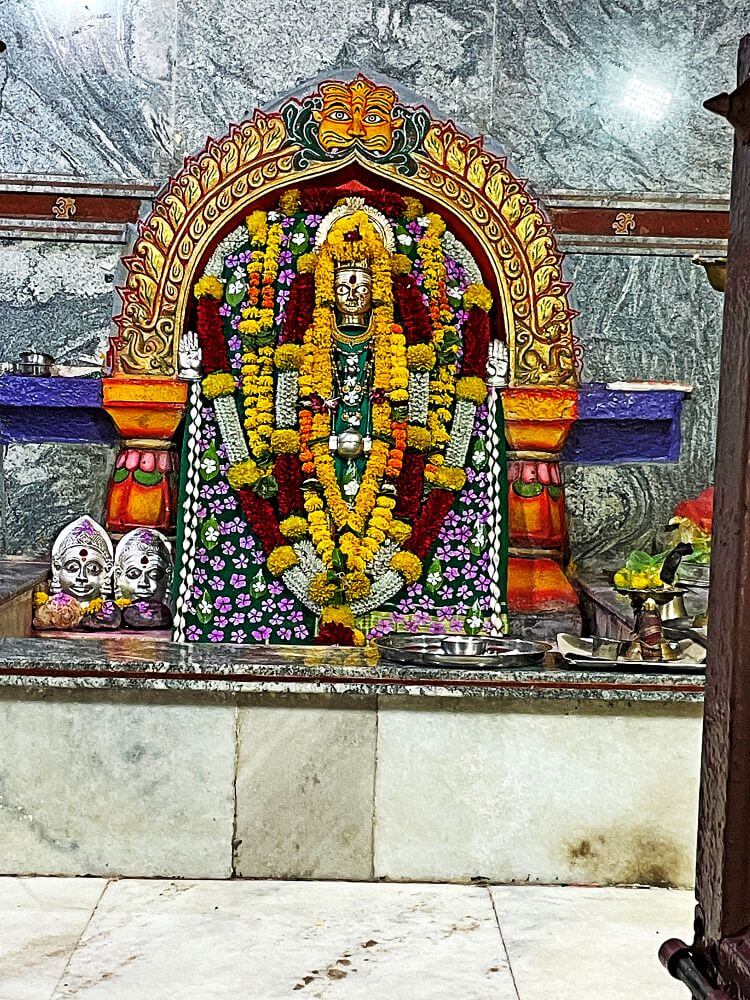
The sanctum sanctorum stands elevated above the antechamber. The doorframes of the garbhagriha are adorned with pillar carvings, and the lalāṭabimba features a lotus flower motif. The stone mūrti of the Devi, seated on the vajrapīṭha within the sanctum, is embellished with a silver mask, various garments, and ornaments. Near the Devi’s feet are silver masks and some stones. On both sides of the mūrti are intricately carved pillars, and the prabhāvalī above them displays a Kīrtimukha at its centre, flanked by creeper motifs on either side. The enclosed garbhagriha has windows to allow for ventilation.
The sanctum sanctorum’s roof is crowned with a two-tiered circular shikhara. At the base of the shikhara is a ring adorned with lotus petal motifs, while the tapering upper section features vertical fluted designs. The shikhara’s griva (neck) has a circular ring, and the tier above it is shaped like a modaka. At the apex of the shikhara is an amalaka, surmounted by a kalasha. Surrounding the shikhara, at all four corners, are miniature shikharas, each with an amalaka and a kalasha.
Within the temple courtyard, adjacent to the compound wall, is a bhakta nivas (devotee accommodation). In the nearby shrine, there is a Shiva lingam, and near the rear wall, an ancient murti of Devi Parvati. Adjacent to the Shiva temple is the temple dedicated to Lord Jethappa. Inside this temple, on a vajra pitha (diamond throne), rests a black stone murti of a guardian deity. In the adjacent chamber is the office of the Devasthan Trust. Next to it is the temple of the local deity, ‘Mavashi’. The Mangal Karyalaya (auspicious hall) located within the temple courtyard hosts weddings and various religious ceremonies.
The temple is surrounded by a dense forest, a ‘ban’. This ‘ban’ is home to fruit trees such as mango, tamarind, and jambhul. It is believed that the Devi sports in this forest. The Ashwin Navratrotsav is celebrated with great devotion at the temple. On the day of Ashtami, the Devi’s annual Jatrotsav is celebrated. During this time, the Devi’s Palkhi Sohala is observed. A three-day Bhaknuk ceremony is held at the temple. For all nine days of Navratri, programmes such as Bhajan, Kirtan, Jagran, and Gondhal are held. On the ninth day, Mahaprasad is arranged for the devotees. During Chaitra Navratri and Sharadiya Navratri, thousands of devotees visit the temple for the Devi’s Darshan and to fulfil their vows.
This sacred temple stands as a testament to deep spiritual devotion, ancient architectural grandeur, and rich local cultural traditions.
The sanctum sanctorum houses the divine idol consecrated according to ancient Vedic traditions, surrounded by serene courtyards and traditional temple architecture.
Navratri, Maha Shivratri, Annual Temple Jatra & Deepotsav
Compare and book flights, secure top-rated local hotels near the temple, hire reliable guides, and rent cars instantly.
Extend your pilgrimage by visiting other highly sacred temples located nearby.


Add ₹999 more to unlock FREE SHIPPING!
Your sacred cart is currently empty.
Shop Photo FramesFill in your delivery details below to place your order.
Add comment