
Add ₹999 more to unlock FREE SHIPPING!
Your sacred cart is currently empty.
Shop Photo FramesThe region of Jat Taluka, where the village of Kolgiri is situated, was a part of the Dandakaranya forest during the Ramayana era, according to mythological legends. It is said that Valya Koli lived in this village, and the cave where he performed his deep meditation is located in the hills of Kolgiri. Bhairavnath is the presiding village deity of this ancient and legendary village. It is said that one of the meanings of Bhairav is the one who protects from fear. For this reason, this guardian deity is established as the village deity in many villages. In Kolgiri, there is an ancient temple of this Bhairavnath that is approximately ٩٠٠ years old.
The story of the Bhairava avatar is narrated in the eighth chapter of the Shiva Purana. It is as follows: Once, all the deities approached Lord Brahma, who was deep in meditation on Mount Sumeru. They asked him about the mystery of creation and the eternal principle within this universe. In response, Lord Brahma began to praise himself, claiming that he alone had created this universe. Hearing this, Lord Vishnu felt distressed, which led to an argument between them. They then sought the testimony of the Vedas. The Vedas declared that Lord Shiva is the supreme principle, but neither deity was willing to accept this. While their argument continued, Lord Brahma suddenly made a derogatory remark about Lord Shankara. Hearing this, Lord Shankara became enraged, and from that anger, a divine being was manifested. His name is Bhairava.
Seeing him, Shankara said, “O Kalraja, you are verily like Time itself. Therefore, from this day forth, you shall be known by the name Kalbhairava.” He commanded this Kalbhairava to punish Brahmadeva, and in accordance with this, Kalbhairava severed the fifth head of Brahmadeva with the little finger of his left hand. The place where Kalbhairava performed this act is known as Kapalmochan. It is called a Tirtha. It remained stuck to the hand of the face of Kalbhairava. After he went to Kashi, it fell off there. For this reason, Kashi is considered the destroyer of sins, as is also stated in the Shiva Purana. Many temples of this same Bhairava exist in villages and towns.
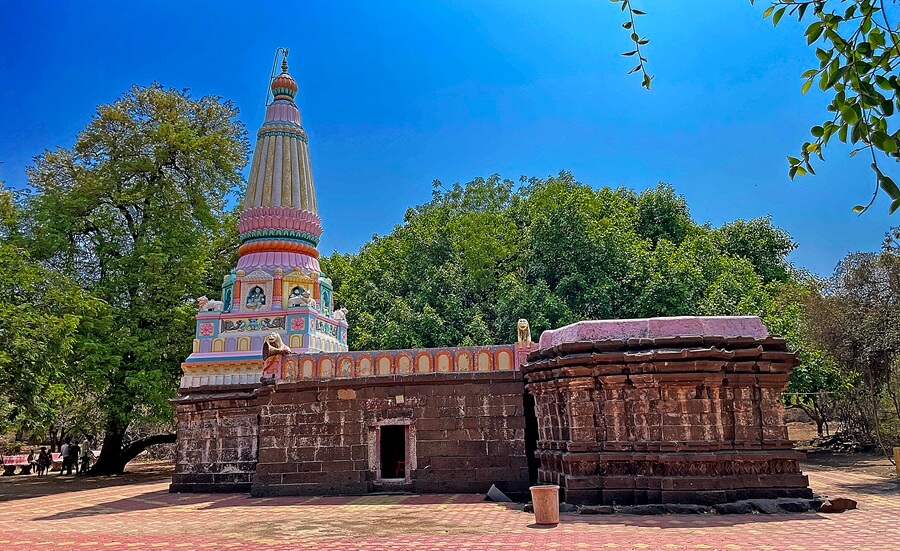
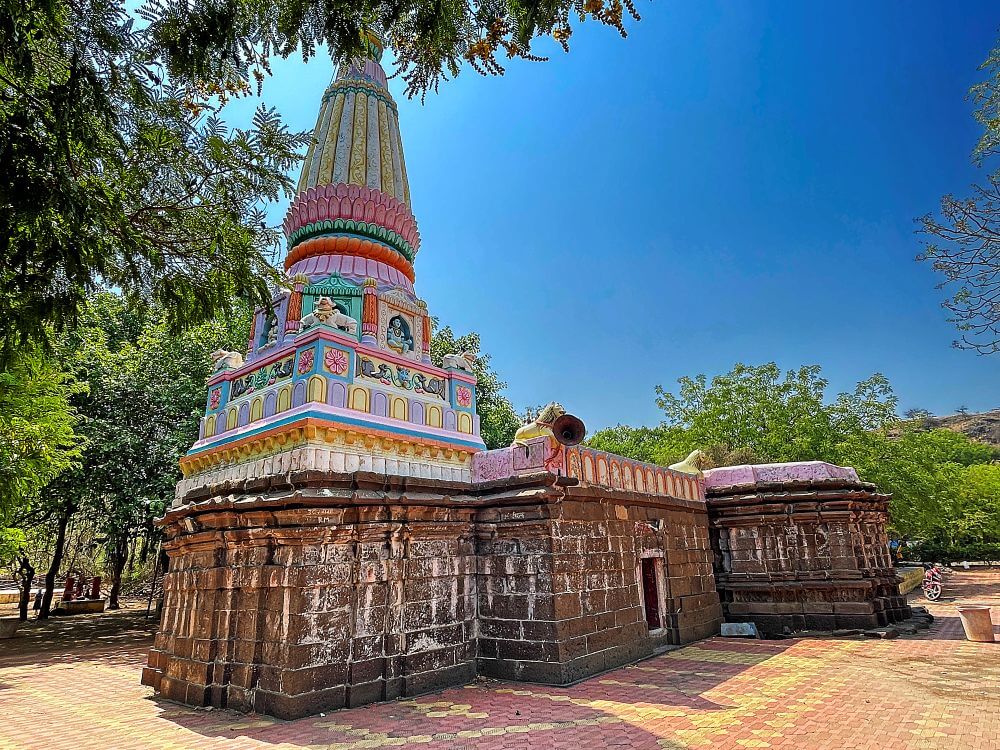
The temple of Bhairavnath here is built in the dry masonry style. Since Hemadri Sodvikar, also known as Hemadpant, the chief minister of the Yadava Emperor Ramdevraya, constructed many temples in this style, it has come to be known as Hemadpanti. However, temples built in this style even before his time still exist today. The Bhairavnath temple at Kolgiri is one of them. Based on a Kannada inscription found in this temple, it is stated that it was built in the eleventh century during the era of the Kalyani Chalukyas. During this period, Vikramaditya VI and his son Someshvara III, also known as Ahavamalla, held power over the region known as Kuntala, which comprised Kolhapur, Satara, Solapur, and Sangli. It was during the reign of this very Someshvara that this temple was erected in the year 1134 CE. Later, King Bijjal of Mangalwedha, a feudatory of the Chalukyas, rebelled and seized the power of the Kalyani Chalukyas. He identified himself as belonging to the Kalachuri dynasty. During the reigns of these Kalachuri kings and the subsequent Yadavas, the temple underwent renovations. However, its original structure was not significantly altered. Later, in 1980, the roof of the temple was repaired. At that time, a shikhara was constructed upon it, and the kalash was consecrated. Because of this, a significant difference is observed between the architectural styles of the original temple and the shikhara.
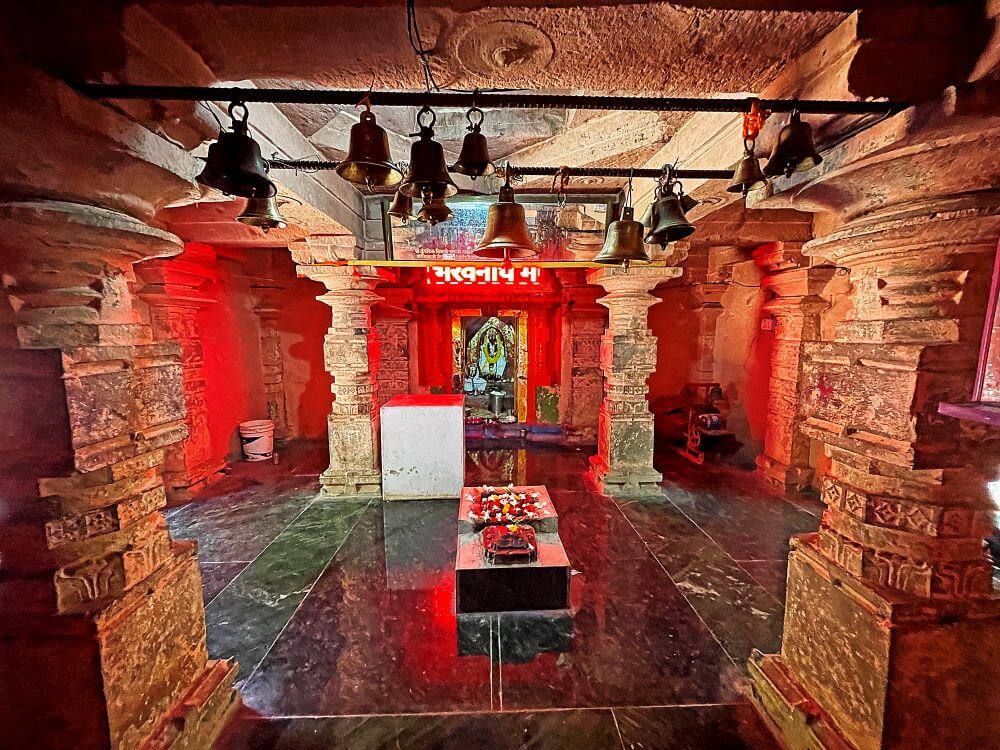
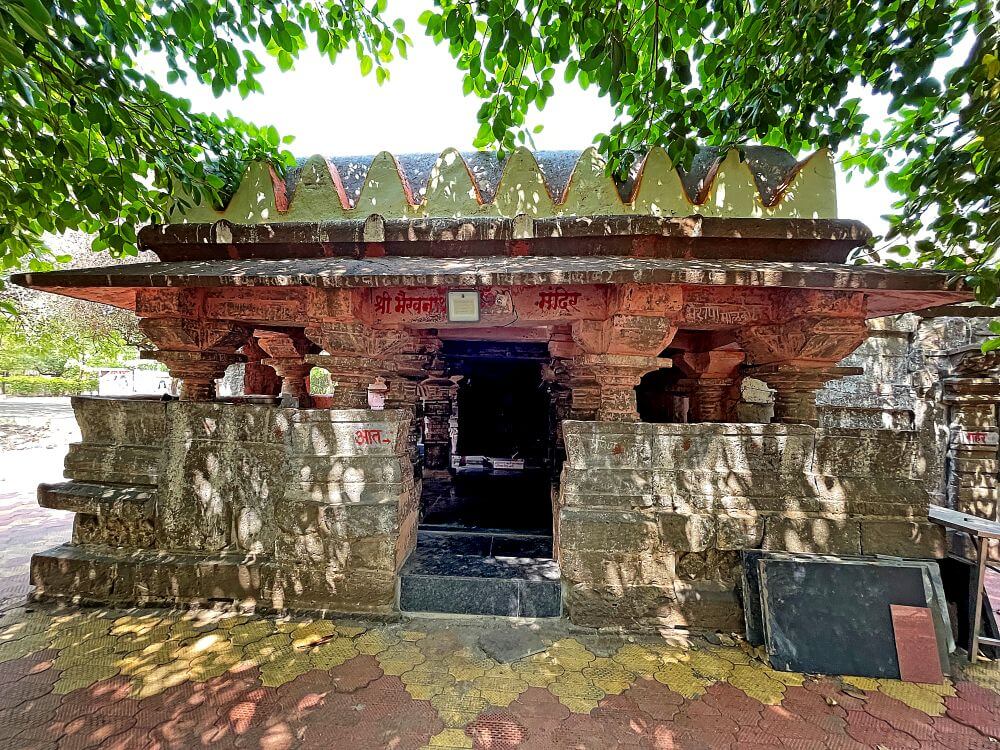
The temple courtyard is adorned with lush greenery. There are safety railings on both sides of the steps leading to the courtyard, which is elevated from the road. In the vast courtyard, there are large tamarind trees at various places, with seating arrangements provided beneath them for devotees. The area around the temple is paved with paver blocks. The structure of this temple consists of a sabhamandapa, an antarala, and three garbhagrihas. The semi-open style sabhamandapa features a railing on the outer side and within it There is an arrangement of stone seats for devotees to sit. In the assembly hall, there are four rows of four ornate pillars each. Standing on wide, square bases, the pillars transition into various geometric shapes such as circular, square, hexagonal, and octagonal forms towards the top. Above the pillars are square capitals, followed by ornate brackets, which support the beams and the ceiling. The niches in the assembly hall contain ancient idols.
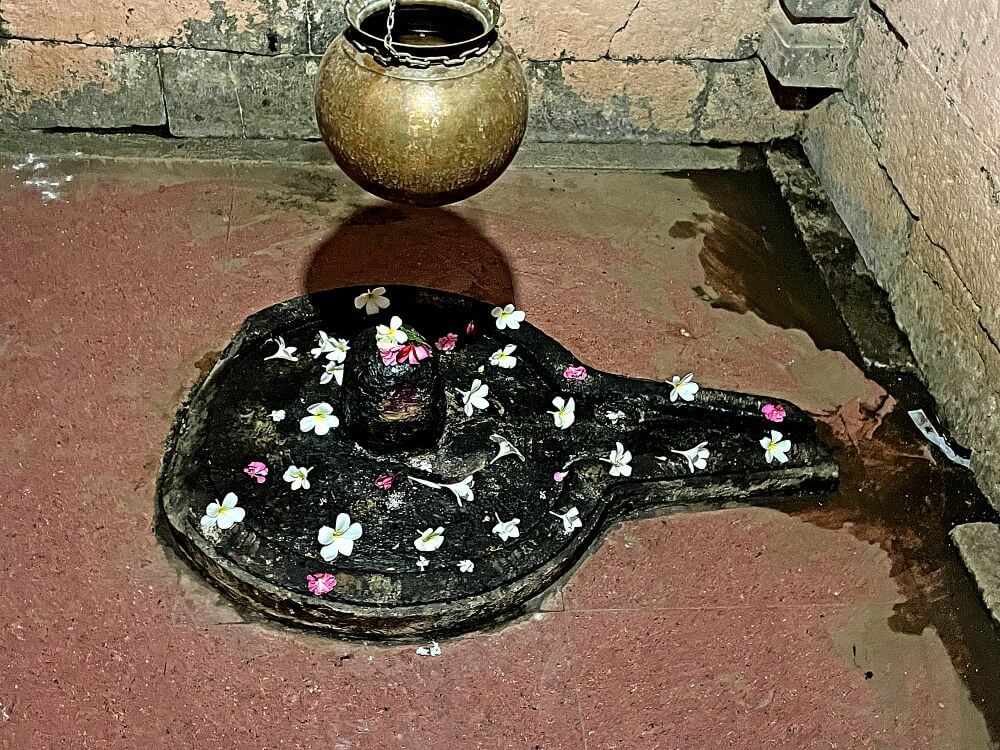
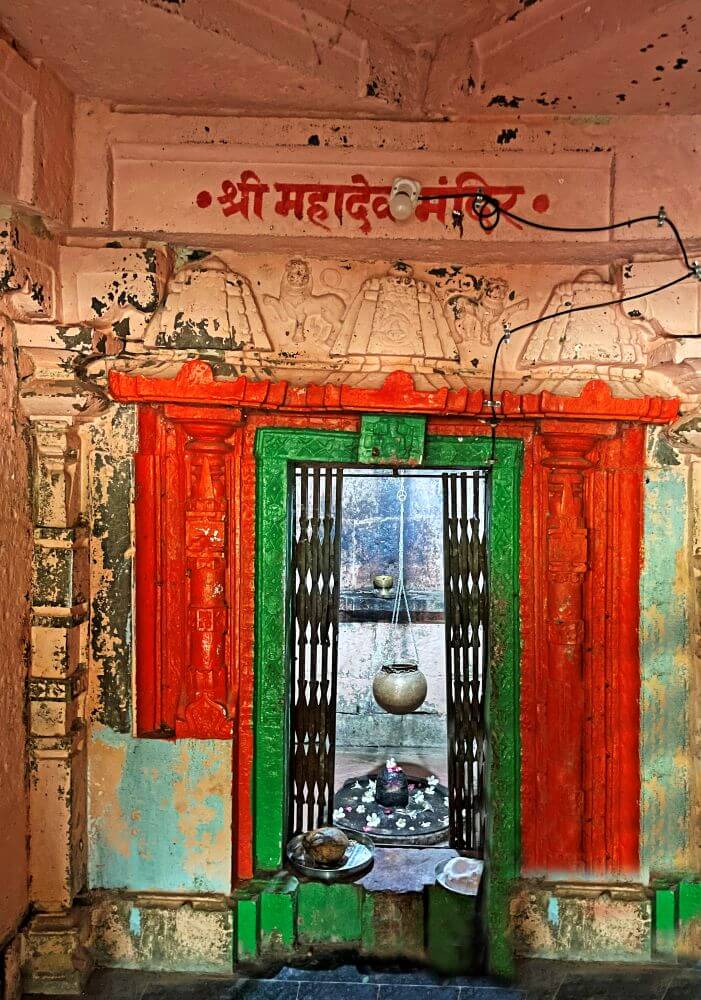
On the right side of the assembly hall is the entrance to the sanctum sanctorum of Goddess Jogeshwari. The door frames feature vertical carvings, and there is an indistinct sculpture on the lintel. On the beams above the pillars on both sides of the entrance, there is torana ornamentation. The architrave is decorated with floral and leaf patterns. On the vertical stone slabs on both sides of the entrance, there are carvings of serpents. On the floor of the sanctum sanctorum, there is a stone pindi of Goddess Jogeshwari. On the other side of Goddess Jogeshwari’s sanctum, there is another vestibule followed by the entrance to a second sanctum sanctorum. The door frames are adorned with floral and leaf carvings, and there is an idol of Lord Ganesha on the lintel. In the torana on the lintel band, there are three spires and two vyala sculptures. On the architrave, there is a moonstone, and above it is a kirtimukha. In the sanctum sanctorum, there is a Shiva pindi on the floor, with a brass serpent holding a canopy over it, and an abhishek vessel for pouring water is suspended from the ceiling.
Ahead is the main Antarala (vestibule) of the temple. In this enclosed space, there are entrances on the right and left sides. The doorframes of these entrances feature floral carvings, and the Lalatabimba (lintel) bears an image of Lord Ganesha. On both sides of the entrances are ornate pillars topped with a balcony. The frieze above the balcony displays two Vyala (mythical beast) sculptures and three miniature spire carvings. There are Yaksha sculptures on either side of the entrances. The threshold features a Chandrashila (moonstone) with a Kirtimukha carved above it. Along the wall of the Antarala, there is an inscription in the Kannada script, approximately five feet high. Beyond the Antarala lies the Garbhagriha (sanctum sanctorum) of Bhairavanath. The doorframes of the Garbhagriha are intricately carved, and the Lalatabimba features a Ganesha sculpture. The architrave above the Lalatabimba is adorned with three spires and two Vyala figures. The threshold has a Chandrashila. On the Vajrapitha (pedestal) inside the Garbhagriha stands the black stone idol of Lord Bhairavanath . Behind the idol, the stone slab features a circular design, and a Trishula (trident) is placed in front of the idol.
The roof of the temple is surrounded by a parapet on all sides. On the four corners of the Antarala roof, there are lion sculptures. Above the roof of the Garbhagriha stands a tall, five-tiered Shikhara (spire) constructed in recent times. On the four walls of the first square tier, there are sculptures of elephants, Kirtimukhas, and Nandi. The second octagonal tier contains eight niches housing idols of various deities and sages. The tier above this features five rings of lotus petal carvings. The two tiers above that are decorated with vertical fluted carvings. At the apex of the Shikhara is the Amalaka, topped by a Kalasha.
Outside the temple, in the courtyard, there are numerous Veeragala (hero stone) sculptures. These depict horsemen, battle scenes with elephants, and struggles against wild animals. These Veeragala depicting battles with wild animals are considered rare. In the courtyard and various parts of the temple premises, there are many broken, ancient idols and Shiva Lingas.
There is a wrestling arena within the temple premises. During the pilgrimage and other festivals, competitions are organized in this wrestling pit. The annual festival is celebrated in the temple on the third Monday of the month of Shravana. The pilgrimage begins on Sunday with the temple being decorated with flowers and lights. Programs such as Bhajans, Kirtans, Jagran, and music are organized for two days. On Monday, Mahaprasad is distributed to the devotees throughout the day. During the annual festivals, thousands of devotees come to seek the blessings of the deity and to fulfill their vows. A unique feature of this temple is that the Aarti of Kalbhairava is sung here in the Kannada language. Its brief meaning is: ‘O Lord, you have come here as the master. You are the master of Kashikhanda. You have been here for ages. O Kolgirisiddha, you have destroyed the demons. You are self-manifested. The gods and celestial beings have come for your Aarti.’
This sacred temple stands as a testament to deep spiritual devotion, ancient architectural grandeur, and rich local cultural traditions.
The sanctum sanctorum houses the divine idol consecrated according to ancient Vedic traditions, surrounded by serene courtyards and traditional temple architecture.
Navratri, Maha Shivratri, Annual Temple Jatra & Deepotsav
Compare and book flights, secure top-rated local hotels near the temple, hire reliable guides, and rent cars instantly.
Extend your pilgrimage by visiting other highly sacred temples located nearby.


Add ₹999 more to unlock FREE SHIPPING!
Your sacred cart is currently empty.
Shop Photo FramesFill in your delivery details below to place your order.
Add comment