
Add ₹999 more to unlock FREE SHIPPING!
Your sacred cart is currently empty.
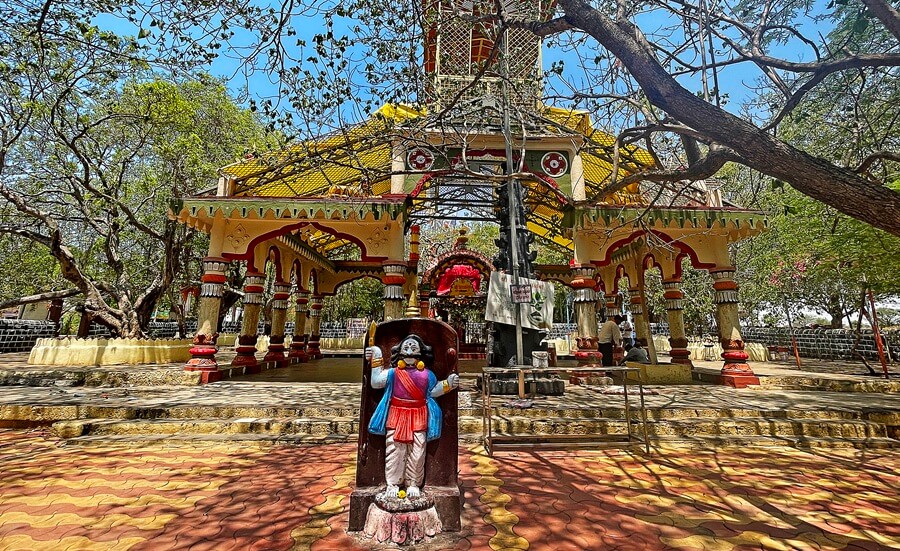
Shop Photo FramesThe tradition of worshipping ancestors or spirits has existed in our culture since ancient times. Since the pre-Aryan era, such customs and traditions have been prevalent in many societies, including tribal communities. As different cultures gradually intermingled, various deities and methods of worship also merged. Consequently, many cooling deities as well as fierce Bhutnath (Lord of Spirits) began to be worshipped. One such ancient temple of the fierce or Aagya Vetal is located at Revangaon in Khanapur taluka. The Vetal here is addressed by names such as Vetalguru, Bhutnath, and others. The structure of this temple, which is devoid of walls and a roof, is unique.
It is said that this seat of Vetal Guru is thousands of years old. Regarding the birth of Lord Vetal, the legend states that Vetal was born from the sacred fire of the Homa performed by Lord Shiva and Goddess Parvati on Mount Kailash. Lord Shiva appointed him as his commander-in-chief and blessed him to be the king of all spirits. Later, Lord Vetal resided in Ujjain alongside the Kalbhairav form of Lord Shiva, and a portion of him manifested in the mountains of Revan village for the salvation of his devotees. As this deity, the protector of devotees, does not prefer to reside in a confined temple, his shrine has neither a roof nor walls.
On the road leading towards Revangaon stands the first welcome arch of the Vetal Guru Temple. The arch features four circular, intricately carved pillars on both sides of the road, with a roof supported by beams above them, and a crescent-shaped decorative crest adorning the roof. The design of this welcome arch includes a pinnacle in the center of this crest and two tiger motifs painted on the walls of the crest. A short distance ahead from here lies the expansive courtyard of the temple, which is enclosed by ramparts and features an entrance gate. The entrance gate is flanked on both sides by two square pillars each, and upon them There is a crescent-shaped arch on the ceiling. There are seats on both sides of the entrance.
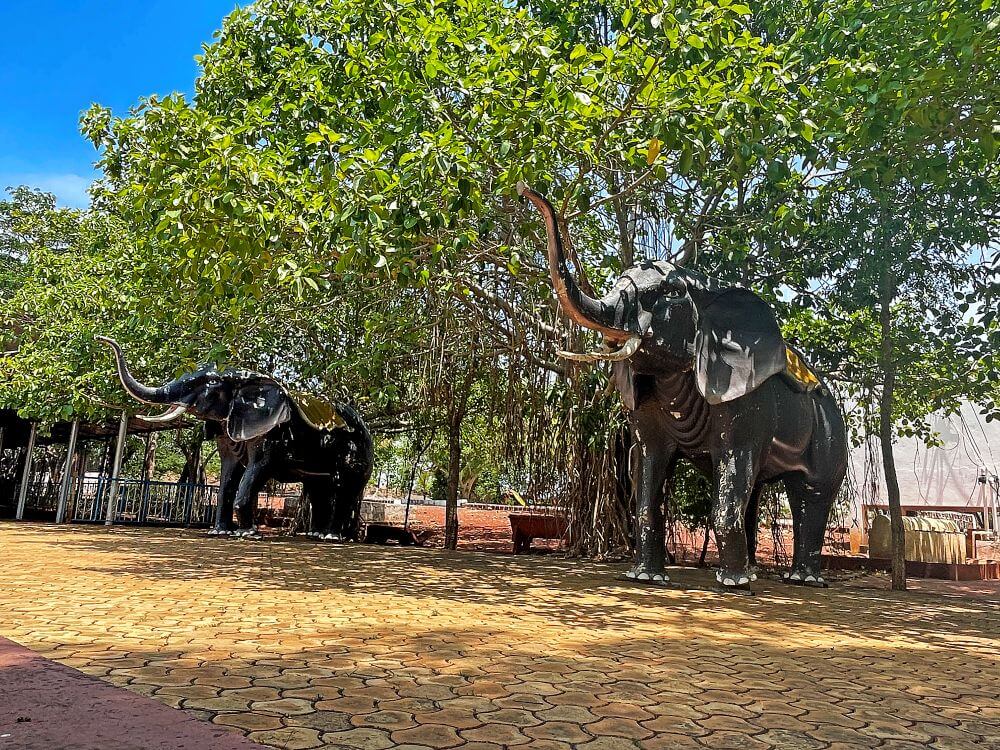
Upon entering the paver-block-covered courtyard through the main gate, one finds shops selling worship materials. Two magnificent elephant sculptures here capture the attention. Seating arrangements are provided for devotees in the courtyard. Despite being in a drought-prone region, the temple courtyard features lush greenery and a garden with various flowering plants. Moving forward from the courtyard, one reaches the temple’s perimeter wall. This wall features an entrance gate with square pillars on both sides, topped by a crescent-shaped arch. Beyond this, in the courtyard that rises in two stages, there is a square stone slab featuring a sculpture of the Khankal demon at the front and back. The Khankal demon holds a bone staff in one hand and a spear in the other. He is adorned in fine garments, sports a heavy mustache on his lips, and has matted hair on his head. It is said that he is the guardian of the divine entrance.
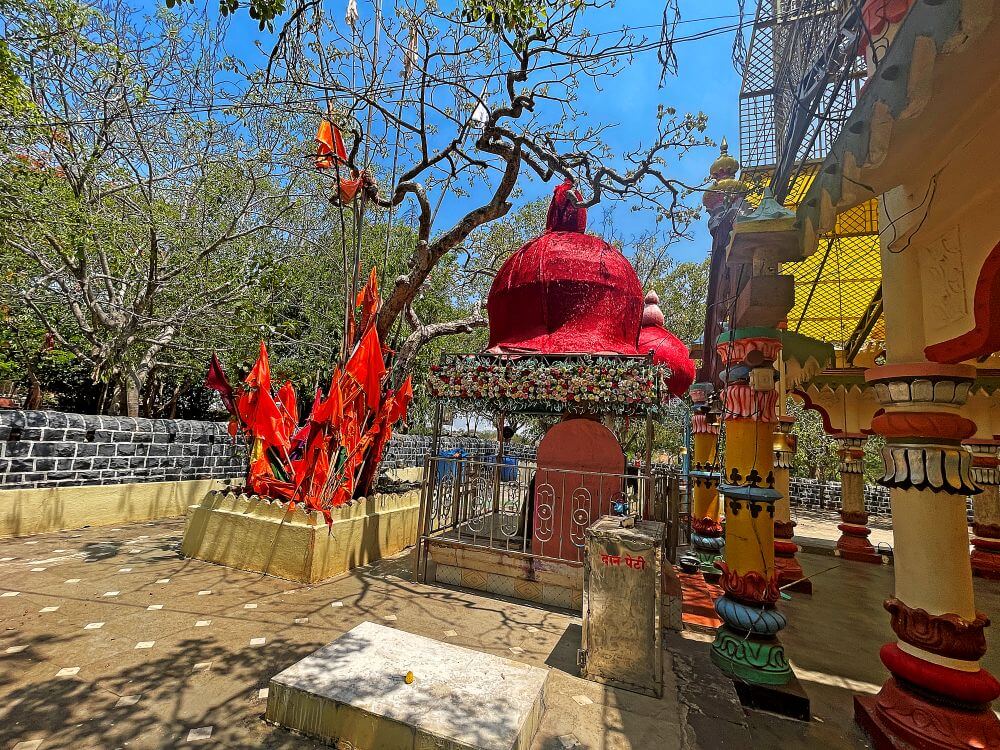
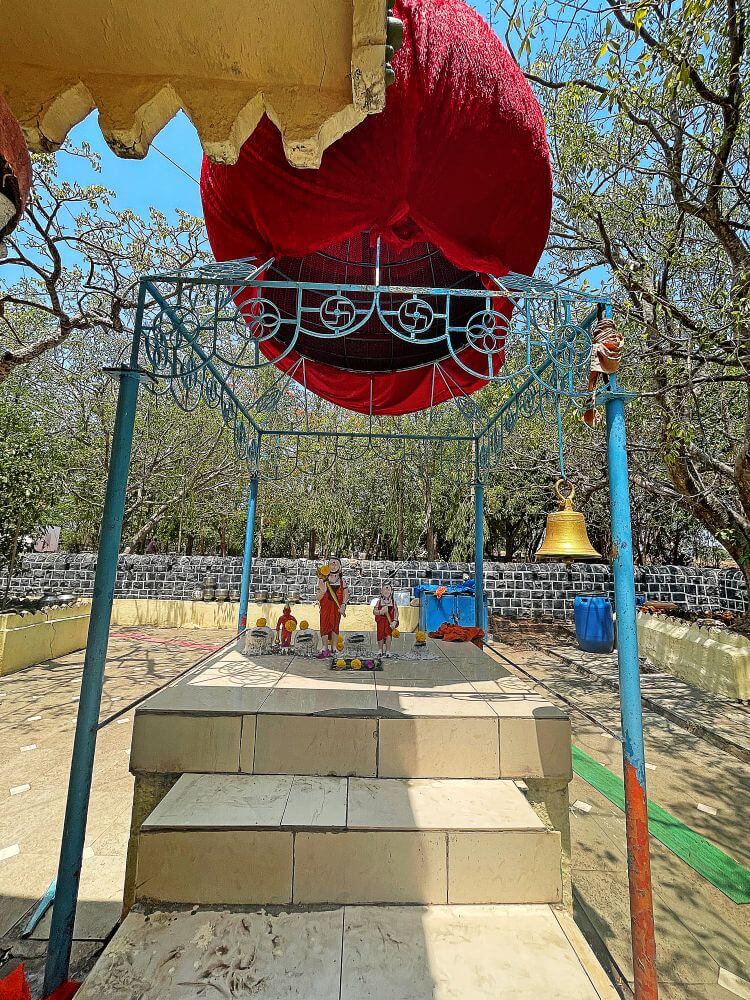
In front of the entrance to the temple’s main hall stands a platform, upon which rests a three-tiered circular lamp tower. The lamp tower features individual holders for lighting the lamps. The tiers of the lamp tower are divided by a circular ring. A portrait of King Vikramaditya is painted on the pedestal of the lamp tower. Beside the lamp tower, there is a Tulsi Vrindavan and a platform. Upon it, there is a Shivpindi.
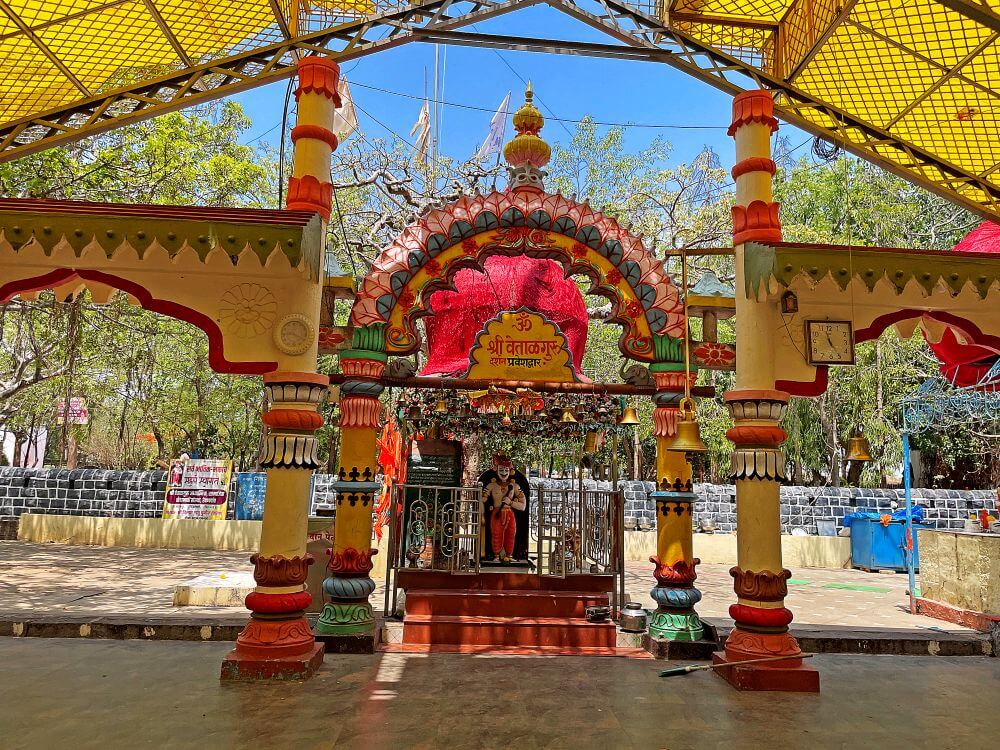
As Lord Vetal does not accept a closed temple, there is no temple here in the conventional sense. Nevertheless, there is a structure of an open assembly hall without walls or a roof, consisting of pillars and a latticed iron canopy above them. In the assembly hall, there are twelve circular, ornate pillars on the outer side. The bases of the pillars are square and wider, and there is a ring of lotus petal carvings on the upper part. All these pillars are connected to each other by arched gateways. Above the arches on the pillars, there are lotus flower carvings, with iron beams at the top and a metallic latticed roof over the beams. Further ahead, there are two circular pillars with lotus flower carvings, topped by a semicircular arch. On the upper side of the arch, there is a lotus petal design, and in the center above, there are two Amalakas placed one upon the other, topped by a Kalasha. In the Amalaka It features lotus petal carvings and serpent sculptures on all four sides.
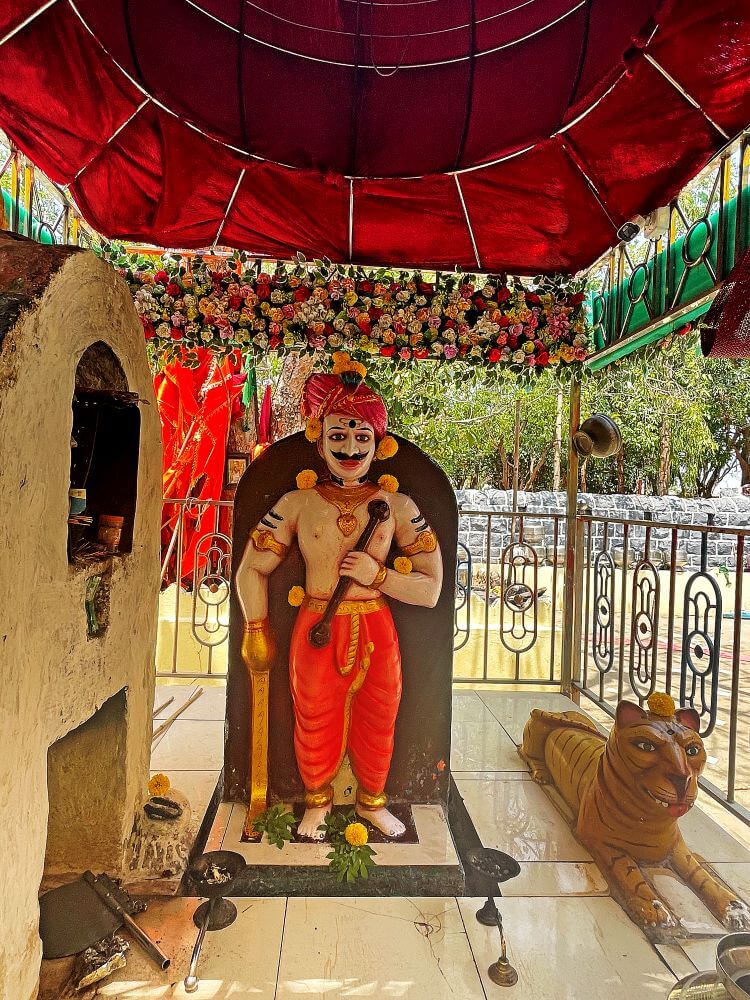
Ahead, there is a platform without walls or a roof, accessible by three steps. This is known as the Garbhagriha (sanctum sanctorum). On all three sides of the Garbhagriha, there is a latticed iron railing. On the Vajrapitha (sacred pedestal) stands the two-armed idol of the deity Vetalguru. In one hand, the deity holds a staff of bones, and in the other, a staff. The deity is adorned with ornaments, a dhoti worn in the traditional style, and a turban on the head. Behind the idol is a back slab. To the left of the idol is a tiger sculpture. On the right side, there are two lamp niches in the pillar, and at the top, there is a tiger sculpture. Offering turmeric, vermilion, and gulal to the Vetal deity here is considered forbidden.
On the platform adjacent to this, there are idols of Machindranath, Gorakhnath, and Maruti. In the courtyard, there is a sacrificial site for offering goats to the ghosts who form the army of Lord Vetal. Next to it, a roofed structure has been erected to prepare the Mahaprasad from the sacrificed goat. In the children’s park within the courtyard, there are swings and various toys for children to play. Chaitra Padwa is the main annual festival of the temple, which is celebrated with great enthusiasm. During this time, the deity’s palanquin procession is celebrated in a devotional atmosphere. A monthly fair is held at the temple on the Amavasya of every month. Mahaprasad is organized for devotees during both monthly and annual festivals. There is a modern Bhaktanivas in the temple premises for the convenience of the devotees.
This sacred temple stands as a testament to deep spiritual devotion, ancient architectural grandeur, and rich local cultural traditions.
The sanctum sanctorum houses the divine idol consecrated according to ancient Vedic traditions, surrounded by serene courtyards and traditional temple architecture.
Navratri, Maha Shivratri, Annual Temple Jatra & Deepotsav
Compare and book flights, secure top-rated local hotels near the temple, hire reliable guides, and rent cars instantly.
Extend your pilgrimage by visiting other highly sacred temples located nearby.


Add ₹999 more to unlock FREE SHIPPING!
Your sacred cart is currently empty.
Shop Photo FramesFill in your delivery details below to place your order.
Add comment