
Add ₹999 more to unlock FREE SHIPPING!
Your sacred cart is currently empty.
Shop Photo FramesThe Navnathas and eighty-four Siddhas of the Nath Sampradaya traveled across Bharat, propagating and spreading their philosophical teachings. During their travels, wherever they halted, they established temples and maths, transforming those locations into centers for the expansion of the tradition. This is why some temples of the Nath Sampradaya are found situated close to one another. The temple at the original birthplace of Revansiddha is one such example, located just one kilometer away from the Revansiddha temple in Renavi. It is believed that the divine power of Revansiddhanath in this temple still rushes to the aid of devotees whenever they call out for protection.
The text ‘Kimayagar’, authored by Gorakshanath, who purified Indian spiritual practices by launching a movement against Vamachari Tantric rituals, serves as the source for this. According to the ‘Navnath Bhaktisar’, composed by the poet Dhundisut Malu based on this text, the Navnaths are incarnations of the Navnarayans. The eighth among these Naths is Revansiddhanath. He It is stated in this scripture that they are an incarnation of Chamasnarayana. According to the Kadsiddheshwar tradition of the Lingayat Shaivas, Revansiddhanath is considered the founder and the first Kadsiddheshwar of the Kadsiddheshwar tradition. It is said that he established the Matha at Kaneri in Kolhapur. The period of Gorakshanath is from 1050 to 1150 AD. Scholars are of the opinion that Revansiddhanath must have been a contemporary of Gorakshanath. It is mentioned in the ‘Navnath Bhaktisar’ that he was named Revan because he was found by a farmer named Sahansaruk on the banks of the Reva River.
The thirty-sixth chapter of this scripture contains the legend associated with this sacred site. It is said that while Revannath was on a pilgrimage across Bharat, he arrived at ‘Vithgram Mandeshi’. At the home of a Brahmin there, a naming ceremony for a newborn child was taking place. At that very moment, Revannath went there to seek alms, chanting ‘Alakh Niranjan’. The Brahmin served him with great devotion and invited him to stay at his home. That very night, the Brahmin’s newborn child passed away. Upon his Seeing the child die in his presence, Revananath became deeply distressed. At that moment, the Brahmin said, “It has happened because it was written in my lowly destiny to witness the death of seven children. Do not feel bad about it.” However, seeing his grief, Revananath used his divine powers to reach Yamaloka and commanded Yama to return the lives of the Brahmin’s seven children. Yama replied that the lives of those Brahmin sons were at Kailasa. Thereupon, Revananath went to Kailasa and retrieved the lives of those children from Mahadeva. Later, he returned to this place. The seventh of these children later became famous as Gahininath. It is stated in the ‘Navnath Bhaktisar’ that after this incident, Revananath ‘still resides in the Vite region’. Because this miraculous event took place in this very area, the temple at Moolsthan holds special significance. As this was the first place Revanasiddhanath stayed when he arrived in this region, this site is known as Moolsthan.
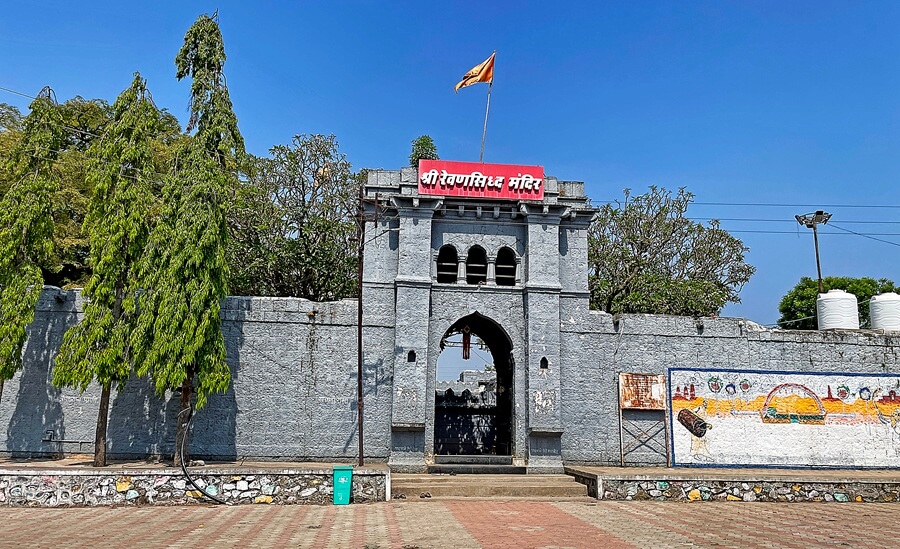
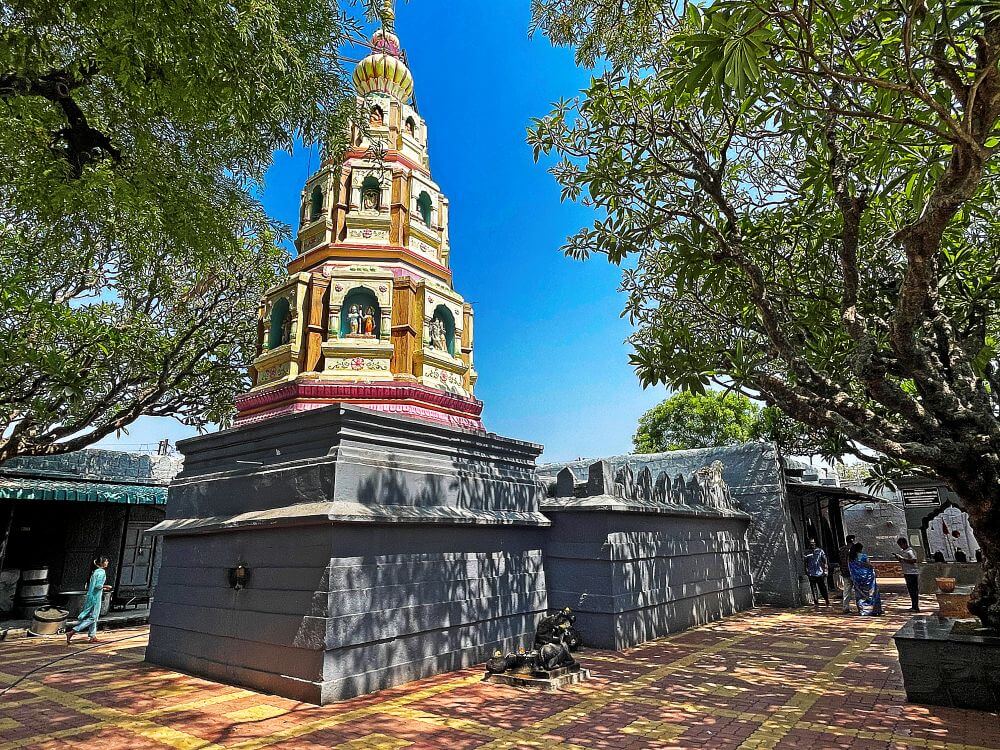
This temple, built in the Hemadpanti architectural style, dates back approximately seven hundred to eight hundred years. It is said to be so. The temple is enclosed by a sturdy fortification wall that is ten to twelve feet high. There are entrance gates in this fortification on the east, west, and north sides. On both sides of the entrance gates, there are pillars with lamp niches. Above the main eastern entrance gate, there is a drum house (Nagarkhana). On both sides inside the entrance, there are guard rooms, and from here, there is a staircase leading up to the drum house above. The drum house features four pillars and arches on each side, topped by an elephant-back (Gajaprishtha) shaped roof. Above the arch of the western entrance gate, there are lotus flower carvings. Inside this entrance, there are guard rooms on both sides, and from here, there is a staircase to ascend to the fortification wall.
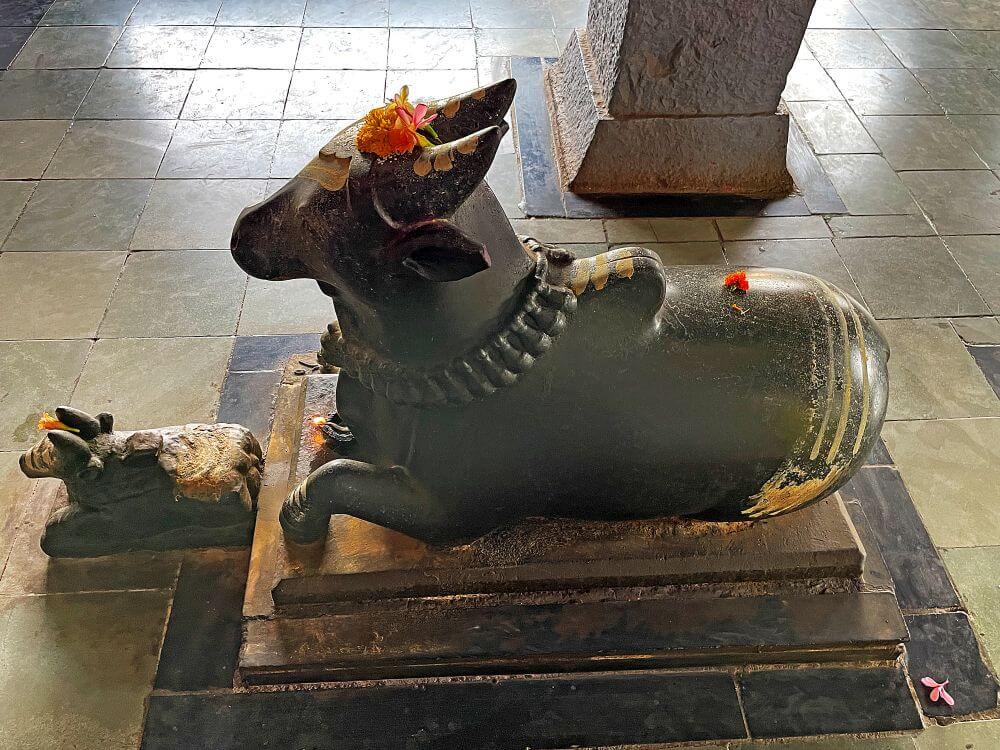
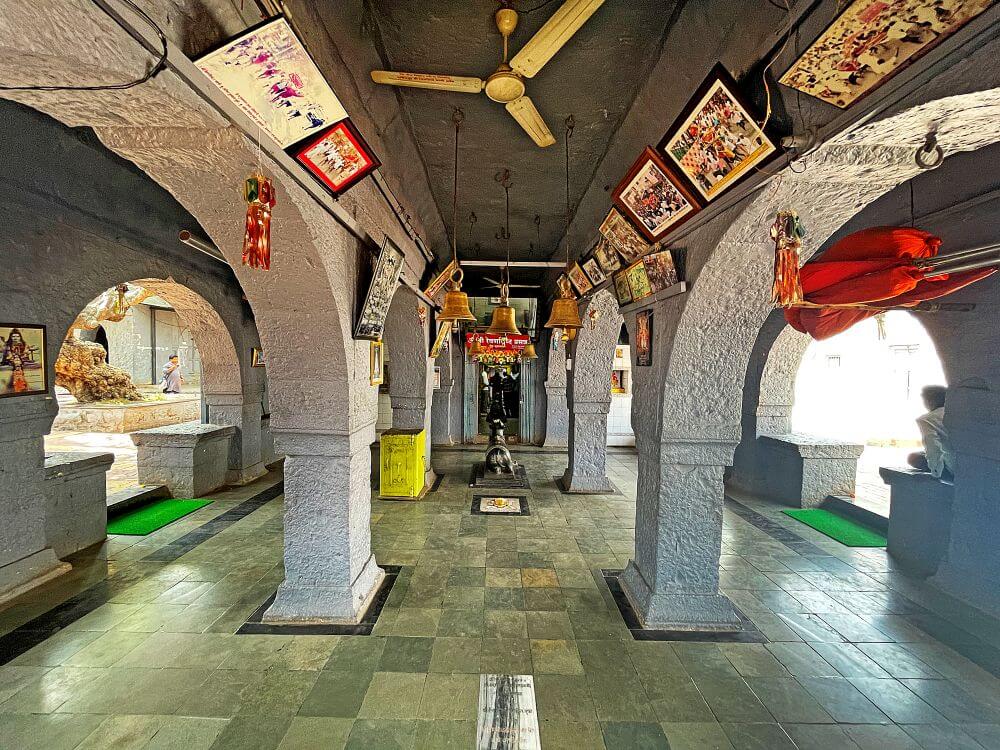
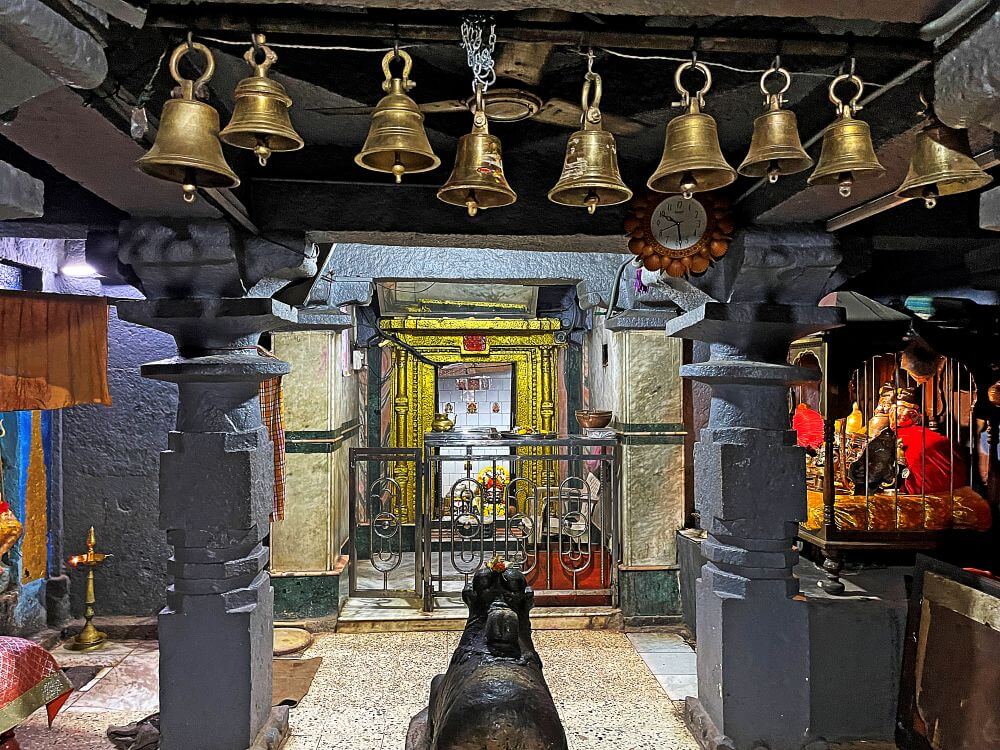
In front of the entrance to the north-facing temple, there is a lamp pillar and several samadhis. On both sides of the entrance, there are sculptures of staff-bearing gatekeepers on the pillars. The roof of the entrance features a decorative parapet. Further ahead is a pillared hall with entrances on all three sides. The semi-open hall consists of four rows of five ornate pillars each. All of these stand on square pillar bases. The pillars are connected to each other by crescent-shaped arches. There are stone benches for devotees to sit in the assembly hall. The assembly hall is paved with tiles, and on the floor here is a tortoise sculpture, with an idol of Nandi made of black stone on a platform in front of it. In front of this Nandi, there is another ancient idol of Nandi. In the assembly hall, in the niche on the left side of the front wall of the sanctum, there is an idol of a local guardian deity holding a shield and sword, and in the right niche, there is an idol of Maruti.
Ahead lies the Antarala (vestibule). Its door frames are adorned with vertical fluted carvings. At the Lalatabimba (lintel center), there is an image of Lord Ganesha, and above the Mandaraka, there is a Kirtimukha sculpture. The Antarala contains four intricately carved pillars. The bases of these pillars are square, while the upper sections transition into various geometric shapes such as circular, octagonal, and hexagonal. The floor of the Antarala is paved with tiles. In the center, there is a Nandi placed on a pedestal. On the left wall, there is a relief sculpture of Lord Ganesha. On the right side, there is one silver mask of Goddess Parvati and six silver masks of Saint Revansiddha. Two of these masks are used during the Palkhi festival. In the Antarala, in front of the entrance to the Garbhagriha (sanctum sanctorum), the silver Padukas (footprints) of Saint Revansiddha are placed on a table.
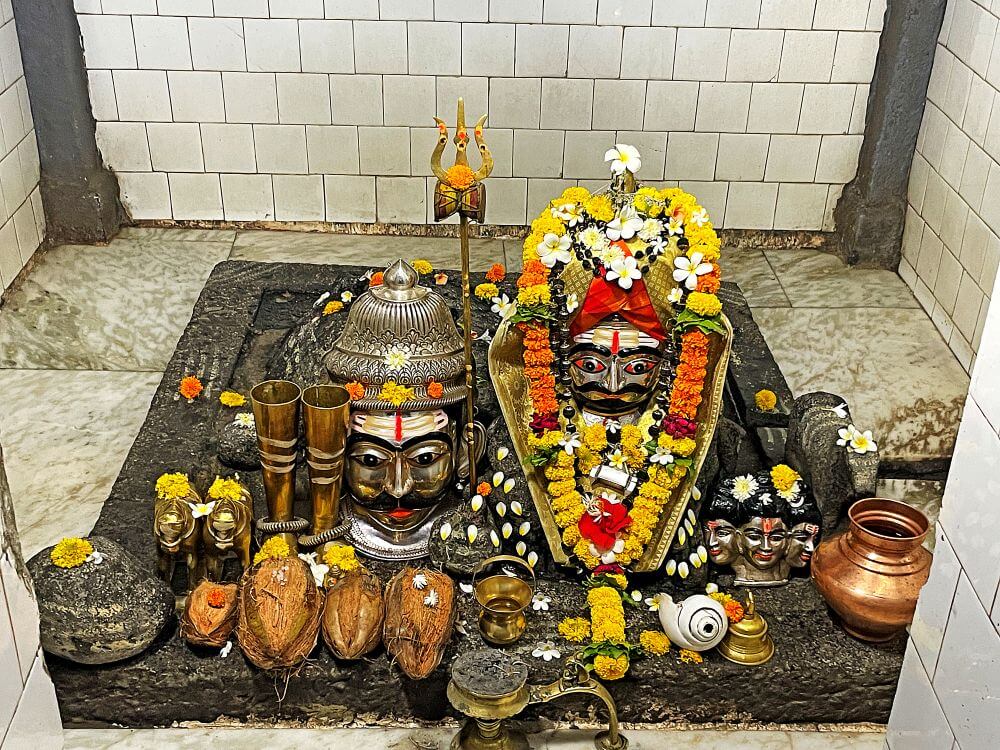
Ahead is the entrance to the sanctum sanctorum, featuring five ornate door frames. The door frames are adorned with intricate carvings of foliage, floral vines, lotus creepers, and vertical fluted patterns. On the lintel sits an image of Lord Ganesha, and at the threshold lies a moonstone. In the center of the sanctum sanctorum resides the self-manifested stone deity. This stone is worshipped as the idol of Saint Revanasiddha. Near the stone are the silver masks of Revanasiddha, a mask of Lord Dattatreya, metal feet, a horse figurine, round stones used for placing roof tiles, a Nandi statue, and a trident. There are ventilation windows in the enclosed vestibule and the sanctum sanctorum to allow for airflow. The temple roof is surrounded on all sides by a decorative parapet. Above the sanctum sanctorum rises a three-tiered octagonal spire. Each tier contains eight niches, each housing an image of a deity. At the pinnacle, there are two Amalakas placed one above the other, surmounted by a Kalasha and a flagstaff. On the exterior of the temple, adjacent to the walls of the Garbhagriha, stands a Meghadambari supported by four pillars with a roof. Inside this Meghadambari, there is a Shivlinga and a Nandi facing it.
In the courtyard, along the fortification walls, there are pillared corridors with arches. These are used as a pilgrims’ rest house. Behind the temple, there is a canopy supported by four pillars, featuring a spire and a finial, which houses an idol of Nandi carved from black stone. In the courtyard, on one raised platform, there are idols of the Navagrahas, and on another, a Shiva Linga and Nandi. Additionally, there is another Nandi and Shiva Linga in the courtyard, along with three circular stones used for laying roof tiles nearby. The corridors along the temple walls contain storage rooms, a palanquin room, and other chambers. Near the temple, there is a modern building for pilgrims equipped with all amenities.
Mahashivratri and the first Monday of the holy month of Shravan are the main annual festivals celebrated here with great enthusiasm. During these times, thousands of devotees arrive to seek the blessings of the deity and fulfill their vows. A large crowd of citizens from the district gathers to listen to the ‘Bhaknuk’, which is a traditional forecast of the year’s weather and crop conditions. On Vijayadashami, the deity’s palanquin procession is celebrated in the temple in a deeply devotional atmosphere. On this day, the deity is seated in a palanquin and taken to the Revansiddha temple in Vita. At that time, this palanquin and the palanquin from that temple are danced together. Devotees flock to the temple for the darshan of Revansiddha on Mondays, Thursdays, and every Amavasya.
This sacred temple stands as a testament to deep spiritual devotion, ancient architectural grandeur, and rich local cultural traditions.
The sanctum sanctorum houses the divine idol consecrated according to ancient Vedic traditions, surrounded by serene courtyards and traditional temple architecture.
Navratri, Maha Shivratri, Annual Temple Jatra & Deepotsav
Compare and book flights, secure top-rated local hotels near the temple, hire reliable guides, and rent cars instantly.
Extend your pilgrimage by visiting other highly sacred temples located nearby.


Add ₹999 more to unlock FREE SHIPPING!
Your sacred cart is currently empty.
Shop Photo FramesFill in your delivery details below to place your order.
Add comment