
Add ₹999 more to unlock FREE SHIPPING!
Your sacred cart is currently empty.
Shop Photo FramesThe Nath Sampradaya, which sparked a revolution of independent thought within the structure of Indian society, once held great influence. There are many temples in Western Maharashtra dedicated to Revansiddhanath, who was the seventh Guru in the Guru-Shishya lineage of the Navnath and one of the Nava Narayanas. One such temple of Revansiddha is located near Renavi village in Khanapur taluka. Because of the presence of the Revannath temple in the village, the entire community, comprising diverse castes and religious backgrounds, has abstained from non-vegetarian food and has adopted a strictly vegetarian lifestyle for many years. Devotees firmly believe that vows made to Revannath with devotion are always fulfilled.
Launching a movement against Vamachari Tantra practices, [the]Indian spiritual tradition’s The text ‘Kimayagar’ by Gorakshanath is a work of purification. According to the ‘Navnath Bhaktisar’, composed by the poet Dhundisut Malu based on this text, the Navnaths are incarnations of the Navnarayans. The eighth Nath among them is Revansiddhanath. This text states that he is an incarnation of Chamasnarayan. According to the Kadsiddheshwar tradition of the Lingayat Shaivas, Revansiddhanath is considered the founder and the first Kadsiddheshwar of the Kadsiddheshwar tradition. It is said that he established the monastery at Kaneri in Kolhapur. The period of Gorakshanath is from 1050 to 1150 A.D. Scholars are of the opinion that Revansiddhanath must have been a contemporary of Gorakshanath. The ‘Navnath Bhaktisar’ mentions that he was named Revan because he was found by a farmer named Sahansaruk on the banks of the Reva River.
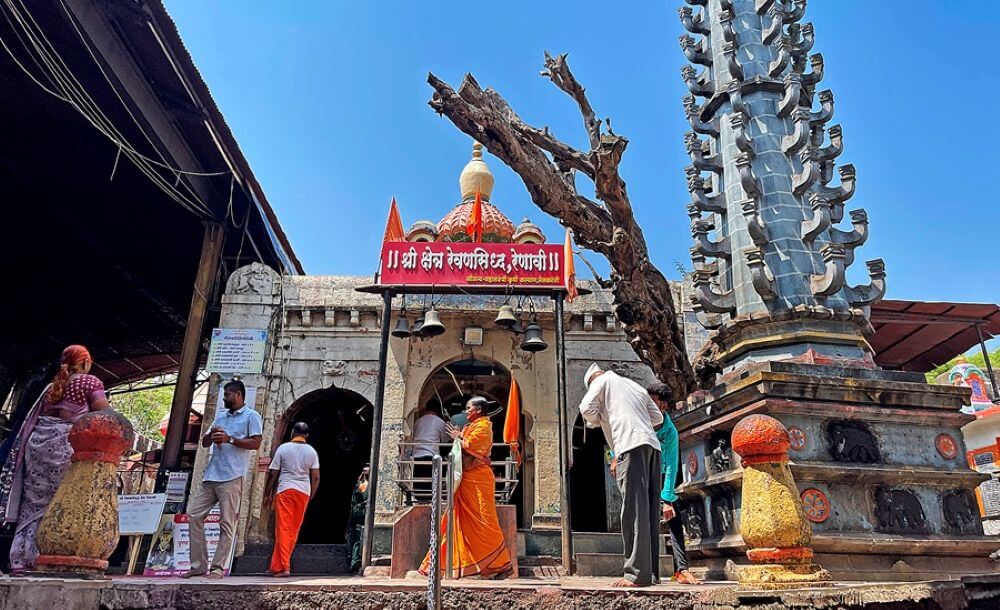
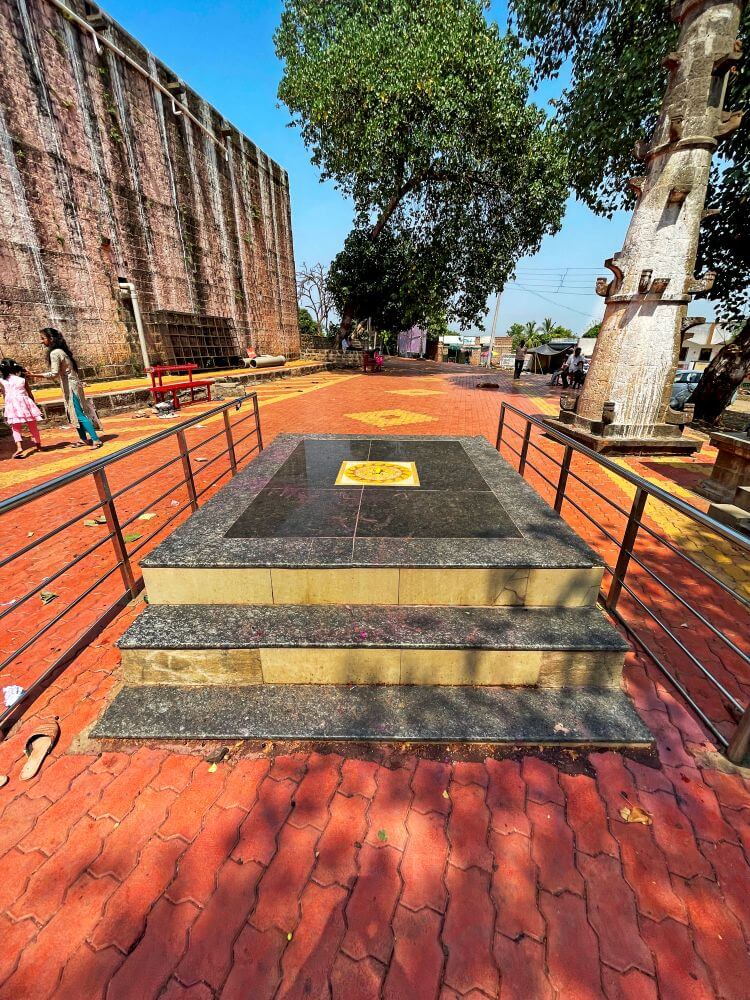
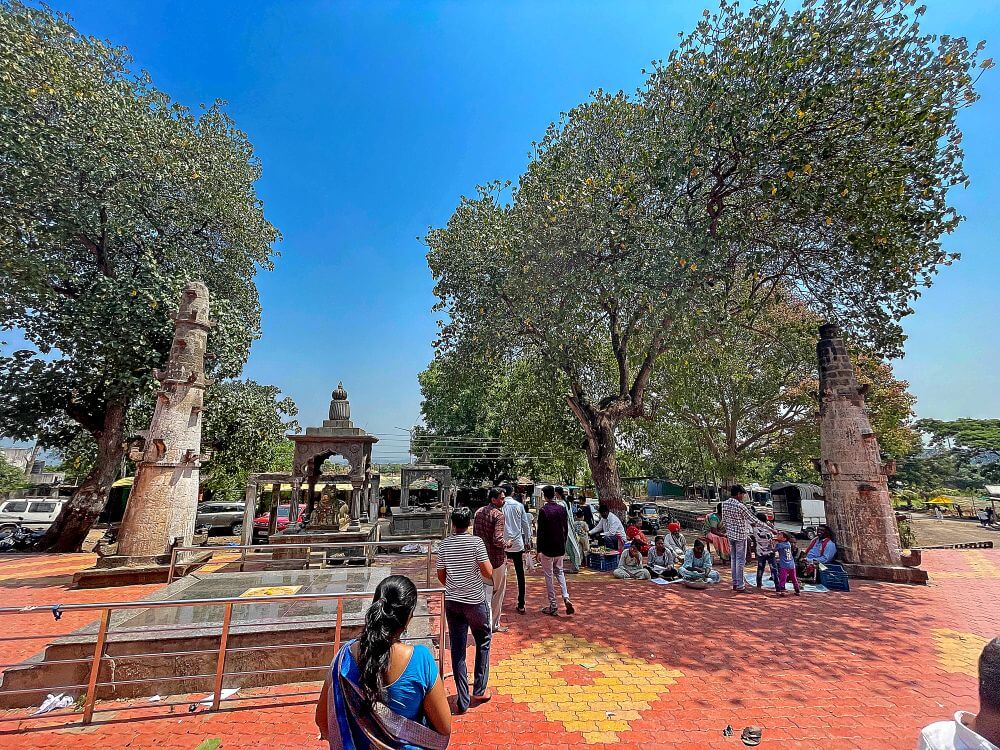
Although it is said that this temple, built in the Hemadpanti architectural style, dates back to the thirteenth century, the local villagers state that the original temple is even older. The various structures and fortifications within the temple complex were built during different periods. Experts believe that they must have been from the past. There is a spacious parking area in front of this temple, which is located one kilometer away from Renave village. Next to the parking area, there are many shops selling worship materials. In front of the entrance, there are three platforms with three circular lamp towers (Deepmalas) on them. Further ahead is the platform for the Bhaknuk. During the fair, predictions regarding the year’s weather and crops are made here; this is known as Bhaknuk.
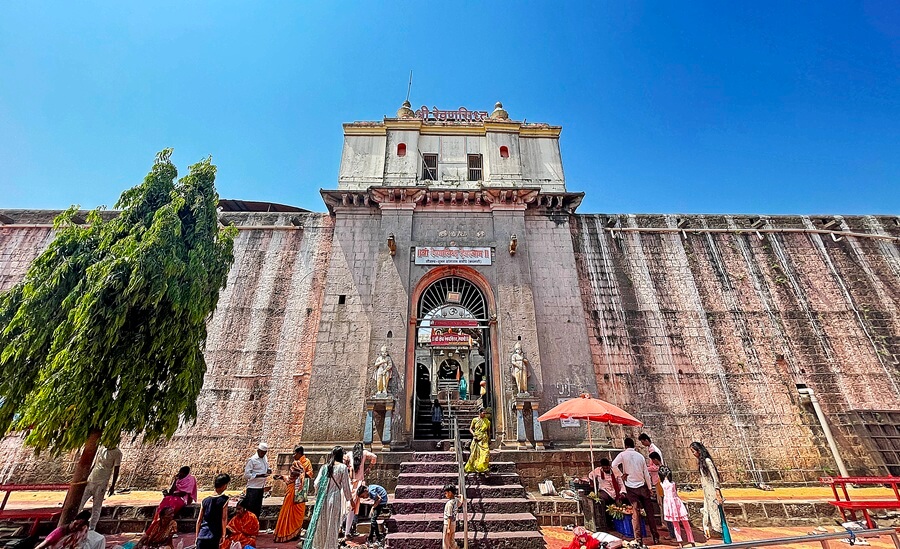
In front of the entrance, there is a black stone idol of Nandi on a platform built of carved stone, and a Tulsi Vrindavan stands to the side. Nearby, there are some ancient Samadhis. The temple is surrounded by a stone fortification approximately 25 feet high. There are entrances on three sides of this fortification. The main entrance, located on the north side, is elevated. On both sides of the entrance, there are two-armed gatekeepers holding staffs, standing on pedestals supported by two pillars each. Above the entrance, there are relief carvings of tigers, elephants, and lotus flowers. There are Vyala sculptures on both sides of the walls. In the center of the architrave, there is a Chandrashila, with Kirtimukhas on both sides. A female figure is carved onto the architrave.
Inside the entrance, there are guard rooms on both sides. In one of these rooms, paintings of Lord Vishnu and Goddess Lakshmi are depicted, while the other room features a painting of Goddess Saraswati. There are niches for lamps in the walls of the guard rooms. From the guard room, there is a stone staircase that leads to the Nagarkhana on the floor above. A panoramic view of the surrounding area can be seen from the Nagarkhana. There is also a staircase within the temple fortifications to ascend to the upper level.
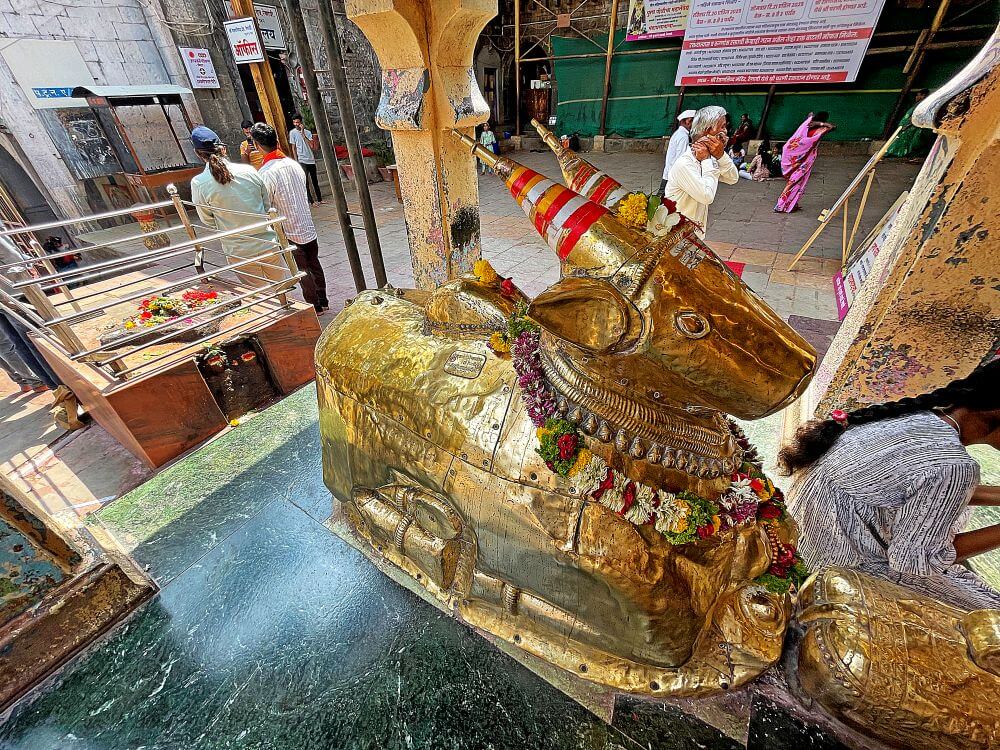
After climbing a few steps from the entrance, one enters the temple courtyard. On a raised platform in the courtyard, there is a unique Shivlinga featuring a rare arrangement of five lingas and four yonis. Beside this linga, there is another Shivlinga below. On the wall of the platform are ancient idols of Goddess Yamai and Goddess Mahalakshmi carved in black stone. Beside this platform stands a circular lamp tower (Deepmal) approximately thirty feet high. On the square base of the lamp tower are relief sculptures of Maruti, Vrishabha, Gajaraj, and others. Further ahead, in the front pavilion (Mukhamandap) which has four pillars and a roof, there are two Nandi idols placed one behind the other on a Vajrapitha. There is a tradition of lifting the circular stone placed in front of the Nandi to seek divine guidance (Kaul). On the roof of the front pavilion, there are small canopies (Meghadambari) at all four corners, topped with finials (Kalash). In the center, there is a dome-shaped spire (Shikhar). The dome features lotus petal carvings and a finial at the apex. Ahead lies the main assembly hall (Sabhamandap) of the temple. The entrance to the assembly hall has three arches supported by four pillars. There are Kirtimukha sculptures on all three arches. On the front wall, there are Vyala sculptures on both sides at the top.
In the assembly hall, there are four rows of five square pillars each. The palanquin used during festival periods is suspended from the ceiling of this hall. Below it, there is a tortoise sculpture and a sacrificial fire pit. On the right wall of the assembly hall is a sculpture of Lord Ganesha, and on the left side, silver sandals are placed on a wooden pedestal on the floor. Further ahead is the entrance to the sanctum sanctorum. The door frames are adorned with floral and leaf carvings, with a Ganesha sculpture on the lintel and a Kirtimukha on the architrave. The entrance is covered in silver plating. Inside the sanctum sanctorum, there are six intricately carved pillars. The sanctum houses the self-manifested stone idol of Revansiddha. This stone idol, in a reclining posture, is twelve to fifteen feet long and three to four feet high. Silver eyes have been affixed to the idol. Near the idol are the brass masks of Revansiddha’s disciples, Basavasiddha and Maralsiddha. Beside the idol are two Shiva Lingas and a silver trident. Water continuously oozes from the stone of Revansiddha.
Every Monday, Thursday, Saturday, Purnima, Amavasya, Ekadashi, and on all festival days, the Utsav Murti of the Deity is adorned and worshipped in ceremonial attire. Other On this day, the stone idol is worshipped. The sanctum sanctorum features a conical-shaped shikhara on its roof, topped with a kalasha. Behind the main temple, there is a smaller shrine. This shrine houses a portion of the stone idol from the main sanctum and naga-shilas (serpent stones). The seven-tiered square shikhara of this shrine is adorned with intricate carvings on all four sides. It features sculptures of Mahadeva, nagas, and tigers in relief style. At the apex, there is an amalaka, crowned by a kalasha and a flag. From the gomukha in the adjacent temple, a continuous stream of water flows. Beside the gomukha stands a yaksha idol, and in front of it is Nandi.
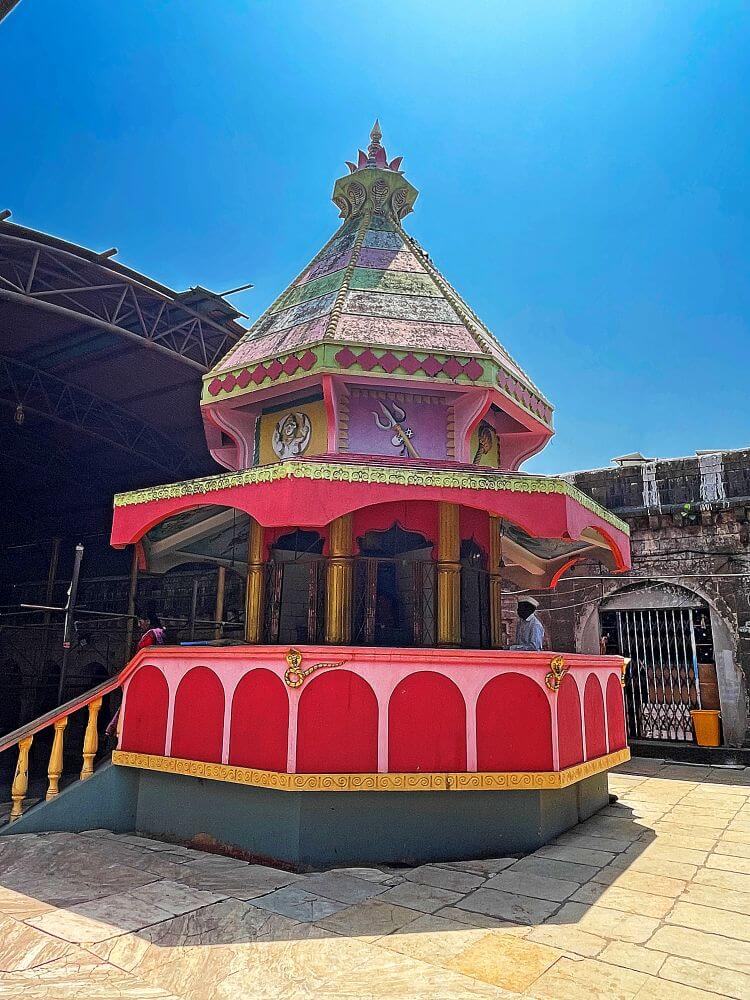
In the courtyard, along the fortification walls, there are pillared corridors featuring ornate columns, arches, and a roof. This structure is used as a pilgrim rest house (Dharmashala). One of these chambers houses the office of the Temple Trust. Some of the corridors serve as residences for the temple priests. In one chamber, there are idols of Rama, Lakshmana, Janaki, Hanuman, Vitthala, Rukmai, and Garuda. In the temple courtyard, there is an elephant-back (Gajapristha) shaped roof. There is an open hall. It is used for cultural programs and as a marriage hall. In the courtyard, there is a small temple of Maralsiddha Deva, a disciple of Revansiddha. The temple houses a self-manifested stone idol of Maralsiddha Deva. Beside this temple is an octagonal Ashtavinayaka temple. In this temple, there are idols of Ganesha facing the eight directions. Apart from this, there is a small Dattatreya temple here. On the Vajrapitha in this temple, there is a marble idol of Shri Dattatreya. Ahead of that, there is a Navagraha temple with walls, pillars, and a roof. In this temple, on the central Vajrapitha, there is an idol of Surya in a chariot drawn by seven horses, and idols of other planets are placed on all four sides. There is a circumambulation path around the Vajrapitha. Further ahead in the courtyard is the Basavasiddha temple located underground. One has to descend stairs to enter the temple. In the sanctum sanctorum, there is a self-manifested stone of Basavasiddha.
In the courtyard, in the Nandi Mandapa facing the east and west entrances, there is a Nandi and stone Padukas in front. In the second Mandapa facing the west entrance, there is an inscription in the Modi script. Nearby is the Sanjeevan Samadhi of Sakhare Maharaj, a devotee of Revansiddha. Outside the courtyard, near the temple, there is a new Bhakta Niwas building equipped with modern amenities.
Mahashivratri is the main annual pilgrimage festival celebrated here with great enthusiasm. On this occasion, the deity’s palanquin procession takes place. The day begins with Laghurudra and Maha-abhisheka, and throughout the day, programs such as Bhajans, Kirtans, discourses, night vigils, music, and Mahaprasad are organized. Sasanakathis arrive at the temple in processions from the surrounding villages. Thousands of devotees come for the Darshan of the deity and to fulfill their vows. On all four Mondays of Shravan, there is a crowd of devotees in the temple. On the day of the pilgrimage and the first Monday of Shravan, the Bhakhanuk (prophetic ritual) program is held.
It is said that Revannath resided in places like Devnagar, Vasumbe, Salsinghe, Vita, and Moolsthan, and finally attained Samadhi at this place in Renavi. Every day, the Maha-puja takes place here between 3 and 5 in the morning. From 5 in the morning, devotees can have the Darshan of Revansiddha in this temple. Aarti is performed at 7:30 in the morning, 7:30 in the evening, and 8:30 at night. The temple doors close for devotees at 10 at night.
This sacred temple stands as a testament to deep spiritual devotion, ancient architectural grandeur, and rich local cultural traditions.
The sanctum sanctorum houses the divine idol consecrated according to ancient Vedic traditions, surrounded by serene courtyards and traditional temple architecture.
Navratri, Maha Shivratri, Annual Temple Jatra & Deepotsav
Compare and book flights, secure top-rated local hotels near the temple, hire reliable guides, and rent cars instantly.
Extend your pilgrimage by visiting other highly sacred temples located nearby.


Add ₹999 more to unlock FREE SHIPPING!
Your sacred cart is currently empty.
Shop Photo FramesFill in your delivery details below to place your order.
Add comment