
Add ₹999 more to unlock FREE SHIPPING!
Your sacred cart is currently empty.
Shop Photo FramesThe concept of the three and a half Shakti Peethas is linked to the three and a half matras of the Omkara. These Peethas are also referred to as Aut Peethas. One of the complete Peethas among these is the Mahalakshmi Temple in Kolhapur. This Goddess is also known as Ambabai and is considered the primordial nature, the Adi Maya Bhagavati. Located in the region of Kolhapur or Karveer, which has a history spanning many centuries and is known as Dakshin Kashi, the Ambabai Temple is also extremely ancient. Thousands of devotees visit here every day to seek the blessings of Ambabai, who is known as the Kuladevata (family deity) of Maharashtra.
In the text ‘Devi Mahatmya’, which is based on the ‘Durga Saptashati’, Mahalakshmi is mentioned as the Adi Maya. It states, “She is the beginning of all, Mahalakshmi herself. She is the complete Supreme Goddess of the entire world, the embodiment of the three Gunas (Triguna).” These three forms of the Goddess can be seen in the Mahalakshmi Temple of Kolhapur. Along with Mahalakshmi, Mahakali and Mahasaraswati are also enshrined here. According to the mythological legend in the Devi Mahatmya, Mahalakshmi created these two forms from the Tamoguna and Sattvaguna and asked them to produce a pair of male and female beings according to their respective qualities
. From this, the universe and creation were formed. Thus, her devotees believe that Mahalakshmi is the primordial nature (Mula Prakriti). This means that this Goddess is not a secondary consort of any deity like Brahma, Vishnu, or Mahesh, but is the direct embodiment of Brahman, the mother, nourisher, and destroyer of the universe.
A legend is told regarding how this Goddess was established in Kolhapur, which is as follows: Lord Brahma had three sons named Gaya, Lavana, and Kolhasura. Brahma sent Kolhasura to Rakshalaya (modern-day Kolhapur) to eliminate a demon named Keshi. He came here, defeated Keshi, and became the king of this place. The name of Kolhasura’s wife was Kadamba. They had four sons: Karveer, Vishal, Kulandhak, and Lljjasura. Kolhasura divided the kingdom among the four and went into the forest for penance. His four sons started harassing the people. Then, Lord Shankar, Brahma, and Indra killed all four of them. Upon learning this, Kolhasura became enraged. He worshipped Goddess Mahalakshmi and asked her to leave this place for one hundred years. Accordingly, the Goddess went to the Himalayas. Thereafter, Kolhasura began to persecute the local people. Therefore, all the deities prayed to the Goddess to be liberated from him. Then the Goddess returned here. Kolhasura had appointed demons named Raktalol in the east, Raktaksha in the west, Raktabhoj in the north, and Raktabija in the south of this place. The Goddess attacked the region and killed these demons. Also, on the day of Ashwin Shuddha Panchami, the Goddess killed Kolhasura. At that time, Kolhasura prayed to the Goddess to name this region after him. He wished for this pilgrimage site to be as holy as the Gaya Kshetra and for a pumpkin (Kohala) to be broken here every year. In this way, this region received the name Kolhapur.
This story also appears in the ‘Kashi Khanda’ of the ‘Skanda Purana’. It states: “Trailokyam Kolarupena trasayantam mahasuram. Vinihatya sthitam tatra ramaye Kolapure pure.” Meaning: A great demon in the form of a boar (Kola) was terrorizing the three worlds. The Goddess killed him, and since then, the Goddess began to reside in Kolhapur. In ‘Lakshmi Ashtakam’ also, it is said: “Namaste Garudarudhe, Kolasurabhayankari. Sarvapaphare Devi Mahalakshmi Namostute.” Meaning: Salutations to Goddess Lakshmi, who is mounted on Garuda, who strikes fear into Kolhasura, and who removes all sins.
Due to the presence of the Goddess, Kolhapur has attained the first position in the count of the Aut Peethas. In the thirty-eighth chapter of the seventh Skandha of the ‘Devi Bhagavata’, it is said: “Kolhapuram mahasthanam yatra Lakshmih sada sthita. Matuhpuram dvitiyam cha Renukadhisthitam param. Tulajapuram tritiyam syat Saptashringam tathaiwa cha.” According to this, Kolhapur is the Mahasthan, Mahur is the second, Tuljapur is the third Peetha, and Saptashringagad is the half-Peetha. In the list of one hundred and eight Shakti Peethas in the Matsya, Padma, and Skanda Mahapuranas, there is also a mention of ‘Karvire Mahalakshmi’. Accordingly, Mahalakshmi is the presiding deity of Karveer. Because of this, Kolhapur is considered a very important region in the tradition of Shakti worshippers.
The greatness and legends of this region are mentioned in the book ‘Shri Karveer Mahatmya’. It is noteworthy that in this book, Mahalakshmi is called Vishnupriya Lakshmi. “Karveer Mahatmya grantha sundar. He bahattar gananche gopur. Lakshmisaha Ramavar. Krida kari tayavari.” (This Karveer Mahatmya book is beautiful. It is the tower of seventy-two Ganas. The Lord of Rama, along with Lakshmi, plays upon it.) The book Karveer Mahatmya was written by Dajiba Joshirao between 1821 and 1832, the period after the end of the Peshwa rule and the beginning of British rule. In it, he gave the form of Vishnu’s wife to Mahalakshmi, who belongs to the Shiva family. According to the entries in the Vishwakosh, in the Indian tradition, Lakshmi is the name of Vishnu’s wife. However, it is observed that the word Mahalakshmi, formed by adding the adjective ‘Maha’, is sometimes used in the sense of Vishnu’s wife and sometimes in the sense of Shiva’s wife. In this context, the ‘Devi Kosha’ states that if a Mahalakshmi idol is to be made in places other than Kolhapur, it is made assuming she is Vishnu’s wife. This means that the Mahalakshmi at Kolhapur has been considered in the form of Shiva’s wife, Parvati.
The exact history of who built the Mahalakshmi Temple here is still unknown. However, according to most historians, the construction of the temple began during the Chalukya period. During the time of the valiant Chalukya King Pulakeshin II (610 to 642 CE), in 624 CE, his governor named Karnadeva built the sanctum sanctorum of the temple. According to temple architecture scholar Yogesh Prabhudesai, when the Chola king of Kanchi attacked the Chalukyas of Kalyani, the Chola king had tried to burn down this Mahalakshmi temple in Kolhapur. This incident happened in the eleventh century. The assumption is that since an attempt was made to burn the temple then, the construction of the temple must have been in wood until that time.
Following this, the Chalukyas likely constructed the present stone temple. According to some historians, the Sind Rajas, who were once feudatories of the Chalukyas, built this temple. The Sind Rajas ruled over Karhad (Karhataka) and parts of Kolhapur. They identified themselves as Phanindravanshi (Nagavanshi). During their reign, the temples of the deities Mahakali and Mahasaraswati were added to the main temple, transforming it from a single-shrine (Ekakuta) structure into a triple-shrine (Trikuta) complex.
The Shilahara dynasty has a close association with this temple. In his book ‘Musalmanpurva Maharashtra’, V. K. Bhave noted that the Shilahara King Marsimha (१०५५-१०७०) had his capital at Kilgil Durg (Kagal). It is believed that he expanded the Mahalakshmi temple. Gandaraditya and Bhoja were his sons. Of these, Gandaraditya installed the pinnacle (Kalash) on the temple. After Gandaraditya’s grandson, Bhoja II, ascended to power, he made donations to the Mahalakshmi temple in Kolhapur. An inscription of his, written in Sanskrit and Nagari script, records the grant of a field near Koparwada and a village named Pava as an Agrahara to Brahmins for the worship of the deities Umamaheshwar and Mahalakshmi.
Mahalakshmi was the family deity (Kuladevata) of the Shilaharas. Similarly, the Chalukyas, Kadambas, and Yadava kings also held deep devotion toward Mahalakshmi. A copper plate of the Kadamba King Shashthadeva II of Goa, dated Shaka ९३२ (१२१० CE), describes the deity as ‘Shrikollapurmetya yena cha Shrimahalakshmi samaradhitā’. Likewise, on a pillar to the right of the steps of the Ganesha temple within the Mahalakshmi temple premises, there is an inscription from the reign of the Yadava King Singhandeva. This inscription, in Sanskrit and Nagari script, dates to Shaka ११४०, Baudhayana Samvatsara (१२१८ CE), and records that a person named Tailan constructed an archway in front of the Mahalakshmi temple.
An inscription of the Yadava ruler Jaysil was found in front of the steps facing the western entrance of this temple. This inscription, carved on ‘Monday, Magha Shuddha १५, Durmukhi Samvatsara, Shaka ११५८’ (१२३६ CE), states that Jaysil donated some government revenue for the offering of incense, lamps, and food (Naivedya) to Sauvarn Jateshwar on the occasion of a lunar eclipse. On a pillar of the Rangamandapa of the Navagraha temple within the temple premises, there is an inscription from the reign of the Yadava ruler Mahadeva. The main purpose of this inscription, dated ‘Shaka ११८७, Krodhana Samvatsara, Magha Shuddha Purnima’ (Friday, २२ January १२६६), was to state that ‘Pandit Kanakachandra and Hegade Vasavadeva donated some land for the maintenance of the Nemadevi Basati for Ishwarkeshava and Narasimha.’ All these facts clarify the antiquity of the Mahalakshmi temple.
Just as the Chaul king had attempted to burn this temple, the Bahamani and Adilshahi Sultans also desecrated it during the १४th and १५th centuries. This is mentioned in Major D. C. Graham’s १८५४ work, ‘Statistical Report of the Principality of Kolhapur’. At that time, the idol of Mahalakshmi was hidden in a house. Later, in १७२२ CE, Chhatrapati Sambhaji II re-consecrated the idol in the present temple. Records indicate that for this consecration, Sambhajiraje sent Sidhoji Hindurao Ghorpade from Panhala Fort to Kolhapur.
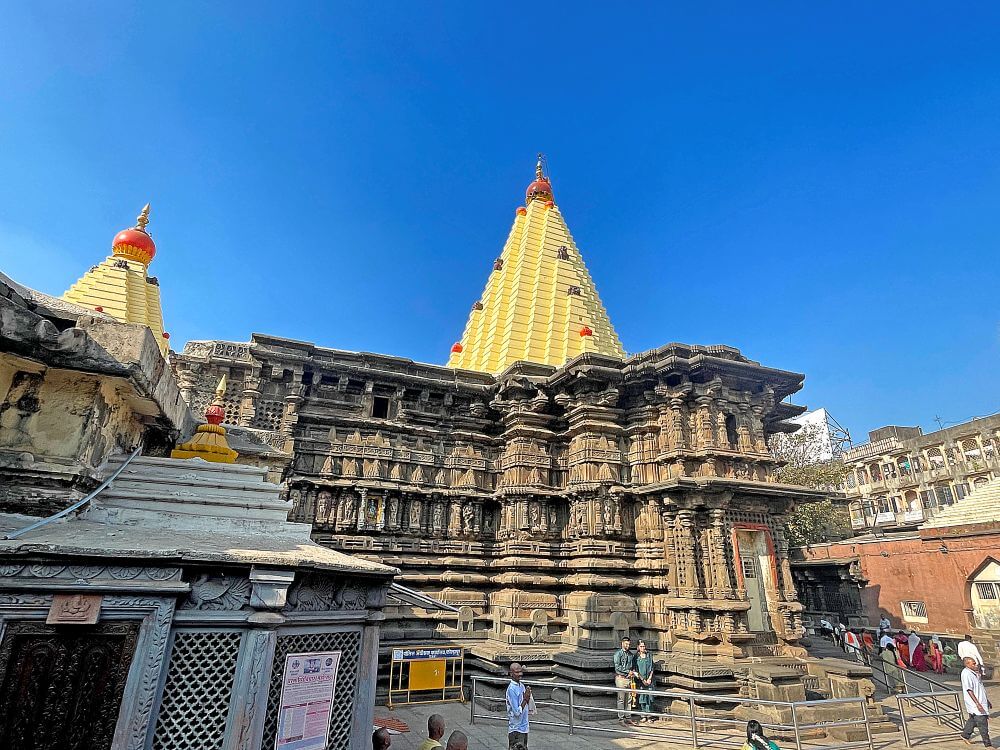
This Mahalakshmi temple is situated on a hillock in the city of Kolhapur. Although the hillock is not easily noticeable due to urban settlement, the slope on the western side of the temple can be seen extending toward Rankala Lake. The construction of this three-spired (Trikuta) temple is in the Hemadpanti style. The temple faces west. The temple courtyard is pentagonal, spacious, and paved with stone. The courtyard has four main entrances. The main western entrance features a Nagarkhana (drum house). The idol of the Goddess is visible from this entrance. There was a large bell on the northern entrance of the courtyard, which is why it is called the Ghati Darwaja (Bell Gate). This bell was installed by Rajarshi Shahu Maharaj. The Portuguese sentence ‘Ava Maria Gratia Dominus Tecum Ihs’ (Hail Mary, full of grace, the Lord is with thee) is inscribed on this bell. It is believed that Chhatrapati Sambhaji Maharaj brought this bell to Kolhapur after the war in Goa in १६८३. The Navagraha temple is located near this Ghati Darwaja. The southern entrance is known as the Vidyapeeth Darwaja, and the eastern entrance is known as the Purva Darwaja.
The structure of the Mahalakshmi temple consists of the Mukhamandapa (front hall), Sabhamandapa (assembly hall), Antarala (vestibule), and Garbhagriha (sanctum sanctorum). The Sabhamandapa here is called the Manimandapa. Upon entering the courtyard through the western entrance, one faces the Mukhamandapa. The Garuda Mandapa is a part of it, constructed between १८४४ and १८६७. There are carved idols in the niches on both sides of this mandapa. It is said that these are idols of Bharata and Shatrughna, though some believe they are Jain door-guardians (Dwarapalas). During the Ashwin Navaratri festival, the silver idol of Mahalakshmi is installed on a stone platform in this very mandapa.
Near the main entrance of the Mukhamandapa (this entrance is now closed), an idol of Ganesha is installed. Directly in front is the Sabhamandapa (Manimandapa). Behind it are the carved idols of the door-guardians, Jaya and Vijaya. A legend states that Jaya and Vijaya built the Mahalakshmi temple in a single night; hence, construction tools are carved beside these idols. The Sabhamandapa has two entrances on either side. The northern entrance leads to the Mahakali temple, and the southern entrance leads to the Mahasaraswati temple. This Sabhamandapa is also called the Mahanatmandapa. A unique feature of this hall is its many wide, intricately carved stone pillars. In the queue for Darshan, one first gets a glimpse of Mahakali, followed by Mahakali and Mahasaraswati. The Antarala of the temple also features wide, carved pillars similar to the Sabhamandapa. All this construction is in the Vesara architectural style. The main sanctum of the temple has an intricately carved door frame. A small idol of Mahakali is carved on the lintel of this frame. A Shriyantra and an idol of Ganesha in a niche are also installed here.
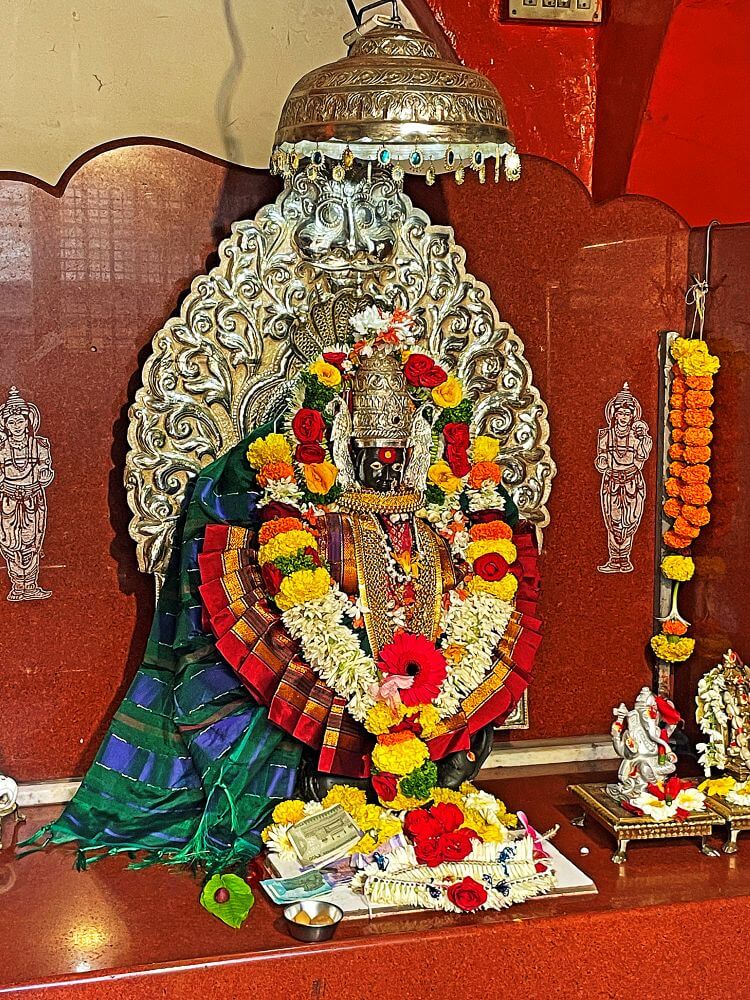
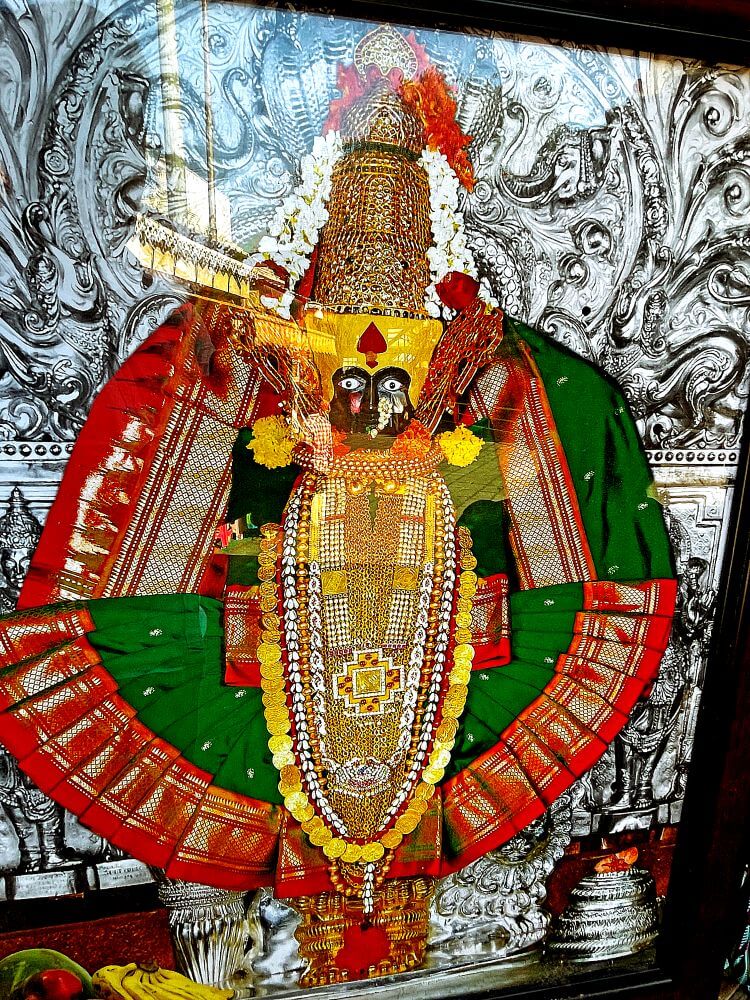
The idol of Mahalakshmi is enshrined on a high pedestal within the sanctum sanctorum. This idol is carved from basalt, or black stone. Standing at a height of 1.22 meters, the idol is in a standing posture, known as the sthanaka form. The deity is four-armed; in her upper right hand, she holds a mace, and in her left, a shield. In her lower right hand, she holds a citron (bijapuraka) fruit, while her lower left hand holds a betel leaf. Accompanying the idol is the figure of a lion, which is why Ambabai is also referred to as Simhavahini. On the deity’s head rests a serpent with three and a half coils, and behind it is a linga, which clearly indicates that this idol belongs to the Shaiva tradition. A unique feature of this sanctum is the presence of chambers such as a bathing room, a storehouse, and a bedchamber. Furthermore, the sanctum is two-storied, with another temple located on the upper level, accessible via a staircase to the left of the Mahalakshmi temple. This upper temple enshrines the Adyalinga or Matrulinga, with an idol of Nandi seated before it. It is said that this Matrulinga was consecrated in the 12th century during the Yadava dynasty. It is believed that because devotees could not have darshan of the Shivalinga on the head of the Mahalakshmi idol, this Matrulinga was installed here.
The exterior of the Mahalakshmi temple, built on a high plinth, is also adorned with exquisite carvings. The walls, constructed of black stone, feature niches at intervals containing magnificent sculptures of musicians, surasundaris, yakshas, and warriors. One of the niches also houses an idol of Shri Krishna. The temple courtyard contains shrines dedicated to various deities, including Sheshashayi Narayan, Dattatreya, Ganapati, the Navagraha, and Vitthal-Rakhumai. Notable among these are the Sheshashayi temple near the eastern main gate and the Navagraha temple near the Ghati Darwaza. The Sheshashayi temple is octagonal in shape, and the rim of its dome, decorated with stunning carvings, features several images of Jain Tirthankaras. It is believed that this temple was originally dedicated to Tirthankara Neminath; notably, it houses an idol of Lord Vishnu reclining on Shesha.
In the Navagraha temple, situated on a high platform, are the idols of the nine planets, along with an image of Mahishasuramardini and a Shivalinga. This temple was built in 1941 by Shrimant Jahagirdar Babasaheb Ghatge. In front of this temple is a small open assembly hall (sabhamandap) dating back to the Yadava period. Its ceiling is intricately carved with figures of the nine planets and the Ashtadikpalas. One of its pillars bears an inscription from the reign of the Yadava king Mahadeva.
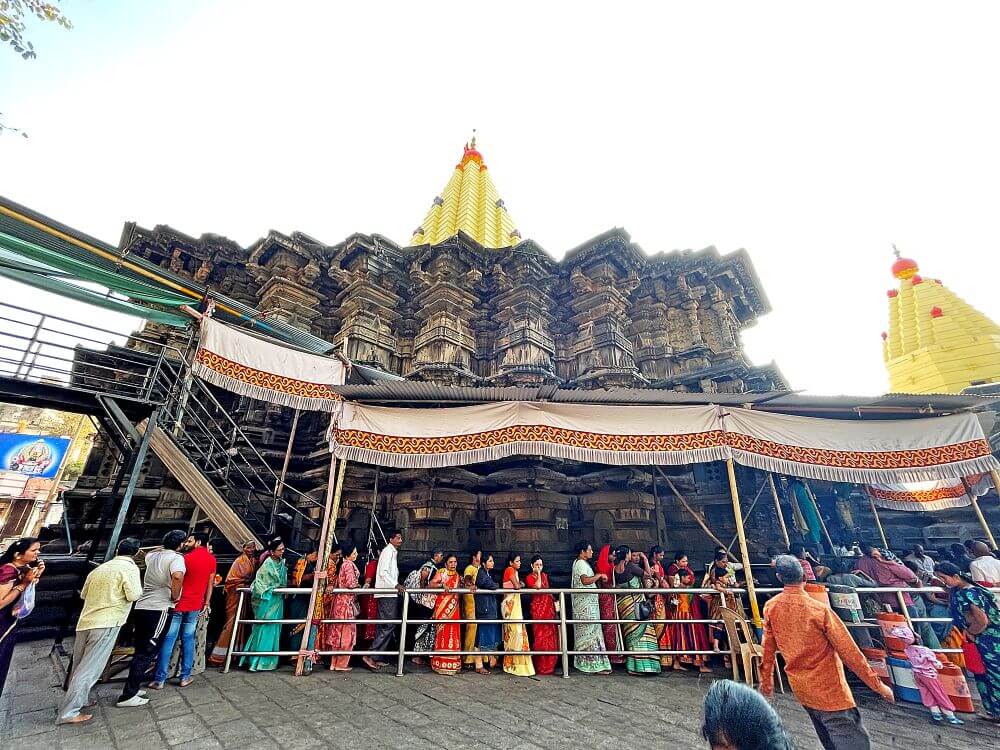
As Mahalakshmi or Ambabai of Kolhapur is the family deity (kuldevata) of all of Maharashtra, thousands of devotees visit daily for darshan and to fulfill their vows. Every Friday, on Chaitra Vadya Pratipada, and on the full moon days of the months of Ashwin, Kartik, Margashirsha, and Magh, a palanquin procession of the brass idol of the Goddess is taken around the temple courtyard. Navaratri is celebrated here with great enthusiasm and fervor in the presence of thousands of devotees. During this festival, on Ashtami, the Goddess is taken in a procession through the city. On Ashwin Panchami, the palanquin of Mahalakshmi is carried in a procession to the Temblai temple, located about 5 km from Kolhapur.
Another important festival, considered a miracle of temple architecture, is the Kiranotsav. Every year, on January 31 and November 9, the sun’s rays fall on the feet of the Mahalakshmi idol. On February 1 and November 10, they reach the Goddess’s chest, and on February 2 and November 11, the sun’s rays illuminate the entire body of the deity. Devotees from across the country and abroad visit to witness this Kiranotsav.
This sacred temple stands as a testament to deep spiritual devotion, ancient architectural grandeur, and rich local cultural traditions.
The sanctum sanctorum houses the divine idol consecrated according to ancient Vedic traditions, surrounded by serene courtyards and traditional temple architecture.


Navratri, Maha Shivratri, Annual Temple Jatra & Deepotsav
Compare and book flights, secure top-rated local hotels near the temple, hire reliable guides, and rent cars instantly.
Extend your pilgrimage by visiting other highly sacred temples located nearby.


Add ₹999 more to unlock FREE SHIPPING!
Your sacred cart is currently empty.
Shop Photo FramesFill in your delivery details below to place your order.
Add comment