
Add ₹999 more to unlock FREE SHIPPING!
Your sacred cart is currently empty.
Shop Photo FramesGoddess Bhavani is the family deity, the Kulswamini, of Chhatrapati Shivaji Maharaj. This Divine Mother, a manifestation of Shiva’s Shakti, protects Her devotees and vanquishes evil. Just as Kolhapur city is home to the sacred shrine of Mahalakshmi-Ambabai, so too does it host this ancient temple of Goddess Bhavani. This temple is, in essence, the very prayer room of the Chhatrapati royal family, and it is reverently known as the Amba Devghar. It is situated within the Bhavani Mandap section of Kolhapur’s Old Palace. Within this sacred space are preserved the silver imprints of Chhatrapati Shivaji Maharaj’s hands. After having darshan of Ambabai, countless devotees visit this temple to seek the blessings of Mother Bhavani.
In Maharashtra, there are three and a half *Shakti Peethas*. The thirty-eighth chapter of the seventh *skandha* of the *Devi Bhagavata* states: ‘*Kolhāpuraṁ mahāsthānaṁ yatra Lakṣmīḥ sadā sthitā. Mātuḥpuraṁ dvitīyaṁ ca Reṇukādhiṣṭhitaṁ param. Tulajāpuraṁ tṛtīyaṁ syāt saptaśr̥ṅgaṁ tathaiva ca.*’ According to this, Tuljapur is a *pūrṇapīṭha* (complete *peetha*), just like Kolhapur and Mahur. The Divine Mother Bhavani Devi there was the tutelary deity of Chhatrapati Shivaji Maharaj. The ‘Sabhasad Bakhar’ mentions that when Afzal Khan advanced, Maharaj went to Pratapgad. There, he resolved, ‘We shall do whatever happens while fighting; there will be no truce.’ That very night, Shri Bhavani of Tuljapur appeared to Maharaj in person and spoke, saying, ‘You
I am pleased. All My help is with you. Through your hands, I shall have Afzal Khan slain.’ This chronicle does not mention the Bhavani sword. However, after receiving the blessings of Bhavani, Maharaj, through his own valour, slew Afzal Khan. Thereafter, in the year १६६१, Maharaj established the idol of Devi Bhavani at Pratapgad. For that festival, Maharaj himself became the Bhopa (priest) of the Devi.
The sacred chant of ‘Jai Bhavani’ for this revered Mother Bhavani is included in the royal emblem of Kolhapur’s Rajarshi Chhatrapati Shahu Maharaj. The royal seal of Chhatrapati Shahu Maharaj bears the inscription, ‘श्री महादेव श्री श्री तुळजा भवानी। चांद्रीलेखेव वर्धिष्णुर्जनानंदप्रदायिनी। शाहू छत्रपतेर्मुद्रा शिव सूनोर्विराजते।।’ which translates to, ‘Shri Mahadev, Shri Shri Tulja Bhavani. This seal of Shahu Chhatrapati, son of Shiva, shines forth, ever-growing like the crescent moon, bringing joy to all people.’ Even in this sacred inscription, there is a mention of Shri Tulja Bhavani. To this day, in the old palace at Kolhapur, daily worship is offered to Revered Mother Bhavani with utmost devotion. This old palace is renowned as a magnificent example of Maratha architectural style. It was constructed approximately two hundred years ago. It is believed that this palace was built during the reign of Karveer Chhatrapati Shivaji Maharaj the Second, in the seventeen-seventies. According to information provided by Shriman Sambhajiraje Chhatrapati of Kolhapur, the Bhavani Mandap is an integral part of this historic structure, the Old Palace. On the fifth of March, nineteen hundred and eight, Rajarshi Chhatrapati Shahu Maharaj’s daughter, Radhabai, also known as Akka Saheb Maharaj, was wed. In celebration of this auspicious wedding, the Bhavani Mandap was erected in front of the Old Palace. This fact is also mentioned in the English biography, ‘Shahu Chhatrapati – A Royal Revolutionary,’ penned by the great biographer Dhananjay Keer. Within this very mandap, the Chhatrapati family maintains a grand shrine, akin to a temple.
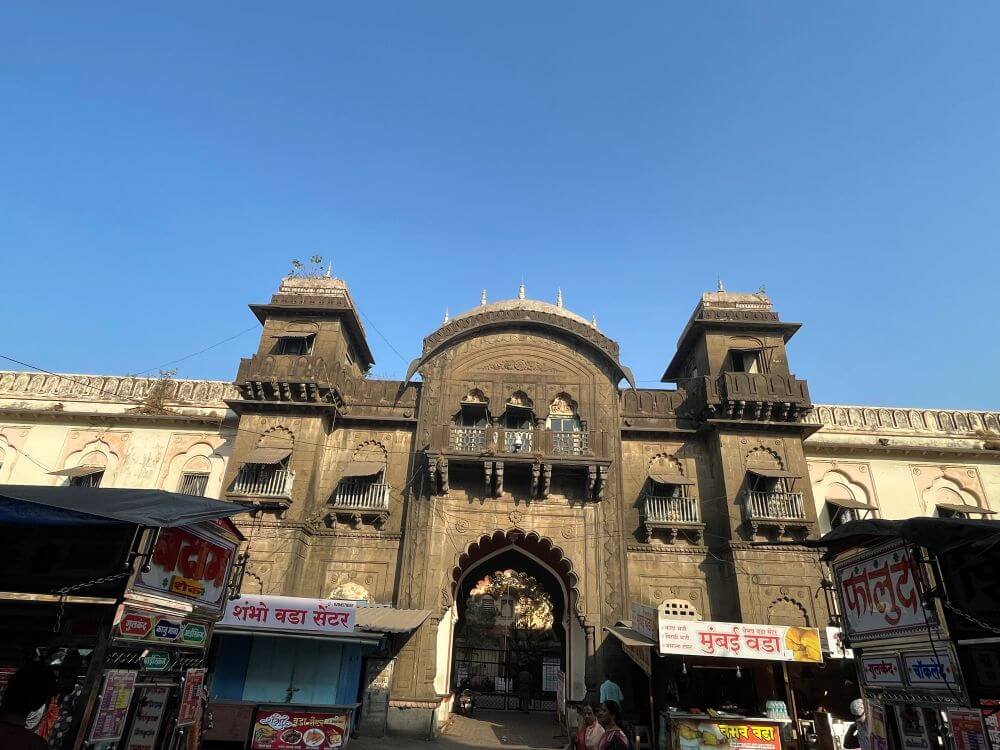
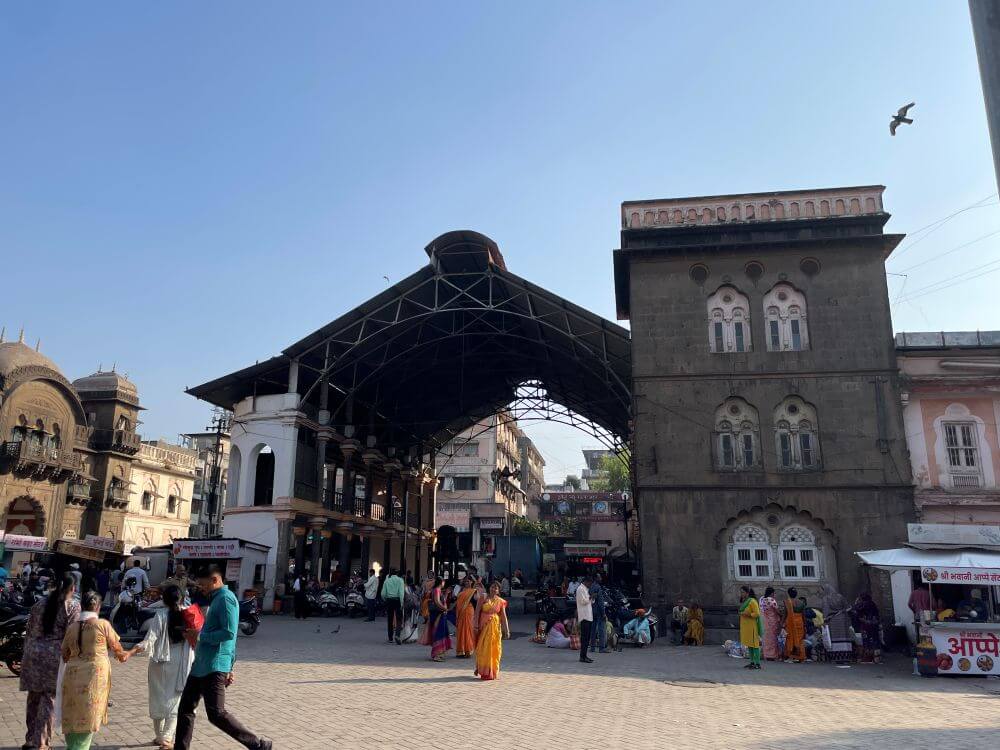
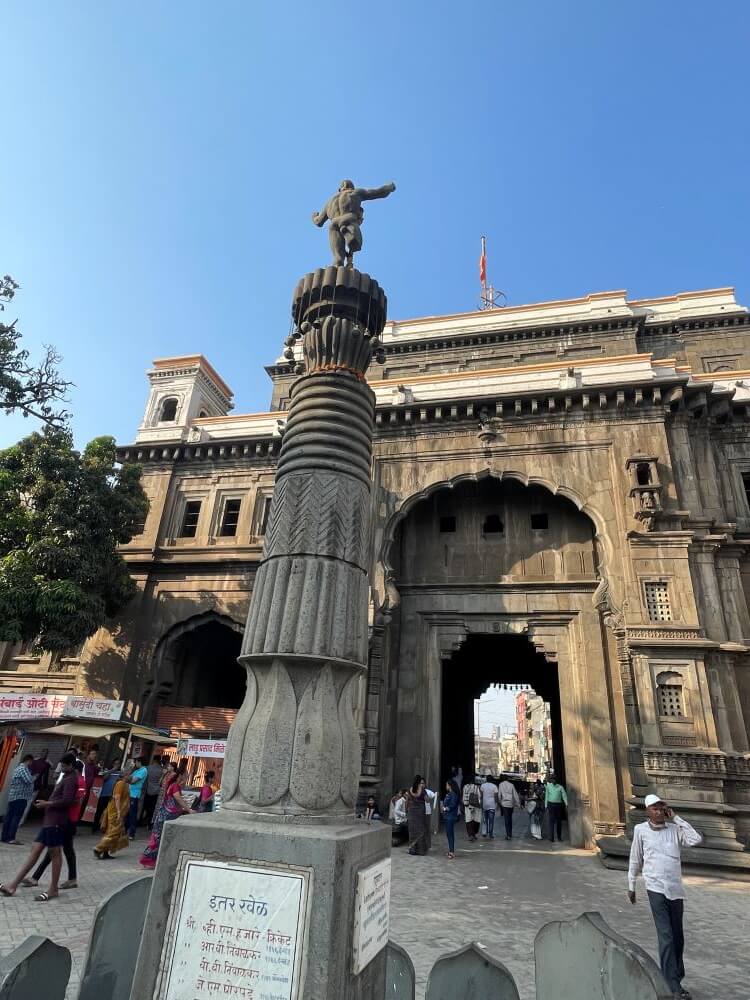
Within the precincts of the Old Palace, one finds the ancient five-storey Nagarkhana building, which serves as the main entrance, and the present-day Rajaram High School—both significant architectural marvels. Directly in front of the Nagarkhana stands a tall, circular, intricately carved stone pillar, known as the Kreeda Stambha, or Sports Pillar. This pillar was erected in memory of the athletes who have brought honour to Kolhapur in the realm of sports. A short distance further, one encounters the magnificent two-storey structure of the Bhawani Mandap.
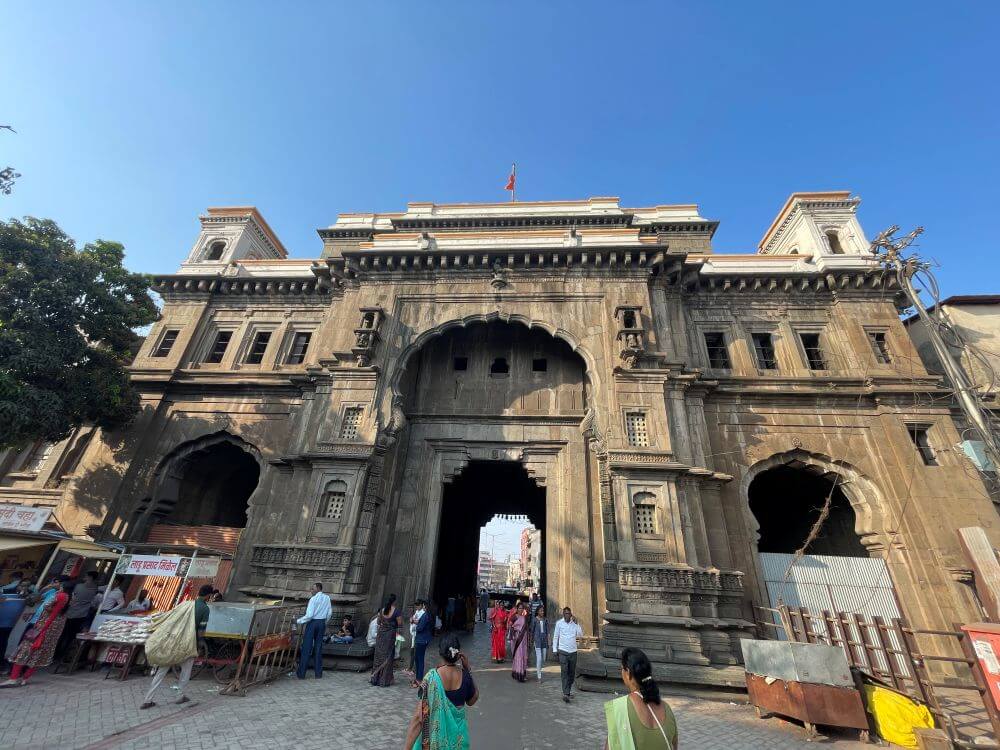
Outside the main hall, a very large and tall tin shed has been constructed, where the Devi’s chariot is reverently kept. The main eastern entrance to the hall is a three-storey high stone structure. Upon entering through this gate, one beholds a large central courtyard, flanked by spacious verandas. Beyond the courtyard area, the upper floors feature terraces. At the crossroads stand square stone pillars, surmounted by graceful wooden pillars, which in turn support a wooden archway adorned with intricate carvings.
Right before us is the Ambā Devghar, which is the sacred temple of Mother Bhavānī. Within the sanctum sanctorum, the divine murti of Tuljā Bhavānī is gracefully seated upon the Vajrapīṭha. Behind the murti, there is an intricately carved silver archway, a mahirap. Below the murti are the sacred images of Gaṇapati, Khaṇḍobā, Śrī Kṛṣṇa, Chhatrapati Śivājī Mahārāj, Śaṅkar-Pārvatī and Bālgaṇeś, as well as the Rāmapañcāyatan, Mahiṣāsuramardinī, Gaṇeś, Bālgaṇeś, Śaṅkha, and Bāṇa, all of whom are worshipped daily by the Chhatrapati royal family.
Additionally, there is a large silver imprint of Chhatrapati Śivājī Mahārāj’s hand (a silver pañjā) here. After the construction of Sindhudurg Fort was completed, an impression of Śivājī Mahārāj’s palm was taken in lime there. This very imprint was then made from that impression, and it too receives daily worship here.
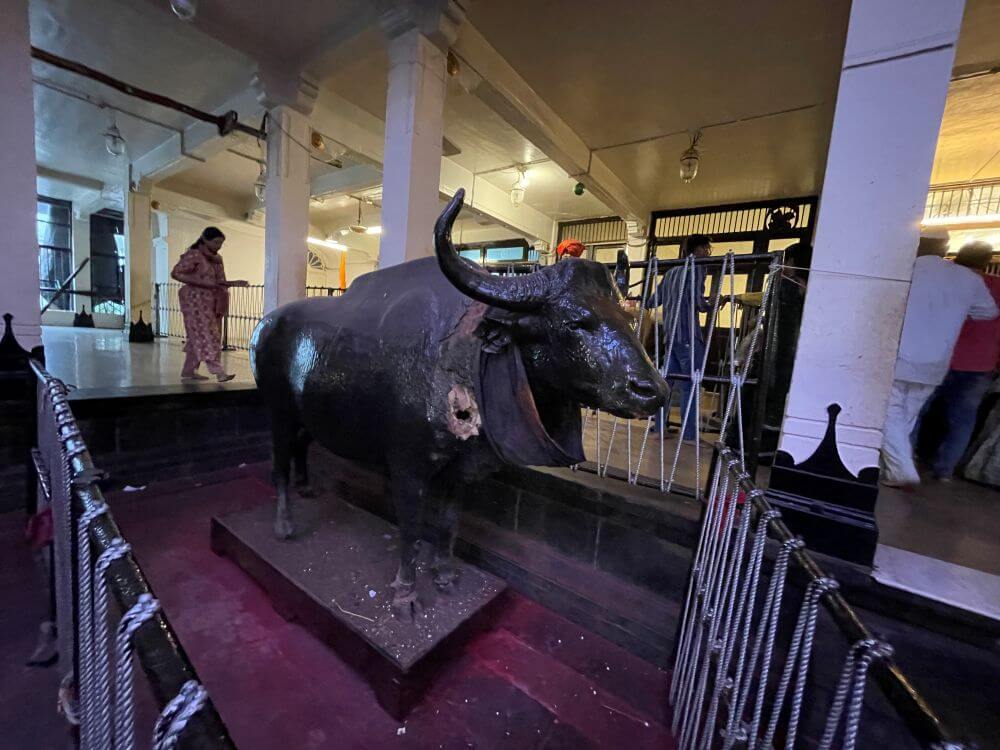
To the left, outside the main shrine, stands a life-size wooden statue of Chhatrapati Shahu Maharaj. Here, one can behold the gaur, leopard, and two deer that Shahu Maharaj hunted and had stuffed. During Navaratri, on the day of Ashtami and also on the day of the Nagarpradakshina (circumambulation of the city), the Utsavamurti (processional deity) of Karveer Nivasini Mahalaxmi-Ambabai arrives in a palanquin at this temple.
This sacred temple stands as a testament to deep spiritual devotion, ancient architectural grandeur, and rich local cultural traditions.
The sanctum sanctorum houses the divine idol consecrated according to ancient Vedic traditions, surrounded by serene courtyards and traditional temple architecture.

Navratri, Maha Shivratri, Annual Temple Jatra & Deepotsav
Compare and book flights, secure top-rated local hotels near the temple, hire reliable guides, and rent cars instantly.
Extend your pilgrimage by visiting other highly sacred temples located nearby.


Add ₹999 more to unlock FREE SHIPPING!
Your sacred cart is currently empty.
Shop Photo FramesFill in your delivery details below to place your order.
Add comment