
Add ₹999 more to unlock FREE SHIPPING!
Your sacred cart is currently empty.
Shop Photo FramesKalbhairav is the presiding deity (Gram-daivat) of Hindale, a village in Konkan associated with the Brahmin Samant royal dynasty. Kalbhairav is considered a Tantric deity and one of the Ashta-Bhairavas described in the Shaiva Agamas. According to lexicographers, the word ‘Bhairav’ means ‘fearsome’. It is also said that one of its meanings is ‘the protector from fear’. Bhairav is the fierce and formidable form of Lord Shiva himself. Kalbhairav is also known as the Kotwal (guardian) of Kashi. Papabhakshana, Amardaka, and Kalraja are his other names. There is an extremely ancient temple of Kalbhairav in the village of Hindale.
According to mythology, Kalabhairava originated from the wrath of Lord Shiva. Once, Lord Brahma insulted Shiva, which enraged Him. From the fire of that rage, the dark-complexioned Bhairava was born, and he severed the head of Brahma that had blasphemed against Shiva. However, this act resulted in the sin of Brahma-hatya (killing a creator). Despite visiting all the holy pilgrimage sites, he could not be absolved of this sin. Finally, he attained liberation from his sin in Kashi, where he placed Brahma’s head. The place where Kalabhairava placed the head is known as Kapalamochana Tirtha. In the Kalika Purana, it is narrated that due to Parvati’s curse, the Gana Mahakala was born in the form of Bhairava. He was born during the fourth watch of the night. Bhairava Jayanti, a sacred vow, is observed on the eighth day of the waning moon (Krishna Paksha) in the month of Kartika.
According to historians, the Kalbhairav Temple in Hindale is primarily associated with the history of the Samant dynasty. One of the oldest references to the village of Hindale is found in a Sanskrit copper plate dating back to 1436 CE. In the fifth to eighth lines of the first plate of this Sanskrit copper plate, known as the ‘Nagdev Copper Plate’, it is written: ‘काश्यपो देवशर्मेति ब्राह्मणो ब्रम्हवित्तमः यजुषां पारगो दांतः षटकर्मनिरतो भवत्। तुरुष्कोपप्लवात्तत्र कौंकणं समगादयं इंदुलाख्ये ग्रामवरे मुहू राज्ञां सभाजितः। राज्यश्रियं तदा लब्ध्वा कुणुकेश्वरवासिनः।’ This means, ‘… A Brahmin named Devasharma of the Kashyapa Gotra was foremost among those who knew Brahman, proficient in the Yajurveda, and deeply engaged in the six religious duties (Shatkarma). Due to an invasion by the Turushkas there (on the banks of the Janhavi), he migrated to the Konkan. In a prosperous village named Indul (present-day Hindale), the king honored him repeatedly. Later, having attained royal prosperity, he was blessed with a son by the grace of Lord Shankara of Kunakeshwar.’ The antiquity of Hindale village is evident from this inscription.
Devasharma, described in this copper plate, was the progenitor of the Adi-Gaudadeshiya Samanta clan in the Kudal region. Distressed by the invasions of the Sultan of Ghazni—the Turushkas—in North India, he migrated to Hindale. The Rane Kshatriyas of Hindale accompanied him. (The samadhi of this progenitor who arrived here is located in the Kalbhairav temple.) Devasharma was a follower of Shaivism. In the research monograph ‘Mathgavcha Shilalekh va Brahman Samant Rajvansh’, published in 1925 under the ‘Bharat Itihas Sanshodhak Mandal’ series, Vasudev Anant Bambardekar stated that Devasharma established his kingdom here. Subsequently, in his lineage, the great and valiant King Mang, also known as Mayindev, was born in the thirteenth century (1220 AD). He significantly expanded the kingdom. Towards the end of the fourteenth century, King Bhairavbhupati was born in this dynasty. According to the research of historian Bambardekar, Bhairavbhupati was a mighty warrior; the temple and the ghat at Hindale, as well as the Bhairavgad fort on the Sahyadri range near Digavale village, were built in his name. The Kalbhairav temple at Hindale was constructed in the name of this Brahmin Samanta king, Bhairavbhupati.
This temple is situated at a junction in the village of Hindale. The facade of the temple is built in a modern style. It features a two-story, open-style assembly hall (sabhamandap) with a sloping roof on both sides and stone seating benches (kakshasanas). This assembly hall is elevated a few feet above the ground. However, the true antiquity of the temple is revealed only after entering this hall. From here, one ascends three steps to enter the main and original assembly hall of the temple. On the front wall of this assembly hall, to the left of the entrance, there is an inscription. It reads, “Offered to the Deity by Ahmadkhan G. Agha (Hindale) and his family.” This is considered a symbol of social harmony in the village of Hindale.
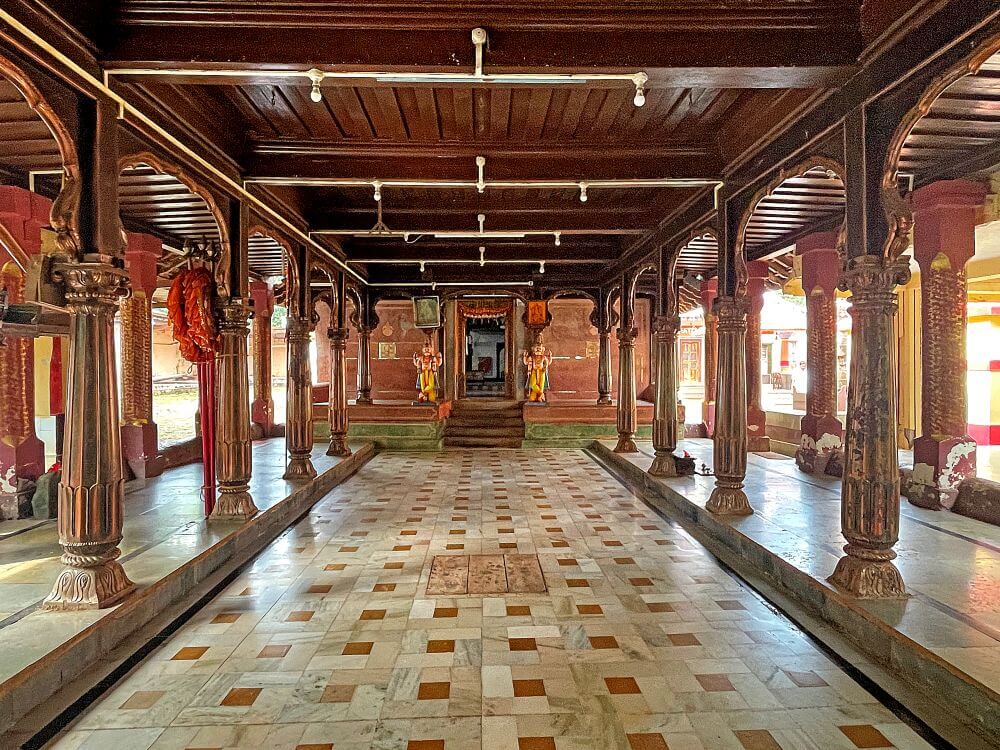
The main assembly hall (Sabhamandapa) of the temple is of an open-air design. It features circular stone pillars along the exterior. Inside, there are seven wooden pillars on both sides. The assembly hall is beautifully adorned with these carved, fluted pillars and the arched gateways that connect them. The ceiling is also lined with teak wood planks over the rafters. Upon entering this assembly hall, one can see the spacious temple courtyard. A boundary wall has been constructed around this courtyard. In this courtyard, there are four lamp pillars (Deepastambhas) each on the left and right sides of the assembly hall. At the base of the fifth pillar in the assembly hall is a square area known as the ‘Chau-Chavhata’. There is a stone placed there. Originally, this term is ‘Chaughachari’. This ‘Chavhata’ is the designated place for the entire village to perform Japa (chanting). It is believed in the village traditions of Konkan that this Japa is extremely powerful.
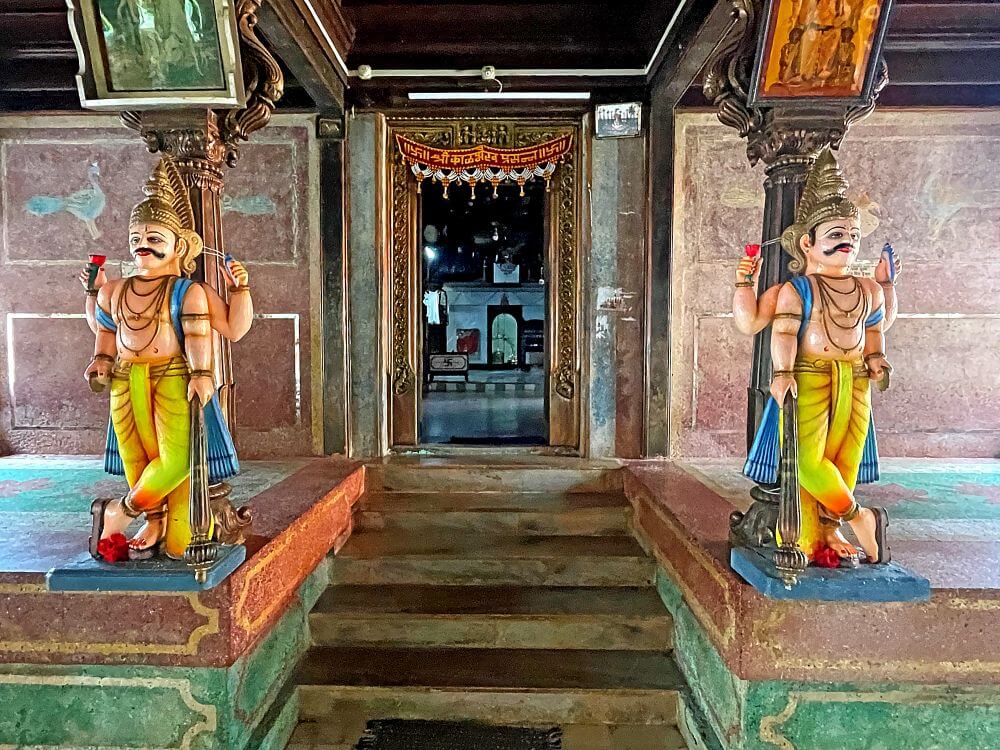
Beyond this, on a jagati (platform) several feet high, lies the antarala (vestibule) of the temple. On both sides of its entrance are tall statues of dwarapalas (gatekeepers). At the entrance The door frame is intricately carved, and an image of Lord Ganesha is sculpted at the lalatabimba (the central position of the lintel). On both sides of Ganesha are the images of his consorts, Riddhi and Siddhi. Upon entering the antarala (vestibule), one’s eyes are immediately drawn to the wooden pillars with their large circumference. These pillars are adorned with ghatapallava (vase and foliage) carvings, featuring beautiful floral patterns. The tarangahastas (bracket figures) at the top of the pillars are a magnificent example of the woodcraft of the Konkan region. These brackets not only feature floral and vine motifs, as well as elephants and serpentine forms, but also display miniature, yet highly expressive, carvings of Trimukhi Dattatreya, Sheshashayi Vishnu, Lakshmi, Brahma seated on a lotus emerging from Vishnu’s navel, Shri Rama, Hanuman, and Saraswati mounted on a peacock. One of these brackets depicts an elephant being swallowed by a crocodile, which serves as a poignant reminder of the mythological legend of Gajendramoksha.
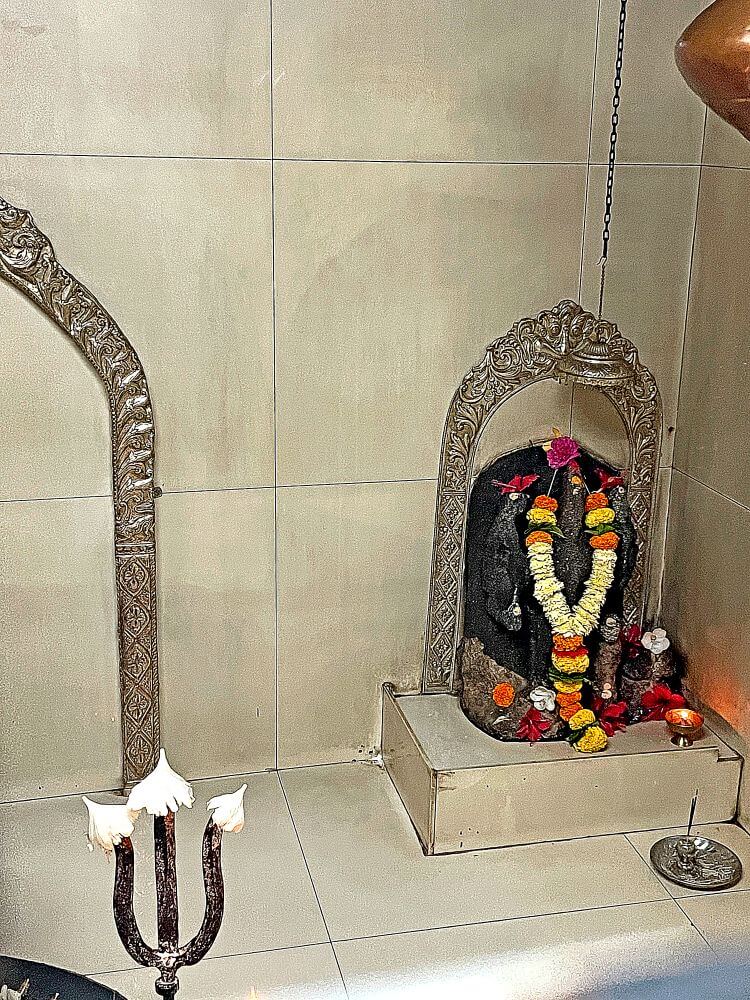
Directly in front is the sanctum sanctorum (Garbhagriha), which has been renovated with marble tiles. There is a circumambulation path (Pradakshina Marg) around the sanctum. Inside, on the ground level, is the Shivling. Behind it, in the corner on a small pedestal, is the stone idol of Bhairavi. It is significant that there is a Shivling here instead of an idol of Kaal Bhairav. According to the local villagers, this is an important site after Kashi where a Shivling is worshipped instead of an idol in a Kaal Bhairav temple.
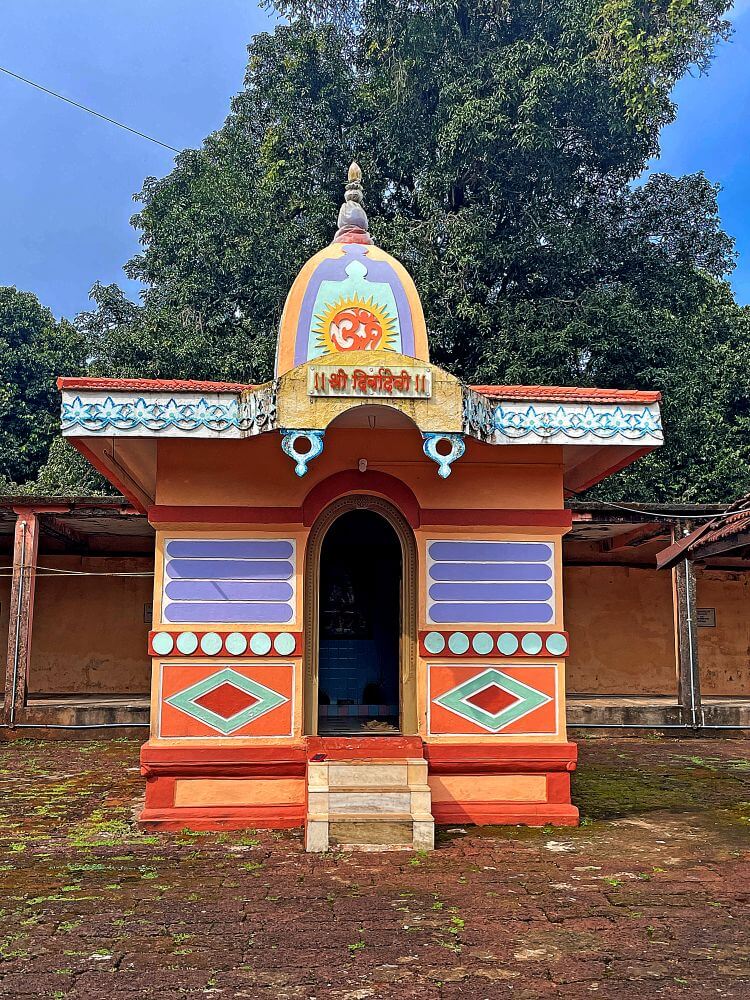
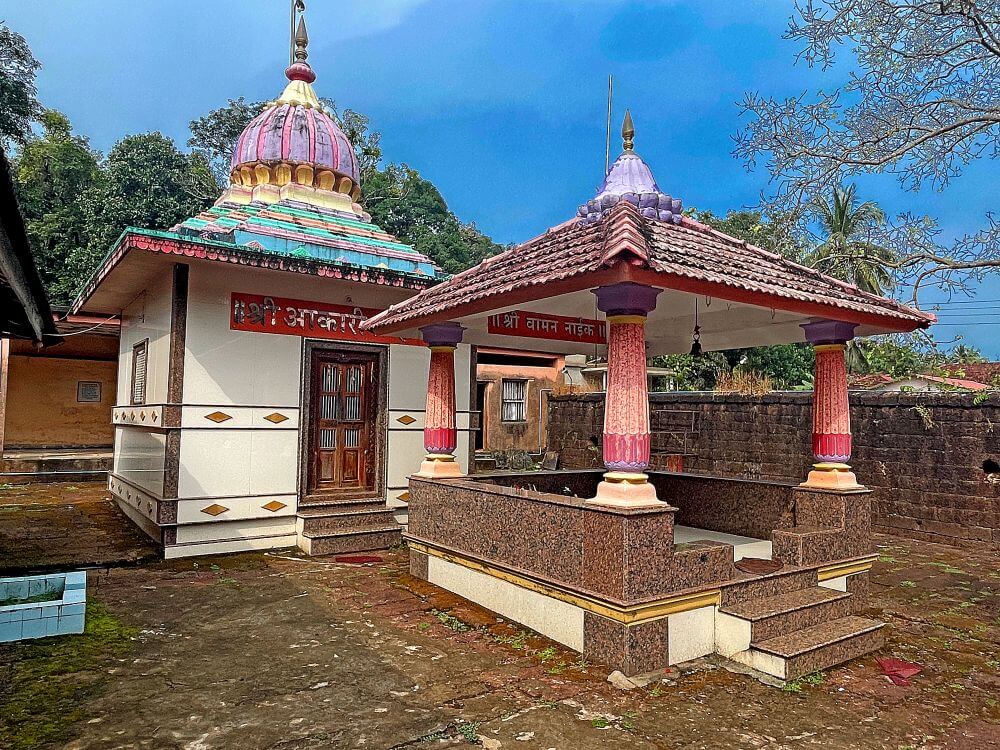
In the large courtyard of the temple, there are shrines dedicated to Akari Brahman and Dirbadevi. In this same courtyard, there are also shrines (chale) dedicated to the ancestral deities (grandfathers), Dev Churmur. In front of the Akari Brahman temple, there is a mandapa built on a high platform. In this mandapa, which bears a plaque reading ‘Shri Vaman Naik’, a Shiva Linga with highly unique carvings and shape has been consecrated. Beside this Shiva Linga stands a beautifully carved Sati Shila (memorial stone). On the lower side of this stone, three arms bent at the elbow are depicted, which makes it clear that this is a memorial stone for three Satis. To the left of the assembly hall (sabhamandapa), there are similar Sati Shilas in one place. Some of them are broken, while one stone has eroded. It is said that in the past, many samadhis and Sati Shilas could be seen in the vicinity of this temple.
The legend regarding these Sati Shilas is that after 1570, when the Bahmani Shah conquered the South Konkan, Muslim rule was established in Hindale village. A few years later, a Maratha clan named Rane, also known as Rawal, established themselves here. Once, a battle took place between these Ranes and a Muslim commander in the fields of Hindale. Many Maratha soldiers were killed in this battle. Historians state that these are the Sati Shilas of the wives of those soldiers who committed Sati. During this battle, the wife of the Brahmin priest of the Bhairav temple cleverly saved a pregnant woman of the Rane family. Because of this, the Rane lineage survived. The son born to this woman grew up to be a great warrior. He renovated the temple of Bhairav Dev, the presiding deity of the woman who saved him from death while he was in the womb. His subsequent descendants expanded this temple and gave it its present form. The memory of this battle has been preserved by the elderly villagers here. It is also said that this village is the ancestral home of Bhairav Mehendale, the brother-in-law and representative of Peshwa Balaji Vishwanath. The Appa Balwant Chowk in Pune today is named after Sardar Appa Balwant Mehendale of this same Mehendale family.
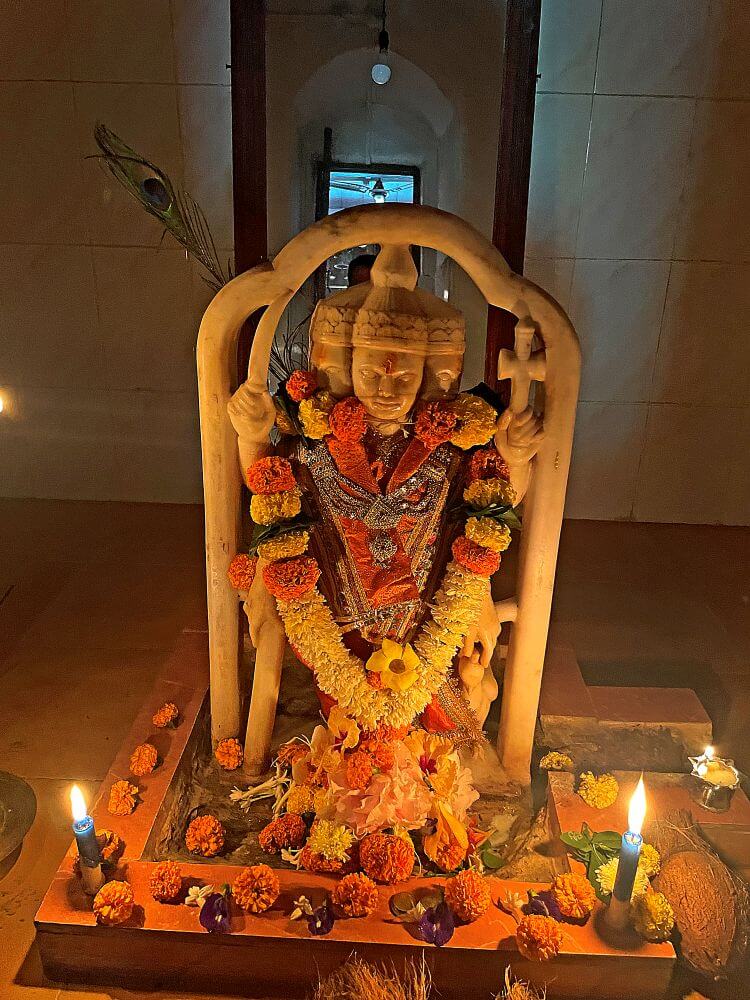
Along with Kalbhairav, another deity of the Shaiva family in Hindale village is the temple of Kartik Swami. Kartikeya, known as Murugan or Subramanyam in the southern states, is the elder brother of Ganesha according to mythology. It is customary for Kartikeya to be installed in a forest, preferably away from human settlements. Accordingly, this charming temple is located at some distance from Hindale village. In this temple, there is a marble idol of Kartikeya holding weapons. Since Kartikeya is a Brahmachari (celibate), women are traditionally prohibited from entering his temple. A grand festival is celebrated in this temple on Tripurari Purnima. On that day, however, women are allowed to enter the temple for a few hours to have darshan of Kartikeya. Near this temple, there is also a temple of Vitthal-Rakhumai.
This sacred temple stands as a testament to deep spiritual devotion, ancient architectural grandeur, and rich local cultural traditions.
The sanctum sanctorum houses the divine idol consecrated according to ancient Vedic traditions, surrounded by serene courtyards and traditional temple architecture.
Navratri, Maha Shivratri, Annual Temple Jatra & Deepotsav
Compare and book flights, secure top-rated local hotels near the temple, hire reliable guides, and rent cars instantly.
Extend your pilgrimage by visiting other highly sacred temples located nearby.


Add ₹999 more to unlock FREE SHIPPING!
Your sacred cart is currently empty.
Shop Photo FramesFill in your delivery details below to place your order.
Add comment