
Add ₹999 more to unlock FREE SHIPPING!
Your sacred cart is currently empty.
Shop Photo FramesIn the picturesque Konkan region, within the Sindhudurg district, lies the village of Kotkamate, blessed with historical and spiritual significance. Here stands the renowned temple of Devi Bhagavati. Nestled amidst hills on all sides and a perennial river, this temple, rich in natural beauty, is one of the awakened shrines of Konkan. This sacred site, renovated by Sarkhel Kanhoji Angre, remains one of the existing Devsthan Inams (endowments). Even today, the Navratrotsav of Devi Bhagavati, known for rushing to the aid of Her devotees, is celebrated with a royal grandeur befitting a princely state.
The legend of Devi Bhagavati recounts that Devi Pavnai, situated to the right in the sanctum sanctorum, was formerly the village deity of Kotkamate. One day, Devi Bhagavati came to visit Devi Pavnai. After much conversation, Devi Bhagavati said to Devi Pavnai, ‘I have come all this way to meet you, yet you did not even offer me water.’ Thereupon, Devi Pavnai went to fetch water from the well in the temple courtyard. At that moment, Devi Bhagavati sat on Devi Pavnai’s vacant seat. After some time, Devi Pavnai returned with water and inquired, ‘Where shall I sit now?’ To this, Devi Bhagavati replied, ‘Sit to my right.’ Since then, Devi Bhagavati became the village deity of Kotkamate.
The history of Kotkamate village reveals that Sarkhel Kanhoji Angre, the chief of the Maratha navy and self-proclaimed king of the Konkan coast, constructed a ground fort in this village, situated between the mahals of Devgad and Salshi. Due to this fort, the village of Kamate came to be known as Kotkamate. Even today, the remnants of the bastions and ramparts of this ground fort can be seen here. In those times, Kanhoji was constantly engaged in struggles with the English and Portuguese, who held great power over the seas. Kanhoji’s navy obstructed the unrestricted movement of the English along the western coast. The fort of Vijaydurg was under Angre’s control. The English, with their mighty fleet, attacked Vijaydurg in the year one thousand seven hundred and seventeen; however, Angre inflicted a crushing defeat upon them. Subsequently, the English and Portuguese united and attacked Kulaba in November of the year one thousand seven hundred and twenty-one. At that time, Bajirao Peshwa arrived with his army to assist Angre, striking fear into the hearts of the English and Portuguese, who then entered into a treaty with Angre. This treaty was concluded on the ninth of January, in the year one thousand seven hundred and twenty-two. In this manner, Angre had established his authority over both the English and the Portuguese. There is a legend that during this war, Kanhoji Angre made a vow to Devi Bhagavati of Kotkamate village, saying, ‘If I am victorious, I will build a grand temple for You and grant the village as an Inam to the Devsthan.’ Accordingly, he renovated this temple in the year one thousand seven hundred and twenty-five. An inscription mentioning this can still be seen in the temple today. It reads as follows: ‘Shri Bhagavati. Shri. Machhak Shodash Shat Satpachatvarinshat Madhik Samvachhar Vishvat Sunma. Subhe Tam Sthich Chhare Angare Kanhoji Sarkhel Shrimatkamay Devi Devalay Makaroditi Jana Tu Jano Bhavishya Man. One. One thousand six hundred and forty-seven.’ Although other personal Inams and princely states across the country were abolished over time, the Inam of Kotkamate village continues to this day. On the seven-twelve extract of every land parcel in this village, the stamp of ‘Inamdar Shri Bhagavati Devi Sansthan Kotkamate’ is still present as the principal occupant. The name of the temple trust is also ‘Inamdar Shri Bhagavati Devi Sansthan’.
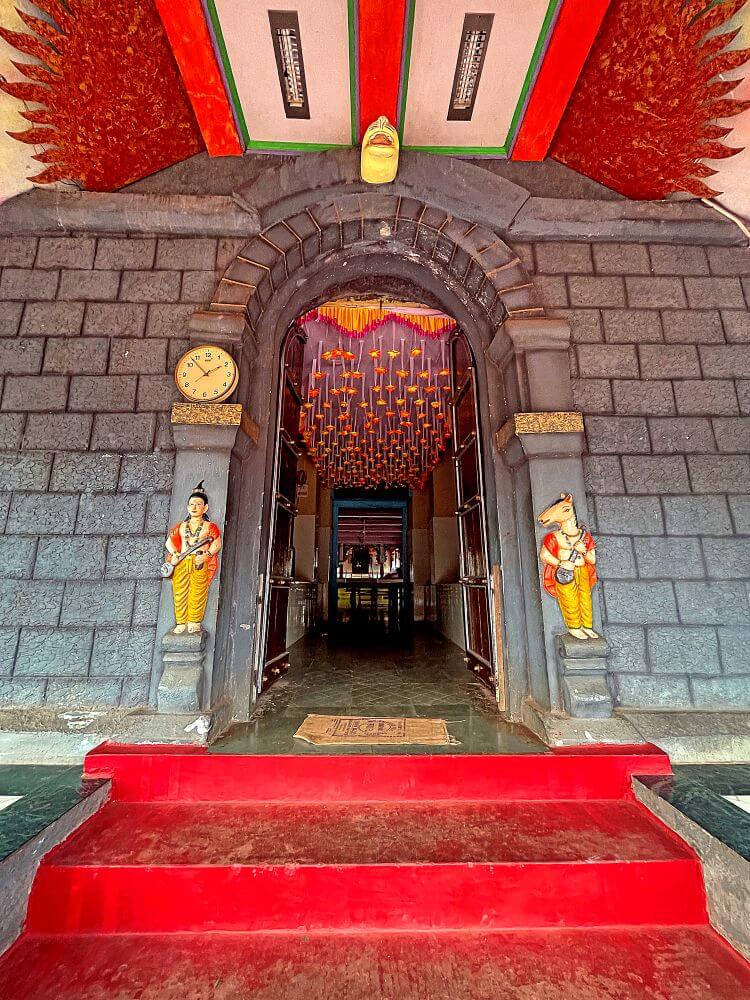
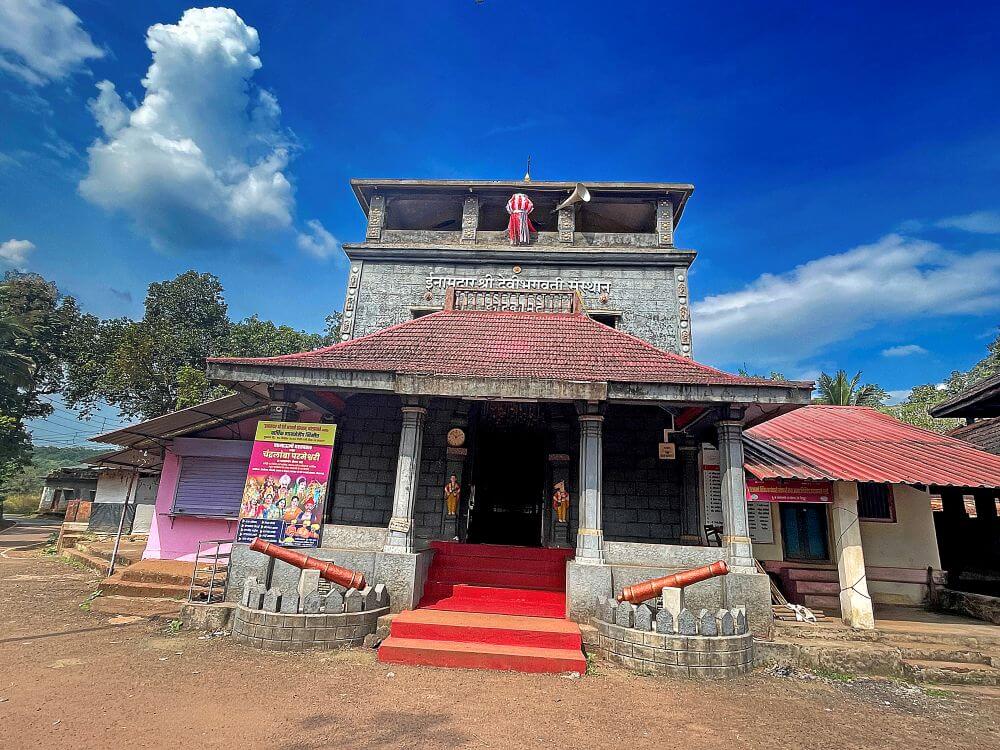
The Bhagavati Devi temple complex in this charming village, nestled in the lap of nature, is peaceful and serene. On the platform in front of the Bhagavati Devi temple, there is a fierce idol of a lion, the mount of the Goddess. Behind this idol, there is a cannon. Nearby, on a small platform, stands a tall, wooden dhalkathi for hoisting the Goddess’s banner. On both sides of the temple’s entrance steps, there are two cannons. The temple’s entrance features a Dindi gate, similar to the entrance of a fort. It has a two-story structure. On the upper floor is the Nagarkhana (drum house). This entrance is adorned with beautiful colored sculptures of Narada and Tumbara playing the Veena.
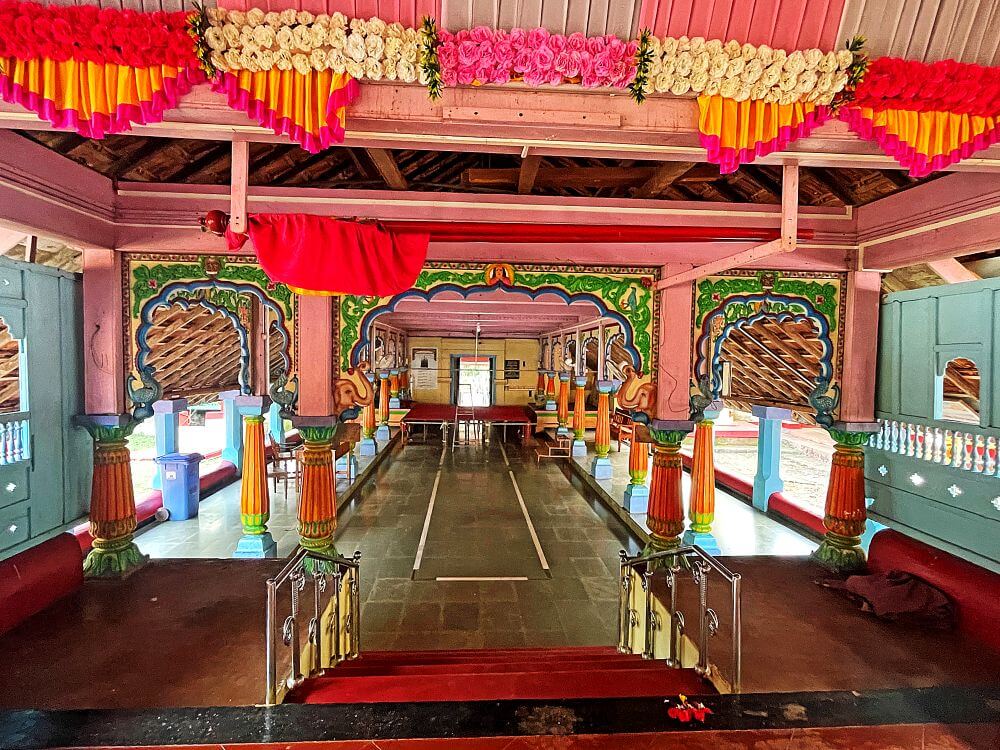
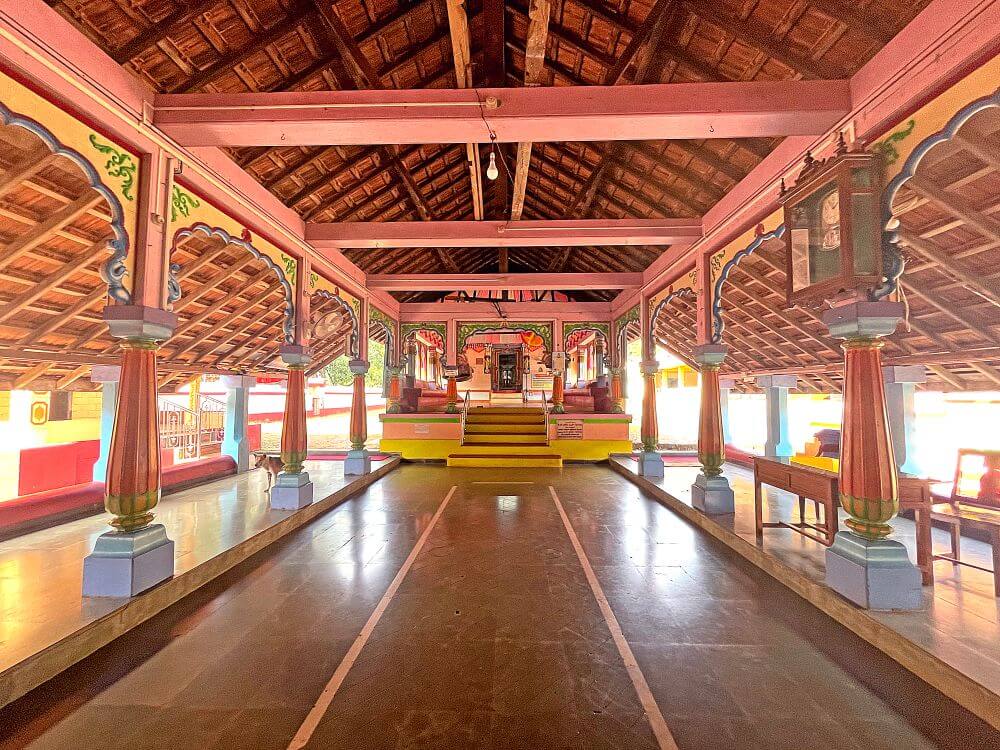
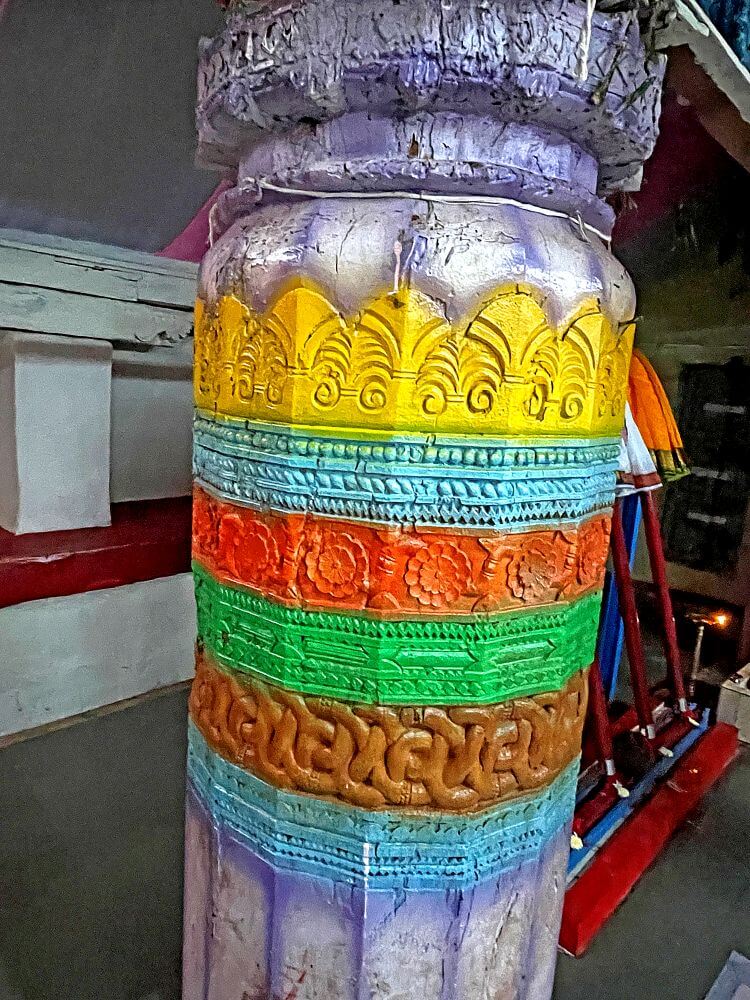
Upon entering through the main gate, one steps into the spacious assembly hall of the temple. This entirely open-plan assembly hall features elegant, man-height, carved pillars. Above them are square, carved wooden pillars, connected to each other by wooden arched mihrabs. These arches are adorned with leaf and flower motifs, as well as peacocks. The arches on the facade of the second assembly hall are carved with Gajmukhas (elephant faces).
From this assembly hall, a flight of five or six steps leads to the second assembly hall (Gopuram). This assembly hall is semi-open and has stone benches on the sides for devotees to sit. The palanquin of the Goddess is kept in this assembly hall. This large palanquin is beautifully carved. The legs of the palanquin resemble the legs of a lion, the mount of the Goddess.
Near the walls of the doorway leading from the Gopuram to the Antarala (vestibule), there is an inscription. It mentions Kanhoji Angre’s renovation of this temple. The lintel of the Antarala doorway features attractive carvings. On both sides of this entrance are captivating standing idols of Ganesha. A Ganesha idol is carved on the Lalatabimba (central part of the lintel) of the entrance, flanked by Riddhi and Siddhi. The Antarala has six large wooden pillars. The circumference of these pillars is barely enough for two people to embrace. These pillars are adorned with beautiful wooden sculptures of Kartikeya, as well as Ganesha and His devotees and attendants. At the top of the pillars is a series of Naga images. On the Kadipata (inner wooden part of the ceiling) of the Antarala, the wooden rafters are carved with designs, and in the spaces between them are lotus flowers with pointed inverted kalashas (finials) embedded. On the left side of the Antarala are four Tarangadevatas (wave deities). The Garbhagriha (sanctum sanctorum) houses a neat and well-defined idol of Devi Bhagavati carved in black stone. Above this idol, two Gajrajas (royal elephants) are carved, showering flowers upon the Goddess. The Goddess holds a Khadga (sword) in Her right hand. On both sides of the idol are Jaya and Vijaya.
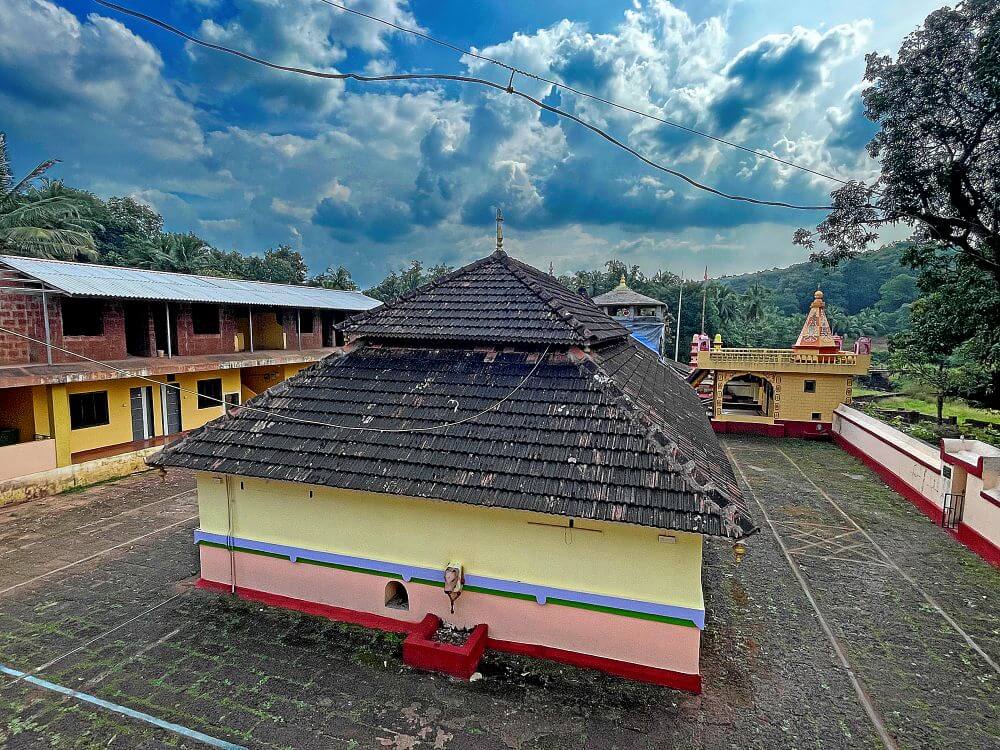
Adjacent to the main temple is the temple of Devi Pavnai. It contains a marble idol of the Goddess. Nearby, there is a well, and next to it are a Dharmashala (pilgrim’s rest house) and the priest’s residence. Behind the temple are the temples of Rameshwar and Jateshwar.
Throughout the year, this sacred temple celebrates a variety of festivals. On the new moon day of the ज्येष्ठ month, the annual festival known as ‘देसरुढ’ is observed. The Bhavai Devi festival takes place from आषाढ शुद्ध त्रयोदशी to आषाढ पौर्णिमा. An unbroken Hari Naam Saptah is held here from श्रावण कृष्ण प्रतिपदा to श्रावण कृष्ण अष्टमी. On अष्टमी, the birth of Shri Krishna is celebrated, concluding the following day with Dahikala. On Ganesh Chaturthi, the men of the temple perform fugadi. Navratrotsav is the principal festival here. This Sharadiya Navratrotsav is celebrated with royal grandeur from अश्विन शुद्ध प्रतिपदा to Vijayadashami. During this period, silver armour is adorned upon the Devi. The Devi’s palanquin is also embellished with silver ornaments.
During this festival, the Kakad Aarti is performed at five o’clock in the morning. Thereafter, following the Shodashopachari Puja of the Devi, the temple opens its doors for devotees to have Darshan. At नौ o’clock in the morning, there is Shehnai playing, at दश o’clock, a classical music concert, at चार o’clock in the evening, Shehnai playing once more, and at पाच o’clock, another classical music concert. Subsequently, devotional bhajans and discourses are held in the temple until नौ o’clock at night. Following this, the Devi’s palanquin proceeds outside the temple for circumambulation. Thereafter, Kirtan and, finally, the Devi’s Sanchar (divine presence) programmes take place. On अष्टमी, the Devi, having manifested Her Sanchar, visits the homes of the villagers. On Navami, a Homa is performed in the temple. On the same day, Mahaprasad is offered. On Vijayadashami, the crossing of the border (Simollanghan) and the ‘looting of gold’ (Sone Lutne) ceremony, accompanied by the Sanchar of four deities, takes place. During Navratrotsav, the honour of playing the Shehnai belongs to the Muslim community. This tradition, passed down through generations, is still observed today. On Tripurari Pournima, a festival of lights (Deepotsav) is celebrated by lighting earthen lamps around the temple premises. The ritual of appeasing the border-protecting deities or the programme of the village deity visiting the homes of the dignitaries is known as Dalap in the Gavrhati dialect of Konkan. Here, in the पौष month, a triennial festival named ‘Dalap Swari’ is celebrated.
This sacred temple stands as a testament to deep spiritual devotion, ancient architectural grandeur, and rich local cultural traditions.
The sanctum sanctorum houses the divine idol consecrated according to ancient Vedic traditions, surrounded by serene courtyards and traditional temple architecture.
Navratri, Maha Shivratri, Annual Temple Jatra & Deepotsav
Compare and book flights, secure top-rated local hotels near the temple, hire reliable guides, and rent cars instantly.
Extend your pilgrimage by visiting other highly sacred temples located nearby.


Add ₹999 more to unlock FREE SHIPPING!
Your sacred cart is currently empty.
Shop Photo FramesFill in your delivery details below to place your order.
Add comment