
Add ₹999 more to unlock FREE SHIPPING!
Your sacred cart is currently empty.
Shop Photo FramesAccording to the Puranas and Upanishads, Shripad Shrivallabh is considered the first avatar of Dattatreya. Narasimha Saraswati is the second avatar. Narasimha Saraswati prioritized the Varnashrama Dharma for the revival and protection of the Vedic tradition. Following him, great personalities such as Janardan Swami, Eknath, Dasopant, Mukteshwar, Niranjan Raghunath, Manik Prabhu, and Swami Samarth of Akkalkot continued the tradition of the Datta Sampradaya. One name in this lineage is that of Vasudevanand Saraswati Tembe Swami. Mangaon in Kudal Taluka is his birthplace. The Datta Mandir established here by Vasudevanand Saraswati is famous.
Three years before the first war of independence against British rule began in the country, Vasudevanand Saraswati Tembe was born on Shravan Krishna Panchami in the year 1854 AD. His father, Ganesh-bhatt, had gone to Gangapur and worshipped Dattatreya for twelve years. Once, he had a vision of Dattatreya. Dattatreya told him, “You continue your householder life; I will be born in your home as your son.” Thereafter, Ganesh-bhatt returned to Mangaon and was blessed with a son. Vasudevanand carried forward the legacy of Datta-bhakti inherited from his father. He frequently visited and stayed at Narasimhawadi. It was there that he received the grace of Narasimha Saraswati and was commanded to go to Mangaon and establish a Datta Mandir. While coming to Mangaon, a metal caster in Kagal gave him a Datta idol. With the help of the villagers, he built a small Datta Mandir in Mangaon within eight days. He consecrated the Datta idol there on Vaishakh Shuddha Panchami in 1883 AD. Later, on May 12, 1938, Shrimant Maharani Indirabai Holkar renovated this temple.
The history behind this is that Maharani Indirabai was the second wife of Shrimant Maharaj Tukojirao Holkar III. She was the daughter of Mukundrao Talcherkar, a senior government officer in Mumbai. When she was 17, her marriage was arranged with the Prince of Indore, Tukojirao. However, Tukojirao then went to England. After six months had passed without any inquiry from there, Talcherkar became worried. He went to Narasimhawadi and showed Indira’s horoscope to Vasudevanand Saraswati Tembe Swami Maharaj. The Maharaj stated that there was no ‘Rajyoga’ (royal fortune) in her horoscope. Everyone became anxious. Upon this, Vasudevanand Saraswati gave Indira a mantra and asked her to chant it. As a result, within a month, in 1913 AD, Indira was married to Tukojirao. From then on, Indira-bai Holkar became a staunch devotee of Vasudevanand Saraswati. She often visited Mangaon to offer her services. During the renovation of the Mangaon Datta Mandir, she had the idols of Datta Maharaj, Devi Saraswati, Adi Shankaracharya, and Vasudevanand Saraswati consecrated by the hands of P. P. Brahmanand Swami of Kashi. In later times, the work of renovating this temple was gradually carried out by the Board of Trustees. There is a record that the golden pinnacle on this temple was donated by Nandodkar Swami.
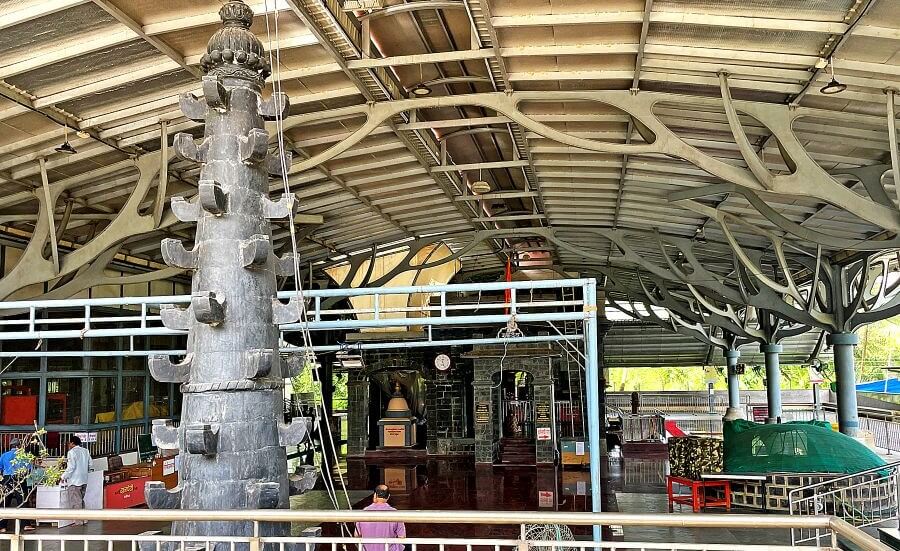
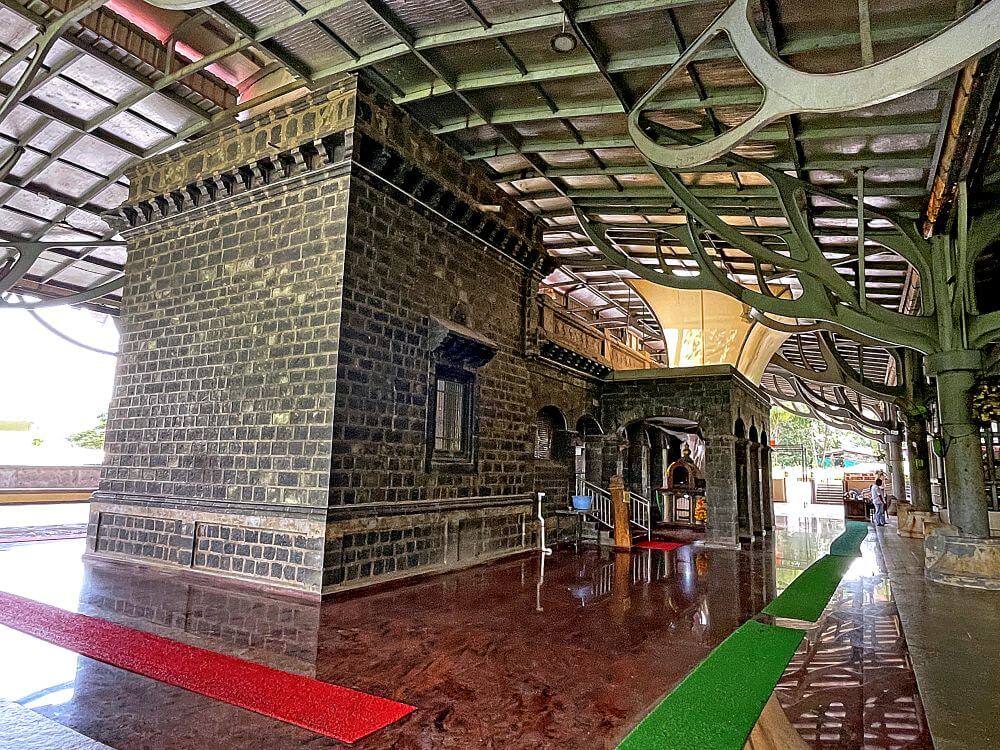
This Datta Mandir is situated in a large courtyard at the foothills of a mountain in Mangaon. This temple is also known as the Math of Vasudevanand Saraswati Tembe Swami Maharaj, who gave the mantra ‘Digambara Digambara Shripad Vallabh Digambara’. Upon arriving here, the first thing one sees is a spacious open pavilion with a tin roof and a cylindrical building in front of it. This is the Samadhi Mandir of Nandodkar Swami, which has a cylindrical sanctum on a circular base and a small square assembly hall in front. A small idol of Nandodkar Swami is consecrated here. A large photograph of him is placed right beside it. The pillars on both sides of the grand pavilion covering the Datta Mandir are very unique. They are designed to be round at the bottom and branch out into many parts at the top. This gives them the appearance of a leafless tree. Outside this pavilion, on one side, are the Math office and the dining hall, while on the other side, at some distance, is the Bhakta Niwas (pilgrim accommodation) building.
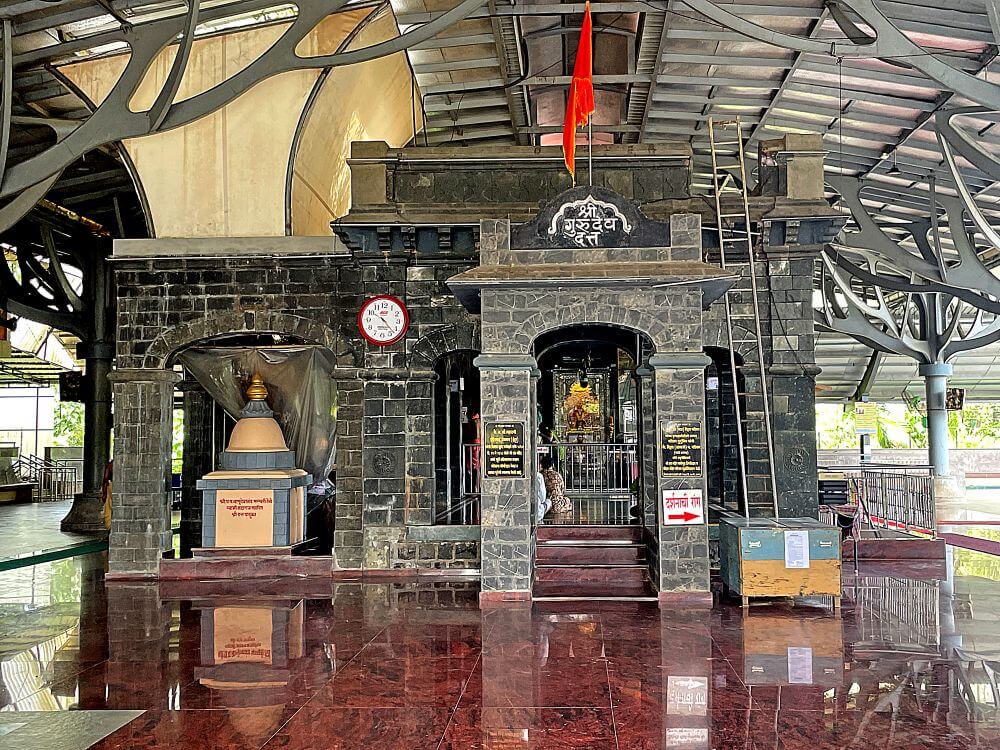
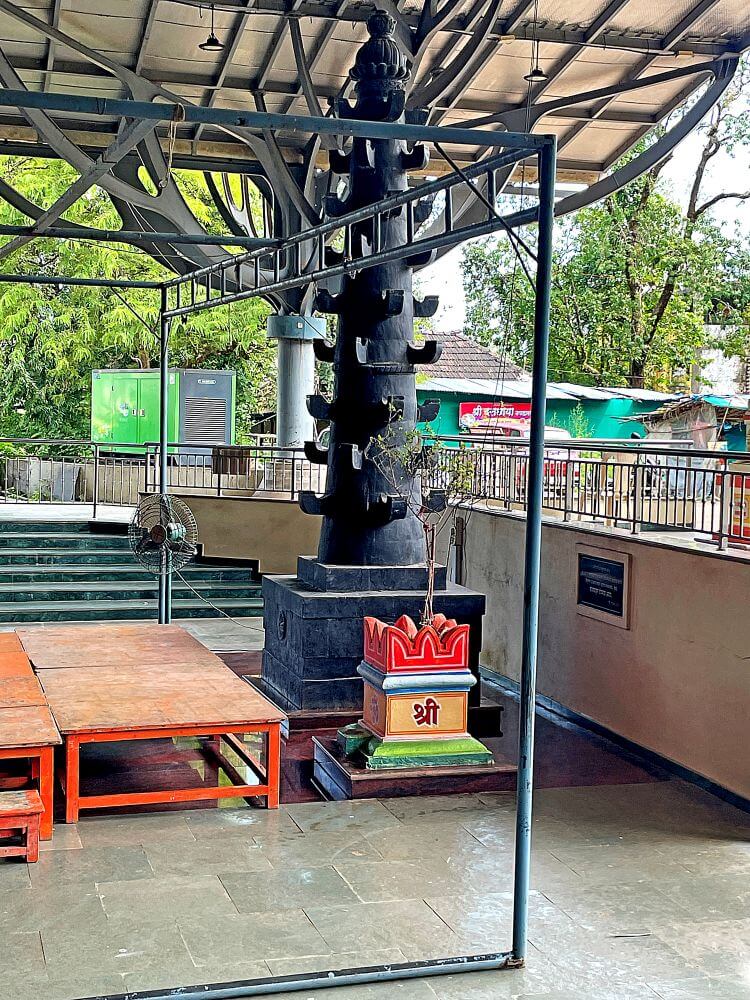
Devotees enter the queue for darshan after washing their face, hands, and feet. A tap facility has been provided for this purpose. In the pavilion, at a distance from the temple, stands a stone lamp pillar (Deepmal). Adjacent to it is a small Tulsi Vrindavan. Inside, on one side, there is a well built with stone masonry. It is said that this well was also renovated by Maharani Indirabai Holkar. Inside the pavilion is the temple of Gurudev Datta. This temple is built entirely of stone. It reflects the colonial architectural style. The structure resembles a stone bungalow and is composed of a porch (Mukhamandap), an assembly hall (Sabhamandap), an intermediate chamber (Antarala), and the sanctum sanctorum (Garbhagriha). This temple does not have a spire (Shikhara). It has a flat roof. The temple’s porch is of the same type found in colonial buildings. On both sides of this porch are two wooden pillars consecrated by Tembe Swami. Devotees believe that touching these pillars dispels any kind of affliction. From here, one climbs four steps to enter the assembly hall. The assembly hall is open in design. The stone pillars of the hall are connected to each other by arches. There is an idol of Ganesha in the assembly hall. The intermediate chamber has a glass wall. In a glass cupboard on the wall here, there is a standing idol of Vasudevanand Saraswati Tembe Swami.
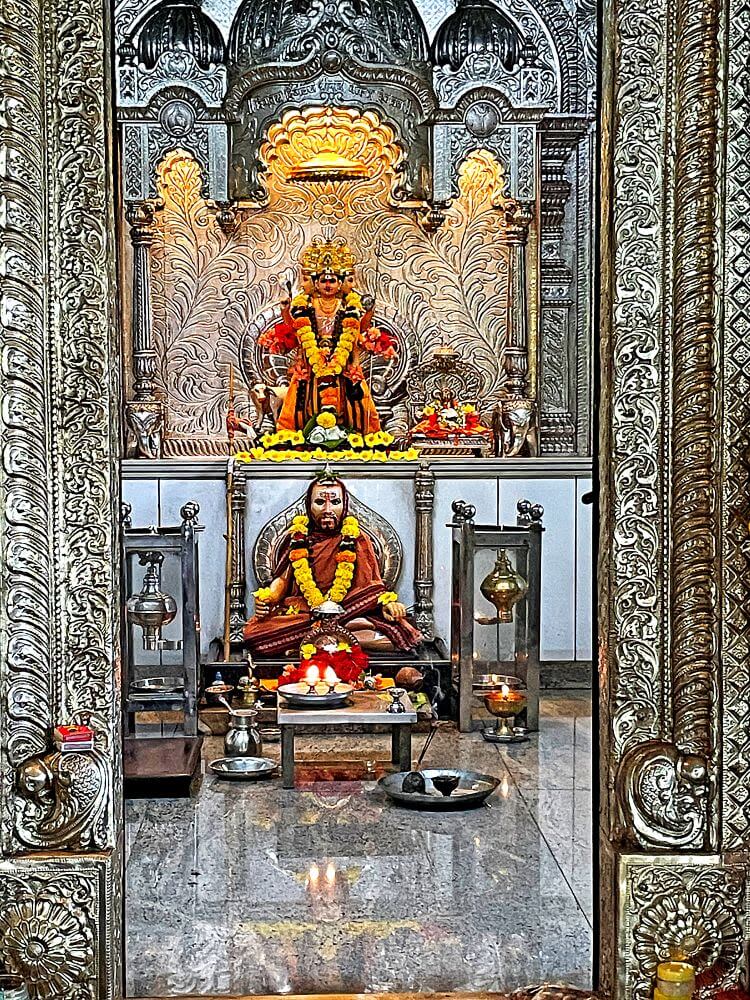
In the sanctum sanctorum, on a pedestal inside a large shrine, is a marble idol of the three-faced Dattatreya. On a low table (Chaurang) near the pedestal below the Datta idol is an idol of Vasudevanand Saraswati Tembe Swami sitting in the Siddhasana posture. The pillars of the shrine, as well as the arch (Makhar) behind the Datta idol, are covered with silver sheets. Furthermore, this silver sheet is decorated with intricate carvings. The sanctum also houses the Utsava-murti (processional idol) from the Swami’s time, as well as idols of Adi Shankaracharya and Saraswati. Adjacent to the assembly hall of the temple, in a small niche within a stone pavilion, are the Datta-padukas (footprints) established by Tembe Swami. In front of them is an Audumbar tree that has been there since ancient times. Its unique feature is that, like the three faces of Datta, this Audumbar has three branches. Near the dining hall close to this temple, there is another Audumbar tree, which also has three branches emerging from its trunk.
In the Dattatreya tradition, the Audumbar tree holds a position of great significance. Audumbar refers to the cluster fig tree. It is a firm belief that wherever this tree exists, Lord Dattatreya resides there. According to the mythological legend regarding this tree, when Lord Vishnu took the Narasimha avatar, He tore open the stomach of King Hiranyakashipu and slew him. Thereafter, the poison from Hiranyakashipu’s stomach caused a burning sensation in the claws of Lord Narasimha. At that time, Mother Lakshmi advised Him to insert His claws into the fruits of the Audumbar tree. This remedy alleviated the burning sensation. Lord Vishnu then blessed the Audumbar tree, granting it the boon that it would always bear fruit and become famous as the Kalpavruksha (the wish-fulfilling tree). According to another legend, the wooden pillar from which Lord Narasimha emerged to slay Hiranyakashipu eventually sprouted leaves and transformed into the Audumbar tree. The Dattatreya incarnation, Shripad Shrivallabha and Narasimha Saraswati, used to sit under the Audumbar tree and perform worship of the Narasimha Mantra. There are two such Audumbar trees near the Dattatreya temple in Mangaon.
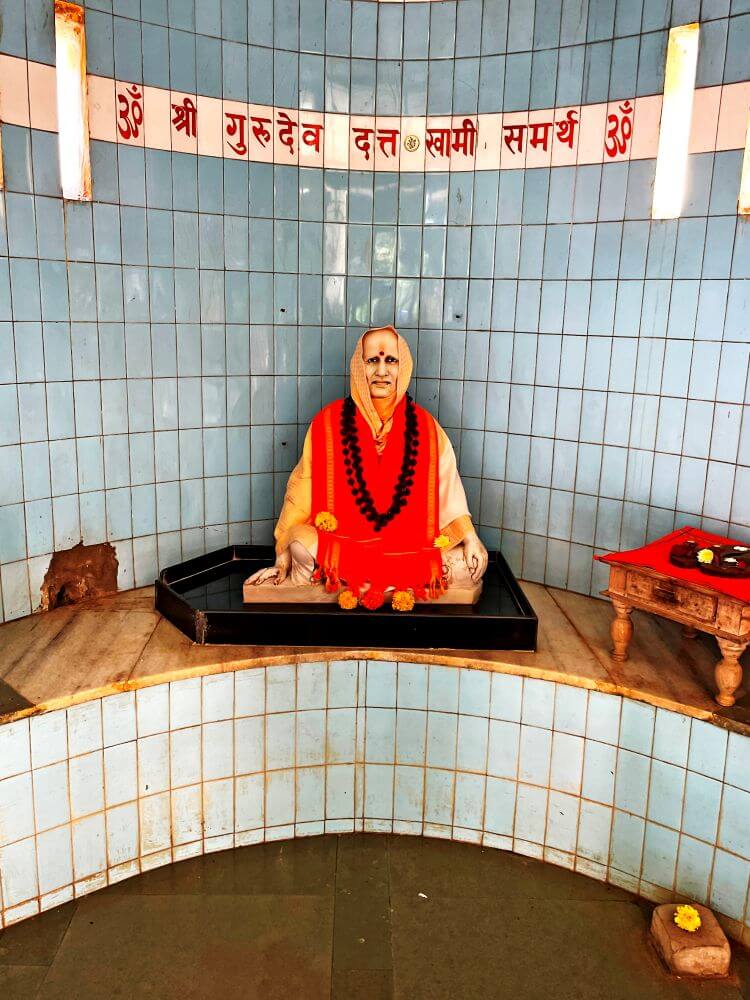
Near the temple of Vasudevanand Saraswati Tembe Swami, there is a meditation cave on the hill. It is said that by performing meditation there, Swami pleased Lord Dattatreya. This cave is natural and measures approximately 15 by 15 feet. Inside, there is a small idol of Vasudevanand Saraswati. Here, devotees of Dattatreya perform Japa, meditation, and the recitation of the Guru Charitra. Every full moon day (Paurnima), the Satya-Datta Vrata ritual is performed here.
In the Dattatreya temple, daily rituals such as Kakad Aarti, worship and offerings to the attendant deities, Abhishek Mahapuja, Dhoop, and Shej Aarti are performed. During the time of Swami, a Palkhi (palanquin) procession used to be held every Thursday and Saturday. The Palkhi festival is celebrated here from Guru Pratipada to Vaishakh Paurnima. Additionally, the Palkhi is taken out on every full moon day, on other festive days, and also on auspicious days upon the request of devotees for a nominal fee. The Palkhi is carried only by Brahmins observing ritual purity (Sovalya). Three circumambulations (Pradakshina) are performed around the Dattatreya temple, and the Palkhi stops at five points during each circumambulation. Mahaprasad is served in the temple daily from 1:00 PM to 2:00 PM and from 8:00 PM to 8:30 PM. However, Mahaprasad is not served during an eclipse.
This sacred temple stands as a testament to deep spiritual devotion, ancient architectural grandeur, and rich local cultural traditions.
The sanctum sanctorum houses the divine idol consecrated according to ancient Vedic traditions, surrounded by serene courtyards and traditional temple architecture.
Navratri, Maha Shivratri, Annual Temple Jatra & Deepotsav
Compare and book flights, secure top-rated local hotels near the temple, hire reliable guides, and rent cars instantly.
Extend your pilgrimage by visiting other highly sacred temples located nearby.


Add ₹999 more to unlock FREE SHIPPING!
Your sacred cart is currently empty.
Shop Photo FramesFill in your delivery details below to place your order.
Add comment