
Add ₹999 more to unlock FREE SHIPPING!
Your sacred cart is currently empty.
Shop Photo FramesThe village of Mangaon, sanctified by the monastery and Dattatreya temple of Vasudevananda Saraswati Tembye Swami Maharaj—who is considered an incarnation of Lord Dattatreya—is home to the temple of Yakshini Devi. Yakshini Devi is the presiding village deity of Mangaon. Local people also address her by the name Jakhubai. This temple is at least several centuries old and is considered significant from both religious and cultural perspectives. There are two reasons for this: firstly, the temple preserves the unique heritage of the Konkani wood-carving tradition, and secondly, the images of the sixty-four Yoginis carved within it. This has made the temple a religious and cultural heritage site.
In Indian mythology, the Yaksha, Yakshi, or Yakshini are considered to be superhuman beings. According to the Puranas, Kashyapa was the father of the Yakshas. He fathered the Yakshas through his wives Ravsa, Krodha, and Muni (Vishva). Yaksha worship has existed in India since the pre-Vedic period. Yakshinis are considered deities of water and fertility in the plant kingdom. They are believed to dwell in trees and vines. There are only a few places in the country where Yakshini temples exist. Yakshini temples are found in Rohtas in Bihar, Banganga in Madhya Pradesh, Chamundi Hills in Mysore and Belgaum in Karnataka, as well as in Trichy and Madurai in Tamil Nadu. Yakshinis are also worshipped alongside the main deity at the Kamakhya Temple in Guwahati, the Kanakadurga Temple in Vijayawada (Andhra Pradesh), the Yakshini-Ayyannar Temple in Madurai, the Bhadrakali Temple in Varanasi, and the Kuppuswami Temple in Thanjavur, Tamil Nadu. The temple in Mangaon is also prominently mentioned among these.
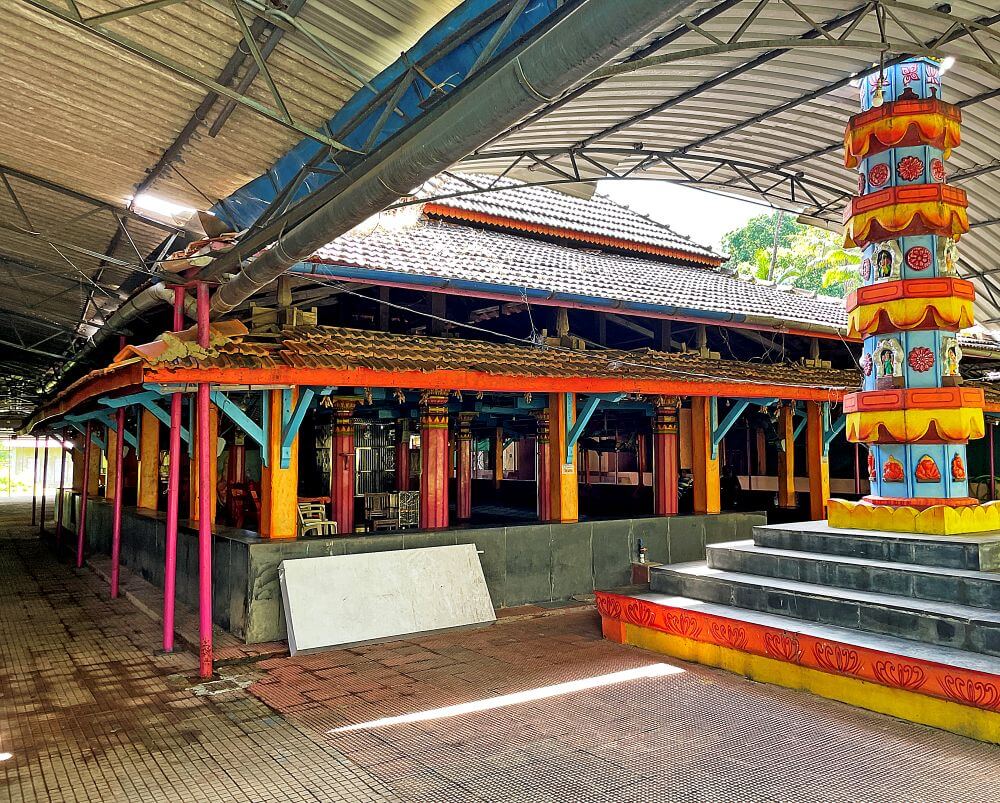
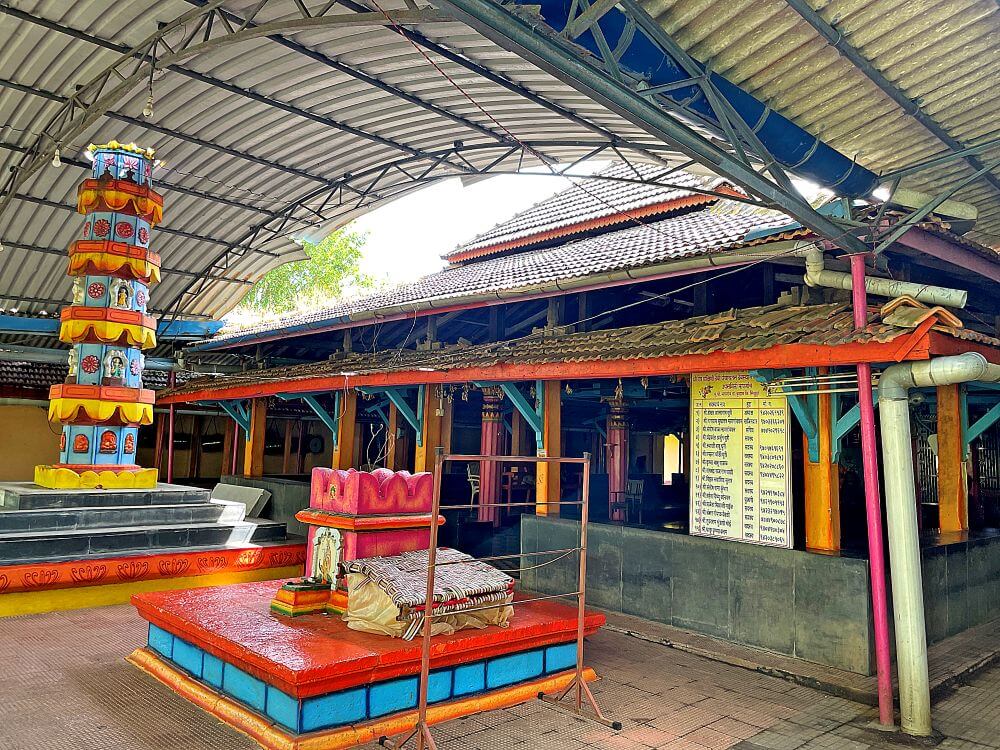
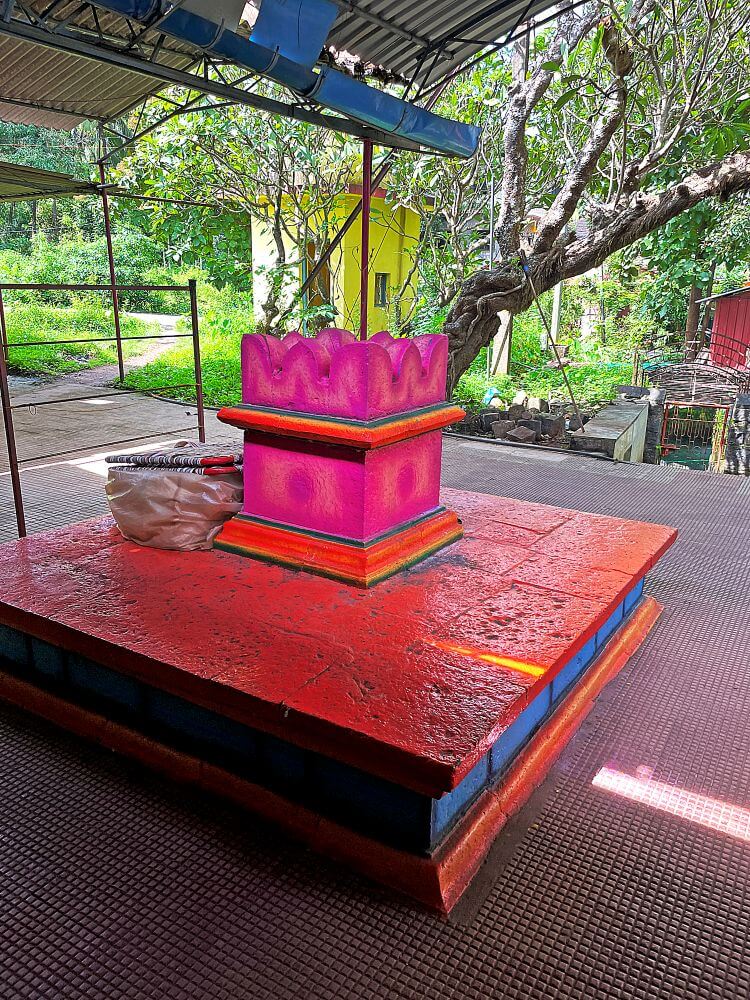
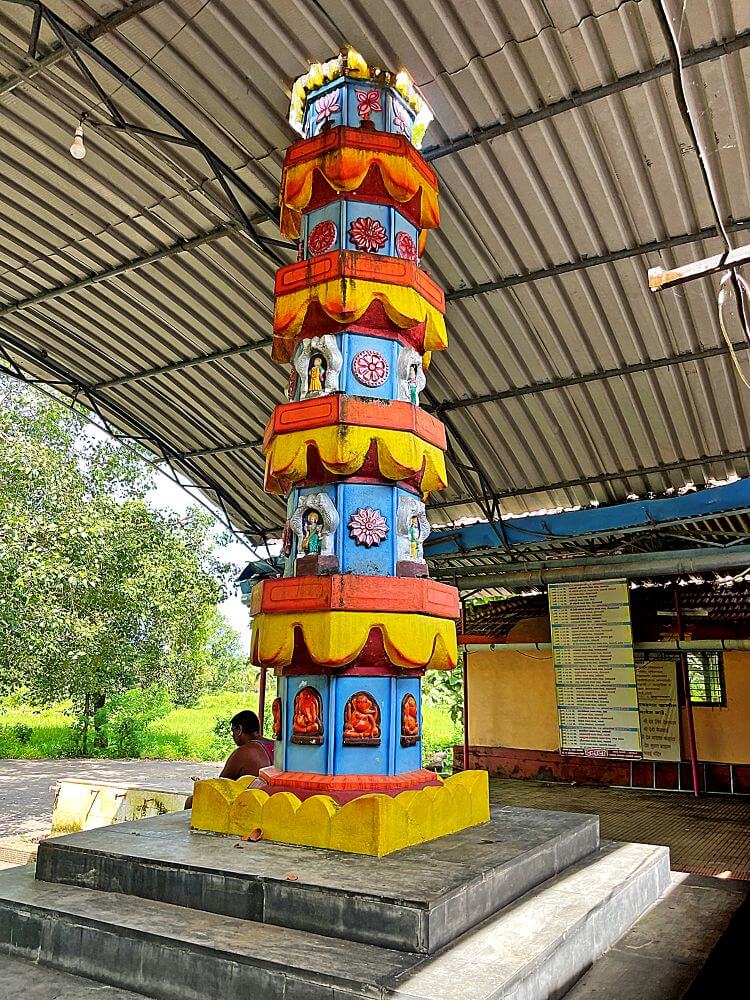
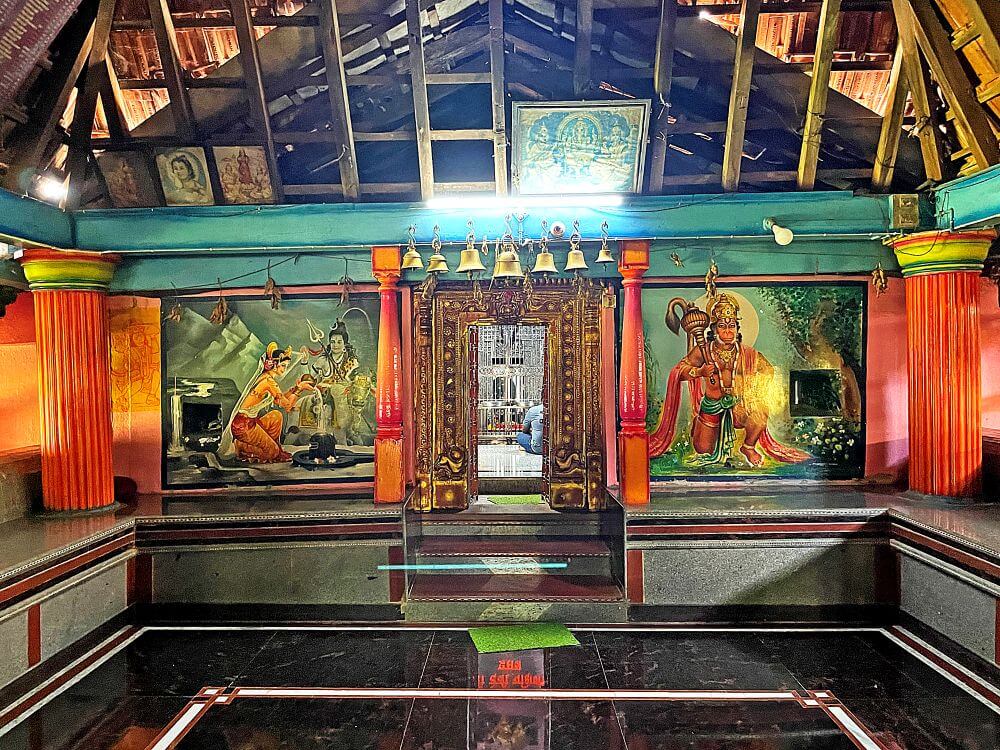
Situated in the heart of Mangaon, in front of a massive Peepal tree, lies this ancient temple, which is a fine example of Konkan architectural style. The temple is built on a high and large plinth. One reaches the base of the temple by climbing five steps from the ground. There, on a spacious platform, stands a tall pedestal featuring a five-tiered lamp pillar (Deepastambha). It is adorned with relief sculptures of the Ashtavinayaka, along with images of other deities and floral carvings. Beside it is a Tulsi Vrindavan. This platform is covered by a large tin canopy. Directly in front is the temple’s wide, horizontal, and semi-open spacious assembly hall (Sabhamandap). The hall features stone benches (Kakshasanas) along the lower sides, while the pillars support the sloping roof above. A short distance inward, there are four circular wooden pillars. The upper parts of these pillars are carved with pot-lotus (Ghatakamala) motifs. In the assembly hall, on the side facing the sanctum sanctorum, there is a cage made of steel bars. Inside it are images of various deities set in wooden frames with intricate carvings. Adjacent to this are six steps, and beside them is a pictorial representation of Goddess Durga, eight-armed and mounted on a lion. Through these steps, one enters the second assembly hall of the temple. Here, there are high stone benches on all four sides, along with smooth wooden pillars. In front, on the facade wall of the inner sanctum (Antarala), an image of Hanuman is painted on the right side of the entrance, and an image of Shankar-Parvati on the left. From here, one climbs three steps and enters the inner sanctum through a wooden doorway.
In the center of the inner sanctum is the temple’s sanctum sanctorum (Garbhagriha). There is a path for circumambulation (Pradakshina) from within the inner sanctum itself. Many excellent examples of ancient woodcraft can be seen here. A short distance from the outer walls, there are four wide, circular pillars on the inside. The upper parts of these pillars have a circular, plate-like shape. Where the pillar meets the ceiling, there is a circular form larger than the pillar itself, carved with multiple serpent heads. The illusion is created as if all these serpents are emerging from the pillar and peering out. The ceiling above appears to be supported by these serpents on their hoods. These pillars also feature carved brackets (Tarangahasta). These include images of a yogi smoking a hookah, Hanuman, Vyala, and others.
Sculptures are carved on the wooden ceiling panels of the inner sanctum. In the Konkan architectural style, wooden panels are laid over the frame of beams that form the ceiling structure. These panels are often carved with sculptures on the underside. Here, they include deities like Agni, the Ashtadikpalas (deities of the eight directions), and also superhuman Yaksha images. These include figures with six heads, eighteen arms, and three legs; two heads and four arms; eighteen heads, thirty-six arms, and nine legs; and five heads, five legs, and ten arms.
A matter of immense religious and cultural importance here is the images of the sixty-four Yoginis carved on the ceiling canopy of the inner sanctum. Scholars believe that the Yogini tradition was established in India in the seventh century AD. In the Yogini tradition, partial manifestations of the Adi Shakti (Primal Energy) are considered Yoginis. The term is also used for female practitioners who have attained mastery over Yoga. However, the Yogini tradition is a Shakta tradition, and Tantric practices are its core foundation. This tradition is always linked to the Shaiva tradition. The Yogini tradition and their practices are also mentioned in the ‘Chaturvarga Chintamani’, a treatise composed by Hemadri, also known as Hemadpant, who was the minister of King Ramadevaraya and whose name is associated with the Bhumija style of temple architecture in Maharashtra. The tenth-century Kalika Purana prescribes the worship of the sixty-four Yoginis for the attainment of Artha (wealth) and Kama (desire). Since Yogini practice emphasizes Tantra, the Panchamakaras are significant there. These Panchamakaras include Madya (wine), Mamsa (meat), Matsya (fish), Maithuna (sexual union), and Mudra (gestures). After the fifteenth century, this tradition declined in the country and is now extinct. However, Yoginis are worshipped as village deities in many places. The Yogini temples in Hirapur and Ranipur in Odisha, as well as in Khajuraho and Bhedaghat in Madhya Pradesh, are distinctive. A study conducted in 2015 revealed to the world that the figures carved in the Yakshini temple in Mangaon are indeed those of the sixty-four Yoginis. The title of this research thesis is ‘Cult Images of Konkan – A Study Through Traditions, Religious Beliefs and Iconography’, which was submitted by researcher Shilpa Hadap to the Tilak Maharashtra Vidyapeeth, Pune, for her PhD.
All these figures on the ceiling of the inner sanctum are approximately 25 centimeters in size. These Yoginis appear in various forms, including one mounted on a fish with a frog’s face, one with a horse’s face, one with a donkey as a vehicle and a goat’s face, and one with an ass’s face. Among them are Vetali, Suryaputri, Gandhari, Kumari, Jasa or Chandrakanthi, Kakarali, Chandika, Tara, Yamuna, Padmavati, The identity of the Yoginis Aghora, Agnihotri, and Khemukhi has been established through iconographic studies.
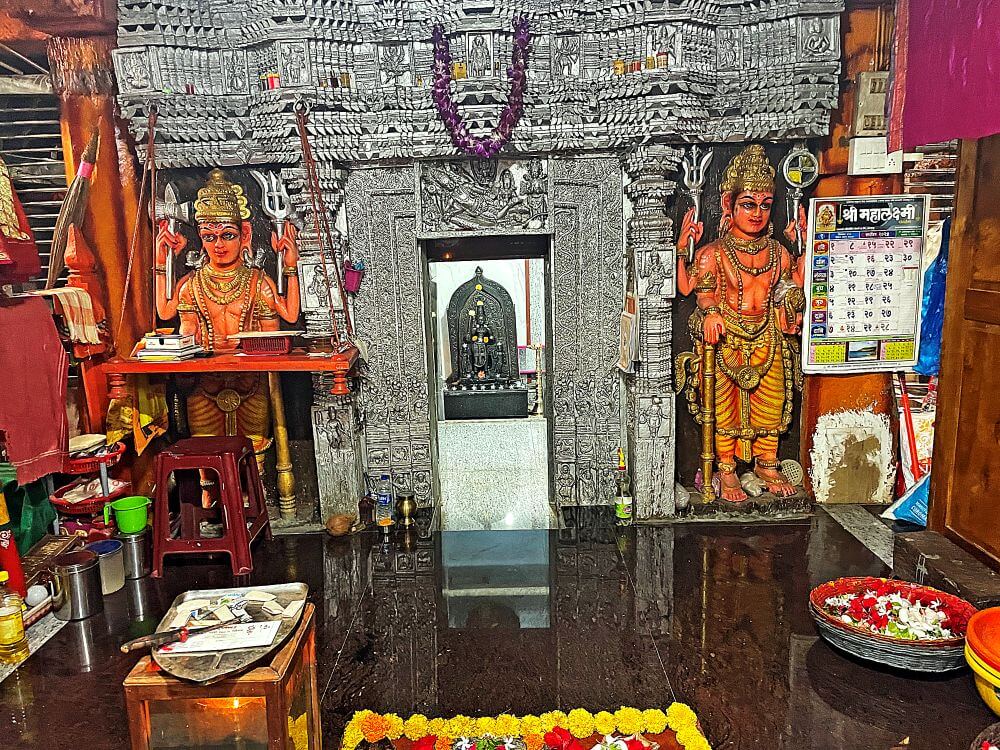
The entrance to the sanctum sanctorum of this temple and the wooden arch-like walls flanking it are adorned with exquisite carvings. This entrance, painted in a silver hue, is three-branched. At the base of these three door-jambs, images of Surasundaris are carved. Above them are sculptures of elephants, swans, Vyala (a mythical creature with parts of different animals), lions, horses, and peacocks. Scholars suggest that the Surasundaris at the base of the central door-jamb, depicted carrying water pots on their heads, symbolize rivers.
On the outer sides of the door-jambs, there are intricately carved wooden pillars, which also feature carvings of deities. Scholars identify one of these, a bird-faced goddess, as Kamakshi. At the lintel of this arched doorway, there is an image of Vishnu. Here, Vishnu is depicted in the Sheshashayi posture, accompanied by carvings of Lakshmi, Garuda, and Brahma serving him. In the upper section above the lintel, known as the Uttara-ranga, the Dashavatara (ten incarnations) are carved. Notably, this entrance lacks a Mandarak, or threshold. On the walls beside the entrance, large, standing figures of door guardians are carved. These guardians, holding a trident, arrow, damaru, and mace, are depicted with beards and mustaches. Inside the sanctum sanctorum, the idol of Yakshini Mata rests on a stone Vajrapitha. This stone idol is approximately one meter in height, with a sword in her right hand. To the left of the Vajrapitha, there is a tall stone statue of a Yogi in a meditative posture. In the circumambulatory path behind the sanctum, there are stone idols of local deities, along with Tarangkathis (ceremonial poles). It appears that the sanctum sanctorum, located beneath the ceiling of the Antarala, underwent renovation in recent times. It has been clad with marble tiles from the outside, and a golden pinnacle sits atop the sanctum. Wood has been extensively used in the construction of this temple, with artistic craftsmanship visible at every turn. Even the rafters here are uniformly shaped in a specific design.
This temple in Mangaon is also associated with Vasudevanand Saraswati, an incarnation of Dattatreya. A legend states that there were several Yoginis in the service of the Dattatreya incarnation Nrusimha Saraswati, among whom Yakshini Devi was a prominent deity. Before taking his next incarnation, Nrusimha Saraswati instructed her, “My next incarnation will be in Mangaon; go there first and establish the village.” According to his wish, Yakshini became the village deity of Mangaon. Devotees believe that Nrusimha Saraswati, and consequently Dattaguru, incarnated here in the form of Vasudevanand Saraswati (Tembe Swami). The birthplace of Tembe Swami is located near this temple.
Every year, a grand fair is held at the Yakshini temple on the day following Tripurari Purnima. Not only people from the surrounding five villages but also those who have moved away for work return to Mangaon for this fair. Similarly, major festivals are celebrated at the temple on Ram Navami and Vijayadashami. Magh Vadya Ashtami is celebrated as the temple’s anniversary.
This sacred temple stands as a testament to deep spiritual devotion, ancient architectural grandeur, and rich local cultural traditions.
The sanctum sanctorum houses the divine idol consecrated according to ancient Vedic traditions, surrounded by serene courtyards and traditional temple architecture.
Navratri, Maha Shivratri, Annual Temple Jatra & Deepotsav
Compare and book flights, secure top-rated local hotels near the temple, hire reliable guides, and rent cars instantly.
Extend your pilgrimage by visiting other highly sacred temples located nearby.


Add ₹999 more to unlock FREE SHIPPING!
Your sacred cart is currently empty.
Shop Photo FramesFill in your delivery details below to place your order.
Add comment