
Add ₹999 more to unlock FREE SHIPPING!
Your sacred cart is currently empty.
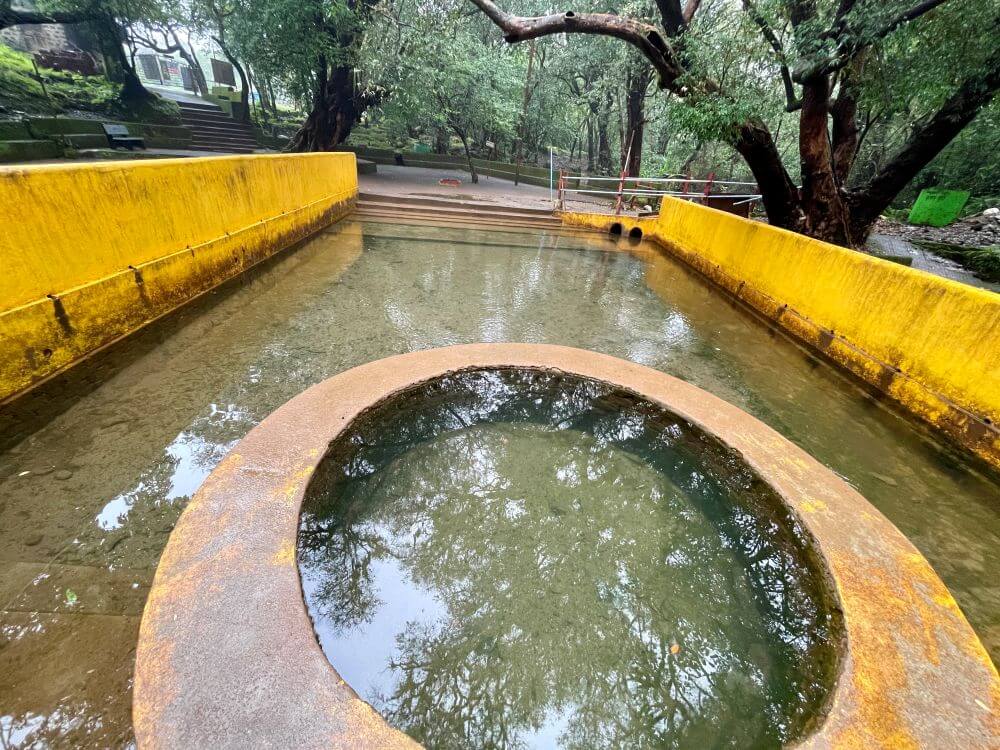
Shop Photo FramesThe famous temple of Goddess Hiranyakeshi is situated near the origin of the Hiranyakeshi River in the Amboli Ghat of Sawantwadi Taluka. It is said that Lord Mahadeva created this Ganga for Goddess Parvati. The river originates from the caves located behind the Hiranyakeshi temple. A unique feature of this place is the Hiranyakeshi fish found in the temple pond. In Sanskrit, the word ‘Hiranyakeshi’ means ‘golden hair’. Researchers claim that this species of fish, which has a golden-yellow color, is not found anywhere else in Maharashtra. The local villagers believe that these fish are the children of the Goddess.
The legend of this temple states that Ramkrishna Vinayak Pendse and his associates from Vajrat village in Vengurla Taluka, Sindhudurg district, had gone to the Karachi province in present-day Pakistan to trade in spices; however, despite many efforts, their business did not prosper as expected. Everyone was disappointed. At that time, Sage Shandilya appeared to Pendse Bhatji in a dream and told him that there is a self-manifested (Swayambhu) seat of Lord Mahadeva to the east of Amboli village in the Konkan region. He instructed him to find it and serve there. At that time, even the locals of Amboli were unaware of this site. Following the vision, Pendse Bhatji searched the area and discovered this site located within the rocks of a cave. From then on, he began the worship of Lord Mahadeva at this place. It was he who named the Mother Parvati here as Hiranyakeshi. He served here from 1938 to 1975. Before his death, he expressed a wish that the waters of the Hiranyakeshi River should flow over his Samadhi. As per his wish, devotees built his Samadhi in the riverbed in 1975.
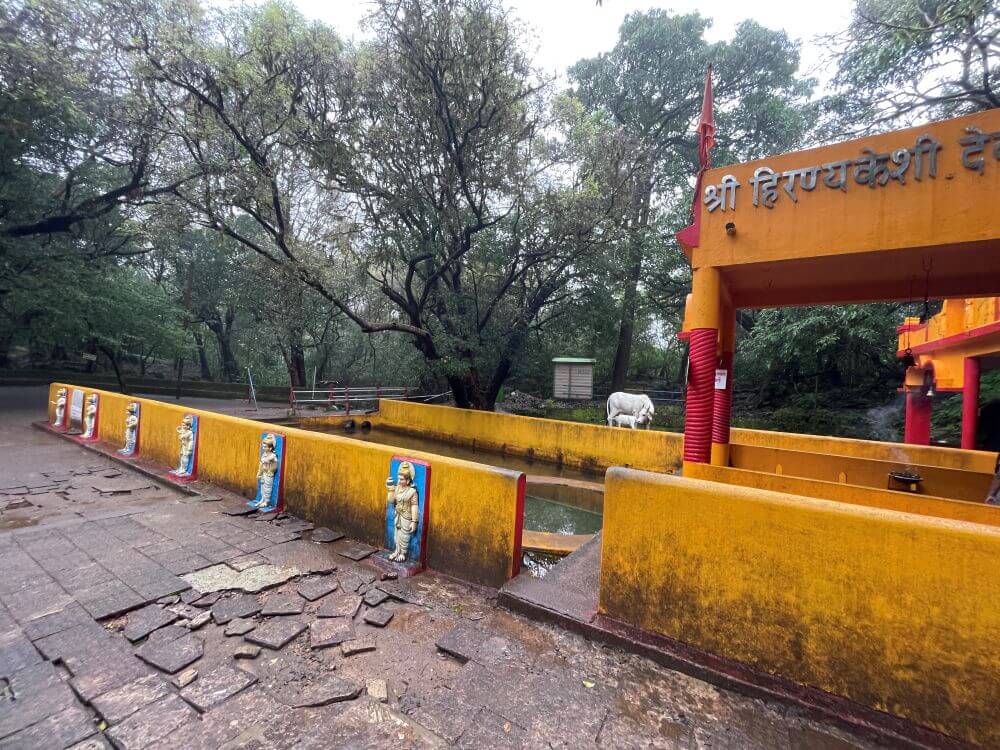
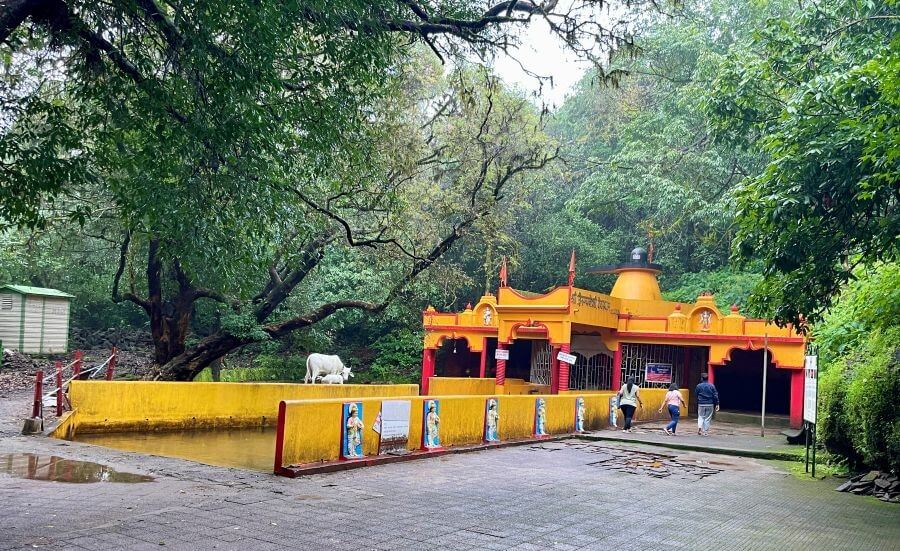
The Hiranyakeshi temple is located a short distance from the Amboli bus stand. After descending a few steps from the main road, one has to cross a small bridge over the Hiranyakeshi River. While walking through this nature-rich environment, one can hear the chirping of various birds, the rustling of leaves, and the sound of the flowing river. For the convenience of devotees, the Maharashtra Tourism Development Corporation (MTDC) has paved the path to the temple with paver blocks. One can reach the temple entrance via this path. Descending a few more steps leads into the temple courtyard. Surrounded by trees on all sides, the courtyard is paved throughout. In the center of the courtyard is a Havan Kund (sacrificial fire pit), and on one side is the Samadhi of Ramkrishna Vinayak Pendse. In front of the temple, there is a water pond. It is said that the Hiranyakeshi fish species breeds in this pond. Previously, a fish called ‘Tamboshi’, similar to a ‘Gold Fish’ with reddish stripes and an orange color, and a slender body, used to be found in these waters. The Hiranyakeshi fish is different from that. Researchers have found that this fish belongs to the ‘Schistura’ family, which is primarily found in South and East Asian countries. These fish are 33 to 37.8 mm in size and feed on algae and small insects. Their habitat was discovered in the stream at the mouth of the Hiranyakeshi River. This was discovered in 2020 by wildlife researcher Tejas Thackeray, son of Shiv Sena party chief Uddhav Thackeray, and his team. This fish has now been named *Schistura hiranyakeshi* after the Hiranyakeshi River. On the three-foot-high walls on both sides of the pond where this fish, often called the ‘God’s fish’, is found, there are idols of the Goddess in various forms. To the left of the pond is a beautiful sculpture of a cow and calf that looks incredibly lifelike.
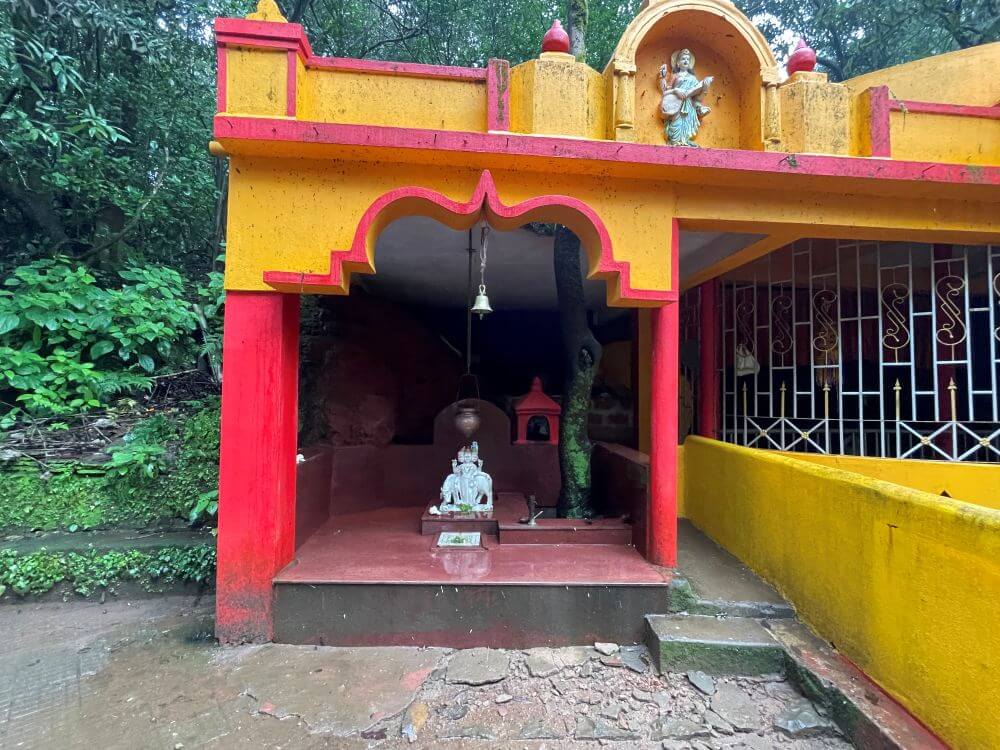
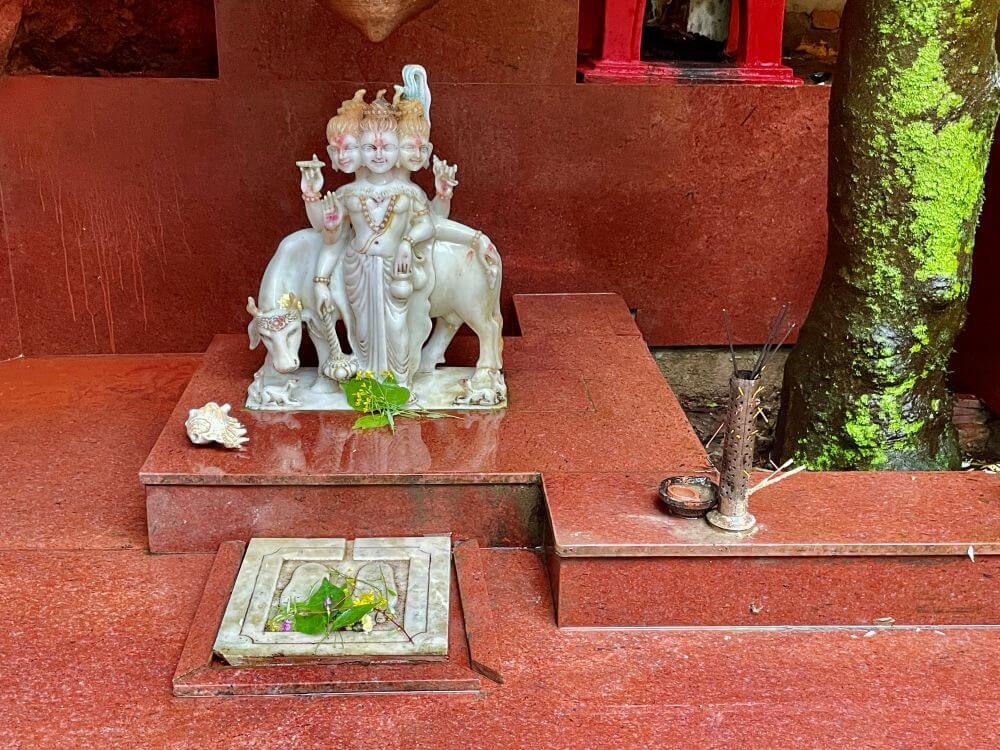
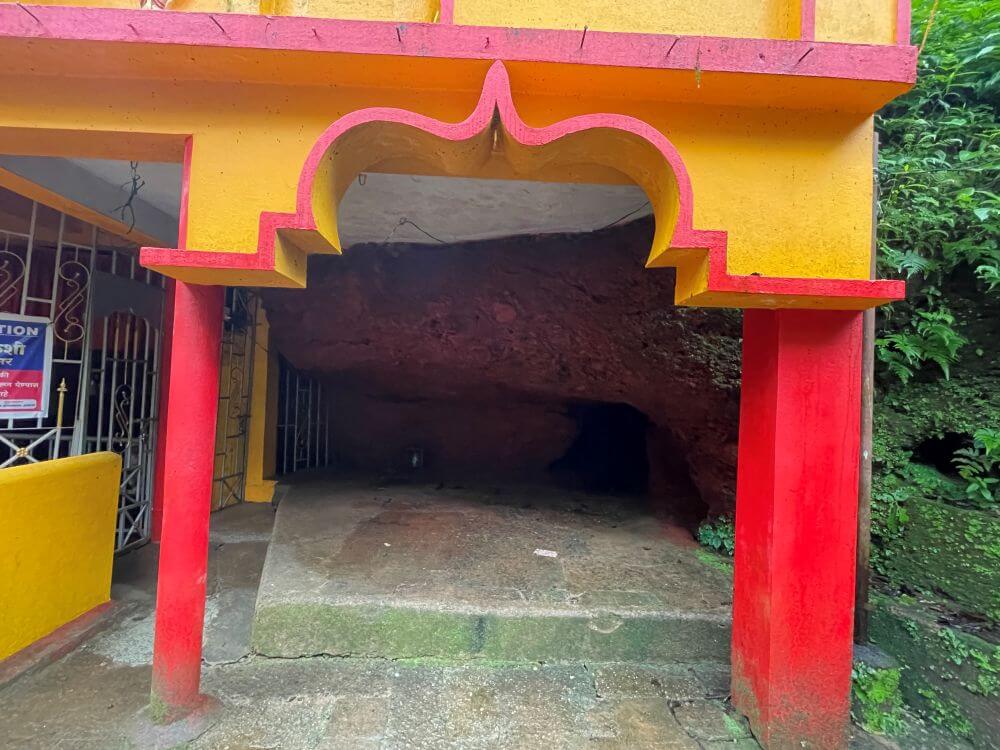
Previously, there was no temple at this site. There was only a Swayambhu Shivling at the base of the rock. In 2006, the Maharashtra Tourism Development Corporation built the current temple. The temple structure consists of water at the base, with a Darshan Mandap and three sanctums (Garbhagriha) above. In the main sanctum in front of the Darshan Mandap, on a Vajrapitha, stands a white marble idol of Goddess Hiranyakeshi standing on a crocodile, with the Shivling of Hiranyagarbheshwara beside it. Nandi is seated in front of this idol, while on a small Vajrapitha to the left is an idol of Lord Ganesha. In the left sanctum, there is a white marble idol of Shri Dattatreya on a Vajrapitha. In the right sanctum, there is a cave. The Hiranyakeshi River originates from this very cave. It is said that Hiranyakeshi is the only river in the state that originates in the east and flows towards the east.
A large fair is held here on Mahashivratri. Apart from this, thousands of devotees come for the darshan of Hiranyakeshi every Monday during the month of Shravan. Religious rituals like Asthivisarjan (immersion of ashes), Tripindi Shraddha, and Narayan Nagbali are also performed here. There is an old stone Dharamshala (pilgrim rest house) in the temple premises. To preserve the biodiversity of Amboli and the Hiranyakeshi fish species, the Government of Maharashtra established the ‘Schistura Hiranyakeshi Biodiversity Site’ on March 31, 2021. This step was taken by the government with the aim of conserving these freshwater fish. This became the first such initiative in the country specifically created to protect rare species of fish. The local villagers have also resolved to maintain the existence of this fish species. The local people refer to these fish as ‘fish from heaven’.
The Amboli Ghat area is known as the ‘Poor Man’s Matheran’ and the ‘Cherrapunji of Maharashtra’. This region receives as much as 747 cm of rainfall. (Rainfall in Mumbai and Pune is generally around 250 to 300 cm.) This ghat is as famous for its biodiversity as it is for tourism. Research on various types of species is conducted here, including many rare plants, flowers, and insects. Located at an altitude of 690 meters above sea level, this ghat was granted the status of a hill station in 1880. Amboli was the summer capital of the Sawantwadi princely state. Remnants of some buildings from that era can still be seen here.
A short distance from the Hiranyakeshi temple is the temple of Raghaveshwar. Like the Hiranyakeshi temple, the path to this temple also passes through a nature-rich area. The flow of the Hiranyakeshi River can be seen along this path. Known as the Raghaveshwar Math, this place has temples of Ganpati and Shri Ram Panchayatan.
This sacred temple stands as a testament to deep spiritual devotion, ancient architectural grandeur, and rich local cultural traditions.
The sanctum sanctorum houses the divine idol consecrated according to ancient Vedic traditions, surrounded by serene courtyards and traditional temple architecture.
Navratri, Maha Shivratri, Annual Temple Jatra & Deepotsav
Compare and book flights, secure top-rated local hotels near the temple, hire reliable guides, and rent cars instantly.
Extend your pilgrimage by visiting other highly sacred temples located nearby.


Add ₹999 more to unlock FREE SHIPPING!
Your sacred cart is currently empty.
Shop Photo FramesFill in your delivery details below to place your order.
Add comment