
Add ₹999 more to unlock FREE SHIPPING!
Your sacred cart is currently empty.
Shop Photo FramesThe Rameshwar Temple, the presiding deity of Bhiravande village in Kankavli Taluka, a region rich in social, historical, and political heritage, is a place of deep faith for thousands of devotees in the Konkan. The current magnificent structure of this temple was built in the years 1979-80. Holding an important place among the religious sites of the Konkan, information about this temple was once featured in the third-grade geography textbook. In this Balbharati textbook, only a few select temples from Maharashtra were included, and this temple was among them.
Regarding the name Rameshwar, a legend is told that Ravana was a Brahmin. By slaying him, Shri Rama incurred the sin of Brahmahatya. Shri Rama asked the sages how to cleanse himself of this sin. The sages advised Shri Rama to install a Shiva Linga and worship it along with Sita and Lakshmana. Following the sages’ instructions, Shri Rama installed a sand Linga created by Sita on the seashore. The Shiva Linga installed by Rama is known as Rameshwaram. Thereafter, Rameshwar Shiva Lingas were installed in many places across India. At the time of the installation of the Rameshwar temple, the sages requested Shri Rama to explain the meaning of the name Rameshwar. Shri Rama then said, ‘Ramasya Ishwarah sah yah Rameshwarah’, meaning, “He who is the Lord of Rama is Rameshwar.” Shiva-Shankara is my Lord. At that time, Shankara said that the meaning of the word Rameshwar is not that, but rather ‘Ramah Ishwaro yasya sah Rameshwarah’, meaning, “He for whom Rama is the Lord is Rameshwar.” This story conveys that Hari and Hara are one and the same.
Bhiravande village in Kankavli is nestled in the lap of the Manga mountain range, which stretches about 4 km to the north-east of the main Sahyadri range. A unique feature of this village is the dense sacred grove (Devrai) maintained by the villagers in the surrounding area. According to historical accounts, Bhan Sawant, the patriarch of the Bhiravandekar Sawant (Patel) Dharpawars, established the settlement here. Along with the ancient Rameshwar temple, there are vibrant shrines dedicated to Rui, Gango, Ravalnath, Holdev, Vitthalai, and Melekar in this village. There was an ancient temple of Rameshwar in this village. While renovating it in the modern style around 1980, the villagers preserved two relics from the old temple. These include the carved stone lamp pillar (Deepstambh) that stood in front of the old temple and a short, elegant stone pillar from the temple. The base of this pillar is cylindrical, and the top is shaped like a water pot (Ghatapallava) resembling a basin. It is adorned with lotus petal carvings. The beauty of these relics gives one a glimpse of the beauty of the original temple.
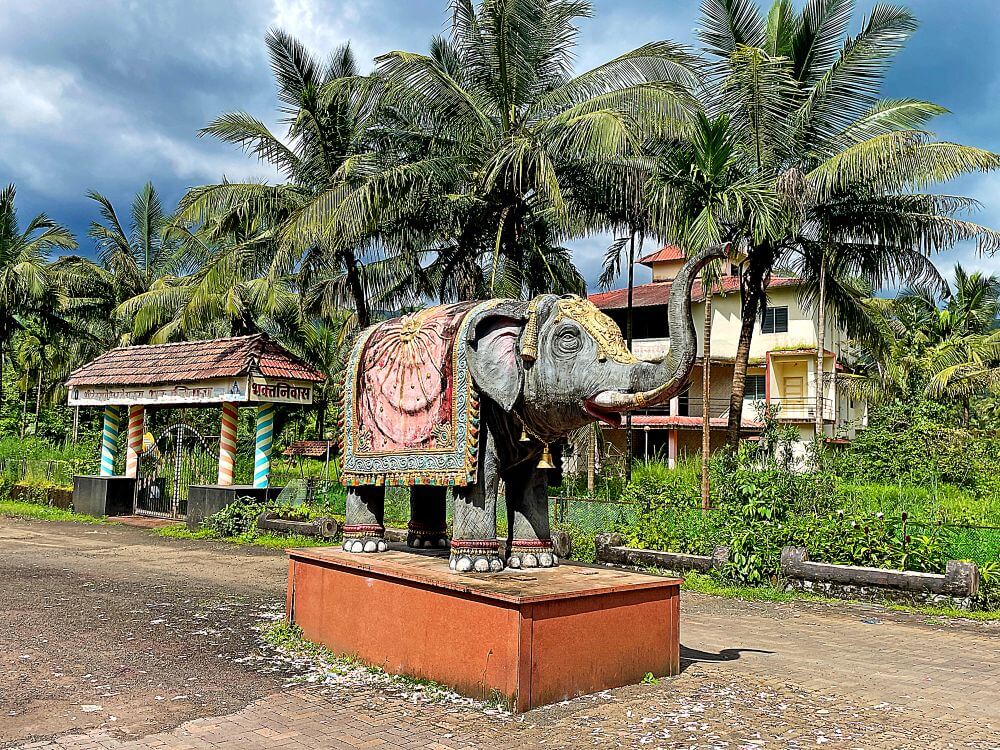
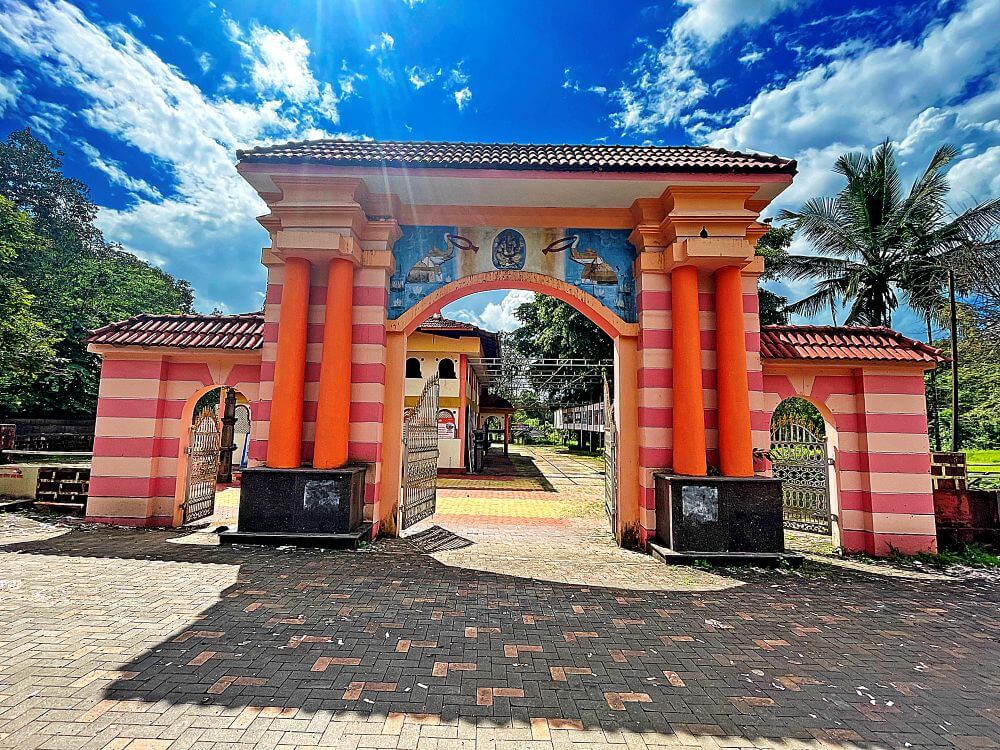
The Rameshwar temple is situated at a slightly lower level than the road. The temple is surrounded on all sides by a fortification wall made of laterite stone. The entrance gate in the fortification has a traditional Konkani tiled roof. Beside it are two small side doors. Descending a few steps from the entrance, one enters the temple courtyard. There, in front of the temple on a platform, stands a newly built, somewhat conical lamp tower (Deepmal). In front of the lamp tower is the old stone lamp pillar, and beside it is a small Tulsi Vrindavan. Near the lamp tower in the courtyard, on a high platform, stands a magnificent statue of an elephant and an artificial waterfall.
The temple is structured with a Mukhamandapa (front hall), Sabhamandapa (main assembly hall), Antarala (vestibule), and Garbhagriha (sanctum sanctorum). The Mukhamandapa has a sloping tiled roof on three sides. The Sabhamandapa is semi-open, large, spacious, and two-storied. The influence of the Konkani architectural style is evident in its construction. The outer walls of the Sabhamandapa consist of pillars and arched windows between them. Below these windows are seating ledges (Kakshasanas). A short distance inside from these, on both sides, are the pillars of the Sabhamandapa. In the center, there is an open space reaching up to the ceiling. All around it is a balcony-like section on the upper floor. There are stairs near the entrance of the Sabhamandapa to go to the second floor.
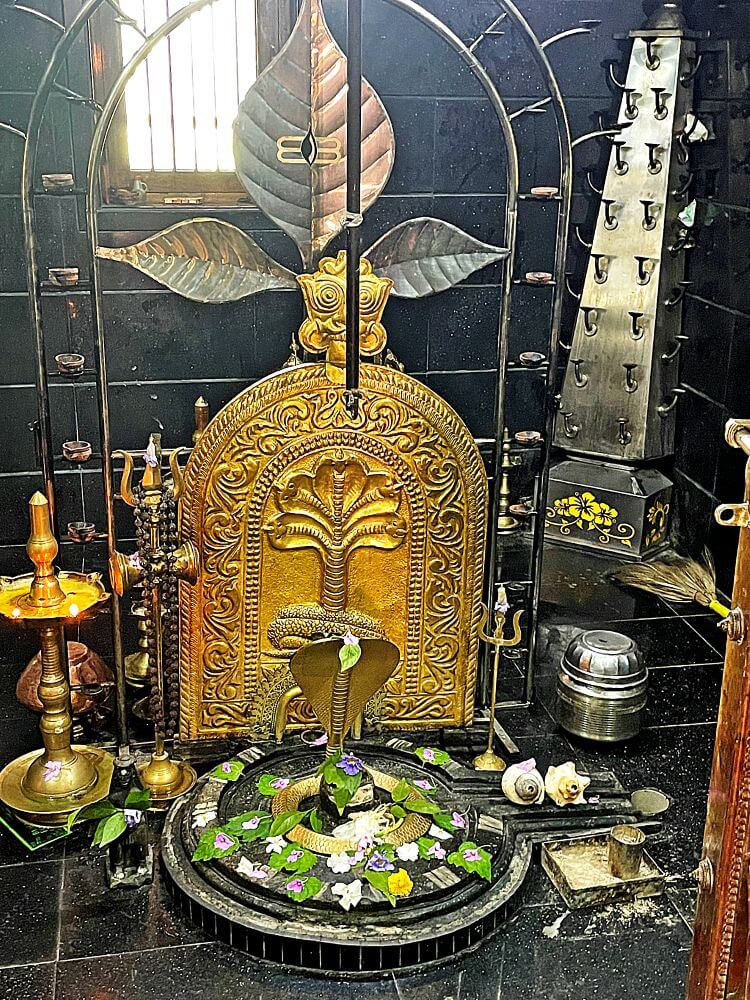
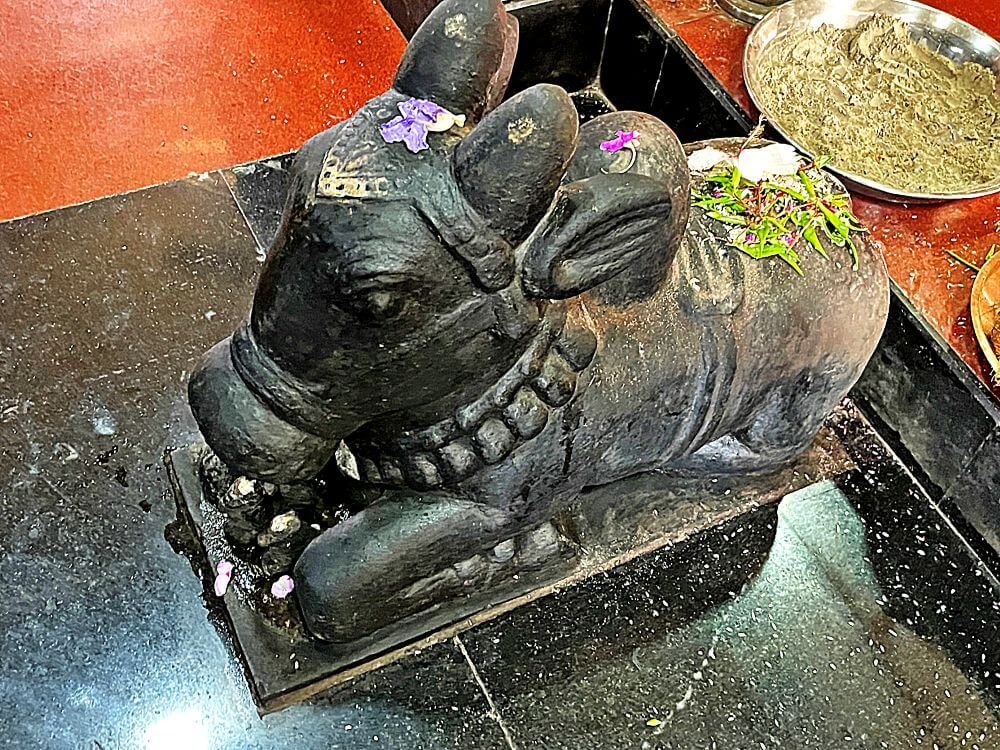
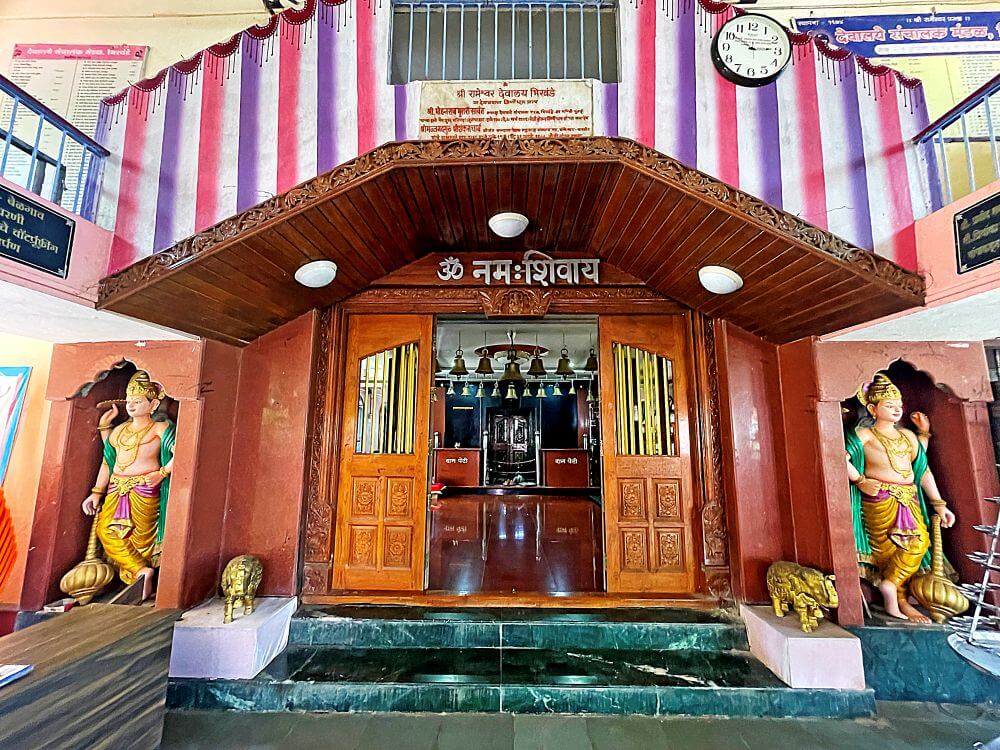
The door to the Antarala is wide and made of wood. On both sides of it are four-armed, mace-bearing gatekeepers, Jaya and Vijaya. There is a great resemblance between the idols of Jaya-Vijaya and Lord Vishnu. The only difference is that Vishnu holds a Sudarshan Chakra in one hand. However, in the Rameshwar temple, Jaya and Vijaya are depicted holding the Sudarshan Chakra. Beside their tall idols are two steps, on which two small brass statues of elephants, symbols of prosperity, are placed. In front of the steps, on the ground, is a tortoise idol. Beyond the Antarala, leaving a circumambulation path, is the Garbhagriha. Near the entrance of this Garbhagriha are two carved wooden pillars. Many brass bells are hung at the top of both these pillars. In front of the entrance to the Garbhagriha, on the floor, is an idol of Nandi carved from a single stone. In the center of the Garbhagriha is a Shiva Linga made of black stone. Behind it, on a brass plate, is a five-hooded Sheshnag carved in relief. Behind that is a large metal Bel leaf.
Every year, starting from Ratha Saptami, an unbroken Harinam Saptah (seven-day chanting of the Lord’s name) is celebrated at the Rameshwar temple. This is the biggest festival of the year. For seven days, the continuous chanting of the Lord’s name echoes here. Thousands of devotees from Sindhudurg district, including villagers and those working in cities, attend this festival. During these seven days, the temple premises take on the atmosphere of a fair. For this festival, the temple is painted, and the temple and its surroundings are attractively decorated and illuminated with lights. On the occasion of this Saptah, renowned singers from Bhiravande village and the district perform Bhajans. Additionally, floats from various schools in the Taluka arrive here. Various programs such as Dindi processions and Goph dance are held. During this week, a palanquin procession of Lord Rameshwar is taken out every night to the sound of drums and cymbals. For the devotees who come for the festival, the temple trust provides accommodation in the Bhakta Niwas and arranges for Mahaprasad.
This sacred temple stands as a testament to deep spiritual devotion, ancient architectural grandeur, and rich local cultural traditions.
The sanctum sanctorum houses the divine idol consecrated according to ancient Vedic traditions, surrounded by serene courtyards and traditional temple architecture.
Navratri, Maha Shivratri, Annual Temple Jatra & Deepotsav
Compare and book flights, secure top-rated local hotels near the temple, hire reliable guides, and rent cars instantly.
Extend your pilgrimage by visiting other highly sacred temples located nearby.


Add ₹999 more to unlock FREE SHIPPING!
Your sacred cart is currently empty.
Shop Photo FramesFill in your delivery details below to place your order.
Add comment