
Add ₹999 more to unlock FREE SHIPPING!
Your sacred cart is currently empty.
Shop Photo Framesकणकवली, in the sacred district of Sindhudurg, is none other than the ancient Kanakavalli. This hallowed name signifies ‘the land of gold’. In this golden land, made pure by the divine presence of the revered spiritual master, Parama Pujya Bhalchandra Maharaj, stands the temple of Shri Chauṇḍeshwari Devi, nestled on the banks of the Janavali River. This Devi is also known as Chamundeshwari in some regions. Throughout our beloved Bharatavarsha, there are many sacred abodes of Mata Chauṇḍeshwari. Among them, the shrine of Singadoor Chauṇḍeshwari in Shivamogga, Karnataka, is particularly renowned. In the Konkan region, there are temples dedicated to Chauṇḍeshwari at Girye (Vijayadurga), as well as in Mohada in Bhandara district, and in Western Maharashtra at Sangli and Ichalkaranji.
Shri Chauṇḍeshwari is revered as the Devi who grants wishes and responds to the heartfelt calls of Her devotees. Chauṇḍeshwari is a deity belonging to the Shaiva pantheon. In the Yogeshwari Sahasranama Stotra, found in the Uttar Khanda of the sacred text ‘Shri Rudrayamala’, it is mentioned that ‘Chauṇḍa’ is one of the thousand names of the Devi. According to the ‘Rudrayamala Tantra’, Yamala is a form of Tantra Shastra. Tantra Shastra has three forms: Agama, Yamala, and Tantra. Among these, the Yamala texts emphasize the unity of Shiva and Shakti. Thus, Chauṇḍeshwari is believed to be a form of Yogeshwari. The mantra for this Devi is ‘Om Shri Shri Shri Viratrupaya Mahamardini Tanno Chauṇḍeshwari Prachodayat’. Shri Chauṇḍeshwari Devi of Kankavli is the revered family deity of the Devang Koshti community.
The caste name ‘Koshti’ is derived from ‘Kosa’ or ‘Kosha’, referring to those who craft textiles. The Devang Koshtis traditionally wove garments for deities and the elite. According to the Devang Purana, after the creation of the universe, no one had been created to produce clothing for human beings. Consequently, humans had to live by covering themselves with bark and animal skins. The distressed people finally prayed to Lord Shiva. In response, Shiva created the Devang (Deval) Rishis. They first obtained threads from Lord Vishnu and wove garments for the Devas. Then, they acquired a spinning wheel and a handloom from Mayasura to weave clothes for humans. There is another legend regarding this: once, as they were on their way to meet Lord Shankara after supplying garments to Lord Vishnu, Vishnu warned them that they would encounter demons on their path. These demons would not only demand their clothes but also kill them. Therefore, Vishnu gave them His Sudarshan Chakra for protection. Indeed, it happened just as Vishnu had foretold. The Devang Muni encountered a demon. A fierce battle ensued between them. Since the demon had a boon of immortality, countless other demons would arise from every drop of his blood that fell to the ground. The Devang Muni became terrified. At that very moment, Shri Chauṇḍeshwari Devi manifested and, by drinking the drops of blood that fell to the earth, She annihilated the demons. As Shri Chauṇḍeshwari Devi came to their aid during this battle fought for textiles, She is regarded as the Kuladevata (family deity) of the Koshti community. This sacred tale is also recounted in the aarti of Mata Chauṇḍeshwari. The refrain of this aarti is, ‘Jai Devi Jai Devi Jai Chauṇḍeshwari, Devang Brahmin Kuli Var De Sundari’ (Victory to the Devi, Victory to the Devi, Victory to Chauṇḍeshwari, O Beautiful One, grant boons to the Devang Brahmin clan).
According to historical records, Indian textiles were exported as early as three thousand two hundred BCE. After the era of the Indus Valley Civilization, bales of textiles were exported from ports in the Konkan region, such as Chaul and Sopara. Shaiva deities are the revered deities of the weaver community, and Mata Chauṇḍeshwari is one of them.
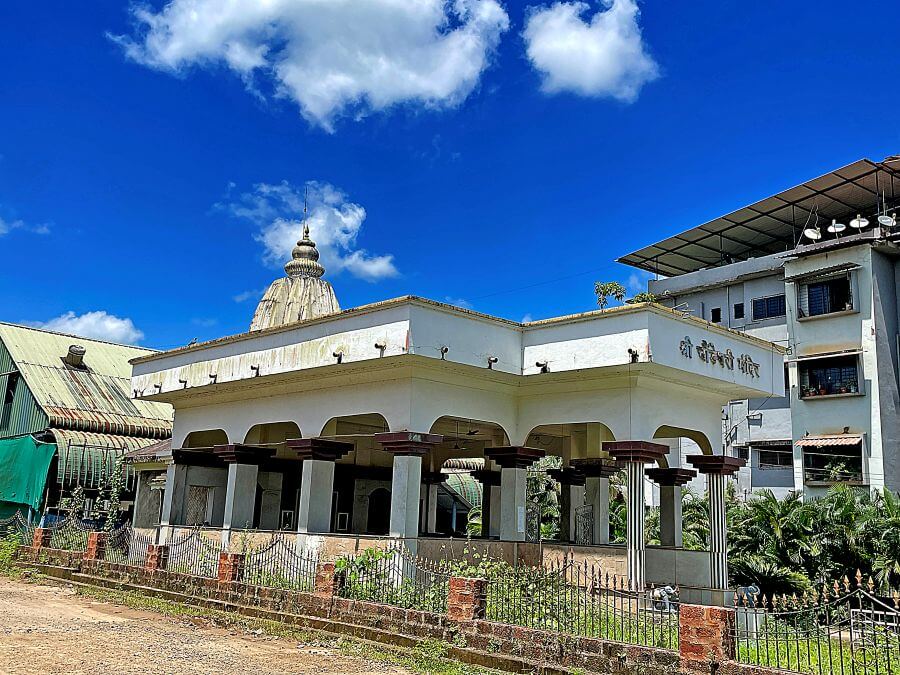
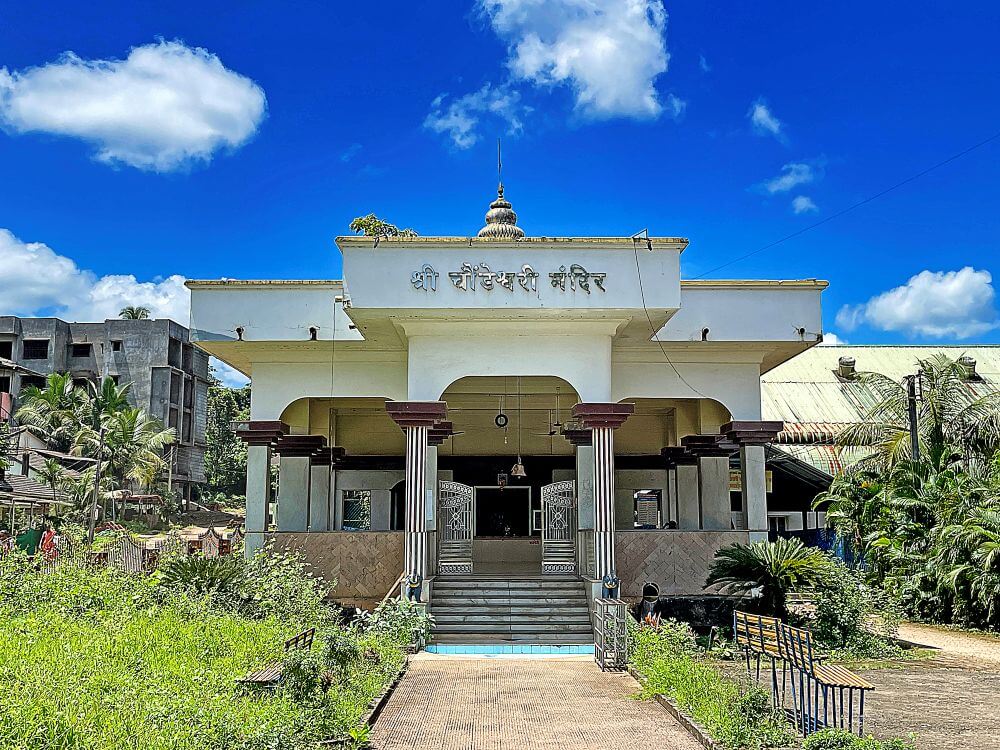
A magnificent temple of Shri Chauṇḍeshwari has been constructed by the Devang Koshti community at Kamble Lane, near Ganapati Sana in Kankavli. In two thousand three, from the sixth to the eighth of May, the inauguration of the temple and the Pranapratishtha ceremony of Shri Chauṇḍeshwari Devi were celebrated with great joy and a deeply spiritual atmosphere.
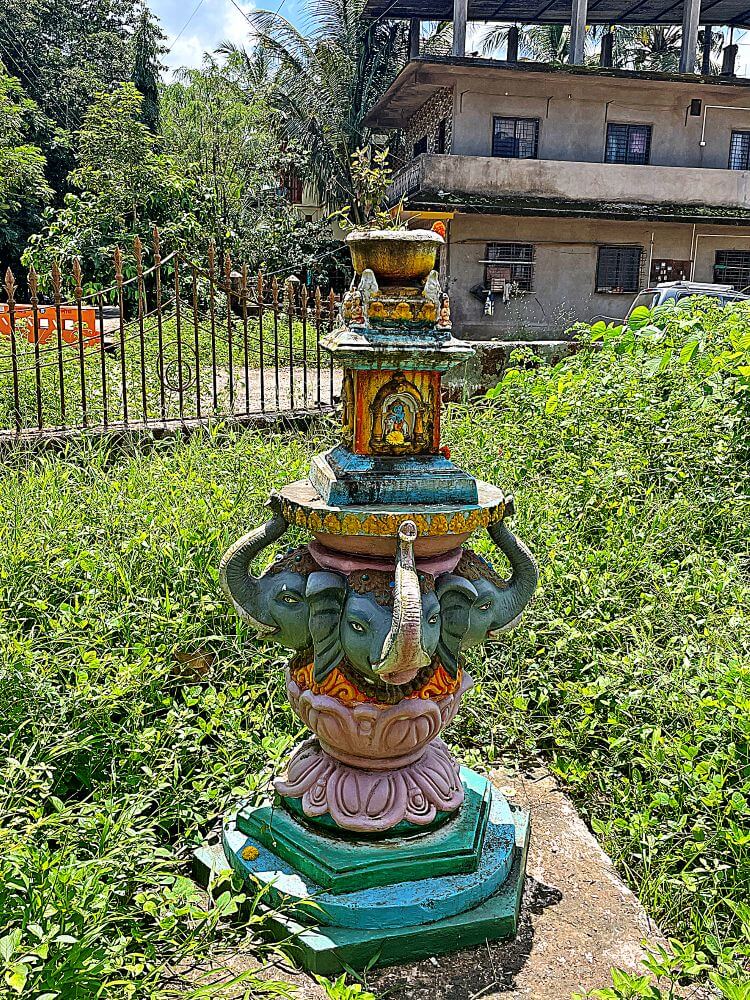
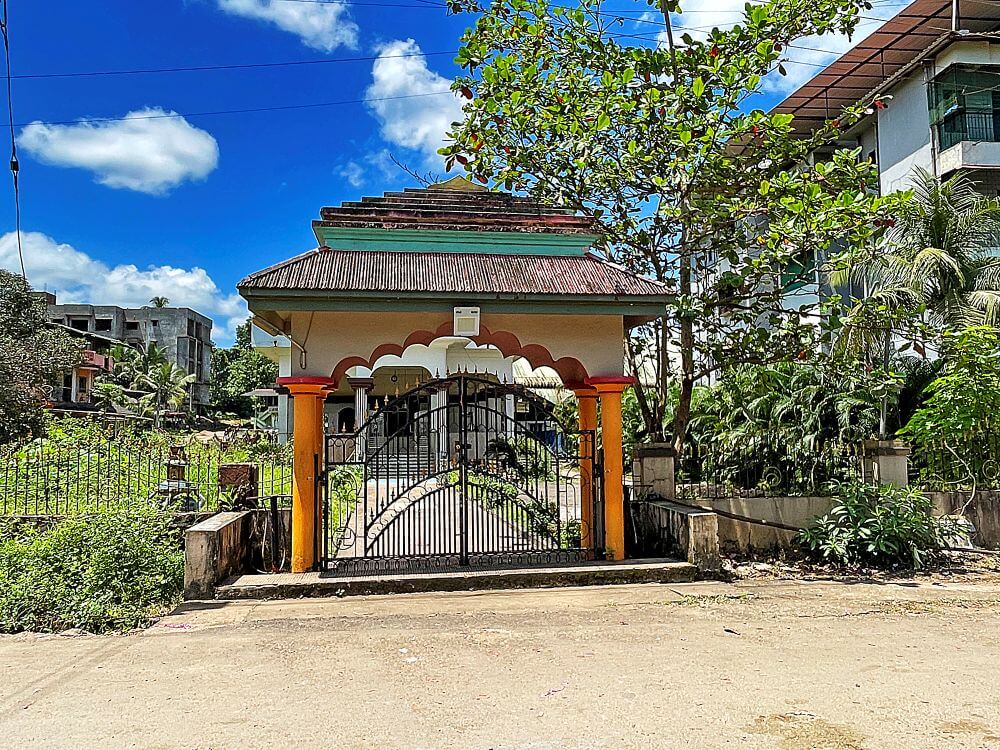
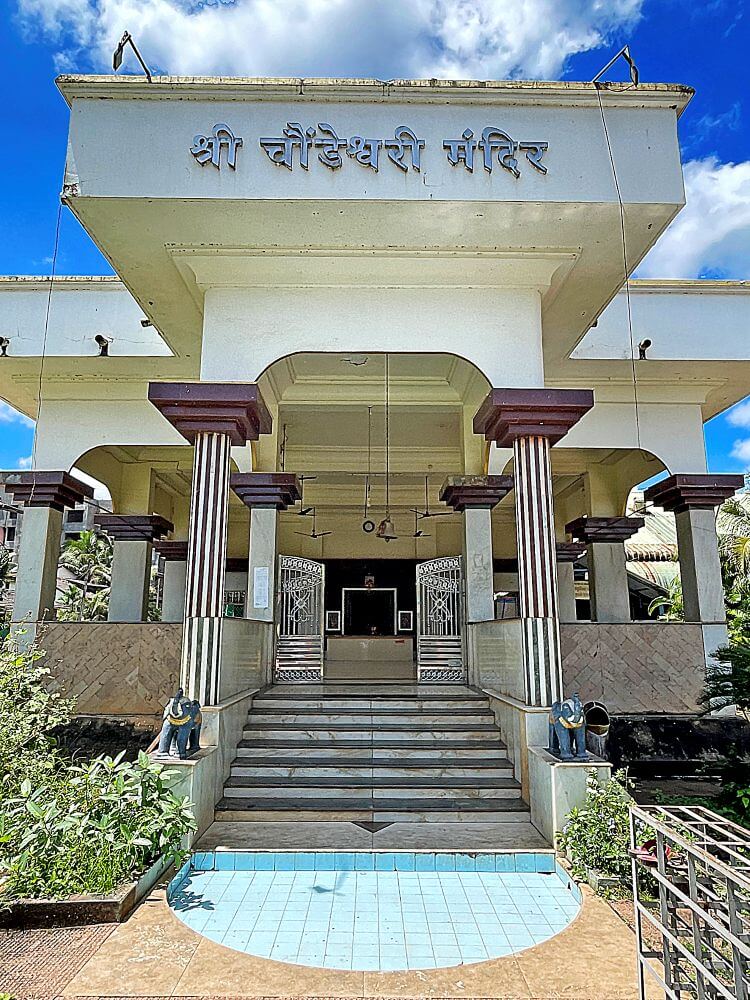
The entrance to the temple courtyard is located alongside the busy road of the town. In front of this entrance, within the courtyard, stands a unique Tulasi Vrindavan. On a raised platform, four elephant-faced figures are seated upon a lotus flower. They appear to be supporting this Tulasi Vrindavan with their trunks, a truly exquisite design. The temple courtyard is spacious, featuring a garden and play equipment for children. Additionally, there are benches placed at various spots for devotees to rest. A paved pathway leads from the entrance to the temple. On this path, in front of the main temple entrance, there is a semi-circular, shallow foot-washing pond. As one proceeds into the temple, the feet are automatically cleansed. The temple is built on a high plinth. One enters the Mukhamandapa (front hall) of the temple by ascending eight steps. On either side of these steps, small statues of Gajraja (Lord Ganesha in elephant form) are installed on platforms. The temple’s structure comprises a Mukhamandapa, a Sabhamandapa (assembly hall), and a Garbhagriha (sanctum sanctorum).
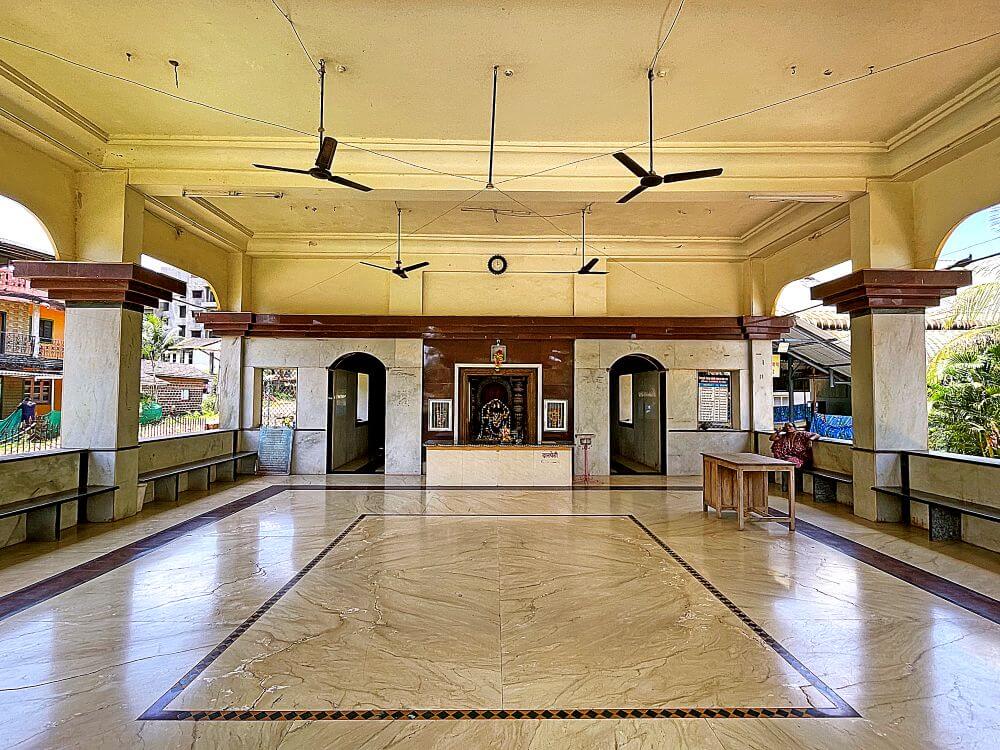
The Mukhamandapa and Sabhamandapa of the temple are semi-open, with side seating arrangements. The Sabhamandapa here is relatively large, with marble flooring throughout. The pillars supporting the seating are intricately connected by arch-like craftsmanship. In the front part of the Sabhamandapa, leaving a circumambulatory path, the Garbhagriha is situated in the center. On the facade wall of the Garbhagriha, in the left niche, are idols of Bansidhar Shri Krishna, and on the right, an idol of Saraswati. Within the Garbhagriha, on a marble Vajra Pitha adorned with tall, ornate pillars and arches, rests the black stone idol of Mata Chauṇḍeshwari. With a prominent kumkum on Her forehead, a pearl nose-ring, various ornaments, and draped in a saree, the Devi’s form radiates beauty. This idol faces east and is Ashtabhuja (eight-armed). It was specially brought from Pandharpur. The temple, painted entirely in pristine white, appears truly resplendent. Above the Garbhagriha is a medium-sized shikhara (spire), topped with three amalakas and a brass kalasha (finial).
This sacred temple stands as a testament to deep spiritual devotion, ancient architectural grandeur, and rich local cultural traditions.
The sanctum sanctorum houses the divine idol consecrated according to ancient Vedic traditions, surrounded by serene courtyards and traditional temple architecture.
Navratri, Maha Shivratri, Annual Temple Jatra & Deepotsav
Compare and book flights, secure top-rated local hotels near the temple, hire reliable guides, and rent cars instantly.
Extend your pilgrimage by visiting other highly sacred temples located nearby.


Add ₹999 more to unlock FREE SHIPPING!
Your sacred cart is currently empty.
Shop Photo FramesFill in your delivery details below to place your order.
Add comment