
Add ₹999 more to unlock FREE SHIPPING!
Your sacred cart is currently empty.
Shop Photo FramesThe discourse delivered by Lord Shri Yogeshwar Krishna to a bewildered Arjuna on the battlefield of Kurukshetra is incorporated into the Mahabharata as the Shrimad Bhagavad Gita. The Gita is the most sacred scripture for all Hindus. Since ancient times, this text has inspired spiritual and social revolutions in India. The Bhavarthadipika, also known as Dnyaneshwari, is a Marathi commentary on the Gita. This scripture also forms the foundation of the Warkari tradition. The text is held in such high reverence by Indians that temples dedicated to it have been built in many places across the country.
There is a Gita Mandir near the Somnath Jyotirlinga temple in Gujarat, at the very spot where Lord Shri Krishna rested before departing for his divine abode (Nijadham). In Mathura, the Birla family has built a Gita Mandir which features a magnificent Gita Stambh (pillar). Similarly, there are Gita Mandirs in Dwarka, Kankhal in Haridwar, and Tumkur in Karnataka. In Northeast India, a Gita Mandir was established in Guwahati in 1981, spread over 16 acres of land. Thus, Gita Mandirs exist in all parts of India. One such grand temple in Maharashtra is located in the city of Paithan, in the Chhatrapati Sambhajinagar district. This temple was established by H.B.P. Bajirao Maharaj Jawalekar, a prominent figure in the Warkari tradition and recipient of the Godavari Bhushan award, who attained Samadhi in this very Gita Mandir on February 25, 2021, at the age of 85.
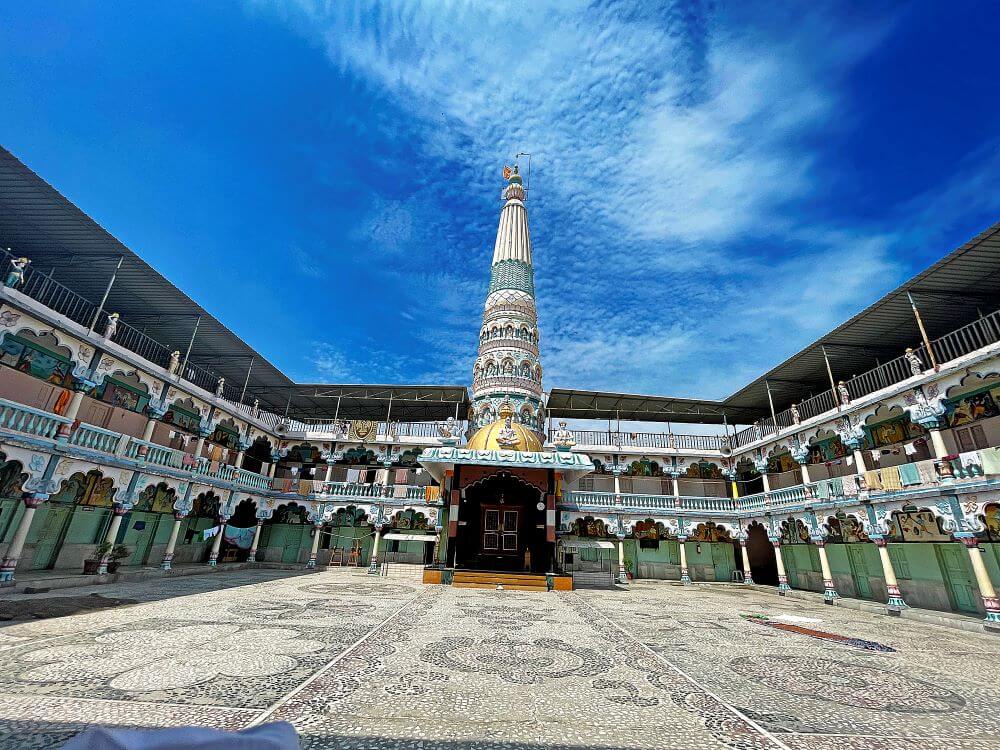
Housed within a grand three-story structure, this temple depicts various episodes from the Bhagavad Gita and the life of Lord Krishna. From a distance, the temple’s massive, elongated building and the paintings of Mahabharata war scenes on its exterior catch the eye. At the temple entrance, there are two statues of Airavata on high pedestals. A grand painting of Vishwaroop Bhagwan Shri Krishna and Arjuna sitting in a posture of salutation before Him is displayed on the door. Above the entrance, an image of Sheshashayi Narayan is depicted. On the floor above, a magnificent colored statue of Shri Krishna driving Arjuna’s chariot on the battlefield of Kurukshetra has been installed. The upper two floors of the temple feature balcony-like structures on the exterior, where the walls are also adorned with scenes from the Mahabharata.
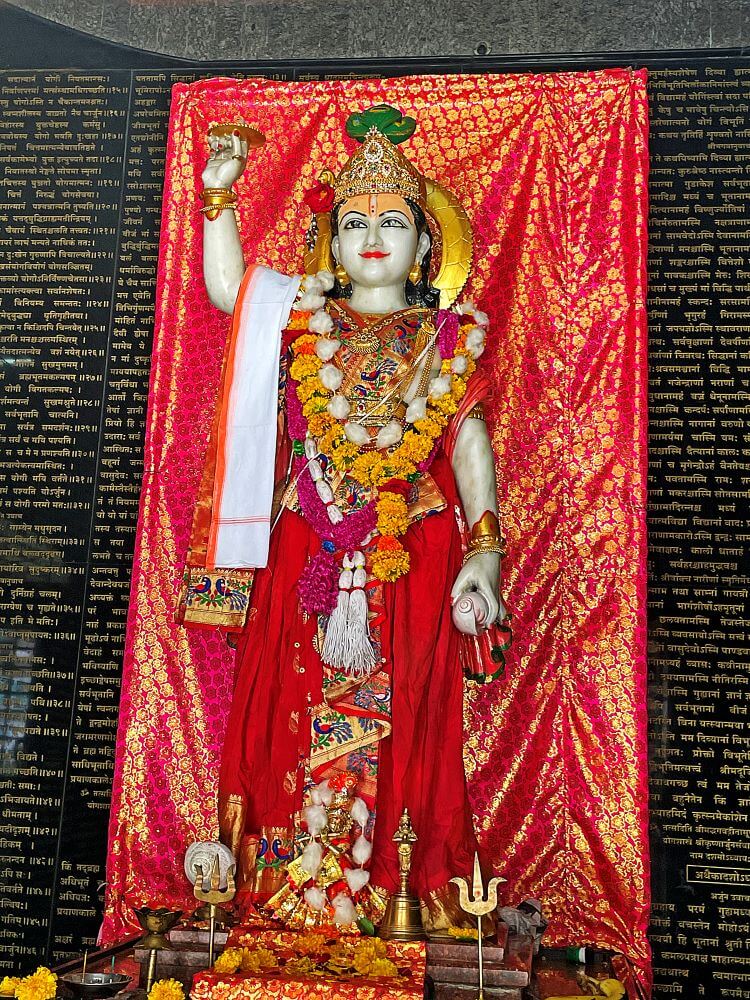
Passing through the entrance leads into the temple courtyard. The temple is designed with a three-story building on all four sides and an open space in the center. The main temple complex consists of a Mukhamandap (front pavilion), Sabhamandap (assembly hall), and a basement. On the front side of the dome-shaped spire of the Mukhamandap are statues of Saint Tukaram Maharaj and Dnyaneshwar Maharaj, with a meditative statue of Lord Vyasa in the center. There is a path to the left of the Mukhamandap leading to the Samadhi in the basement, and an exit path on the right. In the sanctum sanctorum in front of the Mukhamandap, a marble statue of Yogeshwar Shri Krishna holding the Sudarshan Chakra is installed. The walls of this sanctum are inscribed with verses from the Gita, while the basement houses the Samadhi of H.B.P. Bajirao Baba Jawalekar, along with his white marble statue. Devotees can visit the temple daily from 5:00 AM to 10:00 PM.
The temple has a very high, spire-like peak, adorned with statues of various deities, including Lord Ganesha, and saints. There are many rooms on both floors of the building. The walls, railings, and pillars of the balconies are also decorated with various paintings. Programs such as Kirtan, Gita recitation, and Harinam Saptah are regularly celebrated in this temple.
The founder of the Gita Mandir, H.B.P. Bajirao Maharaj Jawalekar, was well-known in the Warkari tradition as Jawalekar Maharaj. He was the first to start a free food distribution center (Annachhatra) for the poor in Paithan, which continues to this day. Additionally, Jawalekar Maharaj provided free Ayurvedic medicines for ailments like paralysis and asthma. In 2006, Jawalekar Maharaj went on a hunger strike at the Nath Mandir to advocate for a grand Mokshadham (cremation ground) on the banks of the Godavari, behind the Eknath Maharaj Samadhi Mandir. Acknowledging his protest, the then-Chief Minister Vilasrao Deshmukh’s government built the Mokshaghat on the banks of the Godavari here. For this reason, Jawalekar Baba is known as the father of this Mokshaghat. He also performed the chanting of the Ram-Nama crores of times here for the construction of the Shri Ram Mandir in Ayodhya. He was honored with awards such as Samaj Bhushan and Ayurvedacharya.
This sacred temple stands as a testament to deep spiritual devotion, ancient architectural grandeur, and rich local cultural traditions.
The sanctum sanctorum houses the divine idol consecrated according to ancient Vedic traditions, surrounded by serene courtyards and traditional temple architecture.



Navratri, Maha Shivratri, Annual Temple Jatra & Deepotsav
Compare and book flights, secure top-rated local hotels near the temple, hire reliable guides, and rent cars instantly.
Extend your pilgrimage by visiting other highly sacred temples located nearby.


Add ₹999 more to unlock FREE SHIPPING!
Your sacred cart is currently empty.
Shop Photo FramesFill in your delivery details below to place your order.
Add comment