
Add ₹999 more to unlock FREE SHIPPING!
Your sacred cart is currently empty.
Shop Photo FramesThe Demon King Ravana was a supreme devotee of Lord Shiva. Many tales of his devotion to Shiva are narrated. In several parts of the country, there are Shiva temples known by Ravana’s name. Among them, the renowned Baidyanath Dham in Deoghar, Jharkhand, is known as Ravaneshwar Dham. It is also believed that the Kamalnath Temple, situated on the Aurgad hills near Udaipur, was established by Ravana. There is also an ancient Ravaneshwar Shiva Temple in Kolhapur. Another such temple in Maharashtra is located in Shiur in the Chhatrapati Sambhajinagar district, known as the Ravaneshwar Mahadev Temple.
The story of Ravana’s penance is told in the tenth chapter of the Uttara Kanda of the Valmiki Ramayana. According to verses 10 to 20 of that chapter, the ten-headed Ravana performed severe penance by fasting for ten thousand years. Upon the completion of every thousand years, he would sever one of his heads and offer it into the sacrificial fire (Homa). In this way, he offered nine of his heads to the Fire God over nine thousand years. As he began to sever his tenth head, the Grandfather Brahma appeared before him and asked for his desire. At that time, Ravana sought the boon that he could not be killed by any Garuda, Naga, Yaksha, Daitya, Danava, Rakshasa, or any of the Devas. A different story of Ravana’s penance is told in the Puranas and the Sthala Mahatmya manuscripts.
According to the Sthala Mahatmya legend of Shiur, Ravana once came to the Dandakaranya forest while wandering and fell in love with this place. He stayed here and performed penance to please Lord Shiva. When Shiva did not appear, he began offering his heads one by one to the Lord. In this manner, he offered nine of his heads. Just as he was about to offer his tenth head, Lord Shiva became pleased with him. A Shiva Linga was installed at this very spot, and in memory of this event, the temple came to be known as the Ravaneshwar Mahadev Temple. At some distance from this temple is a pond called Pranitatirtha. It is said that Ravana used to perform Jalabhishek (water offering) on the Shiva Linga with the water from this pond.
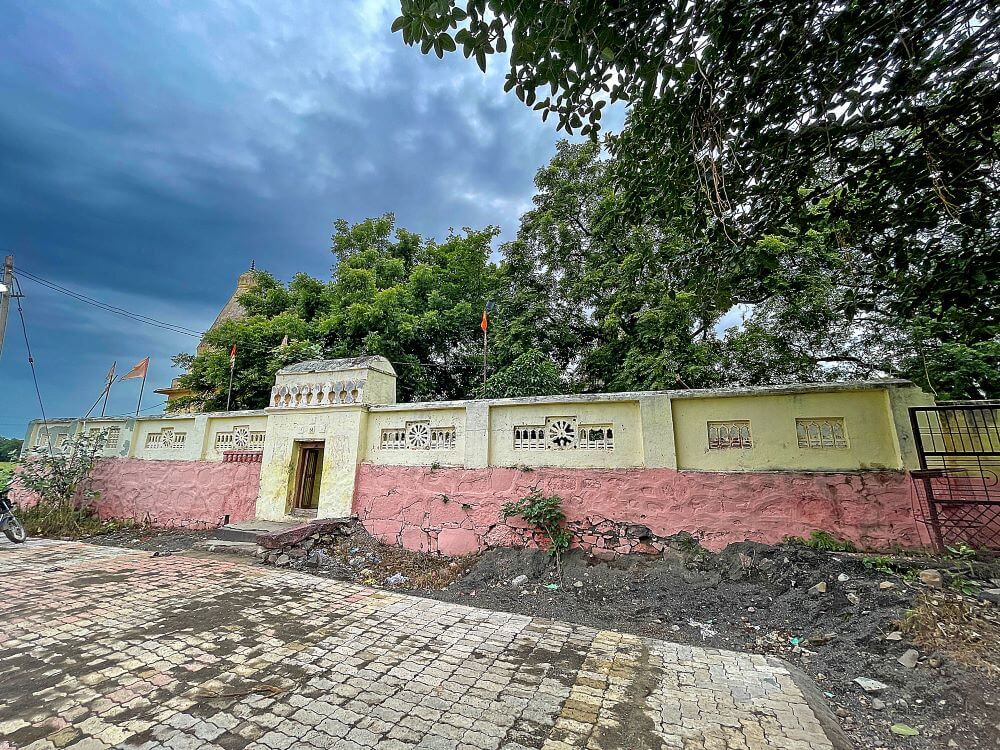
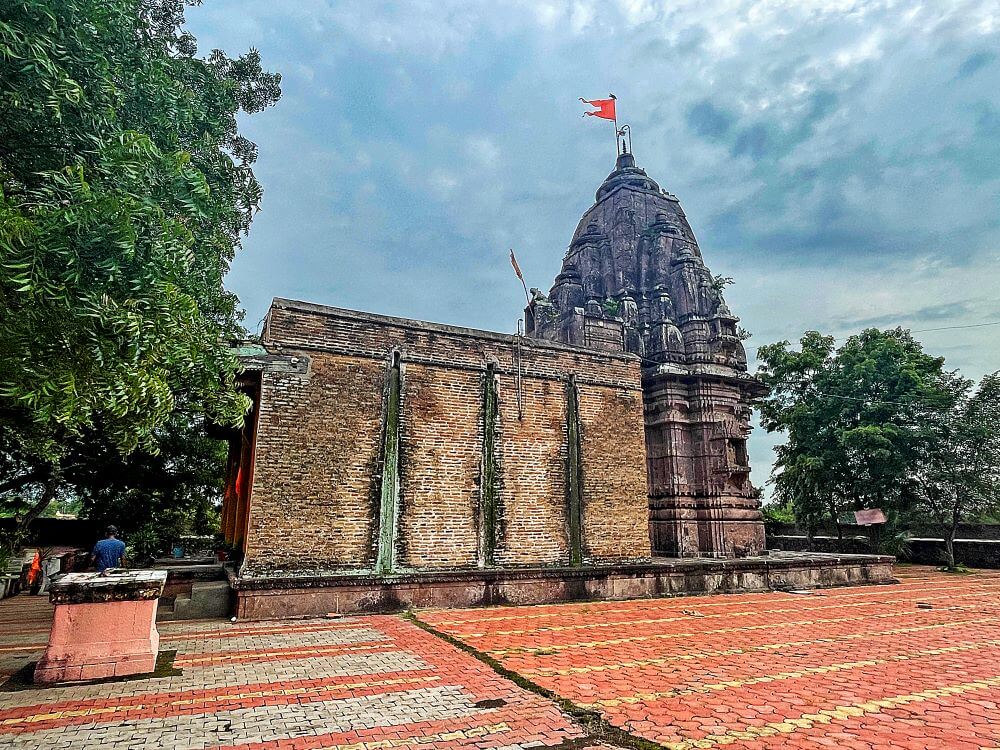
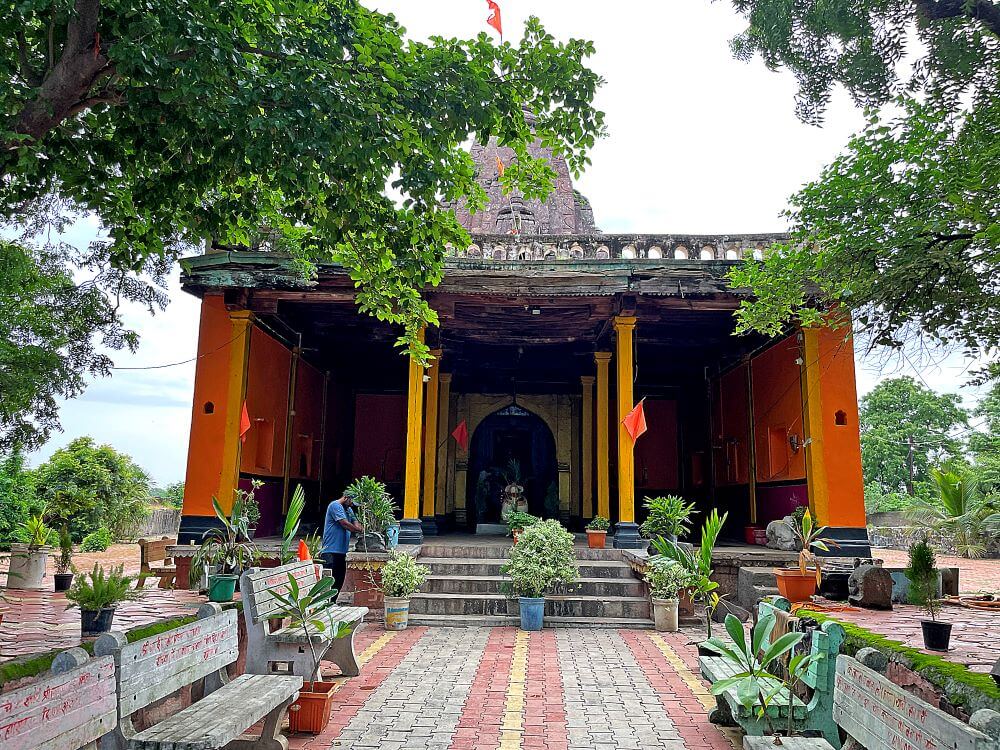
Regarding the village of Shiur, it is said that the village where Ravana installed the Shiva Linga came to be known as Shivpur. Over time, this name corrupted into Shiur. After walking about half a kilometer outside the village, one first sees the stone fortification of the temple. The entrance gate resembles the door of a traditional mansion (wada). In the middle of a stone slab on the side wall, Ravana’s nine heads are carved. Crossing the wooden threshold leads into the temple premises. Directly in front is the square assembly hall (sabhamandapa) of the Ravaneshwar Shiva Temple, which is open from the front. There is a significant difference in the architecture between the stone-built temple and its assembly hall. It appears that this assembly hall was added to the main temple at a later period. The foundation (plinth) of this hall is high. One enters the assembly hall by climbing three steps. The walls here are built of bricks and are plastered from the inside, though the brickwork is clearly visible from the outside. There are three wooden pillars in the side walls of the assembly hall. Additionally, there are three wooden square pillars in each of the two rows in the center. Near the entrance of the assembly hall, there is an idol of Nandi. A short distance ahead, in the middle of the hall, is an idol of a tortoise. Further ahead, in the space (antarala), there is a colorful four-armed idol of Kalbhairava in a stone niche on one side, and a vermilion-smeared idol of Ganesha on the other.
The stone door frame of the sanctum sanctorum is adorned with characteristic carvings and images of deities. The entrance to the sanctum is between two carved circular stone pillars. This entrance is ‘trishakhiya’ (having three bands attached to the outside of the door frame). The inner band is the pillar branch, which is the main frame of the door. Next is the ‘vyalshakha’, on which figures of Vyala (mythical lions) are carved. The outer band features sculptures of minor deities. On these branches, pillar-figures are carved at the bottom. On the lintel of the entrance is an idol of Ganesha. The part above it is called the ‘uttarrang’. There, one finds relief carvings of Ravana’s nine heads, as well as Shiva and his Ganas. On the high threshold of the entrance is a Kirtimukha. In front of it is an ‘ardhachandrashila’, a semi-circular step.
The sanctum of the temple is quite simple. The walls of the sanctum are made of flat stones. After descending a few steps, one gets the darshan of the brass-covered Shiva Linga on the ground. As the ancient Shiva Linga began to wear down, a brass covering was added some years ago. The circular base of the Linga ends and a flat, board-like part begins, where a triangular shape appears on both sides. This is the uniqueness of this Linga.
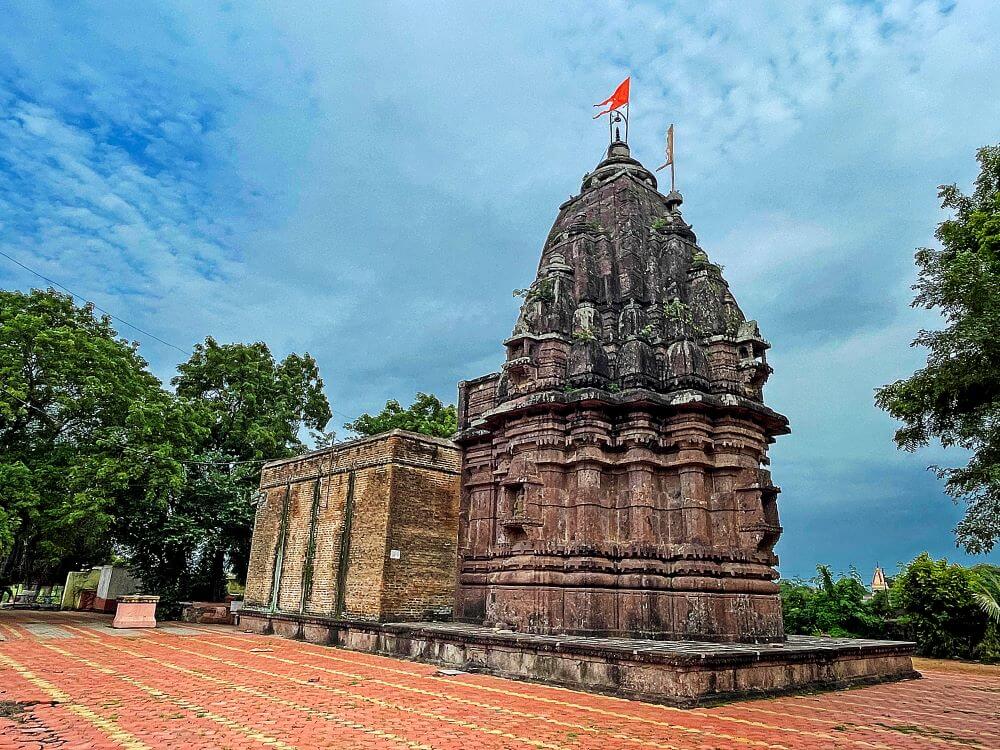
Although the sanctum of the temple is square, the temple appears circular from the outside. This is because the outer wall of the temple is formed by joining various pillars one after another to create that shape. These pillars are square-shaped and are carved with designs. The spire (shikhara) of the temple is also unique. Smaller replicas of the main spire are carved onto it. Because of this, the spire appears to have a tiered structure. Small balcony-like structures have been created on the spire as well as on the walls of the sanctum. Idols of Shiva-Parvati and other deities are carved within them. The Amalaka on the spire is two-tiered, and the finial (kalash) is placed upon it. The entire temple is built on a wide plinth, which also features carvings of elephants. This temple is considered an excellent example of ancient temple architecture. According to temple architects, this temple is in the Bhumija style of Maharashtra.
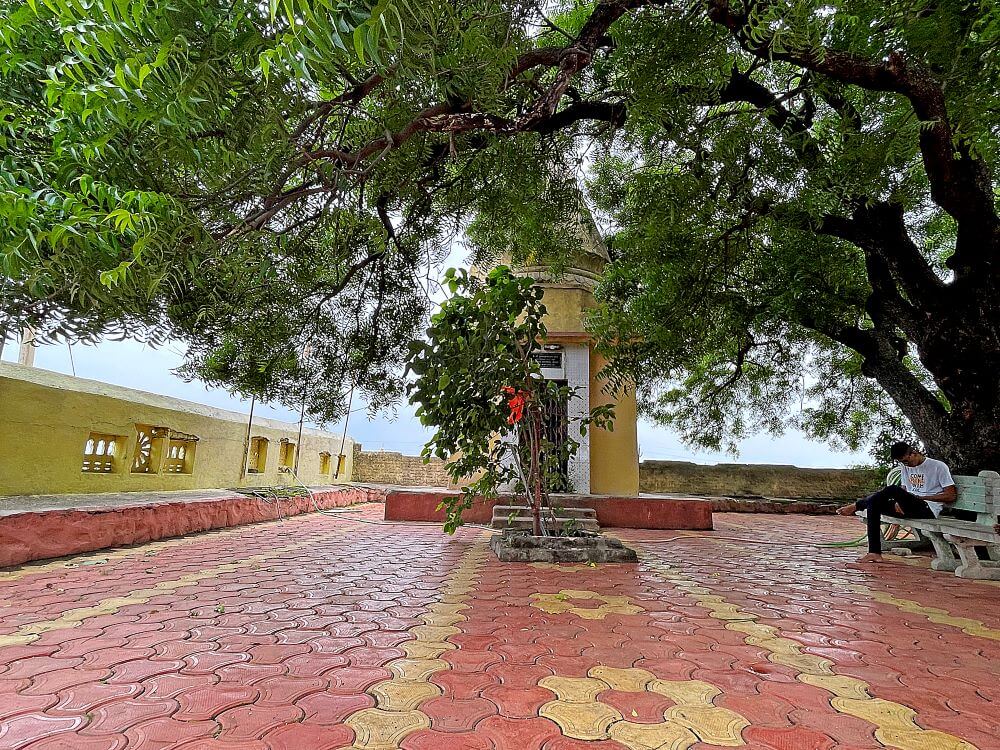
The spacious premises of the temple have many trees, and benches have been provided for devotees to sit. There is a modern temple of Shri Datta in the temple courtyard. Abhishek is performed on the Shiva Linga every Monday at the Ravaneshwar Temple. A large fair is also held here on Mahashivratri.
This sacred temple stands as a testament to deep spiritual devotion, ancient architectural grandeur, and rich local cultural traditions.
The sanctum sanctorum houses the divine idol consecrated according to ancient Vedic traditions, surrounded by serene courtyards and traditional temple architecture.
Navratri, Maha Shivratri, Annual Temple Jatra & Deepotsav
Compare and book flights, secure top-rated local hotels near the temple, hire reliable guides, and rent cars instantly.
Extend your pilgrimage by visiting other highly sacred temples located nearby.


Add ₹999 more to unlock FREE SHIPPING!
Your sacred cart is currently empty.
Shop Photo FramesFill in your delivery details below to place your order.
Add comment