
Add ₹999 more to unlock FREE SHIPPING!
Your sacred cart is currently empty.
Shop Photo FramesThe eighth of the twelve sacred abodes of Khandoba, the family deity (Kuldaivat) of Maharashtra, is situated at the foothills of the mountain in Satara village, near Chhatrapati Sambhajinagar. Renowned as a deity who fulfills the vows of his devotees, thousands of newlyweds visit this temple to perform the ‘Jagran-Gondhal’ ritual. During the fair held here on Margashirsha Shuddha Shashthi (Champa Shashthi), thousands of devotees gather, chanting “Yelkot Yelkot Jai Malhar” while showering turmeric (Bhandara) and dried coconut at the feet of Lord Khandoba.
Legend has it that Khandoba previously resided at Kadepathar, a location some distance away. At that time, the local Jagirdar, Narayan Dixit, would diligently climb the mountain daily to worship Khandoba. He followed this routine for nearly 40 years, climbing and descending two kilometers every day. However, as he aged, he found it difficult to continue. One day, while returning home after offering prayers, Khandoba appeared before him and said, “You are weary due to your age; I am pleased with your devotion and am ready to reside wherever you wish.” Dixit suggested that Khandoba reside in his own home. Accepting the request, Khandoba instructed him to keep walking forward without looking back.
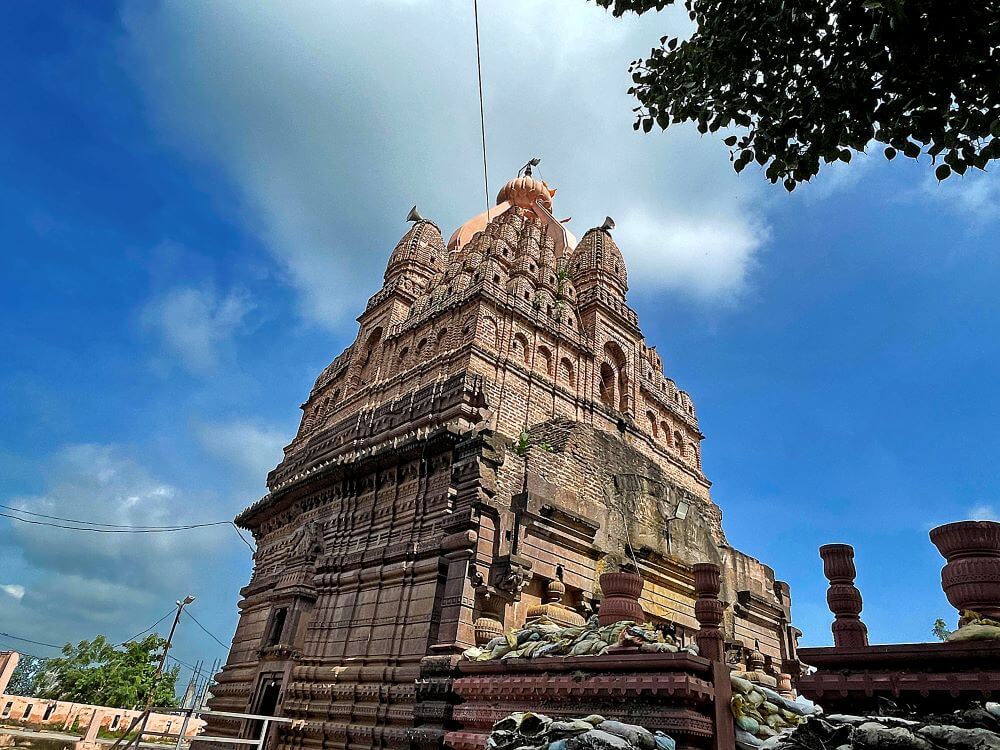
As agreed, Dixit continued walking. However, doubts arose in his mind as to whether the deity was truly following him, and he inadvertently looked back. At that very spot, the deity vanished, and a self-manifested (Swayambhu) idol appeared. That day was Gokul Ashtami, and since then, a grand festival is celebrated here on this day every year. Over time, the villagers built a small temple for Khanderao on the auspicious occasion of Champa Shashthi. Recognizing the significance of the temple, Ahilyabai Holkar renovated it in 1688. The structure up to the sanctum sanctorum is built of stone, while the portion from the spire upwards is constructed of bricks.
The temple is located at the foothills of a mountain in Satara village, a short distance from Chhatrapati Sambhajinagar. Near the main entrance, there are several shops selling flowers, Bhandara, and offerings. Since the temple is elevated, one must climb about 15 steps to reach the entrance. The two-story entrance gate features paintings of gatekeepers (Dwarapals) on both sides. The upper floor of the entrance houses a Nagarkhana (drum house), with paintings of Ahilyabai Holkar on the left and Lord Shiva on the right wall. This Nagarkhana was constructed during the era of Ahilyabai.
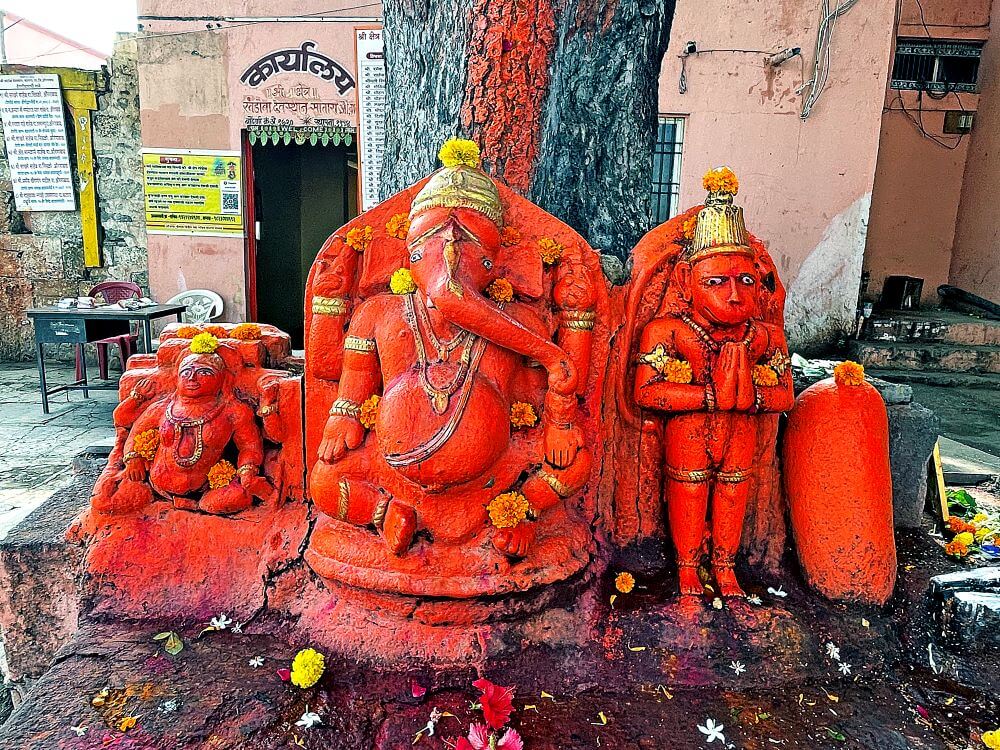
Upon entering the temple courtyard, one sees an ancient and large stone lamp pillar (Deepmal). During Champa Shashthi and other festivals, it is illuminated with hundreds of lamps. In front of the lamp pillar lies a Nandi carved from a single stone. There is a platform in the temple premises where a small stepwell (Barav) once stood. Devotees used to wash their hands and feet there before entering the temple for darshan. However, as the stones of the stepwell became slippery, many devotees would slip and fall; consequently, the well was filled in, and a platform was built in its place. In the courtyard, near a sacred tree, there are vermilion-smeared idols of Munja, Ganpati, Hanuman, and Mhasoba. It is said that an underground tunnel was also discovered beneath this temple some years ago.
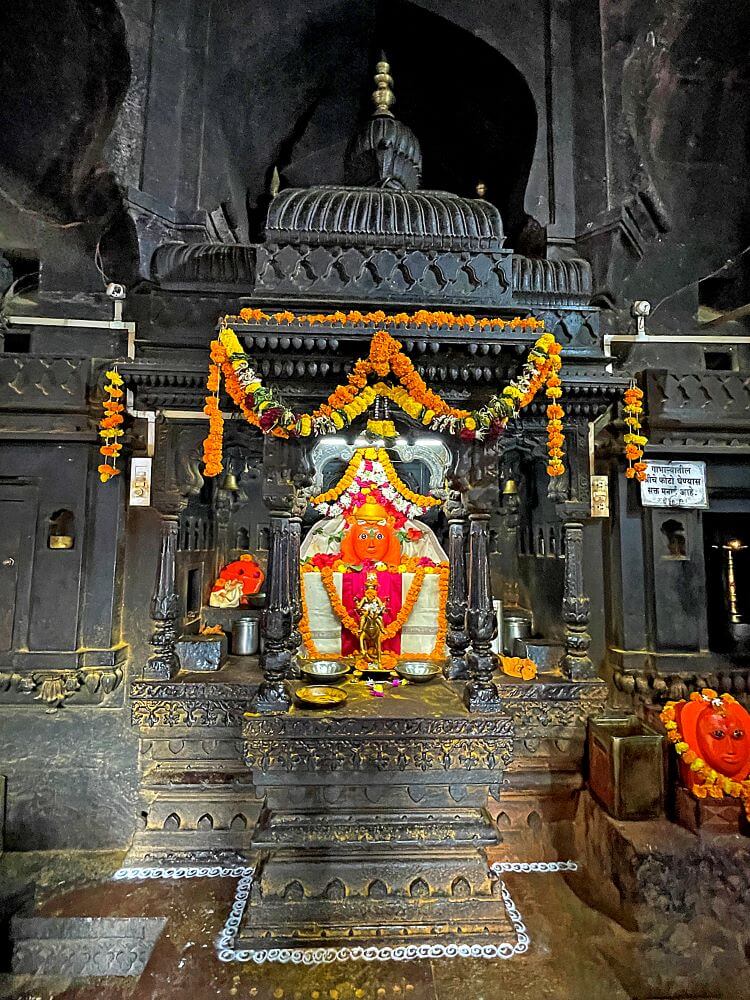
The stone pillars of the Khandoba temple feature attractive craftsmanship and carvings. The outer walls of the temple are adorned with carvings of Gandharvas, Apsaras, and various deities, many of which remain in good condition today. One must climb eight steps to enter the main temple. Near the main entrance, there is an idol of a tortoise. In the niches on the entrance walls, there are idols of Ganesh to the south and Maruti to the north. The upper part of this entrance depicts the Dashavatara (ten incarnations of Vishnu). To the south, the creation by Brahma is depicted, while the north features scenes from the life of Krishna. The upper section on the south side also features a sun sculpture. There are also sculptures of Mirabai and Garuda. The east-facing door is decorated with floral patterns, and there are figures of Jai-Vijay on both sides near the pillars. The lower part of the entrance features a Kirtimukh, and the lintel bears an idol of Ganesh.
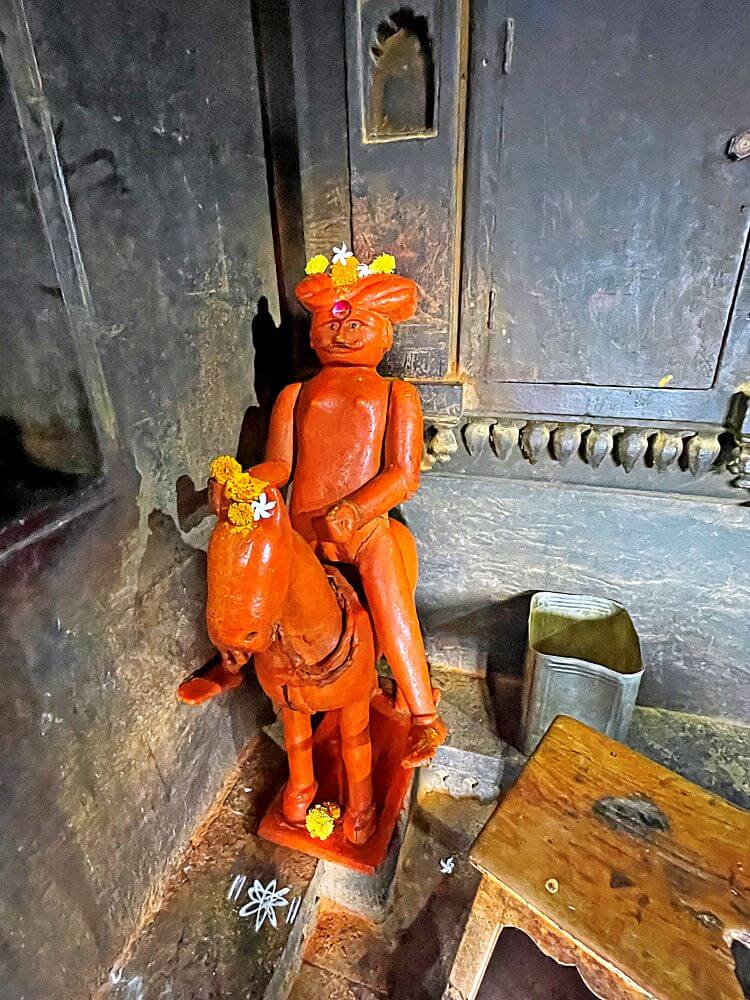
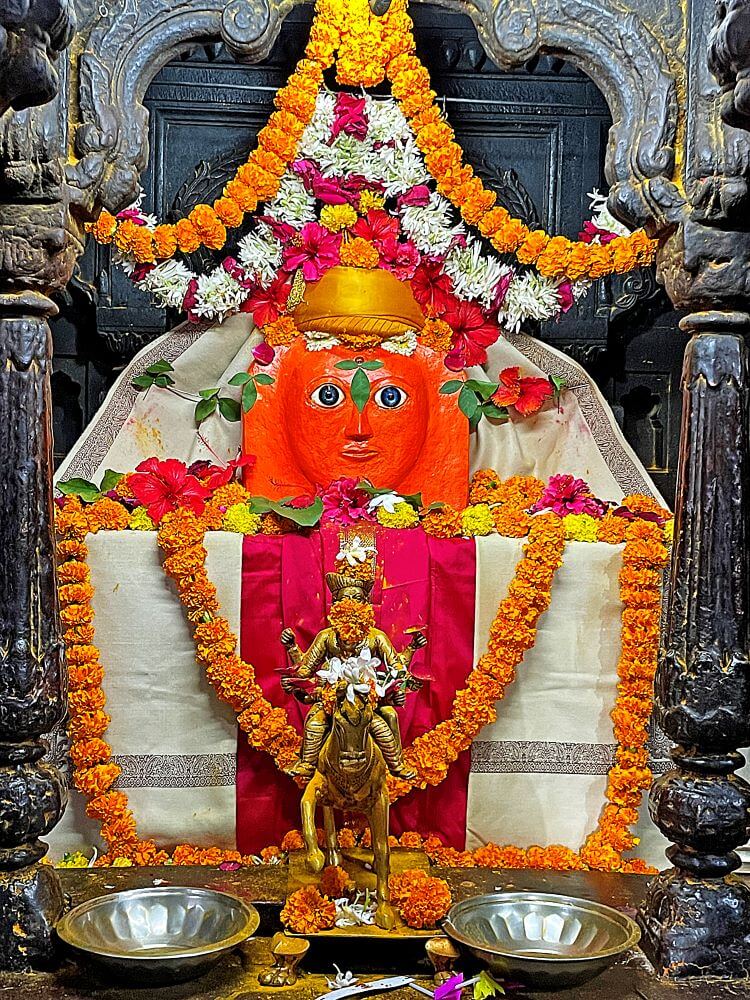
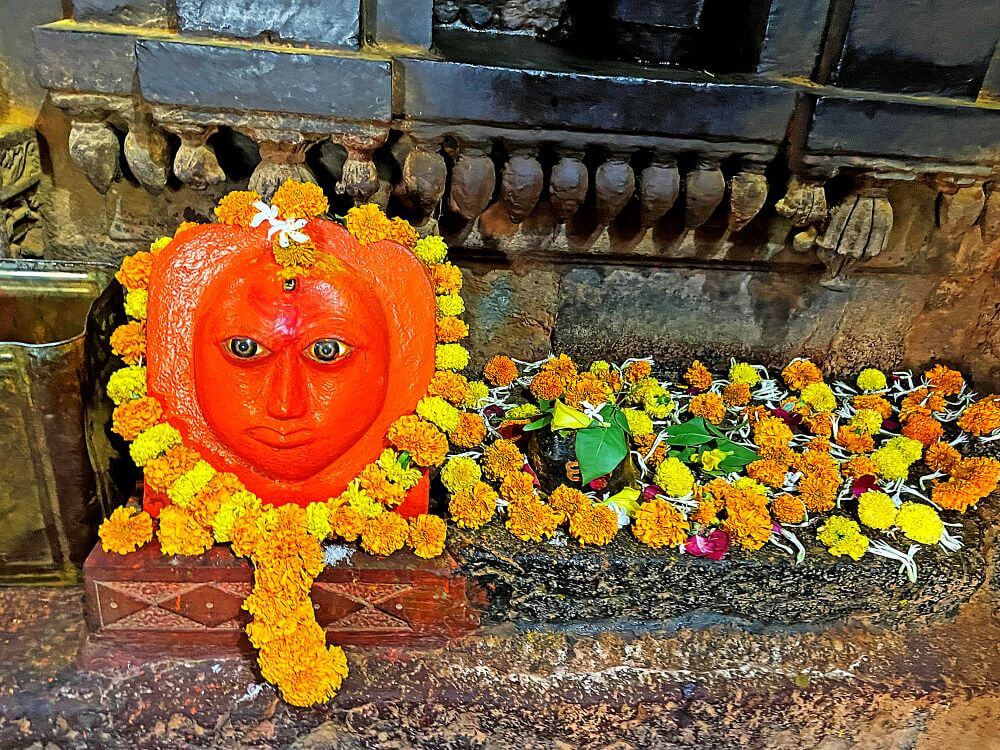
It is said that the sanctum sanctorum of this temple is larger than that of all other Khandoba temples. Inside, on a high, intricately carved platform, stands the Swayambhu idol of Khandoba made of black stone. To the lower left of the idol are Khandoba’s ‘Tandala’ (symbolic stone) and a Shiva Linga. In one corner of the sanctum, there is a vermilion-smeared idol of a warrior mounted on a horse. There is also an ancient eight-foot-long double-edged sword (Khanda). The legend associated with this sword is that in the Treta Yuga, two demons named Mani and Malla were wreaking havoc and tormenting sages. When the sages sought refuge with Shiva, he took the avatar of Khandoba and slew Mani and Malla on this very mountain (Kadepathar) with this sword. Upon exiting the sanctum, one can see the Kadepathar mountain in front.
Festivals such as Champa Shashthi, Paush Purnima, and Chaitra Purnima are celebrated in this temple. A large fair is held on Champa Shashthi, during which the temple and its surroundings are beautifully illuminated. On the morning of Champa Shashthi, after the Laghurudrabhishek, Khandoba is adorned with new clothes. Following this, an offering (Naivedya) of 56 types of food items, including ‘Rodge’, eggplant mash (Vangyache Bharit), and Puran Poli, is presented. The Maha-Aarti takes place at 7:00 AM. At 8:00 AM, the deity’s palanquin (Palkhi) leaves the temple with musical accompaniment. It arrives at the nearby Dixit mansion. Currently, no descendants of the Dixits reside in this mansion. The Palkhi is worshipped in the traditional manner by their relatives, the Dandekar family. Rudrabhishek, family rituals, and Naivedya are offered here. Thereafter, the Palkhi proceeds to the old temple on the mountain. After formal worship there, a procession of the Palkhi is taken through the village.
During the Khandoba fair, folk art programs such as Kalgitura, Wagya-Murali, Sawal-Jawab, and Lavani are performed. Many newlyweds visit here to fulfill vows made to Khandoba and to seek the blessings of Khanderao. Thousands of devotees from the surrounding areas who are unable to visit the Khandoba temple at Jejuri also come here for darshan. This temple and its premises have been declared a state-protected monument by the Archaeological Department, which currently maintains control over the temple. According to mentions in historical novels, Chhatrapati Shivaji Maharaj used to stay in this Khandoba temple disguised as a sage to plan guerrilla warfare against Aurangzeb.
This sacred temple stands as a testament to deep spiritual devotion, ancient architectural grandeur, and rich local cultural traditions.
The sanctum sanctorum houses the divine idol consecrated according to ancient Vedic traditions, surrounded by serene courtyards and traditional temple architecture.
Navratri, Maha Shivratri, Annual Temple Jatra & Deepotsav
Compare and book flights, secure top-rated local hotels near the temple, hire reliable guides, and rent cars instantly.
Extend your pilgrimage by visiting other highly sacred temples located nearby.


Add ₹999 more to unlock FREE SHIPPING!
Your sacred cart is currently empty.
Shop Photo FramesFill in your delivery details below to place your order.
Add comment