
Add ₹999 more to unlock FREE SHIPPING!
Your sacred cart is currently empty.
Shop Photo FramesThe ancient temple of Rasai Devi, situated in a cave at the foothills of the Devgiri Fort (now known as Daulatabad), is especially famous among devotees and tourists. Legend has it that this Goddess lifted the invincible and massive Daulatabad Fort on her little finger. She was named ‘Rasai’ as the deity who guarded the treasure of the Yadava kings, which consisted of heaps of diamonds and pearls. Devotees believe that this self-manifested (Swayambhu) Goddess, located in a crevice of the fort’s moat, is highly awakened and grants the wishes of those who pray to her.
The Daulatabad Fort in Chhatrapati Sambhajinagar district is considered a wonder not only in Marathwada but in the entire country. At an altitude of 901 meters above sea level, the fort was known as Devgiri during the Yadava era. Later, it was renamed Qutubabad, Quwwat-ul-Islam, and finally Daulatabad. Muhammad Tughlaq shifted his pan-Indian capital to this fort for a period. Thus, Chhatrapati Sambhajinagar in Maharashtra holds the unique honor of having been the political capital of the entire country. Although the fort houses many ancient places of worship belonging to the Hindu, Muslim, and Jain religions, the Rasai Devi temple is not inside the fort but in a cave in the mountain at the foothills, near the village of Kesapuri Tanda, approximately three kilometers from the fort’s entrance.
The fort has three successive fortifications like the layers of an onion. These are the outermost fortification, Ambar Kot, followed by Maha Kot, and finally, Kala Kot. To reach the Rasai Devi temple, one must come from Daulatabad via the Gawalipada road, cross the entrance in the Ambar Kot fortification, and reach Kesapuri Tanda. The Daulatabad mountain is visible near this entrance. The temple is at the foothills of this mountain. Vehicles must be parked at a distance from the temple, and one must proceed on foot. While walking along this hilly path, many custard apple trees can be seen. (Khuldabad Taluka is famous in Maharashtra for high-quality custard apples.) Remnants of the fort’s fortifications are also visible along this path. Near the foothills, in front of the temple, stands a stone lamp pillar (Deepmal). Above the foothills, there used to be a drum house (Nagarkhana) for the temple. During festivals, drums were played here. However, it has now partially collapsed.
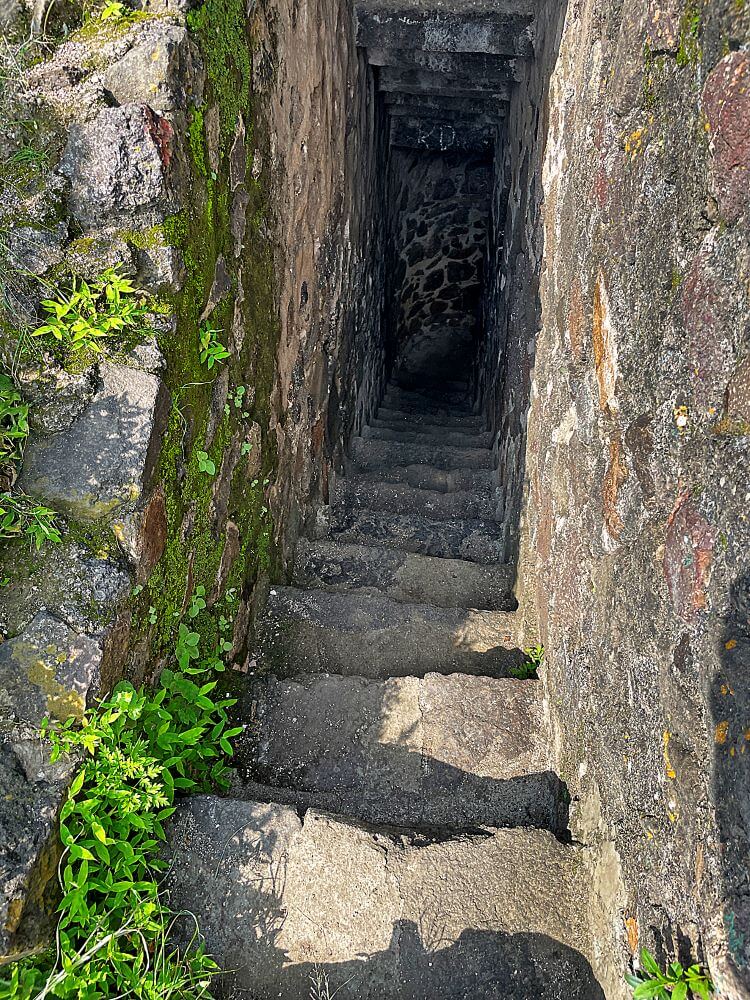
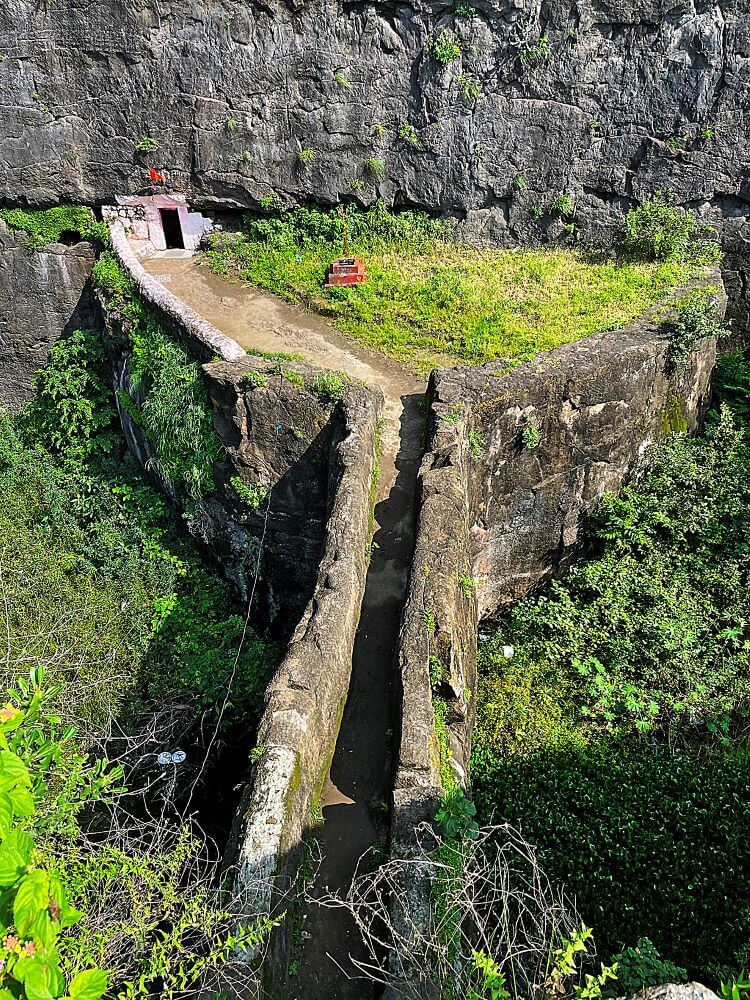
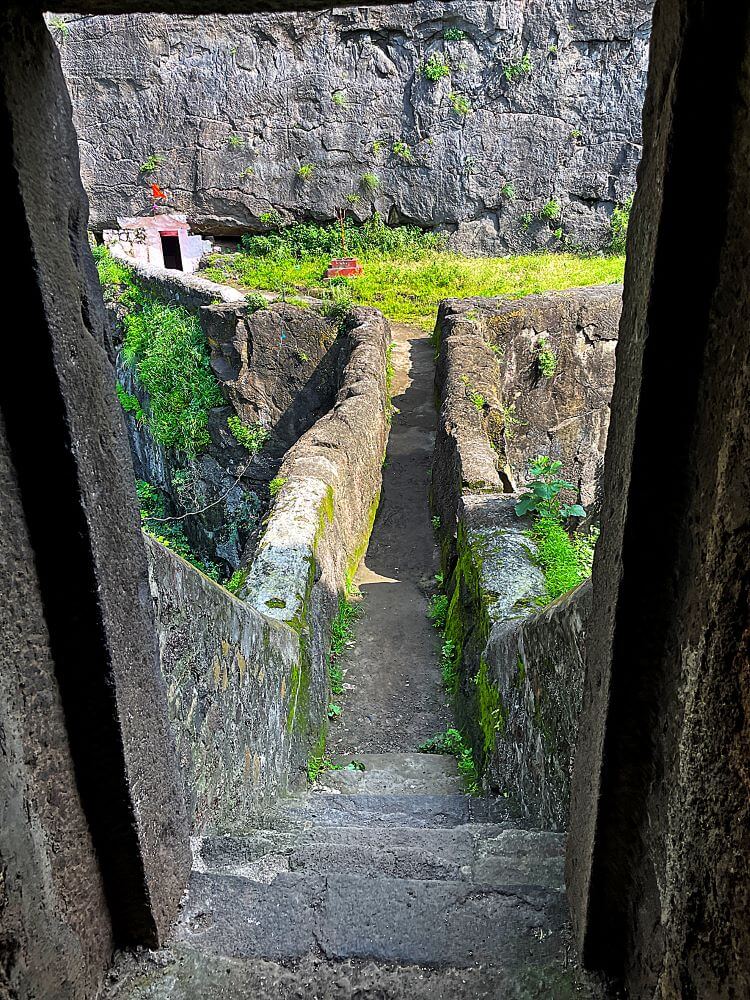
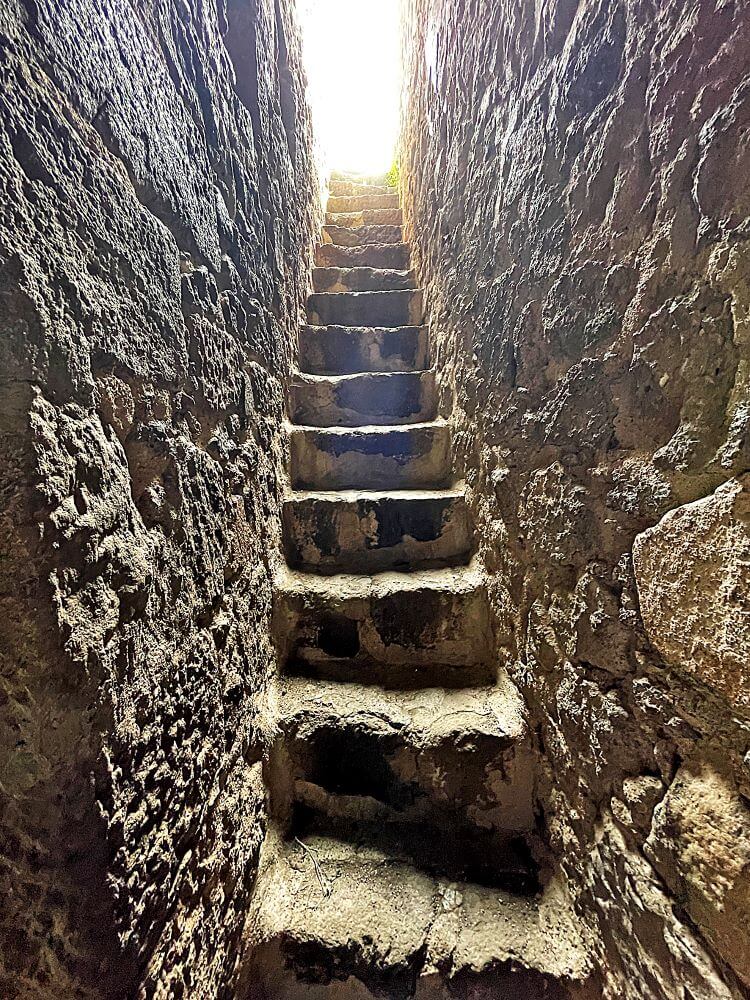
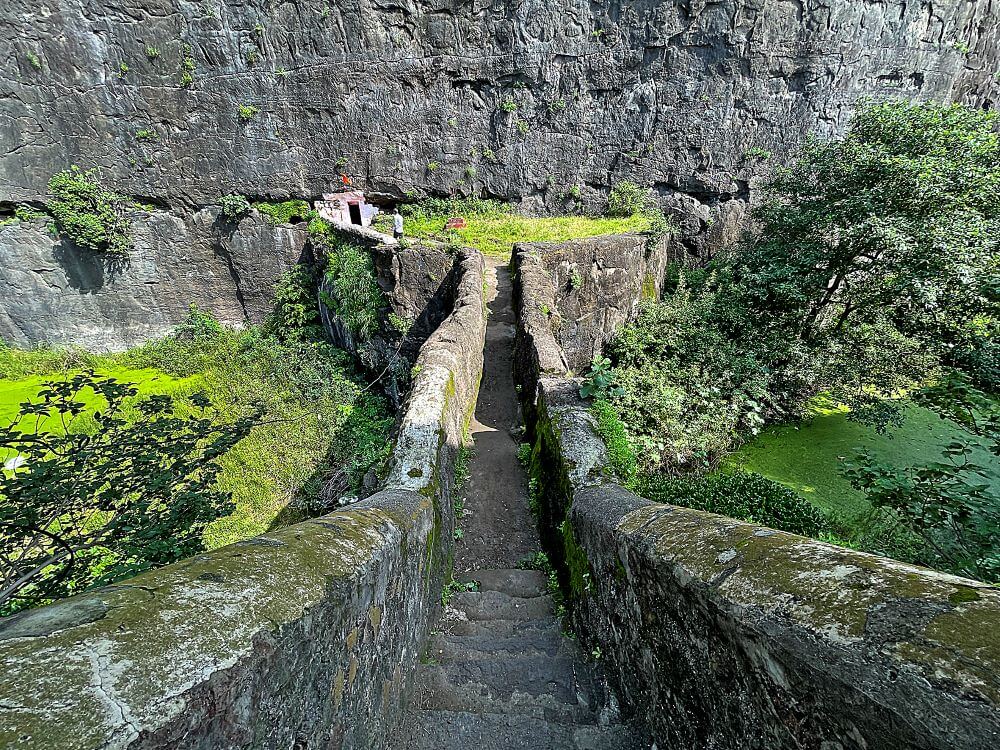
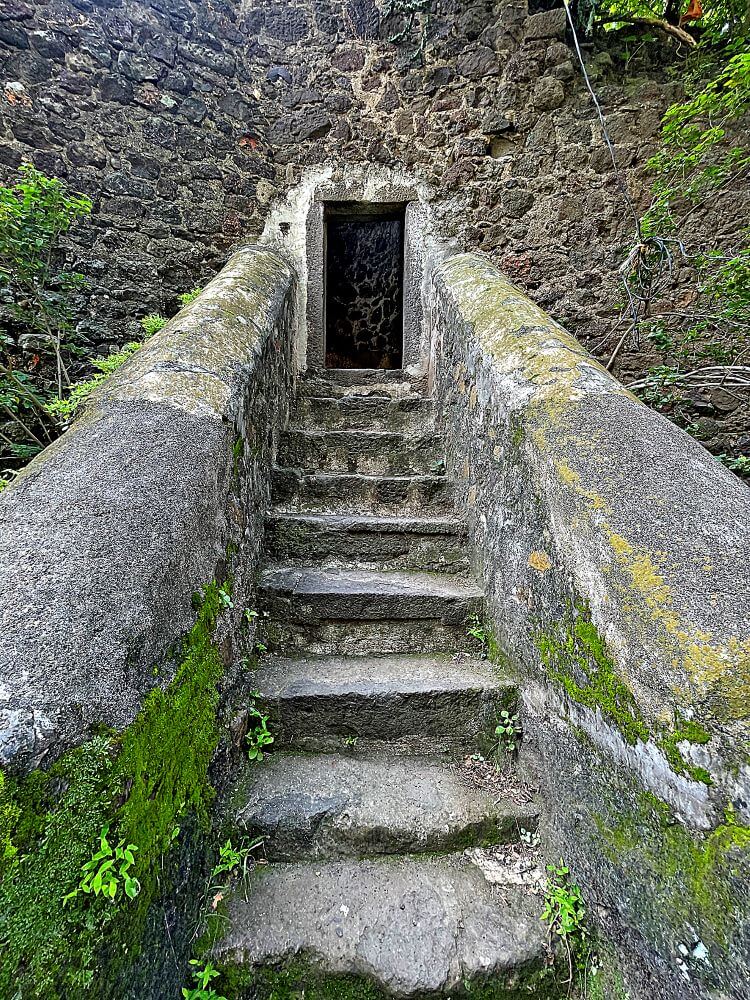
A few steps from the lamp pillar, one must climb eight to ten stone steps. Upon reaching the top, one sees a stone tunnel passing through the fortification. Turning inward at a 90-degree angle from here, one sees a bridge made of monolithic stone. On both sides of this bridge are deep moats. This water moat, about 40 feet wide and 40 feet deep, used to contain crocodiles, alligators, and water snakes. This arrangement was made to prevent enemies from swimming through the moat to enter the fort. Upon reaching the stone bridge, one sees a sheer cliff of the mountain, about 165 feet high, directly ahead. This cliff, the water moat, and the stone bridge are all part of a single, solid rock.
After crossing the stone bridge and entering the temple premises, one can see the Trishul (trident), which is the weapon of the Goddess, and the Yajna Kund (sacrificial fire pit). A few steps from here is the small entrance to the temple. Since the entrance is low, one must bow down to enter. To enter this cave temple, one must descend steps carved into the rock. In this painted cave, which is about seven feet high, the idol of the Goddess, covered in vermilion, is placed on a pedestal. The smiling Goddess has a nose ring (Nath) and a large round mark (Tila) on her forehead. This self-manifested Goddess, the family deity of the descendants of the Yadava kings, is famous as a powerful, awakened deity. As the Goddess is vegetarian, she requires offerings prepared in a state of ritual purity (Sowala). A grand fair is held for the Goddess every year on Chaitra Purnima, when thousands of devotees come for her darshan. Some scenes of the film ‘Ahimsa’, released in 1979, were shot in this area.
This sacred temple stands as a testament to deep spiritual devotion, ancient architectural grandeur, and rich local cultural traditions.
The sanctum sanctorum houses the divine idol consecrated according to ancient Vedic traditions, surrounded by serene courtyards and traditional temple architecture.
Navratri, Maha Shivratri, Annual Temple Jatra & Deepotsav
Compare and book flights, secure top-rated local hotels near the temple, hire reliable guides, and rent cars instantly.
Extend your pilgrimage by visiting other highly sacred temples located nearby.


Add ₹999 more to unlock FREE SHIPPING!
Your sacred cart is currently empty.
Shop Photo FramesFill in your delivery details below to place your order.
Add comment