
Add ₹999 more to unlock FREE SHIPPING!
Your sacred cart is currently empty.
Shop Photo FramesThe Grishneshwar Jyotirlinga Temple is situated in the Verul area, which holds great historical, religious, and cultural significance. This temple is one of the twelve Jyotirlingas. It is recognized as the final, or twelfth, Jyotirlinga described in the Shiva Purana. Along with the Shiva Purana, this temple is also mentioned in the Skanda Purana, the Ramayana, and the Mahabharata. It is also linked to the history of Chhatrapati Shivaji Maharaj. Furthermore, the temple is located just one kilometer away from the world heritage site of the Ellora Caves.
Located in the village of Elapur, at the foothills of the Mahishadri mountain in Verul and on the banks of the Yelganga River, this temple has a history dating back to the Rashtrakuta era. The original temple was built by the Rashtrakuta monarch Krishna Raja. Over time, it fell into disrepair. Later, in 1599 AD, Malojiraje Bhosale, the grandfather of Chhatrapati Shivaji Maharaj, renovated this temple and the Shivalaya Tirtha pond located there. Malojiraje Bhosale was a Panchhazari Mansabdar of the Nizam of Ahilyanagar. Nizam Murtaza had bestowed upon him the title of ‘Raja’. According to information provided by the historian V. K. Rajwade in the preface of ‘Radhamadhavavilasachampu’, “In 1593 AD, at the age of 43, Malojiraje discovered buried treasure and, after a divine vision of Goddess Jagadamba, was blessed with the attainment of a kingdom.”
Malojiraje was a devout follower of Lord Shiva. Therefore, he used the discovered wealth to build a pond at the foothills of Shikhar Shingnapur and renovated the Grishneshwar Temple in Verul, which was the ancestral Patilki estate of his family. Subsequently, due to the conflicts between the Nizamshahi and the Mughal Empire of Delhi, the region fell into chaos, and the temple suffered damage. Aurangzeb had demolished this temple. In 1730 AD, Gautamabai, the wife of Sardar Malharrao Holkar, built the current temple. Thirty-nine years later, in 1769 AD, Punyashlok Ahilyabai Holkar reconstructed the Shivalaya Tirtha. The Government of India has included the Grishneshwar Temple in the ‘PRASHAD 2’ scheme, launched for the development of religious tourism and pilgrimage sites.
According to the legend regarding the temple, Lord Shiva and Goddess Parvati used to play dice frequently. Parvati would win every time. Once, having lost, Shiva became angry. In his rage, he left for the Kamyaka Forest. Parvati followed him in search of him. She assumed the form of a young tribal woman (Bhillini) and won his heart. One day, when Parvati felt thirsty, Shiva struck the ground with his trident, offering her water from the subterranean Bhogavati River. That very spot is known as Shivalaya Tirtha. Once, while at this place, Parvati was preparing sacred vermilion (kumkum) to apply to her forehead. Holding vermilion and saffron in her left hand, she was mixing them with water from the Shivalaya Tirtha pond using her right hand. At that moment, due to the friction, a brilliant light suddenly emanated from Parvati’s hand, and a Shiva Linga manifested from it. Because it was created through friction (gharshan), Parvati named it Grishneshwar. It is also known as Kumkumeshwar.
According to a mythological tale, a devout Shiva worshipper named Sudharma of the Bharadwaj clan and his wife Sudeha lived in prosperity; however, despite many fasts and vows, they were not blessed with a son. Consequently, Sudeha asked Sudharma to marry again. Yielding to her insistence, Sudharma agreed. Accordingly, Sudeha arranged his marriage with her sister, Grishna. Over time, Grishna gave birth to a son. As a result, Sudharma began spending more time with her. This awakened jealousy in Sudeha’s heart. Grishna was also a supreme devotee of Shiva. Every day, she would create a Shiva Linga out of sand by a pond. After worship, she would immerse it in the pond. One day, Sudeha seized the opportunity, killed Grishna’s son, and threw his body parts into the pond. Grishna was performing her daily worship of Shiva there, unaware of her son’s death. Seeing her devotion, Shiva resolved the crisis that had befallen her. As Grishna was worshipping, Shiva appeared before her and called out to her son. The boy emerged from the pond. Seeing this, Grishna’s tears flowed uncontrollably. She held onto Shiva’s feet. Shiva asked her to seek a boon. Accordingly, she requested Shiva to reside there permanently for the welfare of the world. Shiva said “Tathastu” (so be it) and assumed the form of a Jyotirlinga. This is the Jyotirlinga of Grishneshwar.
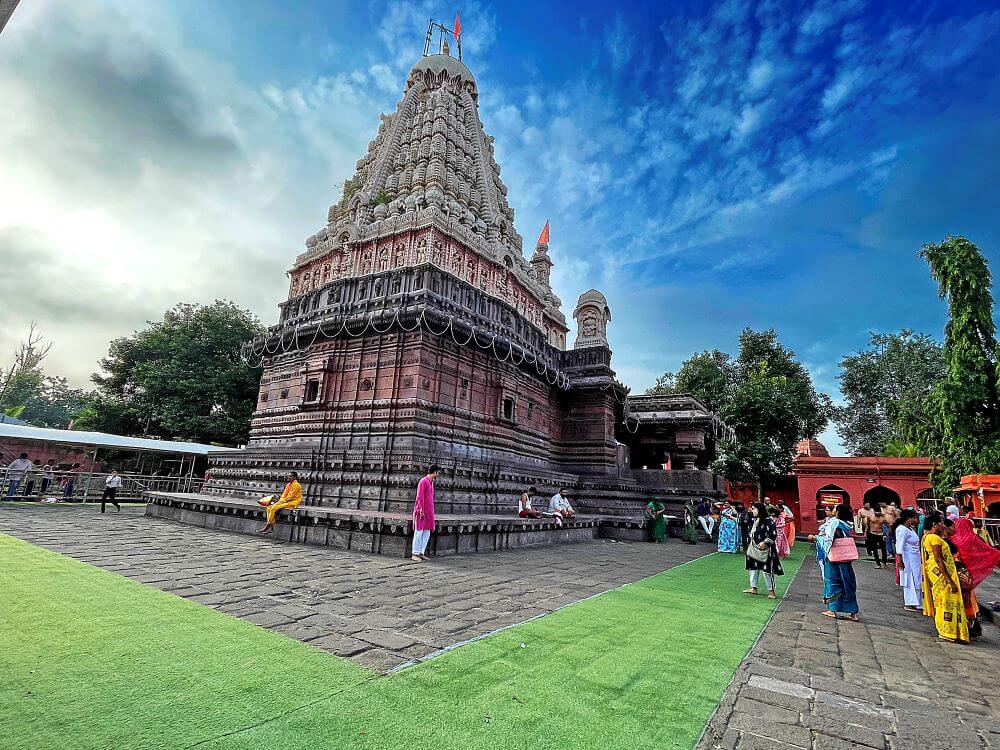
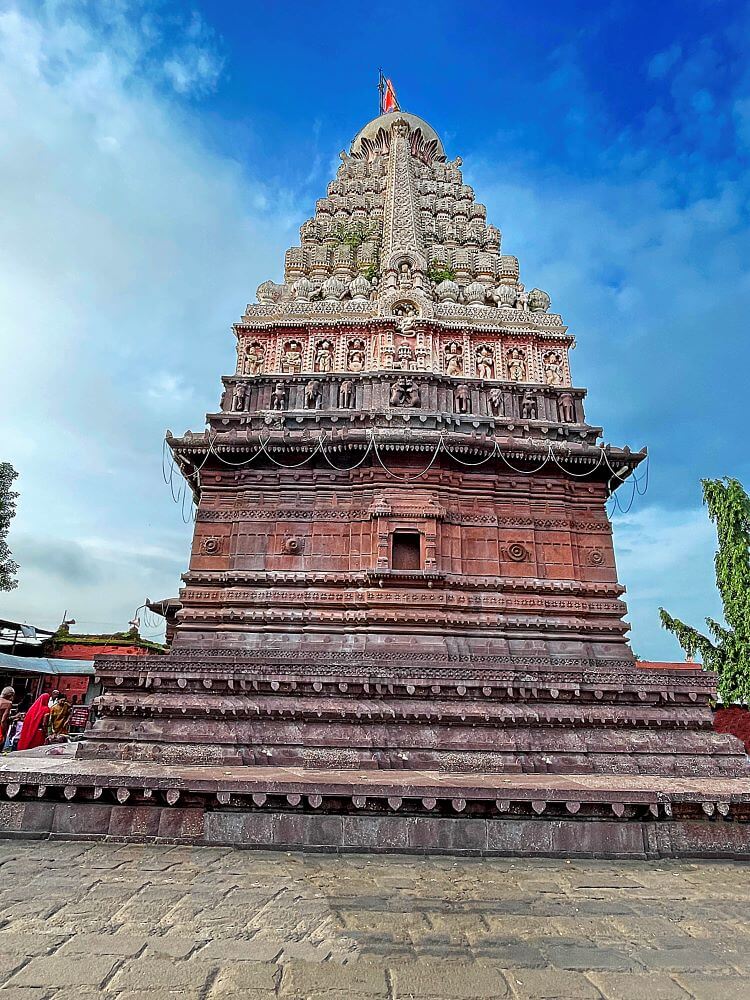
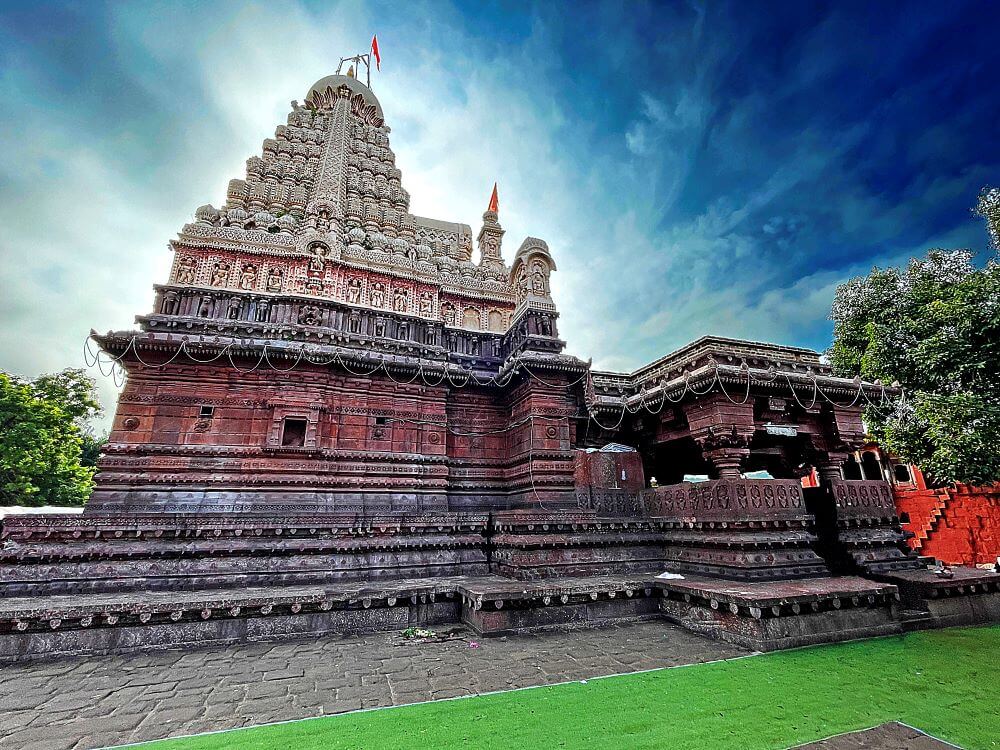
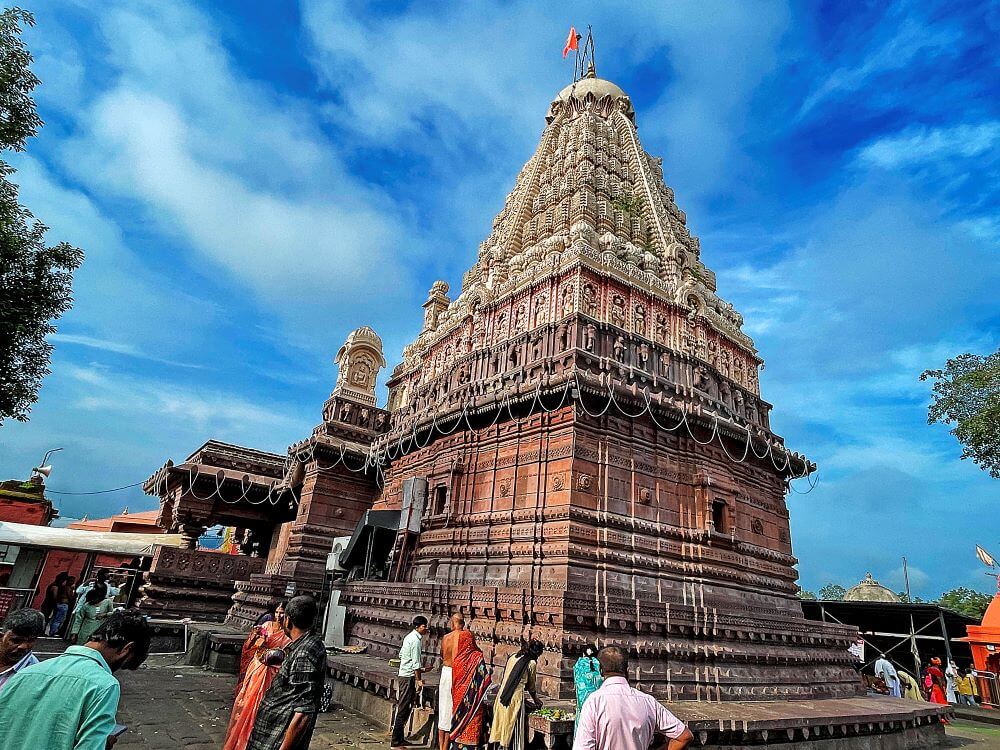
Upon arriving in Verul, one can see the spire (kalash) of the Grishneshwar Temple from a distance. The temple is surrounded by a stone wall about 12 feet high. A fine example of medieval South Indian architecture, this temple is built using reddish stone. The temple’s spire features numerous statues of deities and Nandi. There is a golden kalash atop the spire. The temple has three entrances, with the main entrance being smaller in size. Opposite it stands a temple of Hanuman facing east. All entrances feature beautiful carvings.
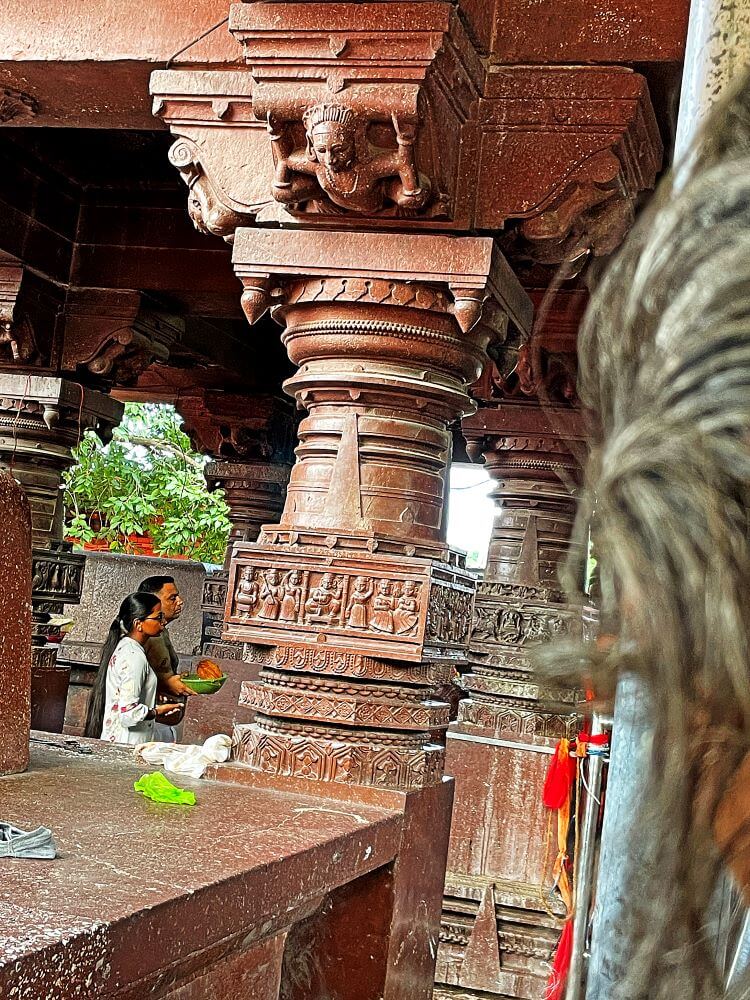
The temple is structured with a Darshan Mandap, Sabha Mandap, Antarala, and Garbhagriha. The Sabha Mandap here is in the form of an Ardha-mandap with side seating (kakshasana). There are 24 stone pillars in the Sabha Mandap. Each of these pillars is carved with images of deities and religious scenes. Additionally, there are ancient inscriptions on these pillars. In the center of the Sabha Mandap stands a magnificent carved Nandi made from a single stone. Beyond this is the Antarala, from which the Garbhagriha is situated slightly lower. One must descend five steps from the Antarala to enter the Garbhagriha. The door frame of the Garbhagriha is carved with leaves, flowers, animals, birds, and various human expressions. The Shiva Linga is installed in the Garbhagriha and faces east. A small metal railing has been built around the Shiva Linga. On special occasions, a large brass statue of a hooded serpent is placed over the Shiva Linga. Near the temple is a deep stepped water tank, which is referred to as Shivalaya Tirtha. It contains eight shrines. It is said that Prajapita Brahma had invited the eight holy sites—Kashi Tirtha, Gaya Tirtha, Ganga Sangam, Viraja Tirtha, Vishaal Tirtha, Tryambak Tirtha, Dwaravati, and Reva Tirtha—to that very spot.
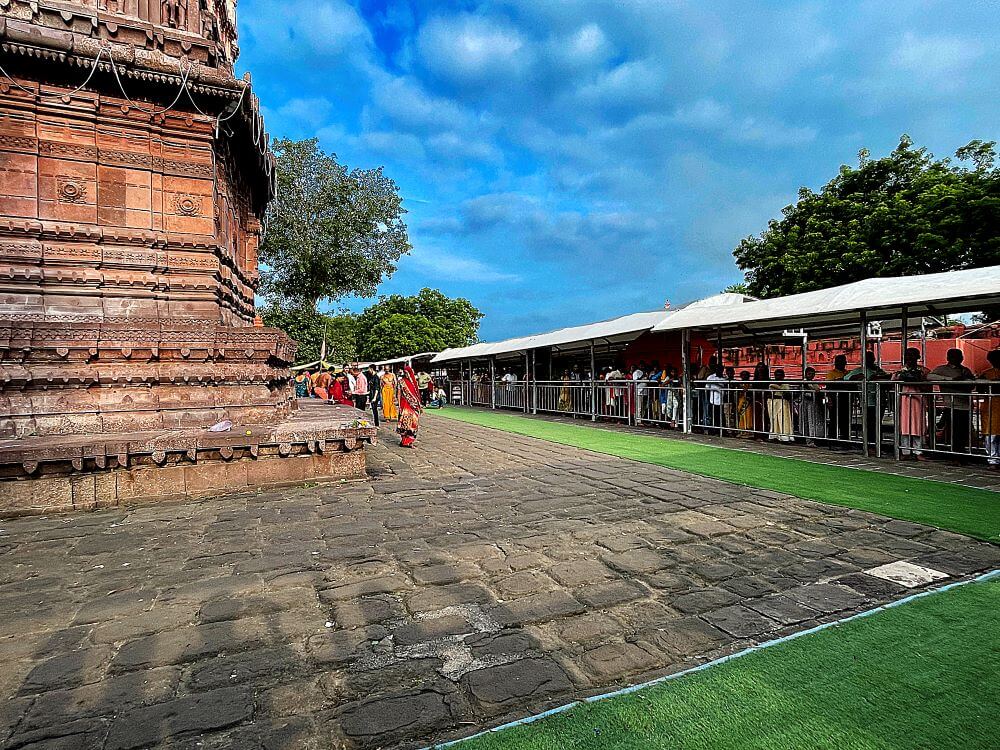
From early dawn, the temple resonates with prayers, chanting, Abhisheka, and the recitation of sacred mantras. There is a specific dress code for men to enter the temple; wearing any garment on the upper body is prohibited. It is customary here to wear a dhoti or sovle while performing the worship of the Jyotirlinga. There is no specific dress code for women. A grand worship (Maha Puja) of Grishneshwar is performed on Mahashivratri, Shivratri, and every Monday. On these days, as well as every Monday during the holy month of Shravan, there is a massive influx of devotees. Even on regular days, thousands of devotees visit the temple for Darshan.
A daily Panchamrit Abhisheka Puja of the Shivalinga is performed at the temple. Devotees can perform various rituals here, including Panchamrit Puja, Rudrabhisheka Puja, all Abhisheka Pujas during the month of Shravan, and Laghu Rudrabhisheka along with Brahmo-bhojan. It is necessary to contact the temple administration in advance for these arrangements. Devotees can visit the temple for the Darshan of Grishneshwar daily from 5:00 AM to 8:00 PM. Near the temple, one can find the world-famous Ellora Caves, the Lakshmivinayak Temple, and the historic fort of Maloji Raje.
Useful Information:
This sacred temple stands as a testament to deep spiritual devotion, ancient architectural grandeur, and rich local cultural traditions.
The sanctum sanctorum houses the divine idol consecrated according to ancient Vedic traditions, surrounded by serene courtyards and traditional temple architecture.
Navratri, Maha Shivratri, Annual Temple Jatra & Deepotsav
Compare and book flights, secure top-rated local hotels near the temple, hire reliable guides, and rent cars instantly.
Extend your pilgrimage by visiting other highly sacred temples located nearby.


Add ₹999 more to unlock FREE SHIPPING!
Your sacred cart is currently empty.
Shop Photo FramesFill in your delivery details below to place your order.
Add comment