
Add ₹999 more to unlock FREE SHIPPING!
Your sacred cart is currently empty.
Shop Photo FramesAn inscription states, “If a king were to desire the construction of such a temple, it would require twenty thousand of the finest craftsmen and a period of one thousand years. Furthermore, he would have to keep his treasury open for all that time. Only then could such a structure be created; otherwise, it is impossible to build such a temple.” This inscription refers to the Kailasa Temple. When Hasan Gangu Bahmani, the founder of the Bahmani Empire, visited the Ellora caves, the Brahmin scholars accompanying him recorded this inscription.
The Kailasa Temple in the Ellora caves is known as a monolithic temple (Shailamandir). Kailasanatha is its original name. This temple is recognized as a marvelous specimen of architecture. It is among the first five sites included in the list of Indian World Heritage Sites prepared by UNESCO. Its construction was planned in a top-down manner, starting from the shikhara (summit) down to the foundation. According to historians, the construction of this Shiva temple began during the reign of the Rashtrakuta king Dantidurga. Later, in the eighth century, King Krishna I of the Rashtrakutas gave it its complete form. Even after that, during the reigns of the next three to four kings, the surrounding cloisters, Sarita temple, Lankeshwar cave, and Matruka temple were carved. In this way, four generations of the Rashtrakutas realized this temple sculpture over approximately 150 years.
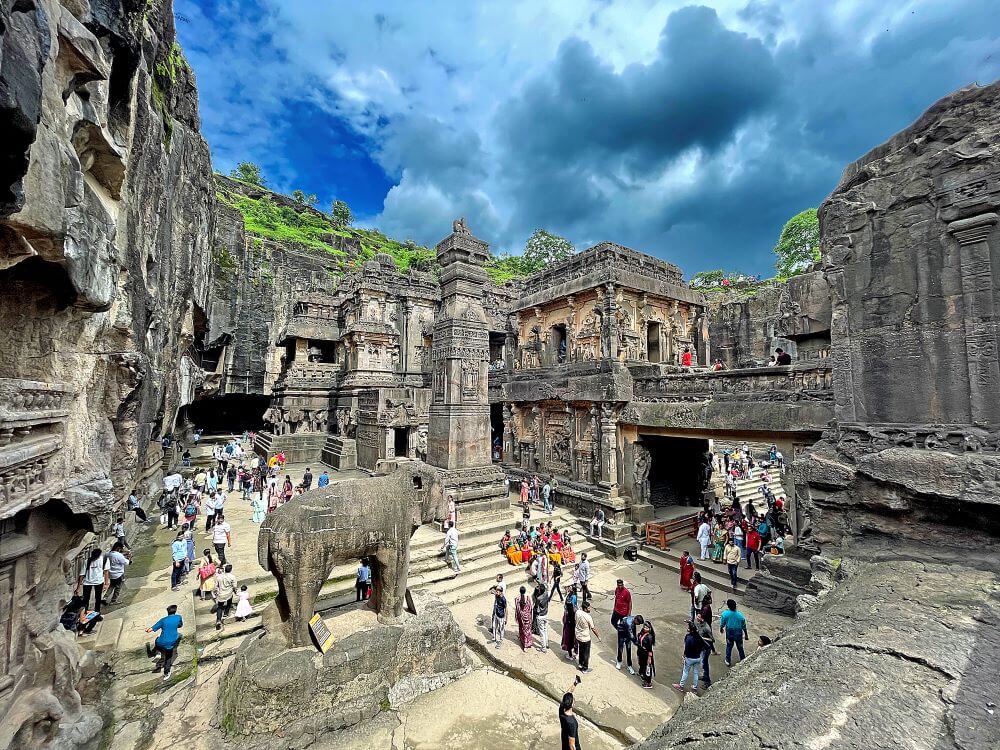
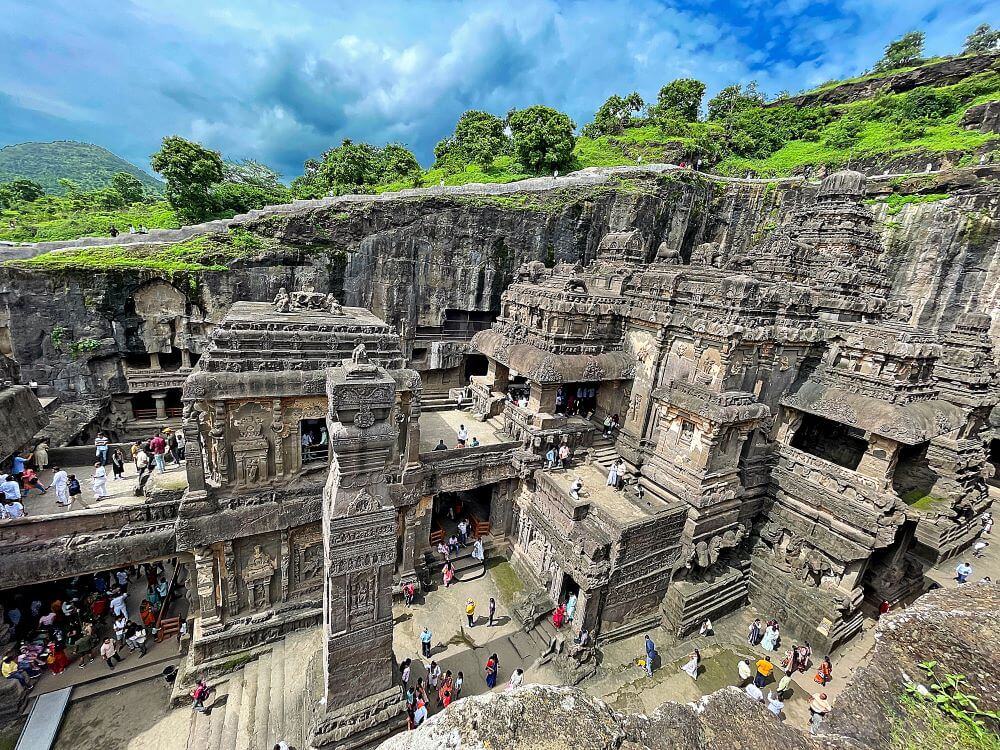
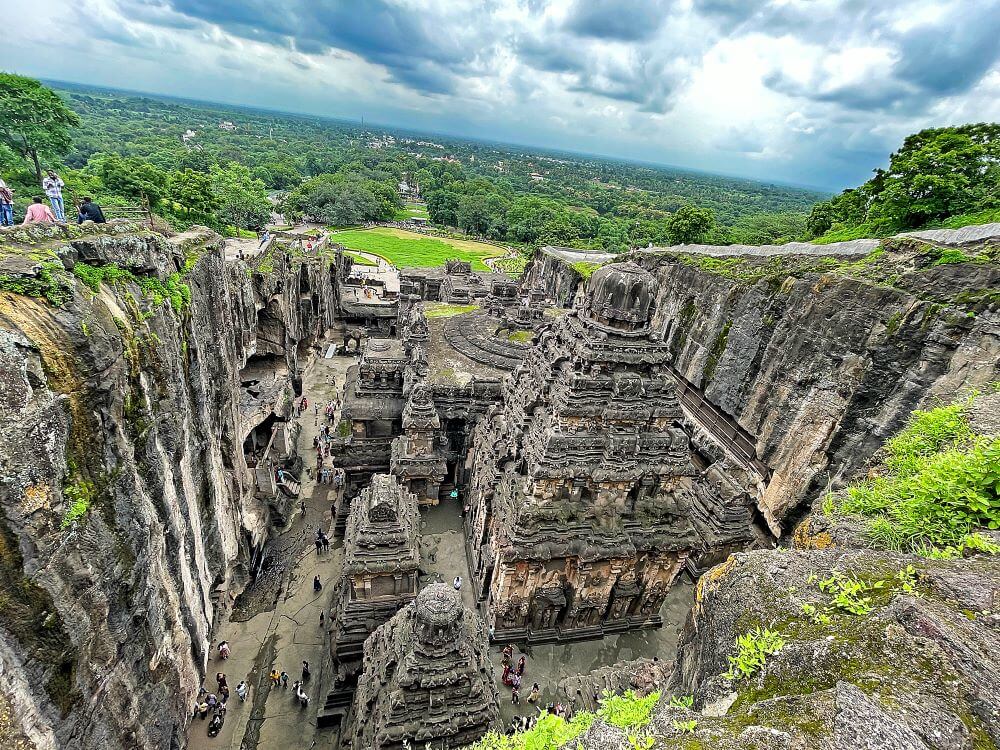
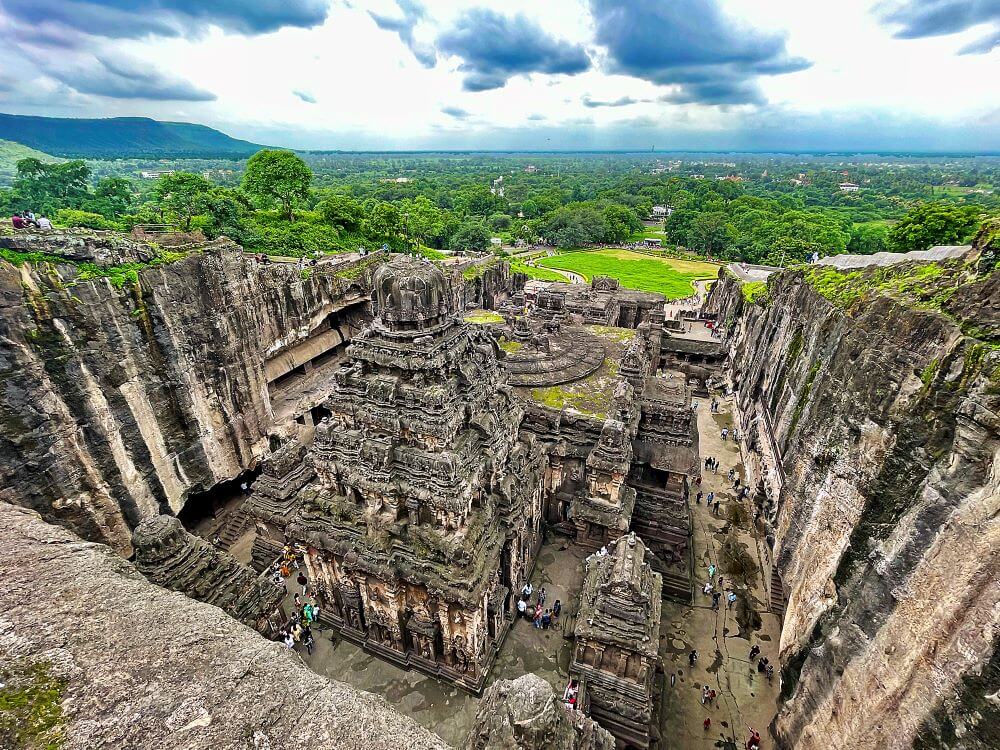
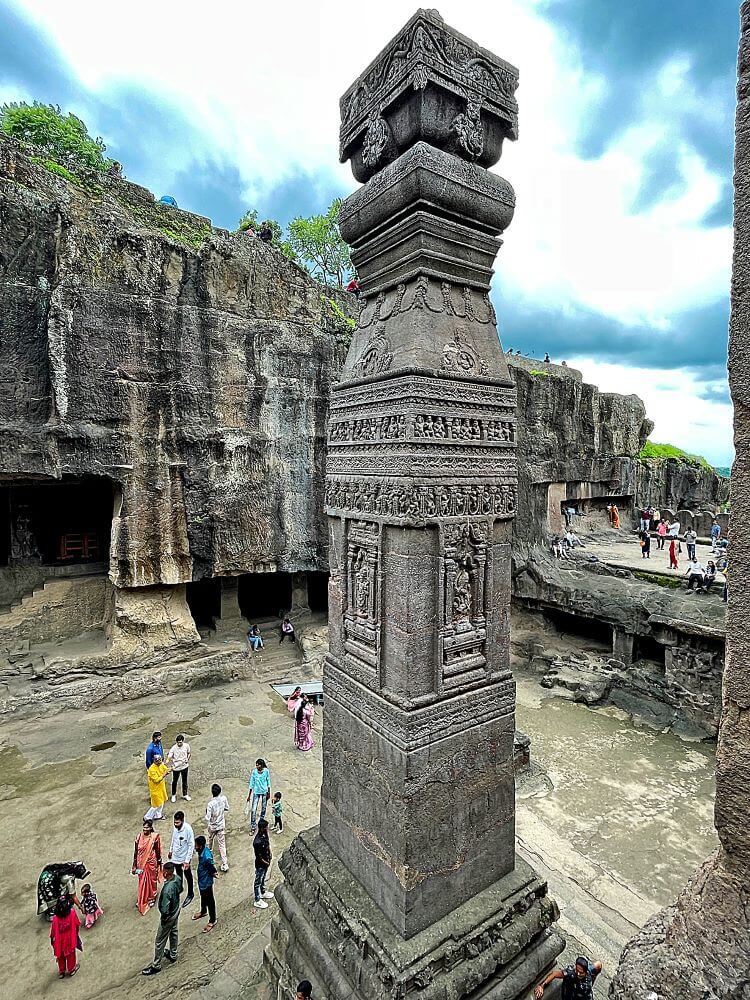
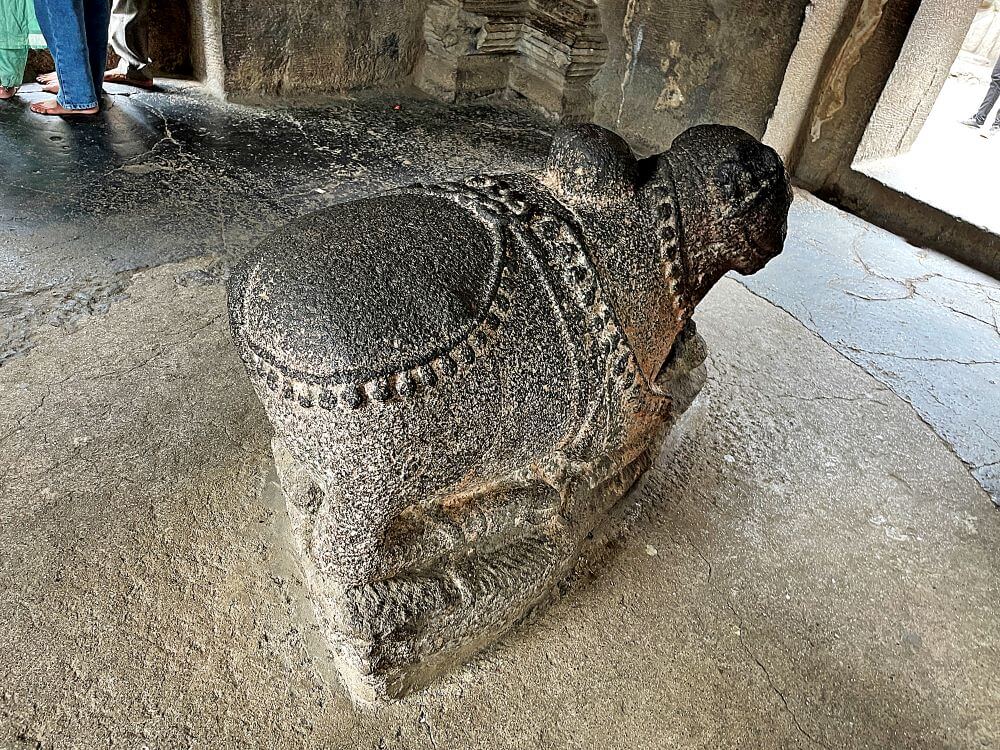
This temple is an excellent example of South and North Indian architectural styles and bears a remarkable resemblance to the Virupaksha Temple in Karnataka. However, the unique feature of the Kailasa Temple is that it is one of the largest monolithic rock-cut excavations in the world. The temple is 300 feet long and 175 feet wide. Gopuras (gateways) are visible at the front, and shikharas (spires) at the back. There is a two-story gopuram at the entrance of the temple, carved with images of deities revered by both Shaivites and Vaishnavites. In the temple courtyard, there is a magnificent elephant statue carved from a single rock. The Rashtrakuta kings considered the elephant a symbol of power and prosperity, and their armies also included elephants. Upon entering through the main gate of the Kailasa Temple, one sees the idol of Gajalakshmi seated on a lotus flower. The sanctum sanctorum (garbhagriha) of the temple is square, housing a massive Shiva Linga. At a short distance around the sanctum are five small shrines, three of which are dedicated to the holy rivers Ganga, Yamuna, and Saraswati. In front is a square mandapa, and at a short distance in front of the mandapa is the Nandi mandapa.
The entire ground floor of this structure is solid. Its plinth (adhisthana) is about three feet high. Scenes from the Ramayana and Mahabharata are sculpted on the plinth, including the battle between Ravana and Jatayu, the Tripuravadha, and Ravana attempting to lift Mount Kailasa. Above the plinth are grand statues of elephants, lions, and various ‘Vyala’ (these sculptures feature the faces of animals like elephants, horses, or rams, with the bodies of mythical creatures, identified as Gajavyala, Ashvavyala, Sharabavyala, etc.). Above this is the temple building, featuring carved pillars, niches, ceilings, and a shikhara, all in the Dravidian style. On the walls on both sides of the temple, mythological scenes such as Tripurantaka, Vishnu, and the wedding of Arjuna and Subhadra are carved. On the walls on both sides of the gopura, there are elephant statues carved from solid rock, as well as two flagstaffs (dhwajastambhas).
Regarding the construction of the temple, scholars suggest that it was carved into the sloping side of a hill. A trench 30 meters wide and equally deep was first excavated, leaving enough space for the gopura and the main temple. A block of rock 60 meters long and 30 meters wide remained in the center. From this, the Kailasanatha temple building and the entrance and gopura were carved from the rock block kept 30 meters in front. About 20,000 tons of rock were excavated and removed in this process. Notably, no traces of this stone are found anywhere near the Kailasa Temple. It is said that the stones excavated for the Kailasa Temple were used in the construction of other temples built in Marathwada during the Chalukya and Rashtrakuta periods.
The dimensions, artistic design, and proportions of the Kailasa Temple are astonishing. Sculptors from all over the world have praised the carvings in this temple. Many legends are told about how this temple might have been built. Some foreign researchers suggest that it might have been built by extraterrestrials. Similarly, it is said that there is an ancient city beneath the temple; however, there is no truth to this, and it is historically accepted that the temple was built during the Rashtrakuta period. According to another legend, Aurangzeb tried to destroy this temple but did not succeed. Aurangzeb, who demolished many temples in India, was himself the Subhedar of Aurangabad. He also lived in this area after the death of Chhatrapati Shivaji Maharaj. Historians say that even he was amazed by the design of this temple, which is why he did not cause any harm to it.
According to mythological accounts, Lord Shiva resides on Mount Kailasa in the Himalayas, which is covered in pristine white snow. Therefore, after the construction of the Kailasa Temple, the entire structure was coated with a white lime wash. Over time, it has faded, though some traces are still visible today.
The legend of this temple states that there was a king of Alajpur, also known as Elichpur. Due to the sins of his past life, he suffered from an incurable disease. Once, he came to this area for hunting along with his queen. Upon arriving here, the queen visited the Grishneshwar temple and made a vow that if the king’s illness was cured, she would build a temple for Lord Shiva. Subsequently, after the king bathed in the local pond, his illness was instantly cured. The queen then informed the king about her vow and pledged to fast until she could see the shikhara (spire) of the temple. Because of this vow, the king decided to build the temple in the shortest possible time; however, this was not possible for any architect. Kokasa, an architect from Paithan, accepted this challenge and promised the king that the queen would be able to see the temple’s shikhara within a week. Kokasa and his associates began carving the rock temple, starting with the shikhara. Thus, the queen’s vow could be fulfilled. In honor of this queen, the temple was named Manikeshwar, and the king established the city of Elapur there, which is now known as Ellora.
In order to ensure that every citizen of the country is aware of this ancient monument, which has been recognized by the United Nations’ ‘UNESCO’, an image of this temple was printed on the 20-rupee note issued by the Reserve Bank on April 26, 2019. Except for Tuesdays, devotees and tourists can visit the Kailasa Temple daily from 9:00 AM to 5:00 PM. The Kailasa Temple, as well as all the caves here, remain closed every Tuesday.
This sacred temple stands as a testament to deep spiritual devotion, ancient architectural grandeur, and rich local cultural traditions.
The sanctum sanctorum houses the divine idol consecrated according to ancient Vedic traditions, surrounded by serene courtyards and traditional temple architecture.
Navratri, Maha Shivratri, Annual Temple Jatra & Deepotsav
Compare and book flights, secure top-rated local hotels near the temple, hire reliable guides, and rent cars instantly.
Extend your pilgrimage by visiting other highly sacred temples located nearby.


Add ₹999 more to unlock FREE SHIPPING!
Your sacred cart is currently empty.
Shop Photo FramesFill in your delivery details below to place your order.
Add comment